Equality

Equality, non-discrimination and racism

Equality is a core value of the EU. You have the right to fair treatment regardless of who you are, what you believe, or how you chose to live.

We carry out research and share expertise to help fight discrimination, inequality and racism in all its forms.

Highlights

  • Data explorer
    FRA’s 2024 survey on Roma and Travellers in Albania, Bulgaria, Czechia, France, Greece, Hungary, Ireland, Italy, North Macedonia, Portugal, Romania, Serbia and Spain collected information from 10,126 respondents living in private households who self-identify as Roma or Traveller, are 16 or older and have lived in the survey countries for at least the 12 months before the survey.
  • Report / Paper / Summary
    25
    November
    2024
    This report presents key results of the EU gender-based violence survey based on data from all 27 Member States. The report focuses on the overall prevalence of physical violence or threats and/or sexual violence by any perpetrator, violence perpetrated by women’s intimate partners and by other people (non-partners) and women’s experiences of sexual harassment at work.
  • Report / Paper / Summary
    25
    October
    2024
    Racism towards Muslims is increasing in countries across the EU. Muslims face racial discrimination and racist harassment because of their religion, skin colour or ethnic background. This report shows a sharp rise since the last survey in 2016.
  • Report / Paper / Summary
    11
    July
    2024
    Antisemitism is still a reality for many Jewish people in the EU today. Faced with prejudice and hostility, most feel unable to live openly Jewish lives. This report presents the results of FRA’s third EU survey of Jewish people’s experiences and perceptions of antisemitism. The survey took place before the Hamas attacks in October 2023 and the war in Gaza; however, it includes evidence from a consultation with national and European Jewish umbrella organisations since. It covers 13 EU Member States that together account for around 96 % of the EU’s Jewish population.
    Publications and data
    8
    November
    2019
    This annual overview provides an update of the most recent figures on antisemitic incidents, covering the period 1 January 2008 – 31 December 2018, across the EU Member States, where data are available. It includes a section that presents evidence from international organisations. In addition, for the first time, it provides an overview of how Member States that have adopted or endorsed the non-legally binding working definition of antisemitism adopted by the International Holocaust Remembrance Alliance (IHRA) (2016) use or intend to use it.
    12
    September
    2019
    FRA’s second EU Minorities and Discrimination survey (EU-MIDIS II) collected information from over 25,000 respondents with different ethnic minority and immigrant backgrounds across all 28 EU Member States. The main findings from the survey, published in 2017, pointed to a number of differences in the way women and men with immigrant backgrounds across the European Union (EU) experience how their rights are respected. This report summarises some of the most relevant survey findings in this regard, which show the need for targeted, gender-sensitive measures that promote the integration of – specifically – women who are immigrants or descendants of immigrants.
    4
    July
    2019
    Based on FRA’s second large-scale survey on experiences and perceptions of antisemitism, this report focuses on the perspectives of young Jewish Europeans (aged 16-34) living in twelve EU Member States. It first describes this particular group and takes a look at defining antisemitism and understanding the place of Israel in it.
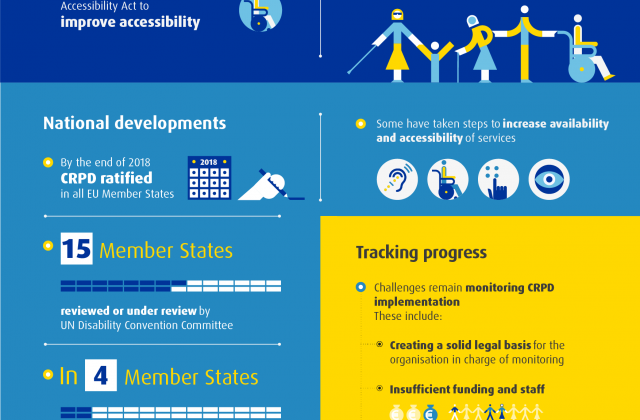
    Fundamental Rights Report 2019: Ten years after the UN’s Disability Convention entered into force, 2018 saw it continue
    to drive advances in disability rights across the EU.
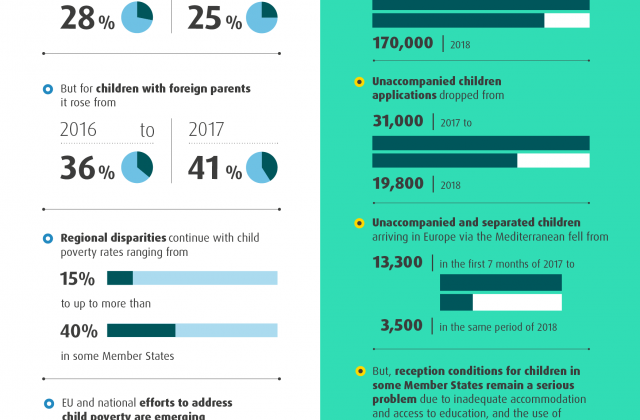
    Fundamental Rights Report 2019: Not all children benefit equally from efforts to guarantee child rights.
    Some groups face particular difficulties.
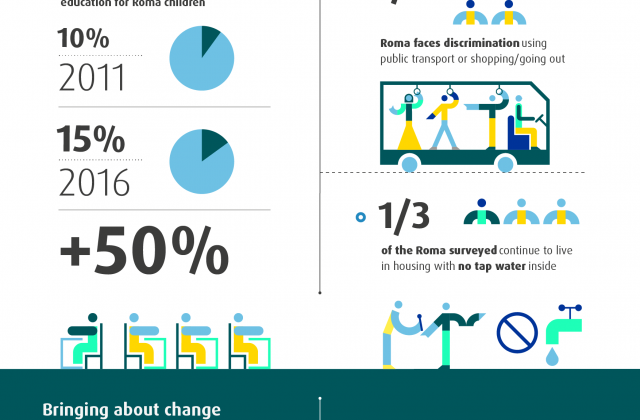
    Fundamental Rights Report 2019: Anti-Gypsyism across the EU remains a persistent barrier to improving the social and
    economic situation of Roma today.
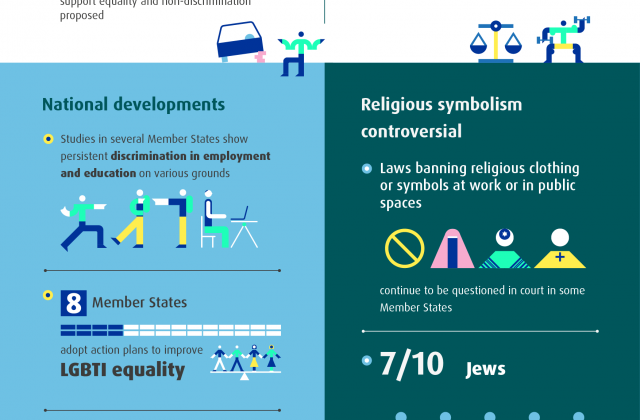
    Fundamental Rights Report 2019: Ethnic minorities and migrants continue to face harassment and discrimination across the EU,
    despite longstanding EU laws against racism.
    Fundamental Rights Report 2019: Efforts to advance equality moved ahead in some areas but remain stalled in others.
    18
    June
    2019
    This technical report presents in detail all the stages
    of the survey and the relevant information needed to
    assess the quality and reliability of the data, as well
    as considerations for interpreting the survey results.
    The following chapters of the report cover the procedures
    used in the development and administration
    of the survey.
    13
    June
    2019
    New language versions: FI, MT, PT, CS, LV, LT, SK, SL, SV, ET
    03 November 2020
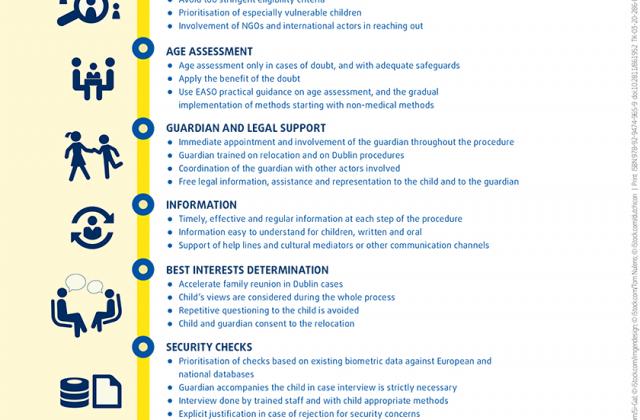
    Children deprived of parental care found in another EU Member State other than their own aims to strengthen the response of all relevant actors for child protection. The protection of those girls and boys is paramount and an obligation for EU Member States, derived from the international and European legal framework. The guide includes a focus on child victims of trafficking and children at risk, implementing an action set forth in the 2017 Communication stepping up EU action against trafficking in human beings, and takes into account identified patterns, including with respect to the gender specificity of the crime.
    11
    June
    2019
    Algorithms used in machine learning systems and artificial intelligence (AI) can only be as good as the data used for their development. High quality data are essential for high quality algorithms. Yet, the call for high quality data in discussions around AI often remains without any further specifications and guidance as to what this actually means.
    6
    June
    2019
    The year 2018 brought both progress and setbacks in terms of fundamental rights protection. FRA’s Fundamental Rights Report 2019 reviews major developments in the field, identifying both achievements and remaining areas of concern. This publication presents FRA’s opinions on the main developments in the thematic areas covered, and a synopsis of the evidence supporting these
    opinions.
    In the latest edition of his video blog, FRA Director Michael O'Flaherty talks about discrimination on the basis of age in the EU and calls for more respect for Human- and Fundamental Rights of older people.
    5
    April
    2019
    Despite efforts by the European Union (EU) and its Member States to reduce gender inequalities among citizens of Roma origin, important gender differences persist. Drawing on FRA’s own EU-MIDIS II survey research in nine EU Member States this report highlights the position of Roma women in education, employment and health, as well as the extent to which they experience hate-motivated discrimination, harassment and physical violence.
    In the light of the events in New Zealand, Michael O'Flaherty talks about discrimination and hate crime against Muslims in the EU and makes 4 proposals on how to make Muslims feel more safe.
    The Compendium of Practices on Equality Data is the product of the Subgroup on Equality Data, which was set up in February 2018 by the EU High Level Group on Non-Discrimination, Diversity and Equality and is facilitated by FRA. The Subgroup on Equality Data brings together representatives of EU Member States and Norway, the European Commission, Eurostat and FRA with the aim to support Member States in their efforts to improve the collection and use of equality data.
    8
    March
    2019
    This summary outlines the main findings of FRA’s second survey on Jewish people’s experiences with hate crime, discrimination and antisemitism in the European Union – the biggest survey of Jewish people ever conducted worldwide.
    The Database 2012-2020 on anti-Muslim hatred provides information on significant international, European and national case law and rulings, UN human rights body decisions, reports, findings by human rights and equality bodies and organisations relating to hate crime, hate speech and discrimination against Muslims, as well as relevant research, reports, studies, data and statistics on these issues. It also provides information on victims' support organisations in the EU Member States.
    12
    December
    2018
    This paper discusses the evolution of European Court of Human Rights case law relating
    to hate crime, providing an update on the most recent rulings. Approaching hate crime
    from a fundamental rights perspective, it shows how Member State authorities’ duty to
    effectively investigate the bias motivation of crimes flows from key human rights
    instruments, such as the European Convention on Human Rights.
    In Madrid on 30 November, FRA took part in the European Platform for Roma Inclusion, a regular event organised since 2009.
    On 7 December, FRA took part in a meeting of the European Commission’s Interservice Group on Child Rights. The meeting discussed the Commission’s recommendation on integrated child protection systems, planned for the first quarter 2024.
    FRA’s presented its work on antisemitism at the International Holocaust Remembrance Alliance Plenary meeting.
    The UN Special Representative of the Secretary-General on Violence against Children, Dr Najat Maalla M'jid, visited FRA on 27 November.
    FRA addressed the Council of the EU’s Working Party on Fundamental Rights, Citizens Rights and Free Movement of Persons (FREMP) on 15 November in Brussels.
    FRA has updated its anti-Muslim hatred database. It provides an easy-to-use overview of information on hate crime, hate speech and discrimination against Muslims across the EU, Albania, Serbia and North Macedonia.
    The annual overview of antisemitic incidents from the EU Agency for Fundamental Rights (FRA) yet again reveals persistent gaps in the recording of antisemitism across Europe. Each country continues to collect data differently. Some still do not collect any data at all. This impedes efforts to effectively counter hatred towards Jews.
    FRA is aware of the recent reported increase in incidents of intolerance and racial discrimination in EU Member States. The Agency stands firmly against all expressions of intolerance and racial discrimination, including hate speech and violence.
    FRA took part in the Other side of the law: Enforcement of antidiscrimination legislation Equinet conference in Brussels on 12 October.
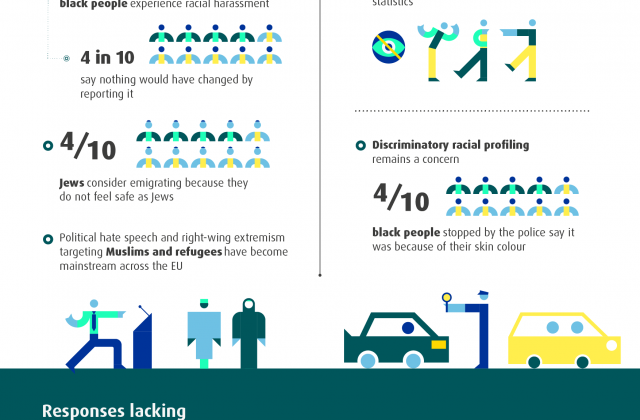
    Almost half of people of African descent in the EU face racism and discrimination in their daily life – a rise since 2016. Racist harassment and ethnic profiling are also common, especially for young people, finds a new survey from the EU Agency for Fundamental Rights (FRA). FRA calls on EU countries to take urgent steps to tackle racial discrimination and harassment to ensure everybody is treated equally and with dignity.
    FRA provided an update about its child rights research on 20 October to European Commission representatives and child rights experts.
    On 19 October, FRA welcomed members of the Vienna NGO Committees on the Status of Women, on Sustainable Development and on Ageing.
    On 12 October, FRA ran an online consultation on FRA’s work on the rights of people with disabilities.
    FRA took part in the 11th meeting of the EU High Level group on combating hate speech and hate crime.
    FRA facilitated the equality data subgroup’s country visit to Finland. The visit took place on 9 October in Helsinki.
    On 6 October, the EU Coordinator on Rights of the Child hosted European Commission representatives and EU Agencies for an update on the stage of implementation of the EU Strategy on the rights of the child.
    FRA delivered a keynote speech at the opening of the German Society for Evaluation’s annual conference.
    Online public services can make it easier to get social benefits or find information. But older people sometimes lack the necessary digital skills to use them. This is a potential barrier to their fundamental rights. It can put them at a disadvantage and risks excluding them from our digitalised societies, warns a report from the EU Agency for Fundamental Rights (FRA). EU countries need to ensure access to public services for everyone. Older people should be able to choose how they access public services and receive support to learn digital skills.
    Whether it happens in football, in the office or on the way home, sexual harassment and violence against women are commonplace in the EU. It is time to show this human-rights abuse a red card. The EU Agency for Fundamental Rights (FRA) calls on EU countries to effectively tackle harassment and violence against women. At the same time, they should better protect women and provide more support for victims.
    Following recent deaths of trans women and attacks on other members of the LGBTIQ community in Europe, the EU Agency for Fundamental Rights (FRA) calls on EU Member States to tackle violence and effectively protect all trans and LGBTIQ people.
    FRA will participate in the European Parliament’s anti-racism and diversity week in Brussels.
    -
    The European Commission’s Child Rights Coordinator is convening several meetings to move forward with the implementation of the EU Strategy on the Rights of the Child.
    -
    The Eurostat working group on crime and criminal justice statistics will hold its annual meeting.
    On 13 March, FRA will welcome the former ambassador of Israel in the EU and Brussels and a delegation of students.
    -
    From 8 to 9 February, FRA will take part virtually in a meeting of the Working Group on Equality and Values in Education and Training.
    FRA Director Michael O’Flaherty will give a speech on liberal democracy at the European Parliament’s Article 17 dialogue seminar.
    On 13 December, FRA will speak at a webinar on ‘Child-friendly justice: Do words matter’.
    On 8 December, FRA will join the European crime prevention award conference in Prague.
    -
    As the European Year of Youth 2022 comes to an end, FRA will attend the year’s final stakeholders and national coordinators meeting and closing conference.
    On 6 December, FRA will speak at a round-table event on child-friendly justice and children as victims of crime at the European Parliament.
    -
    FRA will attend the final conference of the CLEAR-RIGHTS project in Brussels from 1 to 2 December.
    On 24 November, FRA will give a lecture to a delegation of the Diplomatic Academy in Vienna.
    The OSCE’s Office for Democratic Institutions and Human Rights (ODIHR) will hold a workshop in Vienna on 15 November.
    -
    FRA will take part in a UN Women expert group meeting to develop definitions for measuring online and technology-facilitated violence against women and girls.
    FRA will speak on a panel on improving victim support and data collection via multisectoral cooperation.
    -
    The EU subgroup on the national implementation of the EU anti-racism action plan will meet from 9 to 10 November in Brussels.
    -
    FRA will take part in a meeting of project promoters of Czech Roma inclusion projects funded under the EEA/Norway Grants programme.
    FRA will present its Roma survey report results to the European Parliament’s Committee on Civil Liberties, Justice and Home Affairs.
    FRA will take part in a meeting of the Working Group on the European Child Guarantee on 24 October.
    -
    FRA will launch findings from its Roma survey report during the European Platform for Roma Inclusion meeting.