Russia’s invasion of Ukraine forced millions of people to flee. Arriving in EU countries, they received protection in EU law under the Temporary Protection Directive. Many have begun to build a new life in their host country and enrich our societies in new ways. Local authorities took the lead in ensuring access to fundamental rights under temporary protection. This report explores the measures to ensure access to housing, education, employment and healthcare in 26 cities and regional authorities across 12 EU Member States. Despite unprecedented coordination and cooperation to overcome challenges, many uncertainties remain. Longer-term solutions will be needed after the directive expires in March 2025. Based on the information collected, the report identifies 12 priority actions and builds on FRA’s bulletins and survey findings on experiences of people displaced from Ukraine.
Integration and social inclusion are important aspects of EU migration and asylum policy. The fundamental rights of long-term residents in the EU are explored through this report, focussing on the Long-Term Residence Directive. EU long-term resident status includes rights to move and reside in other EU Member States. This report examines the reasons behind the low uptake of EU long-term resident permits, despite them typically giving more rights than national long-term resident permits.
In responding to Russia’s war against Ukraine, the EU activated its Temporary Protection Directive (TPD) for people who fled the country, allowing them to settle in the EU and to access basic public services and the labour market. By spring 2023, more than 4.5 million people had made use of the TPD or similar national protection schemes in the EU. In 2022, the European Union Agency for Fundamental Rights conducted an online survey among people displaced from Ukraine. Eurofound has analysed the survey results on their experiences when seeking to access employment. This paper highlights the main barriers that displaced people encountered and suggests ways to facilitate their inclusion.
Russia’s military aggression against Ukraine triggered scenes not seen in Europe for decades. It has since caused death, immense destruction, and unspeakable suffering. It also set in motion a mass movement of people not seen since World War II. To protect them, the EU activated the Temporary Protection Directive for the first time. In doing so, all EU Member States must offer protection to those displaced from Ukraine.
Many cities throughout the European Union hosted people fleeing Russia’s war of aggression against Ukraine. The EU currently faces the largest displacement of people in Europe since World War II. Since February 2022, over seven million people came to the EU. The arrival of such large numbers of people thrust cities and local governments to the forefront of the EU and its Member States’ relief work. This short publication provides a snapshot of cities’ initiatives to address this humanitarian crisis.
This bulletin looks at the fundamental rights situation of all persons fleeing the Russian war in Ukraine to the four EU Member States neighbouring Ukraine. This is primarily in terms of the application of the EU Temporary Protection Directive. It is based on findings of FRA’s field mission to Hungary, Poland, Romania and Slovakia at the beginning of March 2022. It is also based on weekly country reports prepared by Franet, the contracted research network of FRA between 1 March and 27 April 2022.
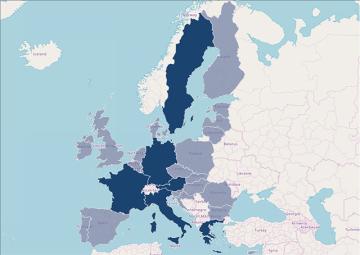
The EU Fundamental Rights Agency published in 2019 its report on the ‘Integration of young refugees in the EU’. The report explored the challenges of young people who fled armed conflict or persecution and arrived in the EU in 2015 and 2016. The report is based on 426 interviews with experts working in the area of asylum and integration, as well as 163 interviews with young people, aged 16 to 24, conducted between October 2017 and June 2018 in 15 regions and cities located in six Member States: Austria, France, Germany, Greece, Italy and Sweden. The links on this page provide a summary of the information collected during this period for each country about unaccompanied children turning 18 and the change in people’s legal status once international protection is granted. These two issues had at the time been identified as moments requiring sufficient, consistent and systematic support, particularly from lawyers, social workers and guardians, to ensure successful integration.


 Report / Paper / Summary12December2023
 Report / Paper / Summary6September2023
 Report / Paper / Summary19November2019