Systems

Support for human rights systems and defenders

Many organisations work to defend your rights. We help their efforts with independent evidence, advice and expertise.

We support their frontline work. And we shine a light on potential risks and priority areas. Together we make your rights a reality.

Highlights

  • Report / Paper / Summary
    12
    December
    2025
    As the EU prepares to join the European Convention on Human Rights (ECHR), this report outlines the main changes that accession would bring, offering an overview of the legal and operational implications. Presented in a Q&A format, it provides answers to 19 key questions for legal professionals and a broader audience. It describes the steps needed to conclude accession, the expected benefits for protecting rights, and some of the challenges that may come up. This legal analysis contributes to the current discussions on EU accession.
  • Report / Paper / Summary
    8
    December
    2025
    This report examines how human rights impact assessments (HRIAs) are built into lawmaking across the EU and its Member States. It highlights that, although progress has been made, the use of HRIAs remains uneven and often superficial. In many EU countries, the EU Charter of Fundamental Rights is frequently overlooked. The report identifies insufficient consultation with external experts, limited stakeholder participation and a lack of evaluation once laws are in force. To address these gaps, it offers practical recommendations for more systematic, inclusive and evidence-based HRIAs that strengthen human rights protection and ensure better, more accountable legislation throughout the EU.
  • Report / Paper / Summary
    11
    July
    2023
    Across the world, human rights defenders protect and uphold human rights in some of the most challenging situations. In some countries they face worrying levels of threats and attacks, intimidation and harassment. This report outlines how human rights defenders can enter and stay in the EU when they need protection. It suggests how EU institutions and Member States could use the flexibility in existing legal provisions and provide shelter for defenders who seek protection.
  • Report / Paper / Summary
    19
    December
    2023
    All EU funds must be spent in a way that respect fundamental rights. The EU spends billions of euros on creating jobs, economic growth, sustainable development and improving people’s lives. To prevent funds from being spent in ways that directly violate people’s fundamental rights, the EU strengthened the conditions how funds can be spent in 2021. This report looks at how the newly introduced conditions related to the EU Charter of Fundamental Rights and the United Nations Convention on the Rights of Persons with Disabilities can be upheld in practice. It analyses the potential role of national human rights institutions, ombudsperson institutions and equality bodies. These safeguards can advance compliance with fundamental rights.
    Publications and data
    Speaking up for human rights has never been more important!

    But how can we bring people together and cut through the noise?
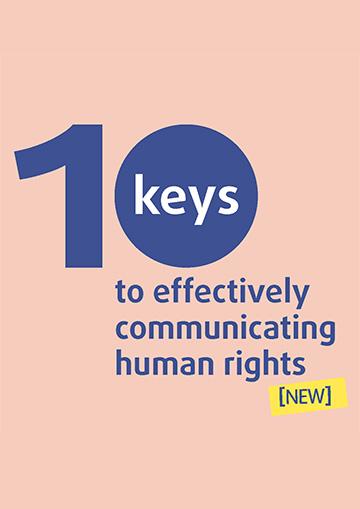
    International and regional human rights organisations across Europe have joined forces with the EU Agency for Fundamental Rights, united behind the '10 keys to effectively communicating human rights'.
    11
    October
    2021
    This report proposes a framework for becoming, and functioning as, a ‘human rights city’ in the EU. It includes ‘foundations’, ‘structures’ and ‘tools’ for mayors, local administrations and grassroots organisations to reinforce fundamental rights locally. It is based on existing good practice and expert input by representatives of human rights cities in the EU, academic experts, international organisations and city networks.
    A clip on human rights cities upon launch of ‘Framework of commitments for human rights cities’
    28
    September
    2021
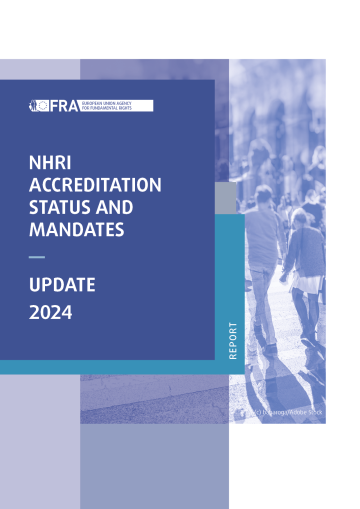
    Since September 2020, three National Human Rights Institutions (NHRIs) had a change in their accreditation status, two new institutions were created and nine have had a change in tasks covered by their mandates. Following up on the September 2020 report “Strong and effective national human rights institutions – challenges, promising practices and opportunities”, this update provides an overview of developments in the accreditation status and mandates of NHRIS in the past 12 months. The update covers the 27 EU Member States as well as three additional states within FRA’s mandate (Albania, North Macedonia and Serbia).
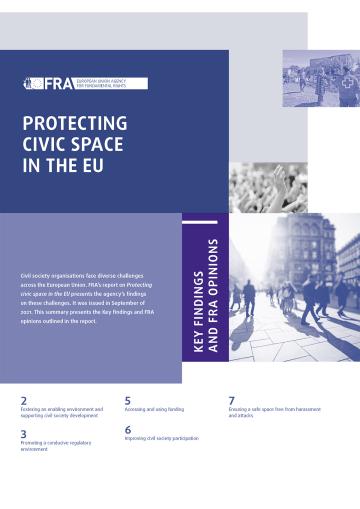
    On the occasion of the launch of FRA’s report ‘Protecting civic space in the EU’ this clip sheds light on the challenges civil society faces across the European Union.
    On 23 February 2021, FRA’s Director, Michael O’Flaherty, listened to fundamental rights concerns and discussed ways to solve them. The second Fundamental Rights Dialogue invited young people to participate in shaping our societies, placing human rights centre stage.
    10
    June
    2021
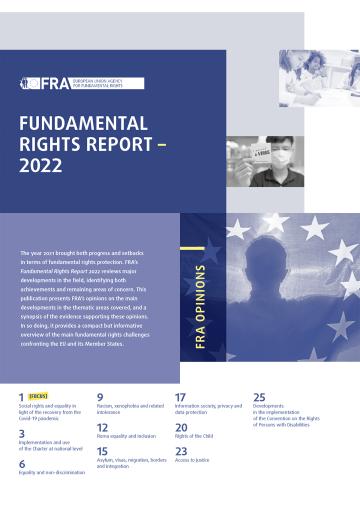
    The year 2020 brought both progress and setbacks in terms of fundamental rights protection. FRA’s Fundamental Rights Report 2021 reviews major developments in the field, identifying both achievements and remaining areas of concern. This publication presents FRA’s opinions on the main developments in the thematic areas covered, and a synopsis of the evidence supporting these opinions.
    10
    June
    2021
    FRA’s Fundamental Rights Report 2021 reviews major developments in the field in 2020, identifying both achievements and areas of concern. It also presents FRA’s opinions on these developments, including a synopsis of the evidence supporting these opinions. This year’s focus chapter explores the impact of the COVID-19 pandemic on fundamental rights. The remaining chapters cover: the EU Charter of Fundamental Rights; equality and non-discrimination; racism, xenophobia and related intolerance; Roma equality and inclusion; asylum, borders and migration; information society, privacy and data protection; rights of the child; access to justice; and the implementation of the Convention on the Rights of Persons with Disabilities.
    On 23 February 2021, FRA’s Director, Michael O’Flaherty, listened to fundamental rights concerns and discussed ways to solve them. The second Fundamental Rights Dialogue invited young people to participate in shaping our societies, placing human rights centre stage.
    On 13 November, the Fundamental Rights Agency (FRA) hosted its first Fundamental Rights Dialogue - a virtual event that gave young people an opportunity to voice their fundamental rights concerns and discussed ways to solve them with FRA's Director Michael O'Flaherty.
    Key statements from the FRA/Euractiv online event Reinforcing the EU Charter: rights of people in the EU in the next decade, 7 December 2020.
    16
    December
    2020
    All language versions now available
    20 July 2021
    The EU is founded on the values of democracy, rule of law and respect for human rights. Yet these values, and discussions on fundamental rights at the EU and Member State level, can seem remote in people’s daily lives. With this in mind, FRA explored what people understand, know and experience with respect to their fundamental rights in practice. The resulting data provide comprehensive and comparable evidence on these aspects.
    This year, the COVID-19 pandemic leaves a lasting mark on society worldwide. It affected everyone but some people more than others. As we look ahead, on Human Rights Day, on 10 December, we need to make the new normal a better normal. In his video message, FRA Director Michael O’Flaherty underlines the need to stand up for human rights to make 2021 a better year. This means ensuring we respect and take into account everybody's human rights.
    30
    November
    2020
    This report outlines some of the measures EU Member States have put in place to protect public health as Europe faces the ‘second wave’ of the Coronavirus pandemic. It highlights how these may affect fundamental rights, especially social rights.
    This video statement by FRA Director Michael O’Flaherty was recorded for the 2020 General conference of the International Coalition of Inclusive and Sustainable Cities (ICCAR): “CommunicAction – A common front to protect human rights at the local level”.
    This video statement by FRA Director Michael O’Flaherty was recorded for the Annual Conference of the Geneva Human Rights Platform: ''Connectivity between regional and global human rights mechanisms".
    This video statement by FRA Director Michael O’Flaherty was recorded for the e-conference "70 years of the European Convention on Human Rights and Fundamental Freedoms: challenges and prospects".
    3
    September
    2020
    Summary version now available
    21 January 2021
    National Human Rights Institutions (NHRIs) are a vital part of the country-level human rights protection system. This report, published 10 years after FRA’s first in-depth study on NHRIs, looks at such bodies in the EU, as well as the Republic of North Macedonia, the Republic of Serbia, and the United Kingdom of Great Britain and Northern Ireland. It explores relevant developments, challenges to their effectiveness and ways to maximise their impact.
    The Agency cooperates with the EEA and Norway Grants as a strategic partner in the protection, promotion and fulfillment of fundamental rights.
    The cooperation aims to support the design and implementation of EEA and Norway Grants funded programmes and projects in selected EU Member States. It also aims to raise awareness on fundamental rights, combating social exclusion and discrimination, and supporting related civil society initiatives.
    29
    July
    2020
    As we enter the second half of 2020, the constraints on our daily lives brought about by the Coronavirus pandemic have become a firm reality. New local lockdowns and the reintroduction of restrictive measures prompted by fresh outbreaks of the virus are a stark reminder that COVID-19 continues to shape our lives – and our enjoyment of fundamental rights – in profound ways. There is compelling evidence of how the pandemic has exacerbated existing challenges in our societies. This FRA Bulletin outlines some of the measures EU Member States adopted to safely reopen their societies and economies while continuing to mitigate the spread of COVID-19. It highlights the impact these measures may have on civil, political and socioeconomic rights.
    In the latest edition of his video blog, FRA Director Michael O'Flaherty focuses on the migration situation in the Mediterranean Sea and makes three proposals.
    Fundamental Rights Report 2019: Ten years after the UN’s Disability Convention entered into force, 2018 saw it continue
    to drive advances in disability rights across the EU.
    Fundamental Rights Report 2019: The Charter of Fundamental Rights is the EU’s bill of human rights. These rights and principles have to be respected and promoted by EU institutions and Member States whenever they act within EU law. Approaching the Charter’s 10th anniversary, Member States do not yet make full use of the potential it offers.
    Fundamental Rights Report 2019: Implementing fundamental and human rights helps create a sustainable future.
    Here the EU plays a key role.
    In the latest edition of his video blog, FRA Director Michael O'Flaherty focuses on press freedom and the importance of an independent media for the society.
    This video blog by FRA Director Michael O'Flaherty is released periodically and will address burning fundamental rights themes.
    FRA Director Michael O'Flaherty focuses on ways to push back against challenges to our human rights system.
    In this third edition of his video blog FRA Director, Michael O'Flaherty, focuses on bolstering our human rights communications to underline why human rights matter to us all.
    FRA Director Michael O’Flaherty speaks about the role of civil society and the FRA’s mechanism for cooperation with civil society, the Fundamental Rights Platform. “A healthy civil society is vital for the protection and promotion of fundamental rights. (…) Without civil society, we are not able to achieve our goals, we are not able to deliver our results. (…) We can cooperate to ensure that our Europe of values remains and gets ever stronger.”
    This video message by Ulrike Lunacek, Vice-President of the European Parliament, was recorded on the occasion of FRA's 10th anniversary.
    In 2017 and beyond, the Fundamental Rights Agency will focus on today’s most urgent human rights quandaries, from migration and asylum, through xenophobia and discrimination, to the very contemporary challenges of privacy, surveillance and hate speech in the digital age.
    FRA spoke during the concluding panel of the European Rule of Law Conference 2025 in Berlin that ran from 15 to 16 September. It was part of the Re:constitution project and brought together legal practitioners, policy consulters and experts across disciplines discussed for two days to discuss how to best address the ongoing democracy and rule of law crisis in the EU.
    FRA’s Director Sirpa Rautio gave the keynote speech on the increasing role of National Human Rights Institutions in protecting human rights at an academic conference at Bocconi University.
    The European Union Agency for Fundamental Rights’ new Brussels Liaison Office has officially opened. It marks an important step in enhancing FRA’s cooperation with EU institutions, Member States’ Permanent Representations in Brussels, European umbrella civil society organisations and other Brussels-based stakeholders.
    FRA discussed how to enhance human rights education for legal professionals and how to improve cooperation among all national and international institutions during the Council of Europe HELP Annual Networking Conference.
    FRA contributed to the European Commission’s 2025 Rule of Law report, following a request from the European Commissioner for Democracy, Justice, the Rule of Law and Consumer Protection.
    FRA has published its contribution to the European Commission as part of the consultation for the next EU budget.
    FRA recently published its contribution to a European Commission consultation on EU funding in the future EU budget.
    On 20 June, FRA hosted a meeting of fundamental rights officers from the EU Agency for Asylum (EUAA), Frontex, and Europol. They are an internal fundamental rights protection mechanism that EU agencies with operational activities which impact on people’s rights have set up as a safeguard to protect and promote the respect for fundamental rights in their activities.
    FRA met with national statutory bodies from EU Member states on 20 and 27 June. These included National Human Rights Institutions, Equality Bodies and Ombuds institutions.
    FRA took part in the Annual Conference of the European Partnership for Democracy on ‘Rebooting Democracy, Lessons from the Past, Code for the Future’.
    FRA’s Director carried out a country visit to Lithuania from 9 to 11 June. She met national authorities and key fundamental rights actors.
    On 10 June, FRA was part of the European Commission and the European Economic and Social Committee (EESC) joint hearing supporting the mid-term review of the Commission’s Strategy on the application of the EU Charter of Fundamental Rights.
    FRA’s was in Berlin on 13 June to speak to youth participants in the European Youth Parliament about how to communicate fundamental rights. In sharing FRA’s resources and recent examples of how to communicate the Agency’s research, the workshop aimed to empower participants in engaging in civic and democratic participation.
    FRA took part in a conference in Madrid to mark the 25th Anniversary of the proclamation of the Charter of the Fundamental Rights. The Centre for Political and Constitutional Studies under the Spanish Ministry for the Presidency, Justice, and Relations with the Parliament organised the event. The Centre conducts research and acts as convener of activities relating to the Spanish public administration and policymaking.
    FRA’s Scientific Committee held its 69th meeting, where members discussed several key priorities. These included the development of the Single Programming Document for 2026–2028, the Agency’s overall strategy, FRA’s activities marking the 25th anniversary of the EU Charter of Fundamental Rights FRA’s or the agency’s submission to the European Commission’s Rule of Law Report.
    The European Union Agency for Fundamental Rights (FRA) expresses deep concern about recent legislative developments in Hungary which can restrict the operating environment for civil society organisations (CSOs). The measures risk undermining the essential role that civil society plays in any rule of law-based democracy and may violate rights protected by the EU Charter of Fundamental Rights – including the rights to freedom of expression, assembly and association, media freedom and pluralism, and privacy.
    On 21 May, FRA hosted a strategic meeting with key partners from institutions and civil society engaged in civic space work. The aim was to connect recent developments with FRA’s ongoing efforts in this area.
    On 19 and 21 May, FRA experts will contribute to the consultation on the 2025 Enlargement Package on issues related to fundamental rights. The consultation will focus on issues such as anti-discrimination, gender equality, children, LGBTIQ, people with disabilities and transitional justice.
    On 7 May, FRA took part in the Spring General Assembly 2025 of the Climate Action Network, Europe. FRA joined the high-level panel on holding the line for climate action.
    The latest review of national human rights institutions (NHRIs) from the EU Agency for Fundamental Rights (FRA) shows how NHRIs provide advice on national laws and policies, how they monitor EU funds or use the EU Charter of Fundamental Rights. It also provides information on their accreditation status and mandates.
    -
    FRA's Director will visit the Council of Europe on 18 and 19 June in Strasbourg. She will exchange views with the Council of Europe’s Committee of Ministers’ Rapporteur Group on External Relations.
    FRA will participate in the Council of Bars and Law Societies of Europe-funded training on the Charter for lawyers in private practice.
    FRA will join Equinet’s conference on 25 years of equality looking at milestones, challenges and horizons.
    On 12 June, FRA will take part in a conference in Madrid on the EU Charter of Fundamental Rights 25 years after the Charter’s proclamation. The event will also deal with the challenging context of increased polarisation in society.
    FRA will speak at a webinar on 6 June on ‘Governance and Participation – Policies That Make a Difference’. The webinar is part of the EU-funded project, B.RIGHT SPACES – Better Rights in Better Civic Spaces.
    -
    FRA will host a foresight workshop in Vienna from 21 to 22 May to develop fundamental rights scenarios for Europe in 2040.
    -
    FRA will speak during a panel discussion on the Ombudsman as a bridge between states, institutions and people. The discussion forms part of a ceremonial meeting and follow-up conference marking 25 years since the establishment of the Czech Ombuds institution and the creation of Czech National Human Rights Institution and the Ombudsman for Children in Czechia this year.
    On 6 May, FRA will speak at the OSCE Supplementary Human Dimension Meeting in Vienna.
    -
    On 22 and 23 April, FRA Director Sirpa Rautio will speak at the high-level Conference on the role of civil society in the protection of the rule of law. The Director will contribute to a panel discussion on the principle of civil society as an EU value.
    FRA and the Permanent Representation of the Polish Presidency will hold a seminar for experts on the role of civil society in defending fundamental rights, the rule of law and democracy.
    FRA will host a webinar on ensuring meaningful participation on 1 April from 14:00 to 15:30 CET. Registration is open.
    -
    FRA will host a foresight workshop that will bring together selected experts from EU institutions, Member States, academia and think tanks. It is part of a FRA project that aims to integrate a fundamental rights perspective into strategic policy foresight by the EU and its Member States.
    On 27 March, FRA will participate virtually in a meeting of the EU Translation Centre’s Management Board.
    On 25 March, FRA will join a policy dialogue on strengthening Equality Bodies to safeguard human rights. It will look at national, regional, and EU perspectives.
    FRA’s Director will speak at a public event on the role of human rights in the current political world order.
    FRA’s Director will deliver a speech during the RIGHTS CITIES project train-the-trainer event and project meeting. The meeting takes place in Vienna on 17 March.
    FRA will contribute to a course organised by the European Institute of Public Administration for the Slovenian Managing Authority, and its Ministry of Cohesion and Regional Development.
    FRA will speak on its work on EU funds and fundamental rights at a meeting of the ECHOFunds project. The meeting will cover how to implement the fundamental rights enabling condition on EU funds in Austria.
    A delegation of judges from the Constitutional Court of Ukraine will visit the Agency on 10 April. This visit is organised by the OSCE Support Programme to Ukraine.
    FRA will present the programme and activities for the EU Justice and Home Affairs Agencies network that the Agency chairs this year.