Top Menu

  • Om FRA
  • Samarbete
  • Newsroom
  • Cookies
  • Contact

Select site language

  • Български
  • Čeština
  • Dansk
  • Deutsch
  • Ελληνικά
  • English
  • Español
  • Eesti
  • Suomi
  • Français
  • Gaeilge
  • Hrvatski
  • Magyar
  • Italiano
  • Lietuvių
  • Latviešu
  • Malti
  • Nederlands
  • Polski
  • Português
  • Română
  • Slovenčina
  • Slovenščina
  • Svenska

Custom Topbar

Home

Search the FRA website

      • Work on rights
        • Rättvisa, brottsoffers rättigheter och rättsligt samarbete
          • Brottsoffrets rättigheter
          • Den tilltalades rättigheter
          • De allmänna domstolarna
          • Rättsligt samarbete och rättsstatsprincipen
          • Säkerhet
          • Företag och mänskliga rättigheter
        • Jämlikhet, icke-diskriminering och rasism
          • Barn, ungdomar och äldre
          • Personer med funktionsnedsättning
          • Hatbrott
          • Ras och etniskt ursprung
          • Religion och övertygelse
          • Romer
          • Kön, sexuell läggning och könsidentitet
        • Asyl, migration och gränser
          • Tillgång till asyl
          • Gränser och informationssystem
          • Barnets skydd
          • Irreguljär migration, återvändande och förvar för migranter
          • Laglig migration och integration
          • Människohandel och arbetskraftsexploatering
        • Dataskydd, integritet och ny teknik
          • Artificiell intelligens och stordata
          • Gränser och informationssystem
          • Dataskydd
          • Olaglig profilering
        • Stöd till människorättssystem och människorättsförsvarare
          • EU-stadgan om de grundläggande rättigheterna
          • Mellanstatliga system för mänskliga rättigheter
          • Nationella system och organ för mänskliga rättigheter
          • Civilsamhället
        • Environmental and social sustainability
          • Climate change and environmental protection
          • Just and green transition
          • Business and human rights
          • Human rights due diligence
          • Consumer protection
      • Europeiska unionens stadga om de grundläggande rättigheterna
        • Vad är grundläggande rättigheter?
        • What is the EU Charter of Fundamental Rights?
        • Ingress
        • Avdelning I: Värdighet
          • 1 - Människans värdighet
          • 2 - Rätt till liv
          • 3 - Människans rätt till integritet
          • 4 - Förbud mot tortyr och omänsklig eller förnedrande bestraffning och behandling
          • 5 - Förbud mot slaveri och tvångsarbete
        • Avdelning II: Friheter
          • 6 - Rätt till frihet och säkerhet
          • 7 - Respekt för privatlivet och familjelivet
          • 8 - Skydd av personuppgifter
          • 9 - Rätt att ingå äktenskap och rätt att bilda familj
          • 10 - Tankefrihet, samvetsfrihet och religionsfrihet
          • 11 - Yttrandefrihet och informationsfrihet
          • 12 - Mötes
          • 13 - Frihet för konsten och vetenskapen
          • 14 - Rätt till utbildning
          • 15 - Fritt yrkesval och rätt att arbeta
          • 16 - Näringsfrihet
          • 17 - Rätt till egendom
          • 18 - Rätt till asyl
          • 19 - Skydd vid avlägsnande, utvisning och utlämning
        • Avdelning III: Jämlikhet
          • 20 - Likhet inför lagen
          • 21 - Icke-diskriminering
          • 22 - Kulturell, religiös och språklig mångfald
          • 23 - Jämställdhet mellan kvinnor och män
          • 24 - Barnets rättigheter
          • 25 - Äldres rättigheter
          • 26 - Integrering av personer med funktionshinder
        • Avdelning IV: Solidaritet
          • 27 - Arbetstagares rätt till information och samråd inom företaget
          • 28 - Förhandlingsrätt och rätt till kollektiva åtgärder
          • 29 - Rätt till tillgång till arbetsförmedlingar
          • 30 - Skydd mot uppsägning utan saklig grund
          • 31 - Rättvisa arbetsförhållanden
          • 32 - Förbud mot barnarbete och skydd av ungdomar i arbetslivet
          • 33 - Familjeliv och yrkesliv
          • 34 - Social trygghet och socialt stöd
          • 35 - Hälsoskydd
          • 36 - Tillgång till tjänster av allmänt ekonomiskt intresse
          • 37 - Miljöskydd
          • 38 - Konsumentskydd
        • Avdelning V: Medborgarnas rättigheter
          • 39 - Rösträtt och valbarhet till Europaparlamentet
          • 40 - Rösträtt och valbarhet i kommunala val
          • 41 - Rätt till god förvaltning
          • 42 - Rätt till tillgång till handlingar
          • 43 - Europeiska ombudsmannen
          • 44 - Rätt att göra framställningar
          • 45 - Rörelse
          • 46 - Diplomatiskt och konsulärt skydd
        • Avdelning VI: Rättskipning
          • 47 - Rätt till ett effektivt rättsmedel och till en opartisk domstol
          • 48 - Presumtion för oskuld och rätten till försvar
          • 49 - Principerna om laglighet och proportionalitet i fråga om brott och straff
          • 50 - Rätt att inte bli dömd eller straffad två gånger för samma brott
        • Avdelning VII: Allmänna bestämmelser
          • 51 - Tillämpningsområde
          • 52 - Rättigheternas och principernas räckvidd och tolkning
          • 53 - Skyddsnivå
          • 54 - Förbud mot missbruk av rättigheter
      • Tools
        • EU Fundamental Rights Information System - EFRIS
        • Criminal detention database
        • Anti-Muslim hatred database
        • National human rights structures navigator
        • Case-law database
        • Charterpedia
        • FRA e-learning platform
        • Data visualisation
        • Equality data collection: promising practices
        • Fighting hate crime: promising practices
      • Produkter
    • About FRA
      • Who we are
        • Structure of FRA
        • Management Board
          • Management Board members
          • Management Board meeting documents
        • Executive Board
        • Scientific Committee
          • Scientific Committee members
        • Director
        • Management team
      • What we do
        • Research and data
        • Capacity-building
        • Advising
        • Convening people
        • FRA for children
          • What are my rights?
          • Where do my rights come from?
        • Areas of work
          • Multi-annual Framework 2007-2022
        • Work Programme
          • Archive
        • Annual Activity report
          • Archive
        • Projects
      • Working at FRA
        • Vacancies and selections
          • Previous vacancies
        • What we offer
        • Work-life balance
        • Application instructions
        • Seconded National Experts
        • Traineeship
        • Study visits at FRA
      • Procurement
        • Ongoing procedures
        • Closed procedures
        • Contracts awarded
      • Finance and budget
        • Financial Rules
        • Financial documents
      • Tillgång till handlingar
        • Access to documents
        • Ansökan om tillgång till handlingar
      • Data protection within FRA
        • Records registry
    • Cooperation
      • EU-institutioner och andra organ
        • European Parliament
        • Council of the European Union
        • European Commission
        • EU agencies
          • Justice and Home Affairs Agencies Network
        • European Committee of the Regions
        • European Economic and Social Committee
        • European Ombudsman
        • EU CRPD Framework
          • Promotion
          • Protection
          • Monitoring
          • Review process
          • Resources
      • EU:s medlemsstater
        • National Liaison Officers
        • National Parliaments
      • Europarådet
      • Civilsamhället och plattformen för grundläggande rättigheter
        • Activities
        • Civic space
        • Platform library
        • How to register
      • Nationella människorättsorganisationer, jämställdhetsorgan och ombudsmannainstitutioner
      • FN, OSSE och andra internationella organisationer
        • EEA and Norway Grants
      • FRANET
    • Newsroom
      • Media contacts
      • News
      • Press releases
      • Stories
      • Events
        • Past Events
      • FRA products 2026
        • FRA products 2025
        • FRA products 2024
        • FRA products 2023
        • FRA products 2022
        • FRA products 2021
        • FRA Products 2020
        • FRA Products 2019
      • Multimedia
        • Videos
        • Infographics
        • Podcasts
      • Speeches
      • Press packs
        • EU LGBTIQ survey - Press pack
        • Fundamental Rights Survey
        • EU LGBTI survey II
        • From institutions to community living for persons with disabilities: perspectives from the ground
        • Second European Union Minorities and Discrimination Survey – Main results
        • Second European Union Minorities and Discrimination Survey (EU-MIDIS II) Muslims
        • Together in the EU: Promoting the participation of migrants and their descendants
        • Second European Union Minorities and Discrimination Survey (EU-MIDIS II) Roma
        • Severe labour exploitation in the EU
        • Child-friendly justice – perspectives and experiences of professionals: Press pack
        • Fundamental rights at EU borders
        • Violence against women press pack
        • Jewish people’s experiences and perceptions of hate crime, discrimination and antisemitism
        • EU LGBT Press pack
        • Child-friendly justice – perspectives and experiences of children
      • Newsletter
    • Account
      • Log in

Main menu

Home
  • Work on rights
    Work on rights
    • Rättvisa, brottsoffers rättigheter och rättsligt samarbete
      • Brottsoffrets rättigheter
      • Den tilltalades rättigheter
      • De allmänna domstolarna
      • Rättsligt samarbete och rättsstatsprincipen
      • Säkerhet
      • Företag och mänskliga rättigheter
    • Jämlikhet, icke-diskriminering och rasism
      • Barn, ungdomar och äldre
      • Personer med funktionsnedsättning
      • Hatbrott
      • Ras och etniskt ursprung
      • Religion och övertygelse
      • Romer
      • Kön, sexuell läggning och könsidentitet
    • Asyl, migration och gränser
      • Tillgång till asyl
      • Gränser och informationssystem
      • Barnets skydd
      • Irreguljär migration, återvändande och förvar för migranter
      • Laglig migration och integration
      • Människohandel och arbetskraftsexploatering
    • Dataskydd, integritet och ny teknik
      • Artificiell intelligens och stordata
      • Gränser och informationssystem
      • Dataskydd
      • Olaglig profilering
    • Stöd till människorättssystem och människorättsförsvarare
      • EU-stadgan om de grundläggande rättigheterna
      • Mellanstatliga system för mänskliga rättigheter
      • Nationella system och organ för mänskliga rättigheter
      • Civilsamhället
    • Environmental and social sustainability
      • Climate change and environmental protection
      • Just and green transition
      • Business and human rights
      • Human rights due diligence
      • Consumer protection
  • Europeiska unionens stadga om de grundläggande rättigheterna
    Europeiska unionens stadga om de grundläggande rättigheterna
    • Vad är grundläggande rättigheter?
    • What is the EU Charter of Fundamental Rights?
    • Ingress
    • Avdelning I: Värdighet
      • 1 - Människans värdighet
      • 2 - Rätt till liv
      • 3 - Människans rätt till integritet
      • 4 - Förbud mot tortyr och omänsklig eller förnedrande bestraffning och behandling
      • 5 - Förbud mot slaveri och tvångsarbete
    • Avdelning II: Friheter
      • 6 - Rätt till frihet och säkerhet
      • 7 - Respekt för privatlivet och familjelivet
      • 8 - Skydd av personuppgifter
      • 9 - Rätt att ingå äktenskap och rätt att bilda familj
      • 10 - Tankefrihet, samvetsfrihet och religionsfrihet
      • 11 - Yttrandefrihet och informationsfrihet
      • 12 - Mötes
      • 13 - Frihet för konsten och vetenskapen
      • 14 - Rätt till utbildning
      • 15 - Fritt yrkesval och rätt att arbeta
      • 16 - Näringsfrihet
      • 17 - Rätt till egendom
      • 18 - Rätt till asyl
      • 19 - Skydd vid avlägsnande, utvisning och utlämning
    • Avdelning III: Jämlikhet
      • 20 - Likhet inför lagen
      • 21 - Icke-diskriminering
      • 22 - Kulturell, religiös och språklig mångfald
      • 23 - Jämställdhet mellan kvinnor och män
      • 24 - Barnets rättigheter
      • 25 - Äldres rättigheter
      • 26 - Integrering av personer med funktionshinder
    • Avdelning IV: Solidaritet
      • 27 - Arbetstagares rätt till information och samråd inom företaget
      • 28 - Förhandlingsrätt och rätt till kollektiva åtgärder
      • 29 - Rätt till tillgång till arbetsförmedlingar
      • 30 - Skydd mot uppsägning utan saklig grund
      • 31 - Rättvisa arbetsförhållanden
      • 32 - Förbud mot barnarbete och skydd av ungdomar i arbetslivet
      • 33 - Familjeliv och yrkesliv
      • 34 - Social trygghet och socialt stöd
      • 35 - Hälsoskydd
      • 36 - Tillgång till tjänster av allmänt ekonomiskt intresse
      • 37 - Miljöskydd
      • 38 - Konsumentskydd
    • Avdelning V: Medborgarnas rättigheter
      • 39 - Rösträtt och valbarhet till Europaparlamentet
      • 40 - Rösträtt och valbarhet i kommunala val
      • 41 - Rätt till god förvaltning
      • 42 - Rätt till tillgång till handlingar
      • 43 - Europeiska ombudsmannen
      • 44 - Rätt att göra framställningar
      • 45 - Rörelse
      • 46 - Diplomatiskt och konsulärt skydd
    • Avdelning VI: Rättskipning
      • 47 - Rätt till ett effektivt rättsmedel och till en opartisk domstol
      • 48 - Presumtion för oskuld och rätten till försvar
      • 49 - Principerna om laglighet och proportionalitet i fråga om brott och straff
      • 50 - Rätt att inte bli dömd eller straffad två gånger för samma brott
    • Avdelning VII: Allmänna bestämmelser
      • 51 - Tillämpningsområde
      • 52 - Rättigheternas och principernas räckvidd och tolkning
      • 53 - Skyddsnivå
      • 54 - Förbud mot missbruk av rättigheter
  • Tools
    Tools
    • EU Fundamental Rights Information System - EFRIS
    • Criminal detention database
    • Anti-Muslim hatred database
    • National human rights structures navigator
    • Case-law database
    • Charterpedia
    • FRA e-learning platform
    • Data visualisation
    • Equality data collection: promising practices
    • Fighting hate crime: promising practices
  • Produkter

You are here

  • Home
  • Work On Rights
  • Environmental and social sustainability
  • Human rights due diligence
  • A Human Rights Approach to Due Diligence: Reflections on key principles
22
October
2025

A Human Rights Approach to Due Diligence: Reflections on key principles

Human rights due diligence
Equality, non-discrimination and racism
Justice, victims’ rights and judicial cooperation
Environmental and social sustainability
This publication discusses how businesses can meet their human rights and environmental responsibilities. It focuses on key elements of mandatory human rights due diligence and presents reflections on principles from international law and EU law. The paper explains why risk-based human rights due diligence is needed and how it should be implemented. It also highlights the importance of stakeholder engagement, access to remedies, and oversight. It aims to inform EU policymakers and stakeholders about ways to effectively promote responsible business conduct and to ensure adequate protection of rightsholders.
Read news item
  • Read Online
  • Related
Export to PDF
Search inside this publication
  • Executive summary
  • Introduction
  • 1. Why is mandatory human rights due diligence needed?
    • 1.1 The EU context
  • 2. A risk-based approach within human rights due diligence
    • 2.1. Business responsibility to respect human rights
    • 2.2. Risk-based approach to identification and assessment of adverse impacts
    • 2.3. Shared responsibility in implementing due diligence across the chain of activities
    • 2.4. Ongoing monitoring in line with a risk-based approach
    • 2.5. A risk-based approach to responsible disengagement
  • 3. Stakeholder engagement
    • 3.1. Conditions and stages of effective stakeholder engagement
  • 4. Access to effective remedies and civil liability
    • 4.1. Civil liability provisions and due diligence obligations
    • 4.2. Overriding mandatory application
    • 4.3. Representation of victims in civil proceedings for effective access to justice
  • 5. Oversight and enforcement
    • 5.1. Supervisory authorities
    • 5.2. Dissuasive penalties and their uniform application
  • About this publication


Introduction

HRDD is a key means by which businesses uphold their responsibilities. HRDD is an ongoing process, which entails, among other things, commitment to a human rights norms or standards, assessing actual and potential human rights impacts against that norm, integrating and acting upon the findings, tracking results and communicating how impacts are addressed [1]
 United Nations, ‘Guiding Principles on Business and Human Rights: Implementing the United Nations “Protect, Respect and Remedy” framework’, 2012, UNGP 17 and its commentary.
The UNGPs are a soft law instrument, and do not create legally binding obligations.
. It requires meaningful consultation with stakeholders such as employees, affected communities, supply chain workers or human rights defenders. Moreover, HRDD applies a risk-based approach while recognising that risks to human rights change over time as company’s activities and operating context evolve [2]
 See UNGP 17 and its commentary.
. This entails prioritising the most serious risks and impacts [3]
 See UNGP 24 and its commentary.
 and adapting due diligence to the specific risks that businesses face [4]
 OECD, ‘Translating a risk-based due diligence approach into law: Background note on regulatory developments concerning due diligence for responsible business conduct’, 2022.
.

Mandatory HRDD measures are essential to bridge the normative aspirations of voluntary international frameworks with enforceable legal obligations. They place sustainability and human rights obligations at the heart of businesses strategy, not merely to advance effective risk management, but to uphold substantive obligations through regulatory oversight and civil liability.

A number of legislative frameworks have been developed to oblige or incentivise companies to conduct HRDD, including in the EU. Adopting a human-rights-based approach, this paper focuses on the foundational elements stemming from international frameworks (UNGPs, OECD Guidelines) that are judged to be central to mandatory HRDD and without which it cannot be effective. They build on recommendations [5] United Nations, ‘EU Mandatory Human Rights Due Diligence Directive:


Recommendations to the European Commission’, 2021.
of the Office of the United Nations High Commissioner for Human Rights (OHCHR) issued in 2021, which outlines crucial considerations for robust HRDD legislation aligned with the UNGPs [6]
 United Nations, ‘Guiding Principles on Business and Human Rights: Implementing the United Nations “Protect, Respect and Remedy” framework’, 2012.
. These recommendations include ensuring a risk-based approach and scope of due diligence encompassing the entire value chain. They recall thatthe structure, sequencing and logic of HRDD should be in line with the UNGPs. They recommend proactive and meaningful stakeholder engagement and the use of leverage to prevent and mitigate adverse impacts. They note that such legislation should include corporate accountability and legal liability along with effective regulation of non-State-based grievance mechanisms. In this context, CSDDD represents a historic advance in terms of human rights protection, with the EU in a global leadership role promulgating law. In this it recalls that the CSDDD,is grounded in and advances goals relating to the functioning of the internal market and goals relating to the protection of human rights.

This paper, based on desk research of the business and human rights framework, is primarily focusing on the UNGPs and OCED’s Guidelines with some examples of applying mandatory HRDD legislation in countries such as France and Germany. It presents initial reflections from FRA’s wider project started in 2024, which analyses the legal and policy frameworks governing corporate sustainability in the EU, selected EU Member States and FRA observer countries. A comparative analysis of this empirical data will be published in 2026.

FRA activity: Fundamental rights in corporate sustainability and due diligence

FRA’s project ‘Fundamental rights in corporate sustainability and due diligence’ aims to provide a thorough understanding of the current state of due diligence legislation and practice in selected Member States, to identify pathways towards achieving effective human rights protection under the new EU corporate sustainability and due diligence framework. It encompasses an in-depth legal analysis of the applicable legal framework, and fieldwork research in 11 Member States. The collected data and legal analysis can be used to identify gaps, inconsistencies, ways to address them or areas for potential harmonisation or improvement in the regulatory landscape. The report with key findings will be published in early 2026.

Source: FRA, ‘FRA single programming document – 2025–2027’, p. 32.

This focus paper discusses a human-rights-based approach to due diligence, reflecting on key elements emanating from international standards of the mandatory corporate due diligence that addresses both human rights and environmental risks (although the term ‘HRDD’ is used throughout). It recalls principial elements of risk-based approach and normative standards Member States should introduce to enforce corporate responsibility. It will discuss these points in following sections:

  1. why mandatory HRDD is needed,
  2. a risk-based approach within HRDD,
  3. stakeholders engagement,
  4. access to effective remedies and civil liability, and
  5. oversight and enforcement mechanisms.

While the analysis set forth in this paper will focus on human rights risks and impacts, this paper also considers both normative and market rationales driving the policy developments. It does not, however, discuss any specific legislative proposals. It is addressed to EU institutions, policymakers in Member States and other stakeholders who are concerned with responsible business conduct. While raising awareness of necessity and added-value of holding companies accountable for their adverse impacts on people and environment, it advocates for a “smart-mix” of soft and hard measures anchored in a risk-based approach.
Executive summary1. Why is mandatory human rights due diligence needed?
Related
FRA, 2026
Opinion / Position Paper
Environmental and social sustainability
Climate change and environmental protection
Consumer protection
25
February
2026

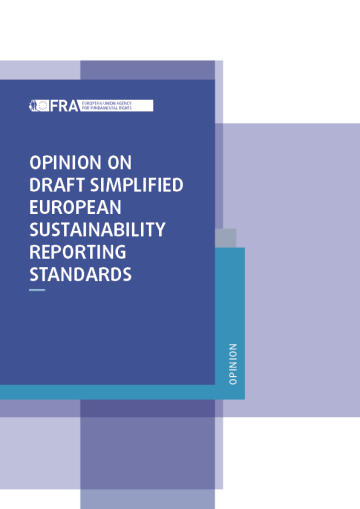
Opinion on Draft Simplified European Sustainability Reporting Standards

This FRA Opinion on the draft simplified European Sustainability Reporting Standards informs the European Commission ahead of the standards’ adoption. This Opinion applies a risk-based human rights approach to assess whether the proposed simplifications preserve essential safeguards for people adversely affected by corporate activities. The Opinion provides practical, proportionate suggestions to strengthen the simplified framework and ensure that efficiency gains do not come at the expense of fundamental rights.
Creative collage of law and justice, gavel and scales
BillionPhotos.com / adobestock.com, 2025
Report / Paper / Summary
EU Charter of Fundamental Rights
Support for human rights systems and defenders
8
December
2025

Better legislation – Human rights impact assessments in lawmaking

This report examines how human rights impact assessments (HRIAs) are built into lawmaking across the EU and its Member States. It highlights that, although progress has been made, the use of HRIAs remains uneven and often superficial. In many EU countries, the EU Charter of Fundamental Rights is frequently overlooked. The report identifies insufficient consultation with external experts, limited stakeholder participation and a lack of evaluation once laws are in force. To address these gaps, it offers practical recommendations for more systematic, inclusive and evidence-based HRIAs that strengthen human rights protection and ensure better, more accountable legislation throughout the EU.
Read news item
Industry smoking chimneys with forest overlay.
Report / Paper / Summary
Consumer protection
Justice, victims’ rights and judicial cooperation
Environmental and social sustainability
7
March
2024

Enforcing consumer rights to combat greenwashing

Tackling greenwashing is an issue where human rights, consumer rights and climate goals align. Companies use greenwashing to convince people to buy products that are not always as environmentally friendly as they claim to be. They mislead consumers and harm the environment. This report shows how a human rights approach can combat greenwashing. It is based on consultations with experts in 10 Member States. The report identifies gaps in existing laws and enforcement. It includes case studies of consumers seeking remedies for misleading environmental claims.
Read news item
Woman watching a virtual screen
HQUALITY © adobestock.com, 2020
Report / Paper / Summary
Artificial intelligence and big data
Data protection, privacy and new technologies
14
December
2020
Slovenian version now available
20 December 2024

Getting the future right – Artificial intelligence and fundamental rights

Artificial intelligence (AI) already plays a role in deciding what unemployment benefits someone gets, where a burglary is likely to take place, whether someone is at risk of cancer, or who sees that catchy advertisement for low mortgage rates. Its use keeps growing, presenting seemingly endless possibilities. But we need to make sure to fully uphold fundamental rights standards when using AI. This report presents concrete examples of how companies and public administrations in the EU are using, or trying to use, AI. It focuses on four core areas – social benefits, predictive policing, health services and targeted advertising.
Read the press release
Watch the launch video
Read press release
© Freshideas / Adobestock
Report / Paper / Summary
Business and human rights
Justice, victims’ rights and judicial cooperation
Environmental and social sustainability
Business and human rights
6
October
2020

Business and human rights – access to remedy

Business activity affects not just customers, employees, and contractors along supply chains, but often entire communities and the environment. This makes it vital that every business complies with human rights. This comparative report looks at the realities victims face when they seek redress for business-related human rights abuses. It presents the findings of fieldwork research on the views of professionals regarding the different ways people can pursue complaints. The findings highlight that obstacles to achieving justice are often multi-layered.
Read news item
Om FRA

Läs mer om byrån och dess arbete här.

  • Om FRA
  • Europeiska Unionens Stadga om de Grundläggande Rättigheterna
  • Här kan du få hjälp
  • Nyheter
  • Prenumerera på uppdateringar
Kontakt
Address
European Union Agency for Fundamental Rights
Schwarzenbergplatz 11
A-1040 Vienna, Austria
E-mail
Kontakta oss
Newsletter
Prenumerera på uppdateringar
  • Facebook
  • Twitter
  • LinkedIn
  • YouTube
  • Newsletter
  • E-mail
  • RSS

© European Union Agency for Fundamental Rights, 2007-2026

  • About this website
  • Legal notice
  • Cookies
  • Data Protection
  • Accessibility