Displaying 1 - 20 of 40
  • Report / Paper / Summary
    12
    December
    2023
    Russia’s invasion of Ukraine forced millions of people to flee. Arriving in EU countries, they received protection in EU law under the Temporary Protection Directive. Many have begun to build a new life in their host country and enrich our societies in new ways. Local authorities took the lead in ensuring access to fundamental rights under temporary protection. This report explores the measures to ensure access to housing, education, employment and healthcare in 26 cities and regional authorities across 12 EU Member States. Despite unprecedented coordination and cooperation to overcome challenges, many uncertainties remain. Longer-term solutions will be needed after the directive expires in March 2025. Based on the information collected, the report identifies 12 priority actions and builds on FRA’s bulletins and survey findings on experiences of people displaced from Ukraine.
  • Report / Paper / Summary
    6
    September
    2023
    Integration and social inclusion are important aspects of EU migration and asylum policy. The fundamental rights of long-term residents in the EU are explored through this report, focussing on the Long-Term Residence Directive. EU long-term resident status includes rights to move and reside in other EU Member States. This report examines the reasons behind the low uptake of EU long-term resident permits, despite them typically giving more rights than national long-term resident permits.
  • Periodic updates / Series
    31
    October
    2022
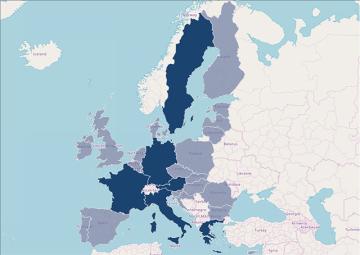
    The table below gives an overview of certain key aspects in national legislation implementing the EU Temporary Protection Directive.
  • Country sheets
    20
    October
    2020
    The EU Fundamental Rights Agency published in 2019 its report on the ‘Integration of young refugees in the EU’. The report explored the challenges of young people who fled armed conflict or persecution and arrived in the EU in 2015 and 2016. The report is based on 426 interviews with experts working in the area of asylum and integration, as well as 163 interviews with young people, aged 16 to 24, conducted between October 2017 and June 2018 in 15 regions and cities located in six Member States: Austria, France, Germany, Greece, Italy and Sweden. The links on this page provide a summary of the information collected during this period for each country about unaccompanied children turning 18 and the change in people’s legal status once international protection is granted. These two issues had at the time been identified as moments requiring sufficient, consistent and systematic support, particularly from lawyers, social workers and guardians, to ensure successful integration.

  • Report / Paper / Summary
    19
    November
    2019
    Over 2.5 million people applied for international protection in the 28 EU Member States in 2015 and 2016. Many of those who were granted some form of protection are young people, who are likely to stay and settle in the EU. The EU Agency for Fundamental Rights interviewed some of them, as well as professionals working with them in 15 locations across six EU Member States: Austria, France, Germany, Greece, Italy and Sweden. This report presents the result of FRA’s fieldwork research, focusing on young people between the
    ages of 16 and 24.
  • Report / Paper / Summary
    12
    September
    2019
    FRA’s second EU Minorities and Discrimination survey (EU-MIDIS II) collected information from over 25,000 respondents with different ethnic minority and immigrant backgrounds across all 28 EU Member States. The main findings from the survey, published in 2017, pointed to a number of differences in the way women and men with immigrant backgrounds across the European Union (EU) experience how their rights are respected. This report summarises some of the most relevant survey findings in this regard, which show the need for targeted, gender-sensitive measures that promote the integration of – specifically – women who are immigrants or descendants of immigrants.
  • Report / Paper / Summary
    6
    December
    2017
    Seventeen years after adoption of EU laws that forbid discrimination, immigrants, descendants of immigrants, and minority ethnic groups continue to face widespread discrimination across the EU and in all areas of life – most often when seeking employment. For many, discrimination is a recurring experience. This is just one of the findings of FRA’s second European Union Minorities and Discrimination Survey (EU-MIDIS II), which collected information from over 25,500 respondents with different ethnic minority and immigrant backgrounds across all 28 EU Member States.
  • Report / Paper / Summary
    15
    March
    2017
    Integrating migrants, refugees and their descendants is of critical importance for the future of the European Union. This report examines Member States’ integration policies and action plans for promoting their participation in society, focusing on non-discrimination, education, employment, language learning and political engagement.
  • Fundamental Rights Report
    30
    May
    2016
    Ce « Focus » examine de façon approfondie les questions de l’asile et de la
    migration dans l’Union européenne (UE) en 2015. Il se penche sur l’efficacité des mesures prises ou proposées par l’UE et
    ses États membres pour gérer cette situation, en se concentrant en particulier sur le respect des droits fondamentaux.
  • Fundamental Rights Report
    29
    May
    2016
    This Focus takes a closer look at asylum and migration issues in the European Union (EU) in 2015. It looks at the effectiveness of measures taken or proposed by the EU and its Member States to manage this situation, with particular reference to their fundamental rights compliance.
  • Report / Paper / Summary
    6
    March
    2015
    Every year, tens of thousands of people risk their lives trying to enter the European Union (EU) in an irregular way, and many die in the attempt. Increasing the availability of legal avenues to reach the EU would contribute to make the right to asylum set forth in Article 18 of the EU Charter of Fundamental Rights a reality for vulnerable refugees and other persons in need of protection who are staying in a third country, often facing risks to their safety. It would also help to fight smuggling in human beings. This FRA focus seeks to contribute towards the elaboration of such legal entry options so that these can constitute a viable alternative to risky irregular entry.

  • Report / Paper / Summary
    11
    February
    2015
    The events that took place in France and Belgium in January 2015 had tremendous impact across the European Union (EU) and beyond. In the immediate aftermath of the events in Paris, FRA collected responses across Europe, focusing on Jewish and Muslim community organisations, political leaders, civil society and the media. The current paper provides an overview of this material and should be regarded as a snapshot of a rapidly changing situation.
  • Report / Paper / Summary
    29
    October
    2014
    Primarily using data and information collected from five EU Member States, this paper briefly describes the phenomenon of forced marriage and selected legislative measures taken to address it. It lists promising practices
    for the prevention of forced marriage and for supporting victims. The paper covers only one among many forms of violence against women analysed by FRA in its Violence against women: an EU-wide survey. Main results report (2014).
  • Handbook / Guide / Manual
    27
    June
    2014
    Европейската конвенция за защита на правата на човека (ЕКПЧ) и правото на Европейския
    съюз (ЕС) предоставят рамка за защита на правата на чужденците, чието значение
    непрестанно расте.
  • Handbook / Guide / Manual
    27
    June
    2014
    Evropská úmluva o lidských právech (EÚLP) a právní předpisy Evropské unie (EU) poskytují
    stále důležitější rámec pro ochranu práv cizinců. Právní předpisy EU v oblasti azylu, hranic
    a přistěhovalectví se rychle rozvíjejí.
  • Handbook / Guide / Manual
    27
    June
    2014
    Den europæiske menneskerettighedskonvention og Den Europæiske Unions lovgivning udgør
    en stadig vigtigere ramme for beskyttelsen af udlændinges rettigheder. Den Europæiske Unions
    lovgivning vedrørende asyl, grænser og indvandring udvikler sig hurtigt.
  • Handbook / Guide / Manual
    27
    June
    2014
    Η Ευρωπαϊκή Σύμβαση για τα Δικαιώματα του Ανθρώπου (ΕΣΔΑ) και η νομοθεσία της Ευρωπαϊκής Ένωσης (ΕΕ) παρέχουν ένα πλαίσιο προστασίας των δικαιωμάτων των αλλοδαπών, το οποίο αποκτά ολοένα και μεγαλύτερη σημασία. Η νομοθεσία της ΕΕ σε θέματα ασύλου, συνόρων και μετανάστευσης εξελίσσεται με ταχείς ρυθμούς.
  • Handbook / Guide / Manual
    27
    June
    2014
    ** Please note than an updated 2020 edition of this handbook is now available.** The Handbook on European law relating to asylum, borders and immigration is jointly produced by the European Court of Human Rights and the FRA. It examines the relevant law in the field of asylum, borders and immigration stemming from both European systems: the European Union and the Council of Europe. It provides an accessible guide to the various European standards relevant to asylum, borders and immigration.
  • Handbook / Guide / Manual
    27
    June
    2014
    El Convenio Europeo para la Protección de los Derechos Humanos y de las Libertades Fundamentales (CEDH) y el Derecho de la Unión Europea (UE) constituyen un marco cada vez más importante para la protección de los derechos de los extranjeros. La legislación de la UE sobre
    asilo, fronteras e inmigración se está desarrollando rápidamente.
Displaying 1 - 20 of 40