eu-charter

EU Charter of Fundamental Rights

No one shall be subjected to torture or to inhuman or degrading treatment or punishment.


Explanations

  • Text:

    The right in Article 4 is the right guaranteed by Article 3 of the ECHR, which has the same wording: "No one shall be subjected to torture or to inhuman or degrading treatment or punishment". By virtue of Article 52(3) of the Charter, it therefore has the same meaning and the same scope as the ECHR Article.

    Source:
    Official Journal of the European Union C 303/17 - 14.12.2007
    Preamble - Explanations relating to the Charter of Fundamental Rights:
    These explanations were originally prepared under the authority of the Praesidium of the Convention which drafted the Charter of Fundamental Rights of the European Union. Although they do not as such have the status of law, they are a valuable tool of interpretation intended to clarify the provisions of the Charter.

Case Law References

National Constitutional Law

34 results found

  • Constitution of the Italian Republic
    Country:
    Italy

    Art. 13 (...) Any act of physical and moral violence against a person subjected to restriction of personal liberty shall be punished. (...) Art. 27. Criminal responsibility is personal. A defendant shall be considered not guilty until a final sentence has been passed. Punishments may not be inhuman and shall aim at re-educating the convicted. (...)

  • Sweden / Instrument of Government
    Country:
    Sweden

    Chapter 2 - Fundamental Rights and Freedoms:

    Article 5 Everyone shall be protected against corporal punishment. No one may be subjected to torture or medical intervention with the purpose of extorting or suppressing statements.

  • Basic Law for the Federal Republic of Germany
    Country:
    Germany

    Article 2 (1) Every person shall have the right to free development of his personality insofar as he does not violate the rights of others or offend against the constitutional order or the moral law. (2) Every person shall have the right to life and physical integrity. Freedom of the person shall be inviolable. These rights may be interfered with only pursuant to a law. Article 104 (1) Liberty of the person may be restricted only pursuant to a formal law and only in compliance with the procedures prescribed therein. Persons in custody may not be subjected to mental or physical mistreatment. (...)

  • Constitution
    Country:
    France

    Article 66-1 Nul ne peut être condamné à la peine de mort.

  • Constitution
    Country:
    France

    Article 66-1 No one shall be sentenced to death.

  • Constitution of Finland
    Country:
    Finland

    Section 7 Right to life, personal liberty and integrity Everyone has the right to life, personal liberty, integrity and security. No one shall be sentenced to death, tortured or otherwise treated in a manner violating human dignity. (...) Section 9 Freedom of movement (...) The right of foreigners to enter Finland and to remain in the country is regulated by an Act. A foreigner shall not be deported, extradited or returned to another country, if in consequence he or she is in danger of a death sentence, torture or other treatment violating human dignity.

  • Constitution of Malta
    Country:
    Malta

    Article 36 (1) No person shall be subjected to inhuman or degrading punishment or treatment. (2) Nothing contained in or done under the authority of any law shall be held to be inconsistent with or in contravention of this section to the extent that the law in question authorises the infliction of any description of punishment which was lawful in Malta immediately before the appointed day. (3) (a) No law shall provide for the imposition of collective punishments. (b) Nothing in this subsection shall preclude the imposition of collective punishments upon the members of a disciplined force in accordance with the law regulating the discipline of that force. 

  • Constitution of the Hellenic Republic
    Country:
    Greece

    Article 7 (2). Torture, any bodily maltreatment, impairment of health or the use of psychological violence, as well as any other offence against human dignity are prohibited and punished as provided by law. [...]

  • Constitution of the Republic of Bulgaria
    Country:
    Bulgaria

    Art. 29. (1) No one shall be subjected to torture or to cruel, inhuman or degrading treatment, or to forcible assimilation. [...]

  • Constitution of the Republic of Estonia
    Country:
    Estonia

    Article 18. No one may be subjected to torture or to cruel or degrading treatment or punishment. (...)

  • Constitution of the Republic of Latvia
    Country:
    Latvia

    95. The State shall protect human honour and dignity. Torture or other cruel or degrading treatment of human beings is prohibited. No one shall be subjected to inhuman or degrading punishment. (…)

  • Constitution of the Republic of Lithuania
    Country:
    Lithuania

    Article 21. (...) It shall be prohibited to torture or injure a human being, degrade his dignity, subject him to cruel treatment, or to establish such punishments. (...)

  • Constitution of the Republic of Poland
    Country:
    Poland

    Article 40 No one may be subjected to torture or cruel, inhuman, or degrading treatment or punishment. The application of corporal punishment shall be prohibited.

  • Costituzione della Repubblica Italiana
    Country:
    Italy

     Art. 13. (...) E' punita ogni violenza fisica e morale sulle persone comunque sottoposte a restrizioni di libertà. (...)Art. 27. La responsabilità penale è personale.L'imputato non è considerato colpevole sino alla condanna definitiva. Le pene non possono consistere in trattamenti contrari al senso di umanità e devono tendere alla rieducazione del condannato. (...)

  • Czechia / Charter of Fundamental Rights and Freedoms
    Country:
    Czechia

    Article 7 (1) The inviolability of the person and of her privacy is guaranteed. They may be limited only in cases provided for by law. (2) No one may be subjected to torture or to cruel, inhuman, or degrading treatment or punishment.

  • Eesti Vabariigi Põhiseadus
    Country:
    Estonia

    § 18. Kedagi ei tohi piinata, julmalt või väärikust alandavalt kohelda ega karistada.(…)

  • Grundgesetz für die Bundesrepublik Deutschland
    Country:
    Germany

    Artikel 2 (1) Jeder hat das Recht auf die freie Entfaltung seiner Persönlichkeit, soweit er nicht die Rechte anderer verletzt und nicht gegen die verfassungsmäßige Ordnung oder das Sittengesetz verstößt. (2) Jeder hat das Recht auf Leben und körperliche Unversehrtheit. Die Freiheit der Person ist unverletzlich. In diese Rechte darf nur auf Grund eines Gesetzes eingegriffen werden. Artikel 104 (1) Die Freiheit der Person kann nur auf Grund eines förmlichen Gesetzes und nur unter Beachtung der darin vorgeschriebenen Formen beschränkt werden. Festgehaltene Personen dürfen weder seelisch noch körperlich mißhandelt werden. (...)

  • Konstytucja Rzeczypospolitej Polskiej
    Country:
    Poland

    Art. 40 Nikt nie może być poddany torturom ani okrutnemu, nieludzkiemu lub poniżającemu traktowaniu i karaniu. Zakazuje się stosowania kar cielesnych.

  • Latvijas Republikas Satversme
    Country:
    Latvia

    95. Valsts aizsargā cilvēka godu un cieņu. Spīdzināšana, citāda cietsirdīga vai cieņu pazemojoša izturēšanās pret cilvēku ir aizliegta. Nevienu nedrīkst pakļaut nežēlīgam vai cilvēka cieņu pazemojošam sodam. (…)

  • Lietuvos Respublikos Konstitucija
    Country:
    Lithuania

    21 straipsnis. (...) Draudžiama žmogų kankinti, žaloti, žeminti jo orumą, žiauriai su juo elgtis, taip pat nustatyti tokias bausmes. (…).

EU Law

13 results found

  • Directive (EU) 2021/1883 of the European Parliament and of the Council of 20 October 2021 on the conditions of entry and residence of third-country nationals for the purpose of highly qualified employment

    Preamble 


    (64) Where the expulsion of a beneficiary of international protection from the territory of a Member State is permitted under Directive 2011/95/EU, the Member State should ensure that all information is obtained from relevant sources, including, where appropriate, from the Member State that granted international protection, and that the information is thoroughly assessed with a view to guaranteeing that the decision to expel that beneficiary complies with Article 4 of the Charter of Fundamental Rights of the European Union (the ‘Charter’).

  • Directive (EU) 2024/1346 of the European Parliament and of the Council of 14 May 2024 laying down standards for the reception of applicants for international protection

    Preamble 


    (31) Applicants who are in detention should be treated with full respect for human dignity and their reception should be specifically designed to meet their needs in that situation. In particular, Member States should ensure that Article 24 of the Charter and Article 37 of the 1989 United Nations Convention on the Rights of the Child are applied.


    (38) In applying this Directive, Member States should seek to ensure full respect for the principles of the best interests of the child and of family unity, in accordance with the Charter, the 1989 United Nations Convention on the Rights of the Child, the European Convention for the Protection of Human Rights and Fundamental Freedoms and, where applicable, the Council of Europe Convention on Preventing and Combating Violence against Women and Domestic Violence.


    (75) This Directive respects the fundamental rights and observes the principles recognised in particular by the Charter. In particular, this Directive seeks to ensure full respect for human dignity and to promote the application of Articles 1, 4, 6, 7, 18, 21, 24 and 47 of the Charter and has to be implemented accordingly.

    Article 19: General rules on material reception conditions and health care

    2.   Member States shall ensure that material reception conditions and health care received in accordance with Article 22 provide an adequate standard of living for applicants, which guarantees their subsistence, protects their physical and mental health and respects their rights under the Charter.

    Article 21: Reception conditions in a Member State other than the one in which the applicant is required to be present

    From the moment applicants have been notified of a decision to transfer them to the Member State responsible in accordance with Regulation (EU) 2024/1351, they shall not be entitled to the reception conditions set out in Articles 17 to 20 of this Directive in any Member State other than the one in which they are required to be present in accordance with Regulation (EU) 2024/1351. This shall be without prejudice to the need to ensure a standard of living in accordance with Union law, including the Charter, and international obligations.

  • Regulation (EU) 2024/1351 of the European Parliament and of the Council of 14 May 2024 on asylum and migration management

    Preamble 

    (46) In accordance with the 1989 United Nations Convention on the Rights of the Child and with the Charter, the best interests of the child should be a primary consideration of Member States when applying this Regulation. In assessing the best interests of the child, Member States should, in particular, take due account of the minor’s well-being and social development in the short, medium and long term, safety and security considerations and the views of the minor in accordance with his or her age and maturity, including his or her background. In addition, specific procedural guarantees for unaccompanied minors should be laid down on account of their particular vulnerability, including the appointment of a representative.


    (48) In accordance with the European Convention for the Protection of Human Rights and Fundamental Freedoms and with the Charter, respect for private and family life should be a primary consideration of Member States when applying this Regulation.


    (62) In order to guarantee the effective protection of the applicants' fundamental rights to respect for private and family life, the rights of the child and the protection against inhuman and degrading treatment because of a transfer, applicants should have a right to an effective remedy, limited to those rights, in accordance, in particular, with Article 47 of the Charter and the relevant case-law of the Court of Justice of the European Union.


    (63) In order to facilitate the smooth application of this Regulation, Member States should in all cases indicate the Member State responsible in Eurodac after having concluded the procedures for determining the Member State responsible, including in cases where the responsibility results from the failure to respect the time limits for sending or replying to take charge requests, carrying out a transfer, as well as in cases where the Member State of first application becomes responsible or it is impossible to carry out the transfer to the Member State primarily responsible due to a real risk that the applicant will be subjected to inhuman or degrading treatment within the meaning of Article 4 of the Charter as a result of the transfer to that Member State and subsequently another Member State is determined as responsible.


    (87) This Regulation respects the fundamental rights and observes the principles which are guaranteed in Union and international law, including in the Charter. In particular, this Regulation seeks to ensure full observance of the right to asylum guaranteed by Article 18 of the Charter as well as the rights recognised under Articles 1, 4, 7, 24 and 47 thereof. Member States should therefore apply this Regulation accordingly, in full observance of those fundamental rights.

    Article 16: Access to the procedure for examining an application for international protection

    3.   Where it is impossible for a Member State to transfer an applicant to the Member State primarily designated as responsible because there are substantial grounds for believing that the applicant, because of the transfer to that Member State, would face a real risk of violation of the applicant’s fundamental rights that amounts to inhuman or degrading treatment within the meaning of Article 4 of the Charter, the determining Member State shall continue to examine the criteria set out in Chapter II or the clauses set out in Chapter III of this Part in order to establish whether another Member State can be designated as responsible.

    Article 18 : Consequences of non-compliance

    1.   Provided that the applicant has been informed of his or her obligations and the consequences of non-compliance therewith in accordance with Article 11(1), point (b), of Regulation (EU) 2024/1356 or Article 5(1) and 21 of Directive (EU) 2024/1346, the applicant shall not be entitled to the reception conditions set out in Articles 17 to 20 of that Directive in any Member State other than the one in which he or she is required to be present pursuant to Article 17(4) of this Regulation from the moment he or she has been notified of a decision to transfer him or her to the Member State responsible.

    The first subparagraph shall be without prejudice to the need to ensure a standard of living in accordance with Union law, including the Charter, and international obligations.

    Article 43: Remedies

    1.   The applicant or another person as referred to in Article 36(1), points (b) and (c), shall have the right to an effective remedy, in the form of an appeal or a review, in fact and in law, against a transfer decision before a court or tribunal.

    The scope of such remedy shall be limited to an assessment of:

    (a) whether the transfer would, for the person concerned, result in a real risk of inhuman or degrading treatment within the meaning of Article 4 of the Charter;

  • Regulation (EU) 2024/1359 of the European Parliament and of the Council of 14 May 2024 addressing situations of crisis and force majeure in the field of migration and asylum and amending Regulation (EU) 2021/1147

    Preamble 

    (8) This Regulation respects the fundamental rights of third-country nationals and stateless persons and observes the principles recognised by the Charter of Fundamental Rights of the European Union (the ‘Charter’), in particular the respect and protection of human dignity, prohibition of torture and inhuman or degrading treatment or punishment, respect for private and family life, the principle of the best interests of the child, the right to asylum and protection in the event of removal, expulsion or extradition, as well as the Geneva Convention Relating to the Status of Refugees of 28 July 1951, as supplemented by the New York Protocol of 31 January 1967 (the ‘Geneva Convention’). This Regulation should be implemented in compliance with the Charter and general principles of Union law as well as with international law. In order to reflect the primary consideration that must be given to the best interests of the child, in line with the 1989 United Nations Convention on the Rights of the Child, and the need to respect family life, as well as to ensure the protection of the health of the persons concerned, safeguards should be applied in respect of minors and their family members, and of applicants for international protection (‘applicants’) whose state of health requires specific and adequate support. The rules and guarantees set out in Regulation (EU) 2024/1348 should continue to apply in respect of persons subject to the derogations provided for in this Regulation, except where this Regulation provides otherwise. The rules set out in Directive (EU) 2024/1346 of the European Parliament and of the Council (7), including those concerning the detention of applicants, should continue to apply from the moment an application for international protection is made.


    (18) In a situation of instrumentalisation, third-country nationals and stateless persons could apply for international protection at the external border or in a transit zone of a Member State, often being persons apprehended in connection with unauthorised crossings of the external border by land, sea or air or who are disembarked following search and rescue operations. This can lead, in particular, to an unexpected significant increase in the caseload of applications for international protection at the external borders. In that regard, effective and genuine access to the international protection procedure must be ensured in accordance with Article 18 of the Charter and the Geneva Convention.


    (42) In situations of crisis and force majeure, the Member State should be authorised to derogate from Regulation (EU) 2024/1348 in order to register applications for international protection no later than four weeks after they are made. Such an extension should be without prejudice to the rights of asylum applicants guaranteed by the Charter, Regulation (EU) 2024/1348 and Directive (EU) 2024/1346. Without prejudice to the exception provided for during the period between the request and the adoption of the Council implementing decision, in a situation of crisis, characterised by mass arrivals of third-country nationals and stateless persons, the extension of the registration period should only be applied during the time period set out in the initial Council implementing decision.

    Article 1: Subject matter

    2.   Temporary measures adopted pursuant to this Regulation shall meet the requirements of necessity and proportionality, be appropriate to achieving their stated objectives and ensuring the protection of the rights of applicants and beneficiaries of international protection, and be consistent with the obligations of the Member States under the Charter, international law and the Union asylum acquis. This Regulation shall not affect the fundamental principles and guarantees, established by the legislative acts from which derogations are allowed pursuant to this Regulation.

  • Directive 2011/36/EU of the European Parliament and of the Council of 5 April 2011 on preventing and combating trafficking in human beings and protecting its victims, and replacing Council Framework Decision 2002/629/JHA

    Preamble 
    (1) Trafficking in human beings is a serious crime, often committed within the framework of organised crime, a gross violation of fundamental rights and explicitly prohibited by the Charter of Fundamental Rights of the European Union. Preventing and combating trafficking in human beings is a priority for the Union and the Member States.


    (8) Children are more vulnerable than adults and therefore at greater risk of becoming victims of trafficking in human beings. In the application of this Directive, the child’s best interests must be a primary consideration, in accordance with the Charter of Fundamental Rights of the European Union and the 1989 United Nations Convention on the Rights of the Child.

    (10) This Directive is without prejudice to the principle of non-refoulement in accordance with the 1951 Convention relating to the Status of Refugees (Geneva Convention), and is in accordance with Article 4 and Article 19(2) of the Charter of Fundamental Rights of the European Union.


    (33) This Directive respects fundamental rights and observes the principles recognised in particular by the Charter of Fundamental Rights of the European Union and notably human dignity, the prohibition of slavery, forced labour and trafficking in human beings, the prohibition of torture and inhuman or degrading treatment or punishment, the rights of the child, the right to liberty and security, freedom of expression and information, the protection of personal data, the right to an effective remedy and to a fair trial and the principles of the legality and proportionality of criminal offences and penalties. In particular, this Directive seeks to ensure full respect for those rights and principles and must be implemented accordingly.

    Article 1: Subject matter

    This Directive establishes minimum rules concerning the definition of criminal offences and sanctions in the area of trafficking in human beings. It also introduces common provisions, taking into account the gender perspective, to strengthen the prevention of this crime and the protection of the victims thereof.

  • Directive 2013/32/EU of the European Parliament and of the Council of 26 June 2013 on common procedures for granting and withdrawing international protection (recast)

    Preamble 
    (33) The best interests of the child should be a primary consideration of Member States when applying this Directive, in accordance with the Charter of Fundamental Rights of the European Union (the Charter) and the 1989 United Nations Convention on the Rights of the Child. In assessing the best interest of the child, Member States should in particular take due account of the minor’s well-being and social development, including his or her background.

    (39) In determining whether a situation of uncertainty prevails in the country of origin of an applicant, Member States should ensure that they obtain precise and up-to-date information from relevant sources such as EASO, UNHCR, the Council of Europe and other relevant international organisations. Member States should ensure that any postponement of conclusion of the procedure fully complies with their obligations under Directive 2011/95/EU and Article 41 of the Charter, without prejudice to the efficiency and fairness of the procedures under this Directive.


    (60) This Directive respects the fundamental rights and observes the principles recognised by the Charter. In particular, this Directive seeks to ensure full respect for human dignity and to promote the application of Articles 1, 4, 18, 19, 21, 23, 24, and 47 of the Charter and has to be implemented accordingly.

    Article 13: Obligations of the applicants

    1. Member States shall impose upon applicants the obligation to cooperate with the competent authorities with a view to establishing their identity and other elements referred to in Article 4(2) of Directive 2011/95/EU. Member States may impose upon applicants other obligations to cooperate with the competent authorities insofar as such obligations are necessary for the processing of the application.

    2. In particular, Member States may provide that:

    (a) applicants are required to report to the competent authorities or to appear before them in person, either without delay or at a specified time;

    (b) applicants have to hand over documents in their possession relevant to the examination of the application, such as their passports;

    (c) applicants are required to inform the competent authorities of their current place of residence or address and of any changes thereof as soon as possible. Member States may provide that the applicant shall have to accept any communication at the most recent place of residence or address which he or she indicated accordingly;

    (d) the competent authorities may search the applicant and the items which he or she is carrying. Without prejudice to any search carried out for security reasons, a search of the applicant’s person under this Directive shall be carried out by a person of the same sex with full respect for the principles of human dignity and of physical and psychological integrity;

    (e) the competent authorities may take a photograph of the applicant; and

    (f) the competent authorities may record the applicant’s oral statements, provided he or she has previously been informed thereof.

    ...

    Article 30: Collection of information on individual cases

    For the purposes of examining individual cases, Member States shall not:

    (a) disclose information regarding individual applications for international protection, or the fact that an application has been made, to the alleged actor(s) of persecution or serious harm;

    (b) obtain any information from the alleged actor(s) of persecution or serious harm in a manner that would result in such actor(s) being directly informed of the fact that an application has been made by the applicant in question, and would jeopardise the physical integrity of the applicant or his or her dependants, or the liberty and security of his or her family members still living in the country of origin.

    ...

    Article 45: Procedural rules

    1. Member States shall ensure that, where the competent authority is considering withdrawing international protection from a third-country national or stateless person in accordance with Article 14 or 19 of Directive 2011/95/EU, the person concerned enjoys the following guarantees:

    (a) to be informed in writing that the competent authority is reconsidering his or her qualification as a beneficiary of international protection and the reasons for such a reconsideration; and

    (b) to be given the opportunity to submit, in a personal interview in accordance with Article 12(1)(b) and Articles 14 to 17 or in a written statement, reasons as to why his or her international protection should not be withdrawn.

    2. In addition, Member States shall ensure that within the framework of the procedure set out in paragraph 1:

    (a) the competent authority is able to obtain precise and up-to-date information from various sources, such as, where appropriate, from EASO and UNHCR, as to the general situation prevailing in the countries of origin of the persons concerned; and

    (b) where information on an individual case is collected for the purposes of reconsidering international protection, it is not obtained from the actor(s) of persecution or serious harm in a manner that would result in such actor(s) being directly informed of the fact that the person concerned is a beneficiary of international protection whose status is under reconsideration, or jeopardise the physical integrity of the person or his or her dependants, or the liberty and security of his or her family members still living in the country of origin.

    3. Member States shall ensure that the decision of the competent authority to withdraw international protection is given in writing. The reasons in fact and in law shall be stated in the decision and information on how to challenge the decision shall be given in writing.

    4. Once the competent authority has taken the decision to withdraw international protection, Article 20, Article 22, Article 23(1) and Article 29 are equally applicable.

    5. By way of derogation from paragraphs 1 to 4 of this Article, Member States may decide that international protection shall lapse by law where the beneficiary of international protection has unequivocally renounced his or her recognition as such. A Member State may also provide that international protection shall lapse by law where the beneficiary of international protection has become a national of that Member State. 

  • Regulation (EU) 2024/1356 of the European Parliament and of the Council of 14 May 2024 introducing the screening of third-country nationals at the external borders and amending Regulations (EC) No 767/2008, (EU) 2017/2226, (EU) 2018/1240 and (EU) 2019/817

    Preamble 
    (25) During the screening, the best interests of the child should always be a primary consideration in accordance with Article 24(2) of the Charter of Fundamental Rights of the European Union (the ‘Charter’). Child protection authorities should, wherever necessary, be closely involved in the screening to ensure that the best interests of the child are duly taken into account throughout the screening. A representative should be appointed to represent and assist the unaccompanied minor during the screening or, where a representative has not been appointed, a person trained to safeguard the best interests and general wellbeing of the minor should be designated. Where applicable, that representative should be the same as the representative appointed in accordance with the rules on unaccompanied minors in Directive (EU) 2024/1346. The trained person should be the person designated to provisionally act as a representative under that Directive, where that person has been designated.


    (37) A preliminary vulnerability check should be carried out with a view to identifying persons with indications of being vulnerable, of being victims of torture or other inhuman or degrading treatment, or of being stateless, or who may have special reception or procedural needs within the meaning of Directive (EU) 2024/1346 and Regulation (EU) 2024/1348, respectively. This should be without prejudice to further assessment in ensuing procedures following the completion of the screening. The vulnerability check should be carried out by specialised personnel of the screening authorities trained for that purpose.


    (38) During the screening, all persons concerned should be guaranteed a standard of living complying with the Charter and have access to emergency health care and essential treatment of illnesses. Particular attention should be paid to individuals with vulnerabilities, such as pregnant women, elderly persons, single-parent families, persons with an immediately identifiable physical or mental disability, persons visibly having suffered psychological or physical trauma and unaccompanied minors. In particular, in the case of a minor, information should be provided in a child-friendly and age-appropriate manner. All the authorities involved in the performance of the tasks related to the screening should report any situation of vulnerabilities observed or reported to them, should respect human dignity and privacy, and should refrain from any discrimination.

    Article 8 : Requirements concerning the screening

    8.   Member States shall ensure that all persons subject to the screening are accorded a standard of living which guarantees their subsistence, protects their physical and mental health and respects their rights under the Charter.

    Article 10 : Monitoring of fundamental rights

    2.   Each Member State shall provide for an independent monitoring mechanism in accordance with the requirements set out in this Article, which shall:

    (a) monitor compliance with Union and international law, including the Charter, in particular as regards access to the asylum procedure, the principle of non-refoulement, the best interest of the child and the relevant rules on detention, including relevant provisions on detention in national law, during the screening; and

    (b) ensure that substantiated allegations of failure to respect fundamental rights in all relevant activities in relation to the screening are dealt with effectively and without undue delay, trigger, where necessary, investigations into such allegations and monitor the progress of such investigations.

    Article 12: Preliminary health checks and vulnerabilities

    3.   Third-country nationals subjected to the screening referred to in Articles 5 and 7 shall be subject to a preliminary vulnerability check by specialised personnel of the screening authorities trained for that purpose, with a view to identifying whether a third-country national might be a stateless person, vulnerable or a victim of torture or other inhuman or degrading treatment, or have special needs within the meaning of Directive 2008/115/EC, Article 25 of Directive (EU) 2024/1346 and Article 20 of Regulation (EU) 2024/1348. For the purpose of that vulnerability check, the screening authorities may be assisted by non-governmental organisations and, where relevant, by qualified medical personnel.

    Article 13: Guarantees for minors

    1.   During the screening, the best interests of the child shall always be a primary consideration in accordance with Article 24(2) of the Charter.

  • Regulation (EU) No 656/2014 of the European Parliament and of the Council of 15 May 2014 establishing rules for the surveillance of the external sea borders in the context of operational cooperation coordinated by Frontex

    Preamble 


    (19) This Regulation respects the fundamental rights and observes the principles recognised by Articles 2 and 6 of the Treaty on European Union (TEU) and by the Charter, in particular respect for human dignity, the right to life, the prohibition of torture and of inhuman or degrading treatment or punishment, the prohibition of trafficking in human beings, the right to liberty and security, the right to the protection of personal data, the right to asylum and to protection against removal and expulsion, the principles of non-refoulement and non-discrimination, the right to an effective remedy and the rights of the child. This Regulation should be applied by Member States and the Agency in accordance with those rights and principles.

  • Regulation (EU) No 604/2013 of the European Parliament and of the Council of 26 June 2013 establishing the criteria and mechanisms for determining the Member State responsible for examining an application for international protection

    Preamble

    (13) In accordance with the 1989 United Nations Convention on the Rights of the Child and with the Charter of Fundamental Rights of the European Union, the best interests of the child should be a primary consideration of Member States when applying this Regulation. In assessing the best interests of the child, Member States should, in particular, take due account of the minor’s well-being and social development, safety and security considerations and the views of the minor in accordance with his or her age and maturity, including his or her background. In addition, specific procedural guarantees for unaccompanied minors should be laid down on account of their particular vulnerability.

    (19) In order to guarantee effective protection of the rights of the persons concerned, legal safeguards and the right to an effective remedy in respect of decisions regarding transfers to the Member State responsible should be established, in accordance, in particular, with Article 47 of the Charter of Fundamental Rights of the European Union. In order to ensure that international law is respected, an effective remedy against such decisions should cover both the examination of the application of this Regulation and of the legal and factual situation in the Member State to which the applicant is transferred.


    (39) This Regulation respects the fundamental rights and observes the principles which are acknowledged, in particular, in the Charter of Fundamental Rights of the European Union. In particular, this Regulation seeks to ensure full observance of the right to asylum guaranteed by Article 18 of the Charter as well as the rights recognised under Articles 1, 4, 7, 24 and 47 thereof. This Regulation should therefore be applied accordingly.

    Article 3: Access to the procedure for examining an application for international protection

    2.   Where no Member State responsible can be designated on the basis of the criteria listed in this Regulation, the first Member State in which the application for international protection was lodged shall be responsible for examining it.

    Where it is impossible to transfer an applicant to the Member State primarily designated as responsible because there are substantial grounds for believing that there are systemic flaws in the asylum procedure and in the reception conditions for applicants in that Member State, resulting in a risk of inhuman or degrading treatment within the meaning of Article 4 of the Charter of Fundamental Rights of the European Union, the determining Member State shall continue to examine the criteria set out in Chapter III in order to establish whether another Member State can be designated as responsible.

    Where the transfer cannot be made pursuant to this paragraph to any Member State designated on the basis of the criteria set out in Chapter III or to the first Member State with which the application was lodged, the determining Member State shall become the Member State responsible.

  • Directive 2013/48/EU of the European Parliament and of the Council of 22 October 2013 on the right of access to a lawyer in criminal proceedings and in European arrest warrant proceedings

    Preamble 

    (1) Article 47 of the Charter of Fundamental Rights of the  European Union (the Charter), Article 6 of the European  Convention for the Protection of Human Rights and  Fundamental Freedoms (the ECHR) and Article 14 of the International Covenant on Civil and Political Rights (the ICCPR) enshrine the right to a fair trial. Article 48(2) of the Charter guarantees respect for the rights of the defence.


    (12) This Directive lays down minimum rules concerning the right of access to a lawyer in criminal proceedings and in proceedings for the execution of a European arrest warrant pursuant to Council Framework Decision 2002/584/JHA of 13 June 2002 on the European arrest warrant and the surrender procedures between Member States (European arrest warrant proceedings) and the right to have a third party informed upon deprivation of liberty and to communicate with third persons and with consular authorities while deprived of liberty. In doing so, it promotes the application of the Charter, in particular Articles 4, 6, 7, 47 and 48 thereof, by building upon Articles 3, 5, 6 and 8 ECHR, as interpreted by the European Court of Human Rights, which, in its case-law, on an ongoing basis, sets standards on the right of access to a lawyer. That case-law provides, inter alia, that the fairness of proceedings requires that a suspect or accused person be able to obtain the whole range of services specifically associated with legal assistance. In that regard, the lawyers of suspects or accused persons should be able to secure without restriction, the fundamental aspects of the defence.

    (52) This Directive upholds the fundamental rights and principles recognised by the Charter, including the prohibition of torture and inhuman and degrading treatment, the right to liberty and security, respect for private and family life, the right to the integrity of the person, the rights of the child, integration of persons with disabilities, the right to an effective remedy and the right to a fair trial, the presumption of innocence and the rights of the defence. This Directive should be implemented in accordance with those rights and principles.

    Article 1: Subject matter

    This Directive lays down minimum rules concerning the rights of suspects and accused persons in criminal proceedings and of persons subject to proceedings pursuant to Framework Decision 2002/584/JHA (‘European arrest warrant proceedings’) to have access to a lawyer, to have a third party informed of the deprivation of liberty and to communicate with third persons and with consular authorities while deprived of liberty.

    Article 11: Legal aid

    This Directive is without prejudice to national law in relation to legal aid, which shall apply in accordance with the Charter and the ECHR.


International Law

9 results found

  • Global Compact for Safe, Orderly and Regular Migration

    Resolution adopted by the General Assembly on 19 December 2018

  • European Convention for the Prevention of Torture and Inhuman or Degrading Treatment or Punishment

    Article 1

    There shall be established a European Committee for the Prevention of Torture and Inhuman or Degrading Treatment or Punishment (hereinafter referred to as “the Committee”). The Committee shall, by means of visits, examine the treatment of persons deprived of their liberty with a view to strengthening, if necessary, the protection of such persons from torture and from inhuman or degrading treatment or punishment.

    ...

  • European Convention on Human Rights - Article 3

    Article 3 – Prohibition of torture

    No one shall be subjected to torture or to inhuman or degrading treatment or punishment.

  • Convention on the Rights of the Child

    Article 37

    States Parties shall ensure that:

    (a) No child shall be subjected to torture or other cruel, inhuman or degrading treatment or punishment. Neither capital punishment nor life imprisonment without possibility of release shall be imposed for offences committed by persons below eighteen years of age;

    (b) No child shall be deprived of his or her liberty unlawfully or arbitrarily. The arrest, detention or imprisonment of a child shall be in conformity with the law and shall be used only as a measure of last resort and for the shortest appropriate period of time;

    (c) Every child deprived of liberty shall be treated with humanity and respect for the inherent dignity of the human person, and in a manner which takes into account the needs of persons of his or her age. In particular, every child deprived of liberty shall be separated from adults unless it is considered in the child's best interest not to do so and shall have the right to maintain contact with his or her family through correspondence and visits, save in exceptional circumstances;

    (d) Every child deprived of his or her liberty shall have the right to prompt access to legal and other appropriate assistance, as well as the right to challenge the legality of the deprivation of his or her liberty before a court or other competent, independent and impartial authority, and to a prompt decision on any such action.

  • Convention on the Rights of Persons with Disabilities - Article 15

    Article 15 – Freedom from torture or cruel, inhuman or degrading treatment or punishment

    1. No one shall be subjected to torture or to cruel, inhuman or degrading treatment or punishment. In particular, no one shall be subjected without his or her free consent to medical or scientific experimentation.

    2. States Parties shall take all effective legislative, administrative, judicial or other measures to prevent persons with disabilities, on an equal basis with others, from being subjected to torture or cruel, inhuman or degrading treatment or punishment.

  • Convention against Torture and Other Cruel, Inhuman or Degrading Treatment or Punishment

    Article 1

    1. For the purposes of this Convention, the term "torture" means any act by which severe pain or suffering, whether physical or mental, is intentionally inflicted on a person for such purposes as obtaining from him or a third person information or a confession, punishing him for an act he or a third person has committed or is suspected of having committed, or intimidating or coercing him or a third person, or for any reason based on discrimination of any kind, when such pain or suffering is inflicted by or at the instigation of or with the consent or acquiescence of a public official or other person acting in an official capacity. It does not include pain or suffering arising only from, inherent in or incidental to lawful sanctions.

    2. This article is without prejudice to any international instrument or national legislation which does or may contain provisions of wider application.

  • International Covenant on Civil and Political Rights

    Article 7

    No one shall be subjected to torture or to cruel, inhuman or degrading treatment or punishment. In particular, no one shall be subjected without his free consent to medical or scientific experimentation.

  • Human Rights Committee, General Comment No. 35 - Article 9: Liberty and Security of person

    ‘34. The individual must be brought to appear physically before the judge or other officer authorized by law to exercise judicial power. The physical presence of detainees at the hearing gives the opportunity for inquiry into the treatment that they received in custody and facilitates immediate transfer to a remand detention centre if continued detention is ordered. It thus serves as a safeguard for the right to security of person and the prohibition against torture and cruel, inhuman or degrading treatment. ‘
    ‘58. Several safeguards that are essential for the prevention of torture are also necessary for the protection of persons in any form of detention against arbitrary detention and infringement of personal security. The following examples are non-exhaustive. Detainees should be held only in facilities officially acknowledged as places of detention. A centralized official register should be kept of the names and places of detention, and times of arrival and departure, as well as of the names of persons responsible for their detention, and made readily available and accessible to those concerned, including relatives. Prompt and regular access should be given to independent medical personnel and lawyers and, under appropriate supervision when the legitimate purpose of the detention so requires, to family members. Detainees should be promptly informed of their rights, in a language they understand; providing information leaflets in the appropriate language, including in Braille, may often assist the detainee in retaining the information. Detained foreign nationals should be informed of their right to communicate with their consular authorities, or, in the case of asylum seekers, with the Office of the United Nations High Commissioner for Refugees. Independent and impartial mechanisms should be established for visiting and inspecting all places of detention, including mental-health institutions.‘

  • UN General Assembly Resolution 70/175 (2015) - United Nations Standard Minimum Rules for the Treatment of Prisoners (the Nelson Mandela Rules)

    Rule 1
    ‘All prisoners shall be treated with the respect due to their inherent dignity and value as human beings. No prisoner shall be subjected to, and all prisoners shall be protected from, torture and other cruel, inhuman or degrading treatment or punishment, for which no circumstances whatsoever may be invoked as a justification. The safety and security of prisoners, staff, service providers and visitors shall be ensured at all times.‘
    Rule 32
    ‘1. The relationship between the physician or other health-care professionals and the prisoners shall be governed by the same ethical and professional standards as those applicable to patients in the community, in particular: [...]
    (d) An absolute prohibition on engaging, actively or passively, in acts that may constitute torture or other cruel, inhuman or degrading treatment or punishment, including medical or scientific experimentation that may be detrimental to a prisoner’s health, such as the removal of a prisoner’s cells, body tissues or organs.‘
    Rule 43
    ‘1. In no circumstances may restrictions or disciplinary sanctions amount
    to torture or other cruel, inhuman or degrading treatment or punishment.
    The following practices, in particular, shall be prohibited:
    (a) Indefinite solitary confinement;
    (b) Prolonged solitary confinement;
    (c) Placement of a prisoner in a dark or constantly lit cell;
    (d) Corporal punishment or the reduction of a prisoner’s diet or drinking water;
    (e) Collective punishment.‘

Publications and data

  • Fundamental Rights Report
    8
    June
    2022
    All language versions now available
    14 September 2022
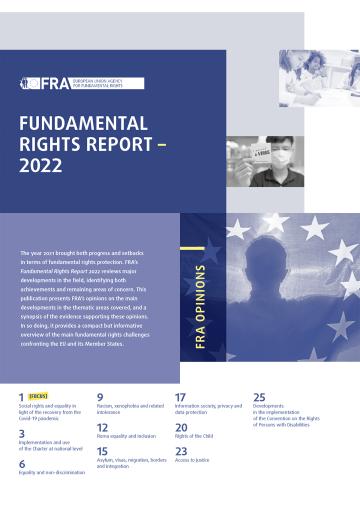
    The year 2021 brought both progress and setbacks in terms of fundamental rights protection. FRA’s Fundamental Rights Report 2022 reviews major developments in the field, identifying both achievements and remaining areas of concern. This publication presents FRA’s opinions on the main developments in the thematic areas covered, and a synopsis of the evidence supporting these opinions.
  • Report / Paper / Summary
    7
    July
    2021
    Italian version now available
    12 September 2022
    This report examines why victims do not report bias-motivated incidents and the barriers that they face when reporting incidents through national crime reporting systems. By mapping existing practices that have a bearing on the victim’s experiences when reporting bias-motivated violence and harassment, it aims to provide evidence to support national efforts to encourage and facilitate reporting – and ultimately assist Member States in delivering on their duties with regard to combating hate crime.
  • Fundamental Rights Report
    11
    June
    2026
    The Fundamental Rights Report: Challenges and Achievements in 2025 is FRA’s flagship annual publication. It provides an overview of the state of fundamental rights in the EU and highlights selected critical developments from 2025. This year, it focuses on four areas: rights protection in a rapidly changing digital environment; the housing crisis and rising homelessness rates; employment challenges for people from non-EU countries; and the implementation of the EU Charter of Fundamental Rights. The publication is a valuable resource for those seeking to stay informed about the EU’s shifting landscape of fundamental rights.
  • Report / Paper / Summary
    27
    November
    2025
    This report looks at the breadth and depth of violence and neglect faced by people with disabilities living in institutions. It highlights the shortcomings by EU Member States in preventing violence and protecting those who are at a higher risk of experiencing it, in line with the UN Convention on the Rights of Persons with Disabilities. Based on research across all EU Member States and FRA observer candidate countries, the report calls for better protection, stronger prevention of violence, and clear accountability. It urges the EU and its Member States to implement their obligations around equality and fundamental rights.
  • Report / Paper / Summary
    17
    September
    2025
    This report highlights the discrimination, harassment, violence, and non-consensual medical interventions faced by intersex people across 30 European countries, based on responses from nearly 2,000 participants in FRA's 2023 EU LGBTIQ Survey III. It reveals that many intersex individuals also identify as trans, non-binary, gender-diverse and have varied sexual orientations, which further compounds their experiences of discrimination. The report aims to support the development of laws and policies that promote the inclusion and dignity of intersex people.
  • In brief / Factsheet
    1
    September
    2025
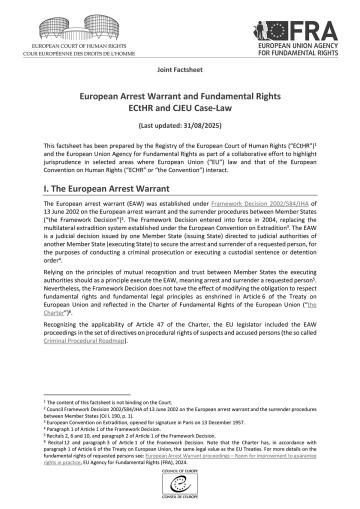
    This factsheet focuses on the European arrest warrant and EU Member States obligations to respect fundamental rights. EU law and the European Convention on Human Rights sometimes overlap. The publication clarifies where there are similar principles in different legislation and provides examples of case law. In collaboration, the EU Agency for Fundamental Rights and the European Court of Human Rights produced this short publication. It is designed to aid lawyers and policymakers in understanding and applying the jurisprudence in this area. The August 2025 version now contains recent case-law developments.
  • Opinion / Position Paper
    23
    July
    2025
    This position paper examines how the EU can counter the instrumentalisation of migrants while also upholding fundamental rights. Instrumentalisation refers to countries outside the EU using migration to exert political pressure. This position paper defines the phenomenon, provides examples, and outlines legal obligations under EU law. It provides legal analysis and warns that some responses risk undermining fundamental rights at the EU’s external borders, including the right to asylum. To counter instrumentalisation and uphold fundamental rights, the position paper proposes practical measures for Member States to take, such as sanctions, border controls, and cooperation with private operators.
  • In brief / Factsheet
    27
    May
    2025
    This factsheet focuses on the European arrest warrant and EU Member States obligations to respect fundamental rights. EU law and the European Convention on Human Rights sometimes overlap. The publication clarifies where there are similar principles in different legislation and provides examples of case law. In collaboration, the EU Agency for Fundamental Rights and the European Court of Human Rights produced this short publication. It is designed to aid lawyers and policymakers in understanding and applying the jurisprudence in this area. The 2025 version now contains recent case-law developments.
  • Opinion / Position Paper
    6
    February
    2025
    This FRA Position Paper outlines the Agency’s position on the creation of 'return hubs' in non-EU countries for migrants who have been ordered to leave the EU. Considering the serious fundamental rights risks connected with running return hubs, this legal analysis presents the conditions that would have to be met for return hubs to respect fundamental rights and comply with EU law. These include setting up agreements with the host countries and creating independent human rights monitoring mechanisms. The position paper does not examine centres in third countries that process asylum applications.
  • Handbook / Guide / Manual
    19
    September
    2024
    This publication guides EU countries on setting up independent monitoring mechanisms to ensure fundamental rights are respected during screening and asylum border procedures. These processes at borders are for people arriving from non-EU countries. Monitoring mechanisms are meant to prevent rights violations, protect victims, and support investigations into any allegations of wrongdoing by public authorities. The guidance highlights the importance of transparency and accountability, which builds trust in public authorities. New EU regulations coming into effect in 2026 will require such monitoring systems to be in place. This updates the guidance published in 2022.