Systems

Support for human rights systems and defenders

Many organisations work to defend your rights. We help their efforts with independent evidence, advice and expertise.

We support their frontline work. And we shine a light on potential risks and priority areas. Together we make your rights a reality.

Highlights

  • Report / Paper / Summary
    12
    December
    2025
    As the EU prepares to join the European Convention Human Rights (ECHR), this report outlines the main changes that accession would bring, offering an overview of the legal and operational implications. Presented in a Q&A format, it provides answers to 19 key questions for legal professionals and a broader audience. It describes the steps needed to conclude accession, the expected benefits for protecting rights, and some of the challenges that may come up. This legal analysis contributes to the current discussions on EU accession.
  • Report / Paper / Summary
    8
    December
    2025
    This report examines how human rights impact assessments (HRIAs) are built into lawmaking across the EU and its Member States. It highlights that, although progress has been made, the use of HRIAs remains uneven and often superficial. In many EU countries, the EU Charter of Fundamental Rights is frequently overlooked. The report identifies insufficient consultation with external experts, limited stakeholder participation and a lack of evaluation once laws are in force. To address these gaps, it offers practical recommendations for more systematic, inclusive and evidence-based HRIAs that strengthen human rights protection and ensure better, more accountable legislation throughout the EU.

  • Report / Paper / Summary
    11
    July
    2023
    Across the world, human rights defenders protect and uphold human rights in some of the most challenging situations. In some countries they face worrying levels of threats and attacks, intimidation and harassment. This report outlines how human rights defenders can enter and stay in the EU when they need protection. It suggests how EU institutions and Member States could use the flexibility in existing legal provisions and provide shelter for defenders who seek protection.
  • Report / Paper / Summary
    19
    December
    2023
    All EU funds must be spent in a way that respect fundamental rights. The EU spends billions of euros on creating jobs, economic growth, sustainable development and improving people’s lives. To prevent funds from being spent in ways that directly violate people’s fundamental rights, the EU strengthened the conditions how funds can be spent in 2021. This report looks at how the newly introduced conditions related to the EU Charter of Fundamental Rights and the United Nations Convention on the Rights of Persons with Disabilities can be upheld in practice. It analyses the potential role of national human rights institutions, ombudsperson institutions and equality bodies. These safeguards can advance compliance with fundamental rights.
    Publications and data
    The Fundamental Rights Report 2025 provides a comprehensive overview of the state of fundamental rights in the European Union, highlighting major developments and trends in 2024. This video provides an insight into the issues covered by this year's report.
    12
    December
    2025
    As the EU prepares to join the European Convention Human Rights (ECHR), this report outlines the main changes that accession would bring, offering an overview of the legal and operational implications. Presented in a Q&A format, it provides answers to 19 key questions for legal professionals and a broader audience. It describes the steps needed to conclude accession, the expected benefits for protecting rights, and some of the challenges that may come up. This legal analysis contributes to the current discussions on EU accession.
    8
    December
    2025
    This report examines how human rights impact assessments (HRIAs) are built into lawmaking across the EU and its Member States. It highlights that, although progress has been made, the use of HRIAs remains uneven and often superficial. In many EU countries, the EU Charter of Fundamental Rights is frequently overlooked. The report identifies insufficient consultation with external experts, limited stakeholder participation and a lack of evaluation once laws are in force. To address these gaps, it offers practical recommendations for more systematic, inclusive and evidence-based HRIAs that strengthen human rights protection and ensure better, more accountable legislation throughout the EU.
    10
    June
    2025
    Оваа публикација е извадок од годишниот
    извештај на Агенцијата на Европската унија за
    фундаментални права (FRA), Fundamental Rights
    Report 2025 (Извештај за фундаменталните права
    2025). Во него се претставени избрани критични
    случувања во областа на фундаменталните права
    во 2024 година, како и клучните наоди и мислења
    на FRA од поглавјата во извештајот.
    10
    June
    2025
    The Fundamental Rights Report 2025 is the annual report of the European Union Agency for Fundamental Rights (FRA). It provides an overview of the state of fundamental rights in the EU and highlights selected critical developments and trends in 2024. The report covers issues such as inclusive elections, gender-based violence, and the implementation of the EU Charter of Fundamental Rights. It presents FRA’s opinions on these developments, setting out the actions that the EU and Member States should take. This annual publication is a valuable resource for those seeking to stay informed about the EU’s shifting landscape of fundamental rights.
    29
    April
    2025
    National Human Rights Institutions (NHRIs) play an important role in providing independent human rights protection in EU Member States. Since 2020, the European Union Agency for Fundamental Rights (FRA) has been tracking the accreditation status and mandates of NHRIs across the EU. The 2025 annual update continues this work. These updates examine whether NHRIs are involved in monitoring compliance with fundamental rights in the use of EU funds, and how they use the EU Charter of Fundamental Rights when advising governments or carrying out education, training, and awareness-raising activities.
    This FRF theme examines key challenges such as tackling disinformation, widening participation, protecting protests, sustaining civil society, ensuring political transparency, safeguarding institutions, and resisting the erosion of fundamental rights. Notable speakers include Emily O'Reilly, former European Ombudsman, Didier Reynders, former EU Commissioner for Justice, Alma Zadić, Austria's former Federal Minister of Justice, and Lilian Thuram, President of the Lilian Thuram Foundation - Education against racism, among others.
    The Fundamental Rights Forum (FRF) is a unique space for dialogue, bringing together diverse voices to tackle Europe’s most pressing human rights challenges. By uniting thinkers, creators and decision makers, the Forum sparks fresh ideas and solutions for a more just future.
    5
    June
    2024
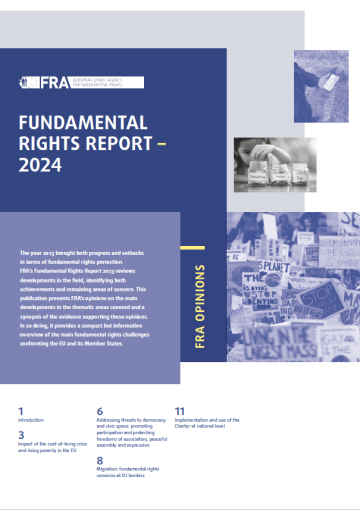
    FRA’s Fundamental Rights Report 2024 analyses the year’s developments in fundamental rights. It focuses on the most pressing fundamental rights concerns facing Europe in 2023: the cost-of-living crisis, rights concerns at the EU’s external borders and migration, and threats to democracy. Re-structured, this year’s new approach is a shorter and sharper analysis. It also presents FRA’s opinions on these developments, including a summary of the evidence supporting these opinions.
    5
    June
    2024
    Годината 2023 донесе напредок, но и назадување во однос на заштитата на основните права. Извештајот за основните права за 2024 на FRA година ги разгледува случувањата во областа, идентификувајќи ги достигнувањата и останатите области на загриженост. Оваа публикација ги презентира мислењата на FRA за главните случувања во опфатените тематски области, како и резиме на доказите што ги поддржуваат овие мислења. Покрај тоа, обезбедува компактен, но информативен преглед на главните предизвици на основните права со кои се соочува ЕУ и нејзините земји-членки.
    Highlights from the Fundamental Rights Forum 2024 that took place in Vienna on 11-12 March.
    babaroga/Adobe Stock
    6
    February
    2024
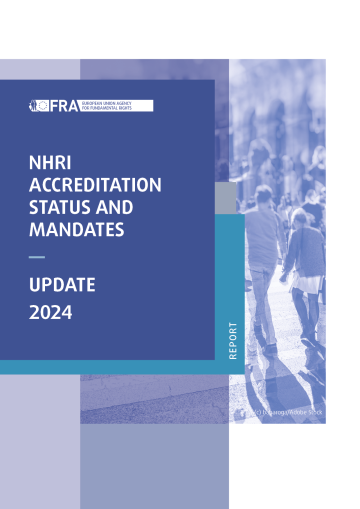
    The 2024 update on NHRIs accreditation status and mandates also covers their engagement in the monitoring of fundamental rights compliance in the use of EU funds at national level. Moreover, the update also shows how NHRIs make use of the EU Charter of Fundamental Rights in their work when advising government or in education, training and awareness raising activities. Since its 2020 report 'Strong and effective national human rights institutions – challenges, promising practices and opportunities', the European Union Agency for Fundamental Rights (FRA) has been regularly tracking the accreditation status and mandates of NHRIs.
    19
    December
    2023
    All EU funds must be spent in a way that respect fundamental rights. The EU spends billions of euros on creating jobs, economic growth, sustainable development and improving people’s lives. To prevent funds from being spent in ways that directly violate people’s fundamental rights, the EU strengthened the conditions how funds can be spent in 2021. This report looks at how the newly introduced conditions related to the EU Charter of Fundamental Rights and the United Nations Convention on the Rights of Persons with Disabilities can be upheld in practice. It analyses the potential role of national human rights institutions, ombudsperson institutions and equality bodies. These safeguards can advance compliance with fundamental rights.
    20
    October
    2023
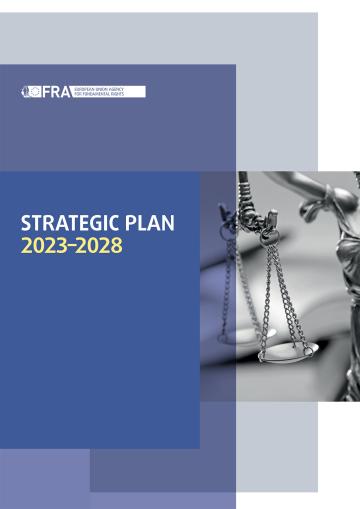
    FRA’s strategic priorities and objectives are based on the agency’s role and mission as defined in its amended founding regulation. They build on FRA’s 2018–2022 strategy as well as how it performed, its experience and its vision. Their design takes into account future fundamental rights challenges facing Europe, the agency’s mandate, the broader operational context and the resources available.
    18
    October
    2023
    Civil society organisations struggle to maintain an environment safe from threats and attacks. FRA’s sixth annual update on civic space explores the challenges for organisations across the EU. While there has been significant development since FRA began monitoring the situation in 2018, civil society organisations remain under immense pressure. Abusive lawsuits and attacks against those involved in migrant search and rescue at sea are just some of the challenges identified. This report presents ways forward to protect civil society and human rights.
    11
    July
    2023
    Across the world, human rights defenders protect and uphold human rights in some of the most challenging situations. In some countries they face worrying levels of threats and attacks, intimidation and harassment. This report outlines how human rights defenders can enter and stay in the EU when they need protection. It suggests how EU institutions and Member States could use the flexibility in existing legal provisions and provide shelter for defenders who seek protection.
    8
    June
    2023
    FRA’s Fundamental Rights Report 2023 reviews major developments in the field in 2022, identifying both achievements and areas of concern. It also presents FRA’s opinions on these developments, including a synopsis of the evidence supporting these opinions.
    8
    June
    2023
    The year 2022 brought both progress and setbacks in terms of fundamental rights protection. FRA’s Fundamental Rights Report 2023 reviews major developments in the field, identifying both achievements and remaining areas of concern. This publication presents FRA’s opinions on the main developments in the thematic areas covered, and a synopsis of the evidence supporting these opinions.
    2
    February
    2023
    Many cities throughout the European Union hosted people fleeing Russia’s war of aggression against Ukraine. The EU currently faces the largest displacement of people in Europe since World War II. Since February 2022, over seven million people came to the EU. The arrival of such large numbers of people thrust cities and local governments to the forefront of the EU and its Member States’ relief work. This short publication provides a snapshot of cities’ initiatives to address this humanitarian crisis.
    babaroga/Adobe Stock
    13
    December
    2022
    National Human Rights Institutions (NHRIs) continue to play a key role in upholding fundamental rights. FRA keeps track of the accreditation status and the mandates of the NHRIs. In 2022, the NHRI in Cyprus was upgraded to an ‘A-status’ institution. In addition, the mandates of six NHRIs changed to include child protection or the protection of LGBTI people.