Justice

Justice, victims’ rights and judicial cooperation

Your access to justice is a fundamental right. It is central to making your other rights a reality.

It protects rights of the individual. It puts right civil wrongs. It holds power to account. We shine a light on obstacles to access to justice. And we give evidence-based advice on overcoming them.

Highlights

    Publications and Data

    Publications and Data

    Displaying results 21 - 30 of 136
    Report / Paper / Summary
    20
    October
    2023
    FRA’s strategic priorities and objectives are based on the agency’s role and mission as defined in its amended founding regulation. They build on FRA’s 2018–2022 strategy as well as how it performed, its experience and its vision. Their design takes into account future fundamental rights challenges facing Europe, the agency’s mandate, the broader operational context and the resources available.
    Fundamental Rights Report
    8
    June
    2023
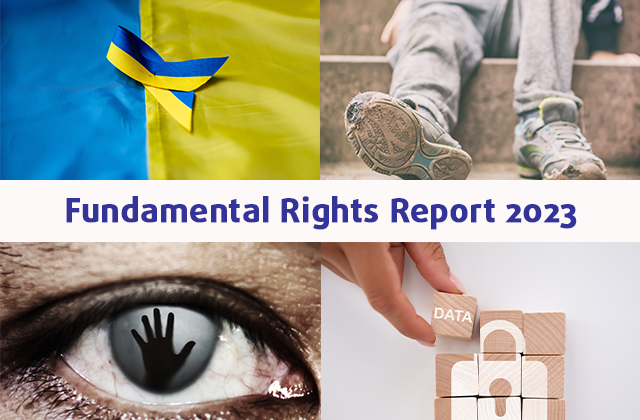
    FRA’s Fundamental Rights Report 2023 reviews major developments in the field in 2022, identifying both achievements and areas of concern. It also presents FRA’s opinions on these developments, including a synopsis of the evidence supporting these opinions.
    Fundamental Rights Report
    8
    June
    2023
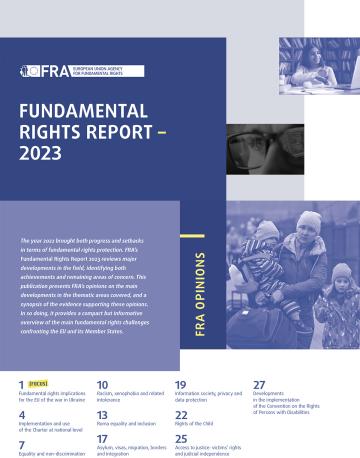
    The year 2022 brought both progress and setbacks in terms of fundamental rights protection. FRA’s Fundamental Rights Report 2023 reviews major developments in the field, identifying both achievements and remaining areas of concern. This publication presents FRA’s opinions on the main developments in the thematic areas covered, and a synopsis of the evidence supporting these opinions.
    Report / Paper / Summary
    22
    February
    2023
    Directive 2012/29/EU represents a milestone in the development of victims’ rights. It establishes minimum standards for the rights, support and protection of victims of crime. It defines the scope of support services, guarantees the right to effective protection against secondary victimisation and comprehensively regulates the measures required for this purpose. This report covers three core components underpinning victims’ rights: support services, crime reporting, and protection from secondary and repeat victimisation. Examples highlight the relevant legal provisions in Member States and how specific rights under the Victims’ Rights Directive work in practice.
    Report / Paper / Summary
    28
    September
    2022
    Acts of terrorism represent a serious threat to the lives and safety of people, and a profound security challenge for states. At the same time, counter-terrorism legislation, policies and other measures can entail, directly or indirectly, serious limitations to fundamental rights, and can adversely affect individuals, groups and society as a whole. This summary presents FRA’s main findings from its report on Directive (EU) 2017/541 on combating terrorism, the main criminal law instrument at EU level in the field of counter-terrorism.
    Report / Paper / Summary
    21
    June
    2022
    Every child has a right to be protected even when they are accused or suspected of committing a crime. The basic principles of justice apply to adults and children alike. But children face specific obstacles during criminal proceedings, such as a lack of understandable information about their rights, limited legal support and poor treatment. The report looks at the practical implementation of Directive (EU) 2016/800 on procedural safeguards for children who are suspects or accused persons in criminal proceedings in nine Member States – Austria, Belgium, Bulgaria, Germany, Estonia, Italy, Malta, Poland and Portugal.
    Fundamental Rights Report
    8
    June
    2022
    FRA’s Fundamental Rights Report 2022 reviews major developments in the field in 2021, identifying both achievements and areas of concern. It also presents FRA’s opinions on these developments, including a synopsis of the evidence supporting these opinions.
    Fundamental Rights Report
    8
    June
    2022
    This focus looks at the impact of the pandemic on social rights. It examines the measures in national recovery and resilience plans that address the social vulnerabilities among a variety of population groups in the EU, including women, children and young people in situations of vulnerability, people with disabilities, older people, Roma and people in precarious working conditions.
    Fundamental Rights Report
    8
    June
    2022
    All language versions now available
    14 September 2022
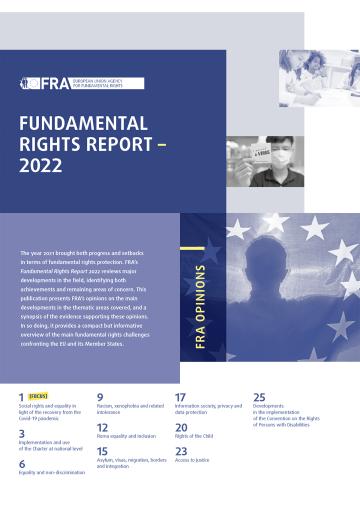
    The year 2021 brought both progress and setbacks in terms of fundamental rights protection. FRA’s Fundamental Rights Report 2022 reviews major developments in the field, identifying both achievements and remaining areas of concern. This publication presents FRA’s opinions on the main developments in the thematic areas covered, and a synopsis of the evidence supporting these opinions.
    Handbook / Guide / Manual
    7
    April
    2022
    12 new language versions now available
    04 March 2026
    Children are full-fledged holders of rights. They are beneficiaries of all human and fundamental rights and subjects of special regulations, given their specific characteristics. This handbook aims to illustrate how European law and case law accommodate the specific interests and needs of children. It also considers the importance of parents and guardians or other legal representatives and makes reference, where appropriate, to situations in which rights and responsibilities are most prominently vested in children’s carers. It is a point of reference on both European Union (EU) and Council of Europe (CoE) law related to these subjects, explaining how each issue is regulated under EU law, including the Charter of Fundamental Rights of the European Union, as well as under the European Convention on Human Rights, the European Social Charter and other CoE instruments.