Justice

Justice, victims’ rights and judicial cooperation

Your access to justice is a fundamental right. It is central to making your other rights a reality.

It protects rights of the individual. It puts right civil wrongs. It holds power to account. We shine a light on obstacles to access to justice. And we give evidence-based advice on overcoming them.

Highlights

  • Report / Paper / Summary
    24
    February
    2026
    The start of Russia’s war of aggression against Ukraine on 24 February 2022 shocked the global community and gave rise to a
    series of urgent fundamental rights challenges across Europe. While much attention has focused on the scale of devastation and its wider impact on all Ukrainians, the war has also inflicted profound personal harm. This report sheds light on the violence, sexual harassment and exploitation experienced by women displaced from Ukraine. Drawing on a survey and in-depth interviews with women from Ukraine, the report documents the prevalence, forms and patterns of gender-based violence and sets out practical measures to improve safety, access to justice and support.
  • Video
    There are no truly safe spaces for women. At home, at work, in public or online, 1 in 3 women and girls have experienced some form of gender-based violence. This ranges from hate, harassment, abuse, to physical and sexual violence. Women are being silenced and harmed - online and offline - every day, as the EU gender-based survey findings show. But we have the tools to fight it. By preventing violence before it starts, by strengthen legal protection, by funding support services for victims and by training police and healthcare professionals.
  • Report / Paper / Summary
    13
    November
    2025
    FRA analysed 31 digital tools and systems across seven EU Member States, exploring potential positive and negative effects on victims, claimants and defendants. By identifying risks early, investing in skills and training, and embedding protections from the outset, policymakers and practitioners can build effective and inclusive justice systems. This report provides practical suggestions to help ensure that digitalised justice systems are accessible and deliver fair outcomes for all.
  • Page
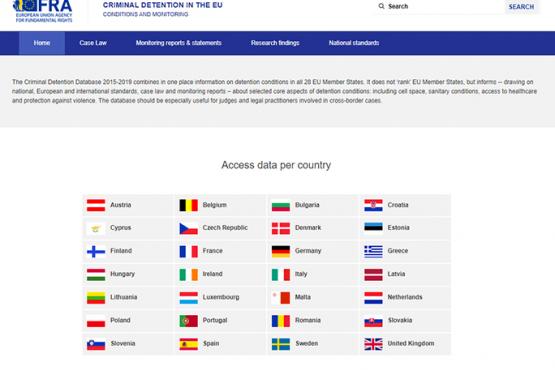
    The Criminal Detention Database 2015-2022 combines in one place information on detention conditions in all 27 EU Member States as well as the United Kingdom.
    Publications and data
    27
    November
    2012
    This EU-MIDIS Data in focus report 6 presents data on respondents’ experiences of victimisation across five crime types: theft of or from a vehicle; burglary or attempted burglary; theft of personal property not involving force or threat (personal theft); assault or threat; and serious harassment. The European Union Minorities and Discrimination Survey (EU-MIDIS) is the first EU-wide survey to ask 23,500 individuals with an ethnic and minority background about their experiences of discrimination and criminal victimisation in everyday life.
    20
    June
    2012
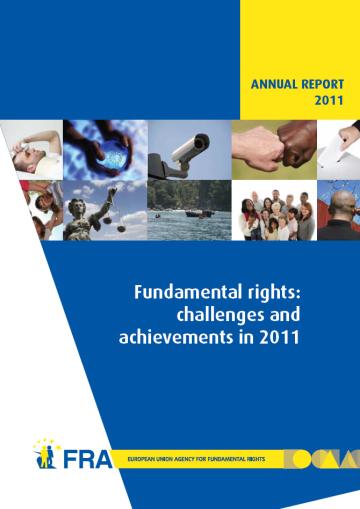
    This publication was originally published in 2012 as part of the FRA Annual Report: Fundamental rights: challenges and achievements in 2011.
    20
    June
    2012
    This year‘s summary of the FRA Annual report – Highlights 2011 – chronicles the positive developments made in 2011 as well as the challenges facing the EU and its Member States in the field of fundamental rights, drawing on objective, reliable and comparable socio-legal data.
    23
    March
    2011
    This report provides an EU-wide comparative analysis of the effectiveness of access to justice, across the EU Member States. Launched on 23 March at the conference "Protecting victims in the EU: the road ahead" hosted in Budapest by the Hungarian Presidency of the Council of the EU with the support of the FRA, the report emphasises obstacles making it difficult for victims to enforce their rights.
    8
    December
    2011
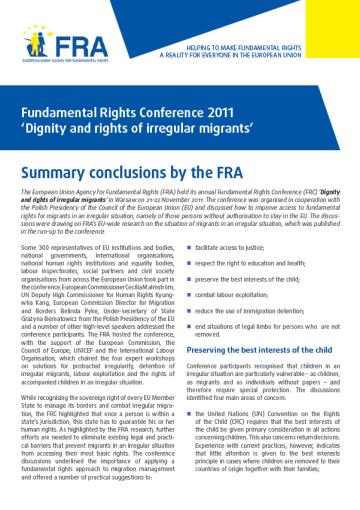
    The European Union Agency for Fundamental Rights held its annual Fundamental Rights Conference 'Dignity and rights of irregular migrants' in Warsaw on 21-22 November 2011. This paper summarises the discussions that took place during the conference and presents follow-up activities to be undertaken by FRA.
    1
    September
    2011
    The Fundamental Rights Conference, the flagship annual event of the FRA, focused in 2010 on ensuring justice and protection for all children, including those who are most vulnerable. This report summarises the speeches, discussion and common conclusions and issues identified during the conference.
    15
    June
    2011
    2010 marked the first year the European Union (EU) operated on the basis of a legally binding bill of rights - the Charter of Fundamental Rights of the EU. This year's annual report of the European Agency for Fundamental Rights puts the spotlight on the achievements and challenges of the EU and its Member States as they strive to inject robust life into their fundamental rights commitments.
    20
    June
    2012
    To secure and safeguard the fundamental rights of everyone in the European Union (EU), the EU and its 27 Member States pressed forward with a number of initiatives in 2011. This report chronicles the positive developments made in 2011 as well as the challenges facing the EU and its Member States in the field of fundamental rights.
    21
    November
    2011
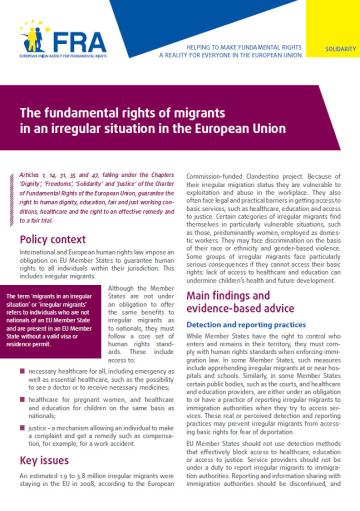
    International and European human rights law impose an obligation on EU Member States to guarantee human rights to all individuals within their jurisdiction. This includes irregular migrants.
    23
    March
    2011
    According to international and European human rights law, EU Member States must guarantee everyone the right to go to court, or to an alternative dispute resolution body, and to obtain a remedy when their rights are violated. This factsheet provides information on access to justice, focusing on non-discrimination law, excluding criminal law.

    23
    February
    2011
    On 14 February 2011, as requested by the European Parliament, the European Union Agency for Fundamental Rights (FRA) issued an opinion on the draft directive regarding the European Investigation Order (EIO) in criminal matters. The draft directive, aimed at mutual recognition of warrants for both existing and new evidence, is intended to replace an existing ‘fragmented regime' with a more comprehensive legislative instrument.
    13
    September
    2010
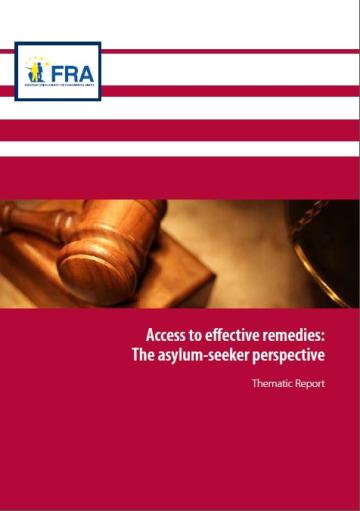
    This factsheet summarises the main points of the two reports 'Access to effective remedies: The asylum-seeker perspective' and 'The duty to inform applicants about asylum procedures: The asylum-seeker perspective'.
    13
    September
    2010
    A fair asylum procedure is one where applicants know their rights and duties, and where they understand its different stages. The right to be informed at decisive moments of the procedure is an important element of procedural fairness. Drawing on evidence from interviews with almost 900 asylum seekers, this report examines the information that asylum seekers have on the asylum procedure. In particular, it looks at the main source of information for asylum seekers, which type of information they receive, and when and how they receive it.
    13
    September
    2010
    Drawing on evidence from interviews with almost 900 asylum seekers, this report presents asylum-seeker experiences in submitting an appeal against a negative asylum decision. While documenting good practices, it also highlights several obstacles which make it difficult for asylum applicants to access effective remedies.
    3
    November
    2009
    On 16 October the Swedish Presidency presented a "draft of the Stockholm Programme" that is to be adopted at the EU summit in December 2009. Following this publication, the Fundamental Rights Agency has presented the following opinion paper "FRA Comments on the Presidency Draft Stockholm Programme" available for download below.
    29
    July
    2009
    The FRA opinion paper presents a selection primarily based on the current thematic priorities of the Agency and are inspired by the factual evidence the Agency's own research has so far produced. This contribution is therefore just a first step in a long term approach of the Agency to follow and address the issues in the Stockholm Programme.
    29
    September
    2005
    The report on "Policing Racist Crime and Violence" is based on information collected by the Agency's National Focal Points. The report examines police recording practices, responses to victims of racist crimes, training provided to the police and their engagement with civil society. The emerging data reveals that only two Member States systematically encourage reporting of racist incidents. International police coordination and cooperation with NGOs could be enhanced, while police training is not specific enough to equip officers to tackle racist crime effectively.