eu-charter

EU Charter of Fundamental Rights

The peoples of Europe, in creating an ever closer union among them, are resolved to share a peaceful future based on common values.

Conscious of its spiritual and moral heritage, the Union is founded on the indivisible, universal values of human dignity, freedom, equality and solidarity; it is based on the principles of democracy and the rule of law. It places the individual at the heart of its activities, by establishing the citizenship of the Union and by creating an area of freedom, security and justice.

The Union contributes to the preservation and to the development of these common values while respecting the diversity of the cultures and traditions of the peoples of Europe as well as the national identities of the Member States and the organisation of their public authorities at national, regional and local levels; it seeks to promote balanced and sustainable development and ensures free movement of persons, services, goods and capital, and the freedom of establishment.

To this end, it is necessary to strengthen the protection of fundamental rights in the light of changes in society, social progress and scientific and technological developments by making those rights more visible in a Charter.

This Charter reaffirms, with due regard for the powers and tasks of the Union and for the principle of subsidiarity, the rights as they result, in particular, from the constitutional traditions and international obligations common to the Member States, the European Convention for the Protection of Human Rights and Fundamental Freedoms, the Social Charters adopted by the Union and by the Council of Europe and the case-law of the Court of Justice of the European Communities and of the European Court of Human Rights. In this context the Charter will be interpreted by the courts of the Union and the Member States with due regard to the explanations prepared under the authority of the Praesidium of the Convention which drafted the Charter and updated under the responsibility of the Praesidium of the European Convention.

Enjoyment of these rights entails responsibilities and duties with regard to other persons, to the human community and to future generations.

The Union therefore recognises the rights, freedoms and principles set out hereafter.


Explanations

  • Text:
    Source:
    Preamble - Explanations relating to the Charter of Fundamental Rights:

Case Law References

0 results found

National Constitutional Law

0 results found

EU Law

0 results found

International Law

0 results found

Publications and data

  • Handbook / Guide / Manual
    23
    October
    2018
    UA version now available
    30 April 2026
    Хартія містить сучасний змістовний каталог прав людини, включно навіть із тими, які відсутні у багатьох традиційних актах про основоположні права, тож на рівні тексту вона виглядає надзвичайно прогресивно. Фахівці, знайомі з основними принципами європейського права, чудово пам’ятають, що Хартія є обов’язковою для інституцій ЄС завжди, а для держав-членів – лише тоді, коли вони здійснюють «імплементацію права Союзу». Але що ж насправді означає це, на перший погляд, звичне формулювання Статті 51 Хартії?
  • Handbook / Guide / Manual
    7
    April
    2022
    BG, EL, HU, RO, SV, and UK version now available
    17 April 2025
    Діти є повноправними носіями прав. Вони є бенефіціарами всіх прав людини та основоположних прав, а також суб’єктами спеціального регулювання, враховуючи їхні специфічні особливості. Цей посібник має на меті проілюструвати, як європейське законодавство та судова практика враховують специфічні інтереси та потреби дітей. Він також ілюструє важливість батьків, опікунів та інших законних представників і, де це доречно, вказує на те, які права та обов’язки найчастіше покладаються на осіб, що здійснюють догляд за дітьми. Він є довідником з права Європейського Союзу (ЄС) та Ради Європи (РЄ), пов’язаного з цими питаннями, і пояснює, як кожне питання регулюється законодавством ЄС, включаючи Хартію основних прав Європейського Союзу, а також Європейською конвенцією з прав людини (ЄКПЛ), Європейською соціальною хартією (ЄСХ) та іншими інструментами РЄ.
  • Report / Paper / Summary
    14
    December
    2020
    Slovenian version now available
    20 December 2024
    Artificial intelligence (AI) already plays a role in deciding what unemployment benefits someone gets, where a burglary is likely to take place, whether someone is at risk of cancer, or who sees that catchy advertisement for low mortgage rates. Its use keeps growing, presenting seemingly endless possibilities. But we need to make sure to fully uphold fundamental rights standards when using AI. This report presents concrete examples of how companies and public administrations in the EU are using, or trying to use, AI. It focuses on four core areas – social benefits, predictive policing, health services and targeted advertising.
  • Report / Paper / Summary
    28
    February
    2023
    Військова агресія Росії проти України призвела до подій, яких не бачили у Європі протягом десятиліть. Відтоді вона спричиняє смерть, величезні руйнування і невимовні страждання. Вона також призвела до масового переміщення людей, якого не траплялося з часів Другої світової війни. Щоб захистити їх, ЄС вперше активував Директиву про тимчасовий захист. Згідно з нею держави-члени ЄС повинні запропонувати переміщеним з України особам.
  • Handbook / Guide / Manual
    19
    August
    2022
    DA, ET, FI, LT, PT, SV versions now available
    30 July 2024
    The Charter of Fundamental Rights of the European Union (CFREU) is the EU’s bill of rights. It always binds the EU institutions and the Member States when they act within the scope of EU law. However, it is far from easy to assess whether a concrete case falls within the scope of EU law. This is why it is necessary to provide training and training material to legal professionals so that they can understand the field of application of the Charter as laid out in its Article 51. This trainer’s manual aims at providing guidance on both the organisation and the implementation of such trainings based on a series of case studies,
    which will be extended in the future.
  • Handbook / Guide / Manual
    25
    May
    2018
    Arabic version now available
    18 July 2024
    The rapid development of information technology has exacerbated the need for robust personal data protection, the right to which is safeguarded by both European Union (EU) and Council of Europe (CoE) instruments. Safeguarding this important right entails new and significant challenges as technological advances expand the frontiers of areas such as surveillance, communication interception and data storage. This handbook is designed to familiarise legal practitioners not specialised in data protection with this emerging area of the law.
  • Report / Paper / Summary
    25
    October
    2022
    02 November 2022
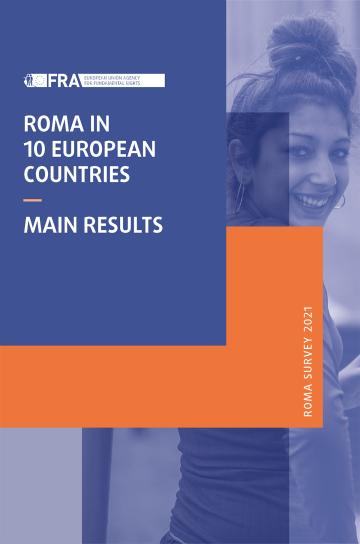
    This report presents findings from FRA’s 2021 survey on Roma in Croatia, Czechia, Greece, Hungary, Italy, Portugal, Romania and Spain, as well as in North Macedonia and Serbia. The survey includes interviews with more than 8,400 Roma, collecting information on more than 20,000 individuals living in their households. By focusing on Roma, the survey provides unique data and information that are not available from European general population surveys, which do not disaggregate on grounds of ethnic origin. The findings present a bleak but familiar picture of exclusion, deprivation, discrimination and racism.
  • Fundamental Rights Report
    8
    June
    2022
    All language versions now available
    14 September 2022
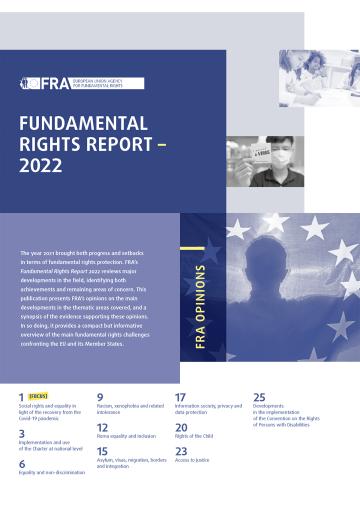
    The year 2021 brought both progress and setbacks in terms of fundamental rights protection. FRA’s Fundamental Rights Report 2022 reviews major developments in the field, identifying both achievements and remaining areas of concern. This publication presents FRA’s opinions on the main developments in the thematic areas covered, and a synopsis of the evidence supporting these opinions.
  • Handbook / Guide / Manual
    24
    July
    2020
    All language versions now available
    12 September 2022
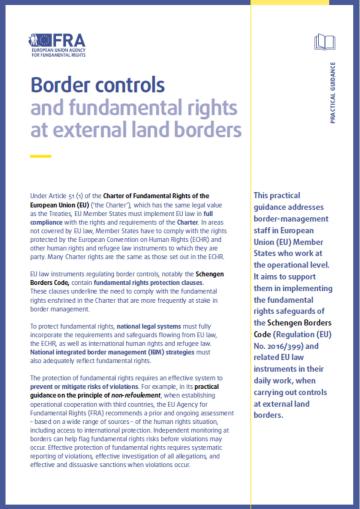
    This practical guidance addresses border-management staff in European Union (EU) Member States who work at the operational level. It aims to support them in implementing the fundamental rights safeguards of the Schengen Borders Code (Regulation (EU) No. 2016/399) and related EU law instruments in their daily work, when carrying out controls at external land borders.
  • Report / Paper / Summary
    7
    July
    2021
    Italian version now available
    12 September 2022
    This report examines why victims do not report bias-motivated incidents and the barriers that they face when reporting incidents through national crime reporting systems. By mapping existing practices that have a bearing on the victim’s experiences when reporting bias-motivated violence and harassment, it aims to provide evidence to support national efforts to encourage and facilitate reporting – and ultimately assist Member States in delivering on their duties with regard to combating hate crime.