eu-charter

EU Charter of Fundamental Rights

1. Every citizen of the Union has the right to move and reside freely within the territory of the Member States.
2. Freedom of movement and residence may be granted, in accordance with the Treaties, to nationals of third countries legally resident in the territory of a Member State.

Explanations

  • Text:

    The right guaranteed by paragraph 1 is the right guaranteed by Article 20(2)(a) of the Treaty on the Functioning of the European Union (cf. also the legal base in Article 21; and the judgment of the Court of Justice of 17 September 2002, Case C-413/99 Baumbast [2002] ECR I-7091). In accordance with Article 52(2) of the Charter, those rights are to be applied under the conditions and within the limits defined by the Treaties.

    Paragraph 2 refers to the power granted to the Union by Articles 77, 78 and 79 of the Treaty on the Functioning of the European Union. Consequently, the granting of this right depends on the institutions exercising that power.

    Source:
    Official Journal of the European Union C 303/17 - 14.12.2007
    Preamble - Explanations relating to the Charter of Fundamental Rights:
    These explanations were originally prepared under the authority of the Praesidium of the Convention which drafted the Charter of Fundamental Rights of the European Union. Although they do not as such have the status of law, they are a valuable tool of interpretation intended to clarify the provisions of the Charter.

Case Law References

National Constitutional Law

39 results found

  • Sweden / Instrument of Government
    Country:
    Sweden

    Chapter 2 - Fundamental rights and freedom:

    Article 7 No Swedish citizen may be deported from or refused entry into the Realm. No Swedish citizen who is domiciled in the Realm or who has previously been domiciled in the Realm may be deprived of his or her citizenship. It may however be prescribed that children under the age of eighteen
    shall have the same nationality as their parents or as one parent;

    Article 8 Everyone shall be protected in their relations with the public institutions against deprivations of personal liberty. All Swedish citizens shall also in other respects be guaranteed freedom of movement within the Realm and freedom to depart the Realm.

  • 4. Zusatzprotokoll zur Konvention zum Schutze der Menschenrechte und Grundfreiheiten
    Country:
    Austria

    Artikel 2 (1) Jedermann, der sich rechtmäßig im Hoheitsgebiet eines Staates aufhält, hat das Recht, sich dort frei zu bewegen und seinen Wohnsitz frei zu wählen.

  • 4th Additional Protocolo the The European Convention on Human Rights (ECHR)
    Country:
    Austria

    Article 2 (1) Everyone lawfully within the territory of a State shall, within that territory, have the right to liberty of movement and freedom to choose his residence.

  • A Magyar Köztársaság Alkotmánya
    Country:
    Hungary

    58. §(1) Mindenkit, aki törvényesen tartózkodik Magyarország területén - törvényben meghatározott esetek kivételével - megillet a szabad mozgás és a tartózkodási hely szabad megválasztásának joga, beleértve a lakóhely vagy az ország elhagyásához való jogot is.(2) A Magyarország területén törvényesen tartózkodó külföldit csak a törvénynek megfelelően hozott határozat alapján lehet kiutasítani.(3) Az utazási és letelepedési szabadságról szóló törvény elfogadásához a jelenlévő országgyűlési képviselők kétharmadának szavazata szükséges.

  • Basic Law for the Federal Republic of Germany
    Country:
    Germany

    Article 11 (1) All Germans shall have the right to move freely throughout the federal territory. (2) This right may be restricted only by or pursuant to a law, and only in cases in which the absence of adequate means of support would result in a particular burden for the community, or in which such restriction is necessary to avert an imminent danger to the existence or the free democratic basic order of the Federation or of a Land, to combat the danger of an epidemic, to respond to a grave accident or natural disaster, to protect young persons from serious neglect, or to prevent crime. Article 17a (2) Laws regarding defence, including protection of the civilian population, may provide for restriction of the basic rights of freedom of movement (Article 11) and inviolability of the home (Article 13).

  • Constitution of Finland
    Country:
    Finland

    Section 9 Freedom of movement Finnish citizens and foreigners legally resident in Finland have the right to freely move within the country and to choose their place of residence. Everyone has the right to leave the country. Limitations on this right may be provided by an Act, if they are necessary for the purpose of safeguarding legal proceedings or for the enforcement of penalties or for the fulfilment of the duty of national defence. Finnish citizens shall not be prevented from entering Finland or deported or extradited or transferred from Finland to another country against their will. However, it may be laid down by an Act that due to a criminal act, for the purpose of legal proceedings, or in order to enforce a decision concerning the custody or care of a child, a Finnish citizen can be extradited or transferred to a country in which his or her human rights and legal protection are guaranteed. The right of foreigners to enter Finland and to remain in the country is regulated by an Act. A foreigner shall not be deported, extradited or returned to another country, if in consequence he or she is in danger of a death sentence, torture or other treatment violating human dignity.

  • Constitution of Ireland
    Country:
    Ireland

    Article 40.3.3. .... This subsection shall not limit freedom to travel between the state and another state.

  • Constitution of Malta
    Country:
    Malta

    Article 44(1) No citizen of Malta shall be deprived of his freedom of movement, and for the purpose of this article the said freedom means the right to move freely throughout Malta, the right to reside in any part of Malta, the right to leave and the right to enter Malta. (2) Any restriction on a citizen’s freedom of movement that is involved in his lawful detention shall not be held to be inconsistent with or in contravention of this article.

  • Constitution of the Hellenic Republic
    Country:
    Greece

    Article 5(4) Individual administrative measures restrictive of the free movement or establishment in the country, and of the free exit and entrance therein of any Greek are prohibited. Restrictive measures of such content may only be imposed as an attendant penalty by a criminal court ruling, in exceptional cases of emergency and only in order to prevent the commitment of criminal acts, as specified by law. [...]

  • Constitution of the Italian Republic
    Country:
    Italy

    Art. 16. Every citizen has the right to reside and travel freely in any part of the country, except for such general limitations as may be established by law for reasons
    of health or security. No restriction may be imposed for political reasons. Every citizen is free to leave the territory of the republic and return to it, notwithstanding any legal obligations.

  • Constitution of the Republic of Bulgaria
    Country:
    Bulgaria

    Art. 35(1) Everyone shall be free to choose a place of residence and shall have the right to freedom of movement in the territory of the country and to leave the country. This right shall be restricted only by virtue of law in the name of national security, public health, and the rights and freedoms of other citizens. [...]

  • Constitution of the Republic of Croatia
    Country:
    Croatia

    Article 32
    Anyone lawfully within the territory of the Republic of Croatia shall enjoy freedom of
    movement and freedom to choose his/her residence.
    All citizens of the Republic shall be entitled to leave the state territory at any time and
    permanently or temporarily settle abroad, and to return at any time.
    The right to movement within the territory of the Republic of Croatia and the right to depart may be exceptionally be curtailed by law, if necessary to protect the legal order, or the health, rights and liberties of others.

    Article 146
    Citizens of the Republic of Croatia shall be European Union citizens and shall enjoy the rights
    guaranteed by the European Union acquis communautaire, and in particular:
    – freedom of movement and residence in the territory of all Member States,
    (...)
    All rights shall be exercised in compliance with the conditions and limitations laid down in
    the founding treaties of the European Union and the measures undertaken pursuant to such
    treaties.
    In the Republic of Croatia, all rights guaranteed by the European Union acquis
    communautaire shall be enjoyed by all citizens of the European Union.

  • Constitution of the Republic of Estonia
    Country:
    Estonia

    Article 34. Everyone whose presence in Estonian territory is lawful has the right to move freely in that territory and to choose freely where to reside. The right to freedom of movement may be circumscribed in the cases and pursuant to a procedure which is provided by law to protect the rights and freedoms of others, in the interests of national defence, in the case of a natural disaster or a catastrophe, to prevent the spread of an infectious disease, to protect the natural environment, to ensure that a minor or a person of unsound mind does not remain unsupervised, or to ensure the proper conduct of a criminal case.
    Article 35. Everyone has the right to leave Estonia. This right may be circumscribed in the cases and pursuant to a procedure provided by law to ensure the proper conduct of a trial or of a pre-trial investigation, or to enforce a court judgment.

  • Constitution of the Republic of Hungary
    Country:
    Hungary

    Article 58(1) Everyone legally staying or residing in the territory of the Republic of Hungary - with the exception of the cases established by law - has the right to move freely and to choose his place of residence, including the right to leave his domicile or the country.(2) Foreigners legally residing in the territory of the Republic of Hungary may only be deported on the basis of a resolution reached in accordance with the law.(3) A majority of two-thirds of the votes of the Members of Parliament present is required to pass the law on the freedom of movement and residence.

  • Constitution of the Republic of Latvia
    Country:
    Latvia

    97. Everyone residing lawfully in the territory of Latvia has the right to freely move and to choose his or her place of residence.98. Everyone has the right to freely depart from Latvia. Everyone having a Latvian passport shall be protected by the State when abroad and has the right to freely return to Latvia. A citizen of Latvia may not be extradited to a foreign country, except in the cases provided for in international agreements ratified by the Saeima if by the extradition the basic human rights specified in the Constitution are not violated.

  • Constitution of the Republic of Lithuania
    Country:
    Lithuania

    Article 32. Citizens may move and choose their place of residence in Lithuania freely and may leave Lithuania freely. These rights may not be restricted otherwise than by law when this is necessary for the protection of the security of the State or the health of people, or for the administration of justice. Citizens may not be prohibited from returning to Lithuania. Everyone who is Lithuanian may settle in Lithuania.

  • Constitution of the Republic of Poland
    Country:
    Poland

    Article 52.1. Freedom of movement as well as the choice of place of residence and sojourn within the territory of the Republic of Poland shall be ensured to everyone.2. Everyone may freely leave the territory of the Republic of Poland.3. The freedoms specified in paras. 1 and 2 above may be subject to limitations specified by statute.4. A Polish citizen may not be expelled from the country nor forbidden to return to it.5. Anyone whose Polish origin has been confirmed in accordance with statute may settle permanently in Poland.

  • Constitution of the Republic of Poland
    Country:
    Poland

    Article 52.1. Freedom of movement as well as the choice of place of residence and sojourn within the territory of the Republic of Poland shall be ensured to everyone.2. Everyone may freely leave the territory of the Republic of Poland.3. The freedoms specified in paras. 1 and 2 above may be subject to limitations specified by statute.4. A Polish citizen may not be expelled from the country nor forbidden to return to it.5. Anyone whose Polish origin has been confirmed in accordance with statute may settle permanently in Poland.

  • Costituzione della Repubblica Italiana
    Country:
    Italy

    Art. 16. Ogni cittadino può circolare e soggiornare liberamente in qualsiasi parte del territorio nazionale, salvo le limitazioni che la legge stabilisce in via generale per motivi di sanità o di sicurezza. Nessuna restrizione può essere determinata da ragioni politiche. Ogni cittadino è libero di uscire dal territorio della Repubblica e di rientrarvi, salvo gli obblighi di legge.

  • Czechia / Charter of Fundamental Rights and Freedoms
    Country:
    Czechia

    Article 14 (1) The freedom of movement and of residence is guaranteed. (2) Everyone who is legitimately staying within the territory of the Czech and Slovak Federal Republic has the right freely to leave it. (3) These freedoms may be limited by law if such is unavoidable for the security of the state, the maintenance of public order, the protection of the rights and freedoms of others or, in demarcated areas, for the purpose of protecting nature. (4) Every citizen is free to enter the territory of the Czech and Slovak Federal Republic. No citizen may be forced to leave her homeland. (5) An alien may be expelled only in cases specified by the law.

EU Law

6 results found

  • Treaty on the Functioning of the European Union

    Article 79

    (ex Article 63, points 3 and 4, TEC)

    1. The Union shall develop a common immigration policy aimed at ensuring, at all stages, the efficient management of migration flows, fair treatment of third-country nationals residing legally in Member States, and the prevention of, and enhanced measures to combat, illegal immigration and trafficking in human beings.

    2. For the purposes of paragraph 1, the European Parliament and the Council, acting in accordance with the ordinary legislative procedure, shall adopt measures in the following areas:

    (a) the conditions of entry and residence, and standards on the issue by Member States of long-term visas and residence permits, including those for the purpose of family reunification;

    (b) the definition of the rights of third-country nationals residing legally in a Member State, including the conditions governing freedom of movement and of residence in other Member States;

    (c) illegal immigration and unauthorised residence, including removal and repatriation of persons residing without authorisation;

    (d) combating trafficking in persons, in particular women and children.

    3. The Union may conclude agreements with third countries for the readmission to their countries of origin or provenance of third-country nationals who do not or who no longer fulfil the conditions for entry, presence or residence in the territory of one of the Member States.

    4. The European Parliament and the Council, acting in accordance with the ordinary legislative procedure, may establish measures to provide incentives and support for the action of Member States with a view to promoting the integration of third-country nationals residing legally in their territories, excluding any harmonisation of the laws and regulations of the Member States.

    5. This Article shall not affect the right of Member States to determine volumes of admission of third-country nationals coming from third countries to their territory in order to seek work, whether employed or self-employed.

  • Treaty on the Functioning of the European Union

    Article 78

    (ex Articles 63, points 1 and 2, and 64(2) TEC)

    1. The Union shall develop a common policy on asylum, subsidiary protection and temporary protection with a view to offering appropriate status to any third-country national requiring international protection and ensuring compliance with the principle of non-refoulement. This policy must be in accordance with the Geneva Convention of 28 July 1951 and the Protocol of 31 January 1967 relating to the status of refugees, and other relevant treaties.

    2. For the purposes of paragraph 1, the European Parliament and the Council, acting in accordance with the ordinary legislative procedure, shall adopt measures for a common European asylum system comprising:

    (a) a uniform status of asylum for nationals of third countries, valid throughout the Union;

    (b) a uniform status of subsidiary protection for nationals of third countries who, without obtaining European asylum, are in need of international protection;

    (c) a common system of temporary protection for displaced persons in the event of a massive inflow;

    (d) common procedures for the granting and withdrawing of uniform asylum or subsidiary protection status;

    (e) criteria and mechanisms for determining which Member State is responsible for considering an application for asylum or subsidiary protection;

    (f) standards concerning the conditions for the reception of applicants for asylum or subsidiary protection;

    (g) partnership and cooperation with third countries for the purpose of managing inflows of people applying for asylum or subsidiary or temporary protection.

    3. In the event of one or more Member States being confronted by an emergency situation characterised by a sudden inflow of nationals of third countries, the Council, on a proposal from the Commission, may adopt provisional measures for the benefit of the Member State(s) concerned. It shall act after consulting the European Parliament.

  • Treaty on the Functioning of the European Union

    Article 77

    (ex Article 62 TEC)

    1. The Union shall develop a policy with a view to:

    (a) ensuring the absence of any controls on persons, whatever their nationality, when crossing internal borders;

    (b) carrying out checks on persons and efficient monitoring of the crossing of external borders;

    (c) the gradual introduction of an integrated management system for external borders.

    2. For the purposes of paragraph 1, the European Parliament and the Council, acting in accordance with the ordinary legislative procedure, shall adopt measures concerning:

    (a) the common policy on visas and other short-stay residence permits;

    (b) the checks to which persons crossing external borders are subject;

    (c) the conditions under which nationals of third countries shall have the freedom to travel within the Union for a short period;

    (d) any measure necessary for the gradual establishment of an integrated management system for external borders;

    (e) the absence of any controls on persons, whatever their nationality, when crossing internal borders.

    3. If action by the Union should prove necessary to facilitate the exercise of the right referred to in Article 20(2)(a), and if the Treaties have not provided the necessary powers, the Council, acting in accordance with a special legislative procedure, may adopt provisions concerning passports, identity cards, residence permits or any other such document. The Council shall act unanimously after consulting the European Parliament.

    4. This Article shall not affect the competence of the Member States concerning the geographical demarcation of their borders, in accordance with international law.

  • Treaty on the Functioning of the European Union

    Article 20

    (ex Article 17 TEC)

    2. Citizens of the Union shall enjoy the rights and be subject to the duties provided for in the Treaties. They shall have, inter alia:

    (a) the right to move and reside freely within the territory of the Member States;

  • Regulation (EU) 2019/1157 of the European Parliament and of the Council of 20 June 2019 on strengthening the security of identity cards of Union citizens and of residence documents issued to Union citizens and their family members exercising their right o

    [...]

    (2) Citizenship of the Union confers on every citizen of the Union the right of free movement, subject to certain limitations and conditions. Directive 2004/38/EC of the European Parliament and of the Council (3) gives effect to that right. Article 45 of the Charter of Fundamental Rights of the European Union (the Charter) also provides for freedom of movement and residence. Freedom of movement entails the right to exit and enter Member States with a valid identity card or passport.

    [...]

  • Regulation (EU) 2021/784 of the European Parliament and of the Council of 29 April 2021 on addressing the dissemination of terrorist content online

    Preamble 


    (20) It should be possible for the competent authority of the Member State where the hosting service provider has its main establishment or where its legal representative resides or is established to scrutinise the removal order issued by competent authorities of another Member State to determine whether it seriously or manifestly infringes this Regulation or the fundamental rights enshrined in the Charter. Both the content provider and the hosting service provider should have the right to request such scrutiny by the competent authority in the Member State where the hosting service provider has its main establishment or where its legal representative resides or is established. Where such a request is made, that competent authority should adopt a decision on whether the removal order comprises such an infringement. Where that decision finds such an infringement, the removal order should cease to have legal effects. The scrutiny should be carried out swiftly so as to ensure that erroneously removed or disabled content is reinstated as soon as possible.


    (23) When putting in place specific measures, hosting service providers should ensure that users’ right to freedom of expression and information as well as the freedom and pluralism of the media as protected under the Charter are preserved. In addition to any requirement laid down in the law, including legislation on the protection of personal data, hosting service providers should act with due diligence and implement safeguards, where appropriate, including human oversight and verifications, to avoid any unintended or erroneous decision leading to the removal of or disabling of access to content that is not terrorist content.

    Article 1: Subject matter and scope

    1. This Regulation lays down uniform rules to address the misuse of hosting services for the dissemination to the public of terrorist content online, in particular on:

    (a) reasonable and proportionate duties of care to be applied by hosting service providers in order to address the dissemination to the public of terrorist content through their services and ensure, where necessary, the expeditious removal of or disabling of access to such content;

    (b) the measures to be put in place by Member States, in accordance with Union law and subject to suitable safeguards to protect fundamental rights, in particular the freedom of expression and information in an open and democratic society, in order to:

    (i) identify and ensure the expeditious removal of terrorist content by hosting service providers; and

    (ii) facilitate cooperation among the competent authorities of Member States, hosting service providers and, where appropriate, Europol.

    2. This Regulation applies to hosting service providers offering services in the Union, irrespective of their place of main establishment, insofar as they disseminate information to the public.

    3. Material disseminated to the public for educational, journalistic, artistic or research purposes or for the purposes of preventing or countering terrorism, including material which represents an expression of polemic or controversial views in the course of public debate, shall not be considered to be terrorist content. An assessment shall determine the true purpose of that dissemination and whether material is disseminated to the public for those purposes.

    4. This Regulation shall not have the effect of modifying the obligation to respect the rights, freedoms and principles referred to in Article 6 TEU and shall apply without prejudice to fundamental principles relating to freedom of expression and information, including freedom and pluralism of the media.

    5. This Regulation shall be without prejudice to Directives 2000/31/EC and 2010/13/EU. For audiovisual media services as defined in point (a) of Article 1(1) of Directive 2010/13/EU, Directive 2010/13/EU shall prevail.

    Article 4: Procedure for cross-borders removal orders 

    3.   The competent authority of the Member State where the hosting service provider has its main establishment or where its legal representative resides or is established may, on its own initiative, within 72 hours of receiving the copy of the removal order in accordance with paragraph 1, scrutinise the removal order to determine whether it seriously or manifestly infringes this Regulation or the fundamental rights and freedoms guaranteed by the Charter.

    Where it finds an infringement, it shall, within the same period, adopt a reasoned decision to that effect. 

International Law

0 results found

Publications and data

  • Report / Paper / Summary
    16
    December
    2020
    All language versions now available
    20 July 2021
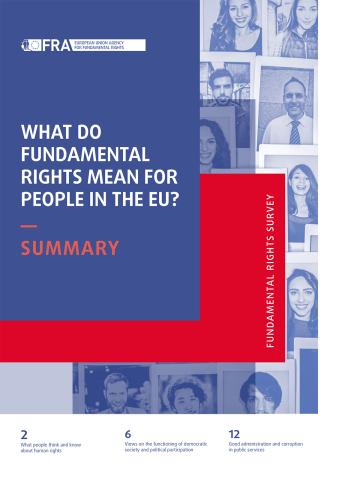
    The EU is founded on the values of democracy, rule of law and respect for human rights. Yet these values, and discussions on fundamental rights at the EU and Member State level, can seem remote in people’s daily lives. With this in mind, FRA explored what people understand, know and experience with respect to their fundamental rights in practice. The resulting data provide comprehensive and comparable evidence on these aspects.
  • Report / Paper / Summary
    24
    June
    2020
    Summary version now available
    07 December 2020
    FRA’s Fundamental Rights Survey collected data from 35,000 people about their experiences, perceptions and opinions on a range of issues that are variously encompassed by human rights. This report presents a small selection of the survey results. It focuses on findings with respect to respondents’ opinions about human – or fundamental rights; their views and perceptions on the functioning of democratic societies – as a pillar on which human rights can flourish; and on their thoughts on and engagement with public services that have a duty to enforce human rights law and to protect people’s rights.
  • Handbook / Guide / Manual
    13
    June
    2019
    New language versions: FI, MT, PT, CS, LV, LT, SK, SL, SV, ET
    03 November 2020
    Children deprived of parental care found in another EU Member State other than their own aims to strengthen the response of all relevant actors for child protection. The protection of those girls and boys is paramount and an obligation for EU Member States, derived from the international and European legal framework. The guide includes a focus on child victims of trafficking and children at risk, implementing an action set forth in the 2017 Communication stepping up EU action against trafficking in human beings, and takes into account identified patterns, including with respect to the gender specificity of the crime.
  • Report / Paper / Summary
    6
    September
    2023
    Integration and social inclusion are important aspects of EU migration and asylum policy. The fundamental rights of long-term residents in the EU are explored through this report, focussing on the Long-Term Residence Directive. EU long-term resident status includes rights to move and reside in other EU Member States. This report examines the reasons behind the low uptake of EU long-term resident permits, despite them typically giving more rights than national long-term resident permits.
  • Report / Paper / Summary
    28
    September
    2022
    Acts of terrorism represent a serious threat to the lives and safety of people, and a profound security challenge for states. At the same time, counter-terrorism legislation, policies and other measures can entail, directly or indirectly, serious limitations to fundamental rights, and can adversely affect individuals, groups and society as a whole. This summary presents FRA’s main findings from its report on Directive (EU) 2017/541 on combating terrorism, the main criminal law instrument at EU level in the field of counter-terrorism.
  • Fundamental Rights Report
    8
    June
    2022
    FRA’s Fundamental Rights Report 2022 reviews major developments in the field in 2021, identifying both achievements and areas of concern. It also presents FRA’s opinions on these developments, including a synopsis of the evidence supporting these opinions.
  • Report / Paper / Summary
    18
    November
    2021
    This report examines the EU’s main criminal law instrument in the field of counter-terrorism, Directive (EU) 2017/541. Specifically, it considers how the directive engages issues of fundamental rights, affecting individuals, groups and society as a whole.
  • Fundamental Rights Report
    10
    June
    2021
    FRA’s Fundamental Rights Report 2021 reviews major developments in the field in 2020, identifying both achievements and areas of concern. It also presents FRA’s opinions on these developments, including a synopsis of the evidence supporting these opinions. This year’s focus chapter explores the impact of the COVID-19 pandemic on fundamental rights. The remaining chapters cover: the EU Charter of Fundamental Rights; equality and non-discrimination; racism, xenophobia and related intolerance; Roma equality and inclusion; asylum, borders and migration; information society, privacy and data protection; rights of the child; access to justice; and the implementation of the Convention on the Rights of Persons with Disabilities.
  • Fundamental Rights Report
    10
    June
    2021
    This focus looks at COVID-19’s impact on fundamental rights. It underscores that a human rights-based approach to tackling the pandemic requires balanced measures that are based on law, necessary, temporary and proportional. It also requires addressing the pandemic’s socio-economic impact, protecting the vulnerable and fighting racism.
  • Periodic updates / Series
    30
    November
    2020
    This report outlines some of the measures EU Member States have put in place to protect public health as Europe faces the ‘second wave’ of the Coronavirus pandemic. It highlights how these may affect fundamental rights, especially social rights.