eu-charter

EU Charter of Fundamental Rights

The peoples of Europe, in creating an ever closer union among them, are resolved to share a peaceful future based on common values.

Conscious of its spiritual and moral heritage, the Union is founded on the indivisible, universal values of human dignity, freedom, equality and solidarity; it is based on the principles of democracy and the rule of law. It places the individual at the heart of its activities, by establishing the citizenship of the Union and by creating an area of freedom, security and justice.

The Union contributes to the preservation and to the development of these common values while respecting the diversity of the cultures and traditions of the peoples of Europe as well as the national identities of the Member States and the organisation of their public authorities at national, regional and local levels; it seeks to promote balanced and sustainable development and ensures free movement of persons, services, goods and capital, and the freedom of establishment.

To this end, it is necessary to strengthen the protection of fundamental rights in the light of changes in society, social progress and scientific and technological developments by making those rights more visible in a Charter.

This Charter reaffirms, with due regard for the powers and tasks of the Union and for the principle of subsidiarity, the rights as they result, in particular, from the constitutional traditions and international obligations common to the Member States, the European Convention for the Protection of Human Rights and Fundamental Freedoms, the Social Charters adopted by the Union and by the Council of Europe and the case-law of the Court of Justice of the European Communities and of the European Court of Human Rights. In this context the Charter will be interpreted by the courts of the Union and the Member States with due regard to the explanations prepared under the authority of the Praesidium of the Convention which drafted the Charter and updated under the responsibility of the Praesidium of the European Convention.

Enjoyment of these rights entails responsibilities and duties with regard to other persons, to the human community and to future generations.

The Union therefore recognises the rights, freedoms and principles set out hereafter.


Explanations

  • Text:
    Source:
    Preamble - Explanations relating to the Charter of Fundamental Rights:

Case Law References

0 results found

National Constitutional Law

0 results found

EU Law

0 results found

International Law

0 results found

Publications and data

  • Fundamental Rights Report
    11
    June
    2020
    Now available in Macedonian and Serbian
    13 November 2020
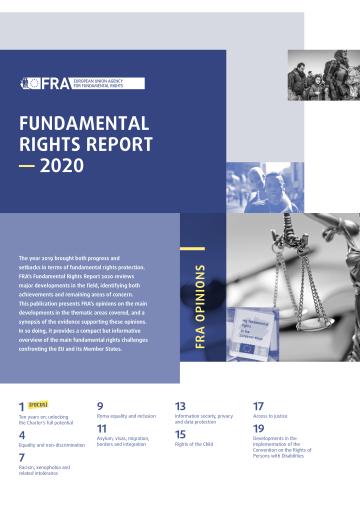
    The year 2019 brought both progress and setbacks in terms of fundamental rights protection. FRA’s Fundamental Rights Report 2020 reviews major developments in the field, identifying both achievements and remaining areas of concern. This publication presents FRA’s opinions on the main developments in the thematic areas covered, and a synopsis of the evidence supporting these opinions. In so doing, it provides a compact but informative overview of the main fundamental rights challenges confronting the EU and its Member States.
  • Handbook / Guide / Manual
    13
    June
    2019
    New language versions: FI, MT, PT, CS, LV, LT, SK, SL, SV, ET
    03 November 2020
    Children deprived of parental care found in another EU Member State other than their own aims to strengthen the response of all relevant actors for child protection. The protection of those girls and boys is paramount and an obligation for EU Member States, derived from the international and European legal framework. The guide includes a focus on child victims of trafficking and children at risk, implementing an action set forth in the 2017 Communication stepping up EU action against trafficking in human beings, and takes into account identified patterns, including with respect to the gender specificity of the crime.
  • Report / Paper / Summary
    27
    March
    2020
    French version now available
    24 April 2020
    Council of Europe (CoE) and European Union (EU) Member States have an undeniable sovereign right to control the entry of non-nationals into their territory. While exercising border control, states have a duty to protect the fundamental rights of all people under their jurisdiction, regardless of their nationality and/or legal status. Under EU law, this includes providing access to asylum procedures.
  • Leaflet / Flyer
    20
    November
    2019
    French and German versions now available
    21 April 2020
    Child rights come first. Measures to ensure child protection and participation apply to all children in the EU. This brochure guides you to relevant FRA reports and tools that can support you when promoting and protecting the rights of all children in the EU.
  • Fundamental Rights Report
    6
    June
    2018
    Finnish version now available
    27 January 2020
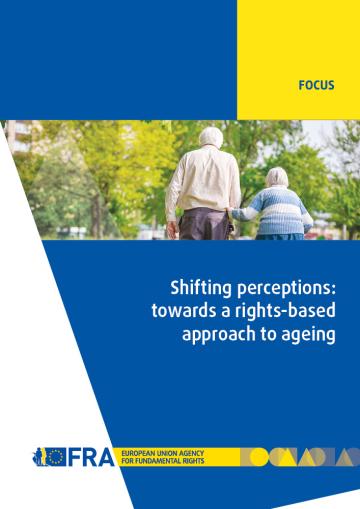
    European societies are not getting any younger! It is a simple truth we must face both about ourselves and Europe as a whole. In two generations, by 2080, those aged 65 or above will account for almost 30% of the European Union’s population.
  • Report / Paper / Summary
    18
    August
    2026
    The Roma Survey 2024 and its predecessors describe discrimination and bias-motivated harassment and violence experienced by Roma and Travellers across Europe. The Survey provides data which policy makers can use to address these high-priority agenda issues and most importantly assess progress over time as regards equality and non-discrimination in key areas of life. This technical report provides a detailed overview of the survey methodology used by FRA when collecting the survey data.
  • Periodic updates / Series
    28
    July
    2026
    The EU Agency for Fundamental Rights regularly collects data on the operations of NGO vessels involved in search and rescue in the Mediterranean. This includes any legal proceedings against them, as well as any difficulties in disembarking migrants in safe ports. This paper provides an overview of criminal investigations and other legal proceedings initiated by European Union Member States against civil society organisations deploying search and rescue vessels and aircraft in the Mediterranean and/or against crew members. The latest update covers the period from 2018 up until 30 June 2026.
  • Periodic updates / Series
    21
    July
    2026
    This is the second bulletin in FRA’s new quarterly series monitoring the situation of migrants, asylum seekers and refugees. It covers key developments and ongoing concerns from 1 April to 30 June 2026.

    Following regular reporting on fundamental rights issues related to migration and asylum from 2015 to 2023, FRA resumed the series in 2026 under the EU's 2024 Asylum and Migration Management Regulation, ahead of the June 2026 implementation of the EU Migration and Asylum Pact. The first bulletin, published in April 2026, covered developments from 1 January 2025 to 31 March 2026.
  • Easy-to-read report
    7
    July
    2026
    This report talks about the situation of people with disabilities who live in institutions. Institutions are places where people with disabilities often live away from other people. Our report is based on a study we made in 30 countries in Europe. This text is a short version of the report in easy language.
    FRA
  • In brief / Factsheet
    30
    June
    2026
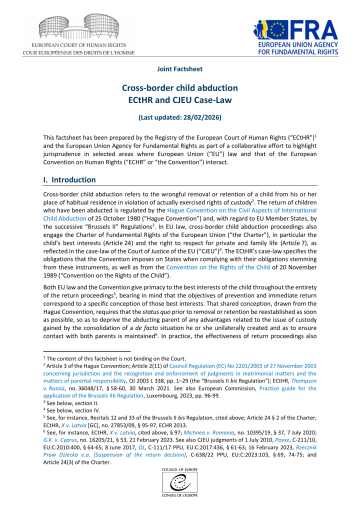
    This factsheet examines case law on cross-border child abduction, meaning the unlawful removal of a child from one EU Member State to another. Jointly published by the European Court of Human Rights and the EU Agency for Fundamental Rights, it explains how courts handle issues where EU law and human rights law overlap. It highlights key court decisions from the Court of Justice of the European Union (CJEU) and the European Court of Human Rights (ECtHR) to show how these two legal systems work together on issues of child abduction and prioritising the best interests of the child.