• Periodic updates / Series
    19
    December
    2025
    The EU Agency for Fundamental Rights (FRA) publishes annual updates on the forced return monitoring systems set up by EU Member States under Article 8(6) of the EU Return Directive (2008/115/EC). This project has been ongoing since 2014.
    The latest report covers the period until the end of 2024.
  • Video
  • In brief / Factsheet
    15
    December
    2025
    This factsheet outlines key judgments of the Court of Justice of the European Union (CJEU) and the European Court of Human Rights (ECtHR) relating to the intersection of climate change and human rights. The issues examined include territorial jurisdiction, standards of protection, standing and victim status, and procedural guarantees in climate-related cases, including the rights of access to information. It is intended to assist legal practitioners, policymakers, and researchers in understanding and applying the evolving human rights jurisprudence in the context of climate change within the European legal space.
  • Report / Paper / Summary
    12
    December
    2025
    As the EU prepares to join the European Convention on Human Rights (ECHR), this report outlines the main changes that accession would bring, offering an overview of the legal and operational implications. Presented in a Q&A format, it provides answers to 19 key questions for legal professionals and a broader audience. It describes the steps needed to conclude accession, the expected benefits for protecting rights, and some of the challenges that may come up. This legal analysis contributes to the current discussions on EU accession.
  • Report / Paper / Summary
    8
    December
    2025
    This report examines how human rights impact assessments (HRIAs) are built into lawmaking across the EU and its Member States. It highlights that, although progress has been made, the use of HRIAs remains uneven and often superficial. In many EU countries, the EU Charter of Fundamental Rights is frequently overlooked. The report identifies insufficient consultation with external experts, limited stakeholder participation and a lack of evaluation once laws are in force. To address these gaps, it offers practical recommendations for more systematic, inclusive and evidence-based HRIAs that strengthen human rights protection and ensure better, more accountable legislation throughout the EU.

  • Report / Paper / Summary
    4
    December
    2025
    Artificial Intelligence comes with both benefits and risks. Safe AI use that accounts for fundamental rights is thus crucial. While the 2024 EU AI Act was a milestone in this regard, its broad definitions regarding AI systems and high-risk AI could introduce loopholes for fundamental rights compliance. This report offers an empirical basis for much-needed practical guidance on the Act’s implementation. Based on interviews with AI developers, sellers, and users, FRA addresses challenges of its use in critical domains, like asylum, education, and employment. Our findings help guide next steps in realising the AI Act’s potential to ensure responsible innovation.
  • Report / Paper / Summary
    27
    November
    2025
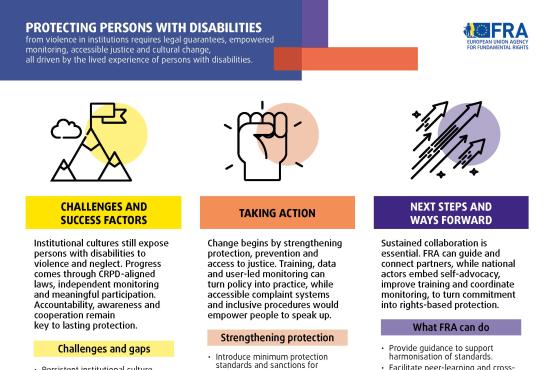
    This report looks at the breadth and depth of violence and neglect faced by people with disabilities living in institutions. It highlights the shortcomings by EU Member States in preventing violence and protecting those who are at a higher risk of experiencing it, in line with the UN Convention on the Rights of Persons with Disabilities. Based on research across all EU Member States and FRA observer candidate countries, the report calls for better protection, stronger prevention of violence, and clear accountability. It urges the EU and its Member States to implement their obligations around equality and fundamental rights.
  • Report / Paper / Summary
    13
    November
    2025
    FRA analysed 31 digital tools and systems across seven EU Member States, exploring potential positive and negative effects on victims, claimants and defendants. By identifying risks early, investing in skills and training, and embedding protections from the outset, policymakers and practitioners can build effective and inclusive justice systems. This report provides practical suggestions to help ensure that digitalised justice systems are accessible and deliver fair outcomes for all.
  • In brief / Factsheet
    30
    October
    2025
    This factsheet summarises key Court of Justice of the European Union (CJEU) and European Court of Human Rights (ECtHR) cases on reasonable accommodation for persons with disabilities. Building on Article 2 of the United Nations Convention on the Rights of Persons with Disabilities (UNCRPD), the courts address employment, physical accessibility, and education. In collaboration, the EU Agency for Fundamental Rights and the European Court of Human Rights produced this short publication. It is designed to aid lawyers and policymakers in understanding and applying the jurisprudence in this area.
  • Handbook / Guide / Manual
    10
    October
    2025
    Labour inspectors are essential for enforcing workers’ rights and for detecting and addressing labour exploitation. Together, the European Labour Authority (ELA) and the European Union Agency for Fundamental Rights (FRA) have developed a guide for workplace inspectors on how to detect labour exploitation. This guide is a practical tool for labour inspectors. It focuses on non-national workers in the EU who work in a country other than their own. Such workers are particularly vulnerable to labour exploitation. The guide is also accompanied by a leaflet that summarises the detailed information provided in this guide.
  • Handbook / Guide / Manual
    8
    October
    2025
    The Entry/Exit System (EES), launching in 2025, will register non-EU nationals crossing the EU’s external borders. This FRA guidance supports managers overseeing the operation of the new system. It helps them to ensure compliance with EU fundamental rights. It outlines operational considerations: clear communication, dignified biometric data collection and data protection. It also addresses staff training needs. Based on fieldwork at 10 border crossing points in 6 Member States, the guidance will ensure rights are respected under the new system. A separate guidance publication for border guards accompanies this publication.
  • Handbook / Guide / Manual
    8
    October
    2025
    System EES (Entry/Exit System), który ruszy w 2025 roku, będzie rejestrował obywateli państw trzecich przekraczających zewnętrzne granice UE. Niniejsze wytyczne FRA mają wesprzeć kadrę zarządzającą odpowiedzialną za funkcjonowanie nowego systemu. Mają pomóc im zapewnić zgodność z unijną ochroną praw podstawowych. Przedstawiają kwestie operacyjne, takie jak jasna komunikacja, godne pobieranie danych biometrycznych oraz ochrona danych. Obejmują także potrzeby szkoleniowe personelu. Na podstawie badań terenowych przeprowadzonych w 10 przejściach granicznych w 6 państwach członkowskich, wytyczne te mają zagwarantować poszanowanie praw podstawowych w ramach nowego systemu. Oddzielna publikacja z wytycznymi dla funkcjonariuszy straży granicznej towarzyszy temu dokumentowi.
  • Handbook / Guide / Manual
    8
    October
    2025
    The Entry/Exit System (EES), launching in 2025, will register non-EU nationals crossing the EU’s external borders. This FRA guidance helps border guards apply the new rules in line with EU fundamental rights. It offers practical tips on informing people, collecting biometric data and supporting people with specific needs. Based on fieldwork at 10 border crossing points in 6 Member States, the guidance will ensure rights are respected under the new system. A separate guidance publication for managers accompanies this publication.
  • Handbook / Guide / Manual
    8
    October
    2025
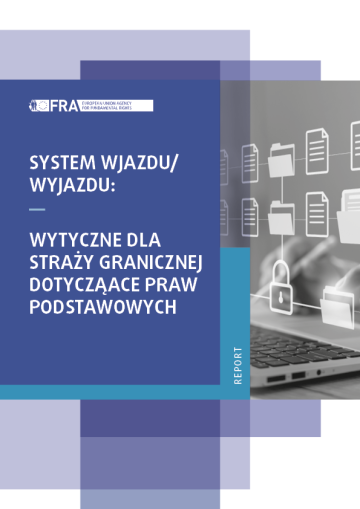
    System EES (Entry/Exit System), który ruszy w 2025 roku, będzie rejestrował obywateli państw trzecich przekraczających zewnętrzne granice UE. Niniejsze wytyczne FRA mają pomóc funkcjonariuszom straży granicznej stosować nowe przepisy zgodnie z unijną ochroną praw podstawowych. Oferują praktyczne wskazówki dotyczące informowania podróżnych, pobierania danych biometrycznych oraz wspierania osób o szczególnych potrzebach. Na podstawie badań terenowych przeprowadzonych w 10 przejściach granicznych w 6 państwach członkowskich, wytyczne te mają zagwarantować poszanowanie praw podstawowych w ramach nowego systemu. Oddzielna publikacja z wytycznymi dla kadry zarządzającej towarzyszy temu dokumentowi.
  • Report / Paper / Summary
    2
    October
    2025
    This report examines the fundamental rights and living conditions of Roma and Travellers across 10 EU Member States and
    3 accession countries. The survey evaluates progress towards the EU Roma strategic framework’s 2030 objectives, covering areas such as discrimination, poverty, education, employment, health, and housing.