Asylum

Asylum, migration and borders

The increase in migration has presented opportunities and challenges across Europe. FRA encourages rights-compliant responses.

We provide practical expertise on this complex issue. This includes regular updates, focus papers and toolkits. We also outline policy alternatives and best practices.

    Publications and Data

    Publications and Data

    Displaying results 131 - 140 of 234
    In brief / Factsheet
    6
    September
    2018
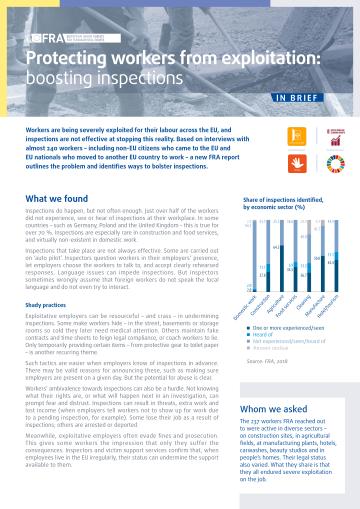
    Workers are being severely exploited for their labour across the EU, and
    inspections are not effective at stopping this reality. Based on interviews with
    almost 240 workers – including non-EU citizens who came to the EU and
    EU nationals who moved to another EU country to work – a new FRA report
    outlines the problem and identifies ways to bolster inspections.
    Periodic updates / Series
    23
    July
    2018
    The EU Agency for Fundamental Rights has been collecting relevant data since September 2015, in light of the increasing numbers of refugees, asylum seekers and migrants entering the EU. This report focuses on the fundamental rights situation of people arriving in Member States particularly affected by large migration movements. The countries covered are: Austria, Bulgaria, Croatia, Denmark, Finland, France, Germany, Greece, Hungary, Italy, the Netherlands, Poland, Spain and Sweden.
    Report / Paper / Summary
    21
    June
    2018
    The EU Return Directive (2008/115/EC) in Article 8 (6) introduced an important fundamental rights safeguard for third-country nationals ordered to leave the EU because they do not or no longer fulfil the conditions for entry and/or stay. According to the Directive, Member States must provide for an effective forced-return monitoring system.
    Report / Paper / Summary
    15
    June
    2018
    The stories of the domestic workers FRA interviewed for this paper reveal appalling working conditions and fundamental rights abuses in private homes across the EU. These stories indicate that, seven years on from FRA’s first report on domestic workers in 2011, little has changed in terms of the risks and experiences of severe labour exploitation domestic workers in the EU face.
    Fundamental Rights Report
    6
    June
    2018
    The year 2017 brought both progress and setbacks in terms of rights protection. The European Pillar of Social Rights marked an important move towards a more ‘social Europe’. But, as experiences with the EU Charter of Fundamental Rights underscore, agreement on a text is merely a first step. Even in its eighth year as the EU's binding bill of rights, the Charter's potential was not fully exploited, highlighting the need to more actively promote its use.
    Fundamental Rights Report
    6
    June
    2018
    The year 2017 brought both progress and setbacks in terms of fundamental rights protection. FRA’s Fundamental Rights Report 2018 reviews major developments in the field, identifying both achievements and remaining areas of concern.
    Periodic updates / Series
    28
    May
    2018
    In view of the increasing numbers of refugees, asylum seekers and migrants entering the EU, the EU Agency for Fundamental Rights has been collecting relevant data since September 2015. This report focuses on the fundamental rights situation of people arriving in Member States particularly affected by large migration movements. This report addresses fundamental rights concerns between 1 March-30 April 2018.
    Report / Paper / Summary
    17
    May
    2018
    Civil society organisations in the European Union play a crucial role in promoting fundamental
    rights, but it has become harder for them do so – due to both legal and practical restrictions.
    This summary outlines the main
    findings and FRA’s opinions on the different
    types and patterns of challenges faced by civil society
    organisations across the EU,
    Report / Paper / Summary
    25
    April
    2018
    The methods used to determine the age of
    an applicant may include “invasive” medical tests which interfere with the rights of the child, including their right to dignity,
    integrity and privacy. It is often a challenge to find the right balance between protecting children from harm and promoting
    their participation in these procedures. This report provides important insights and identifies the implications of collecting
    children’s biometric data and conducting age assessments.
    Opinion / Position Paper
    19
    April
    2018
    This Opinion by the European Union Agency for Fundamental Rights (FRA) aims to inform the European Parliament position concerning legislative proposals on interoperability between EU information technology systems (IT systems) presented on 12 December 2017 and currently discussed by the EU legislators.