eu-charter

Az Európai Unió Alapjogi Chartája

14. cikk - Az oktatáshoz való jog

14. cikk - Az oktatáshoz való jog

(1) Mindenkinek joga van az oktatáshoz, valamint a szakképzésben és a továbbképzésben való részvételhez.
(2) Ez a jog magában foglalja a kötelező oktatásban való ingyenes részvétel lehetőségét.
(3) Az oktatási intézmények demokratikus elvek figyelembevételével történő alapításának szabadságát, valamint a szülők azon jogát, hogy gyermekeik számára vallási, világnézeti vagy pedagógiai meggyőződésüknek megfelelő nevelést biztosítsanak, tiszteletben kell tartani az e jogok és szabadságok gyakorlását szabályozó nemzeti törvényekkel összhangban.

Magyarázatok

  • Text:

    1. E cikk a tagállamok közös alkotmányos hagyományain, valamint az EJEE kiegészítő jegyzőkönyvének 2. cikkén alapul, amelynek szövege a következő:
    `Senkitől sem szabad megtagadni az oktatáshoz való jogot. Az állam az oktatás és tanítás terén vállalt feladatkörök gyakorlása során köteles tiszteletben tartani a szülők vallási és világnézeti meggyőződésével összhangban lévő oktatáshoz és tanításhoz való jogot.`
    Célszerűnek tűnt e cikk hatályát a szakképzésben és a továbbképzésben való részvételre is kiterjeszteni (lásd a munkavállalók alapvető szociális jogairól szóló közösségi charta 15. pontját és a Szociális Charta 10. cikkét), valamint az ingyenes kötelező oktatás elvét is belefoglalni. A megfogalmazás szerint ez utóbbi elv csupán azt foglalja magában, hogy a kötelező oktatás tekintetében minden gyermeknek joga van olyan intézménybe járni, amely ingyenes oktatást biztosít. Nem írja elő azonban, hogy valamennyi oktatást, szakképzést és továbbképzést biztosító intézmény, különösen egy magánintézmény, ingyenes legyen. Nem tiltja azt sem, hogy egyes sajátos oktatási formákért fizetni kelljen, amennyiben az állam megteszi a szükséges intézkedéseket a pénzügyi kompenzáció biztosítása érdekében. Annyiban, amennyiben a Charta alkalmazandó az Unióra, ez azt jelenti, hogy az Uniónak a képzési politikájában tiszteletben kell tartania a kötelező oktatás ingyenességét, ugyanakkor új hatásköröket természetesen nem teremt. Ami a szülők jogát illeti, azt a 24. cikk rendelkezéseivel összefüggésben kell értelmezni.
    2. A magán- vagy közoktatási intézmény alapításának joga a vállalkozás szabadságának egyik formájaként biztosított, azonban kizárólag a demokratikus elvek tiszteletben tartásának korlátai és a nemzeti jogszabályok által meghatározott rendelkezések keretei között gyakorolható.

    Source:
    Az Európai Unió Hivatalos Lapja C 303/17 - 14.12.2007
    Preamble - Explanations relating to the Charter of Fundamental Rights:
    Az alábbi magyarázatok eredetileg az Európai Unió Alapjogi Chartáját kidolgozó Konvent elnökségének irányításával kerültek megfogalmazásra. A magyarázatok naprakésszé tétele az Európai Konvent elnökségének felelőssége mellett, az elnökségnek a Charta szövegéhez (nevezetesen az 51. és 52. cikkéhez) tett kiigazításainak megfogalmazása, valamint az uniós jog további fejlődése fényében történt. Bár a magyarázatok nem bírnak jogi erővel, az értelmezés értékes eszközei, amelyek célja a Charta rendelkezéseinek megvilágítása.

Esetjog

Nemzeti alkotmányjog

48 results found

  • Constitution of the Italian Republic
    Ország:
    Italy

    Art. 30. It is the duty and right of parents to support, raise and educate their children, even if born out of wedlock. Art. 33. The Republic guarantees the freedom of the arts and sciences, which may be freely taught. The Republic lays down general rules for education and establishes state schools of all branches and grades. Entities and private persons have the right to establish schools and institutions of education, at no cost to the State. The law, when setting out the rights and obligations for the non-state
    schools which request parity, shall ensure that these schools enjoy full liberty and offer their pupils an education and qualifications of the same standards as those afforded to pupils in state schools. State examinations are prescribed for admission to and graduation from the various branches and grades of schools and for qualification to exercise a profession. Art. 34. Schools are open to everyone. Primary education, given for at least eight years, is compulsory and free of tuition. Capable and deserving pupils, including those lacking financial resources, have the right to attain the highest levels of education. The Republic renders this right effective through scholarships, allowances
    to families and other benefits, which shall be assigned through competitive examinations.

  • Sweden / Instrument of Government
    Ország:
    Sweden

    Chapter 1 - Basic Principles of the form of government:

    Article 2 The personal, economic and cultural welfare of the individual shall be fundamental aims of public activity. In particular, the public institutions shall secure the right to employment, housing and education, and shall promote social care and social security, as well as favourable conditions for good health. (...)

    Chapter 2 - Fundamental Rights and Freedoms:

    Article 18 All children covered by compulsory schooling shall be entitled to a free basic education in the public education system. The public institutions shall be responsible also for the provision of higher education. The freedom of research is protected according to rules laid down in law.

  • 1. Zusatzprotokoll zur Konvention zum Schutze der Menschenrechte und Grundfreiheiten
    Ország:
    Austria

    Artikel 2 Das Recht auf Bildung darf niemandem verwehrt werden. Der Staat hat bei Ausübung der von ihm auf dem Gebiete der Erziehung und des Unterrichts übernommenen Aufgaben das Recht der Eltern zu achten, die Erziehung und den Unterricht entsprechend ihren eigenen religiösen und weltanschaulichen Überzeugungen sicherzustellen.

  • 1st Additional Protocol to the The European Convention on Human Rights (ECHR)
    Ország:
    Austria

    Article 2 No person shall be denied the right to education. In the exercise of any functions which it assumes in relation to education and to teaching, the State shall respect the right of parents to ensure such education and teaching in conformity with their own religious and philosophical convictions.

  • Basic Law for the Federal Republic of Germany
    Ország:
    Germany

    Article 6 (...) (2) The care and upbringing of children is the natural right of parents and a duty primarily incumbent upon them. The state shall watch over them in the performance of this duty. (...) Article 7 (1) The entire school system shall be under the supervision of the state. (2) Parents and guardians shall have the right to decide whether children shall receive religious instruction. (3) Religious instruction shall form part of the regular curriculum in state schools, with the exception of non-denominational schools. Without prejudice to the state’s right of supervision, religious instruction shall be given in accordance with the tenets of the religious community concerned. Teachers may not be obliged against their will to give religious instruction. (4) The right to establish private schools shall be guaranteed. Private schools that serve as alternatives to state schools shall require the approval of the state and shall be subject to the laws of the Länder. Such approval shall be given when private schools are not inferior to the state schools in terms of their educational aims, their facilities, or the professional training of their teaching staff, and when segregation of pupils according to the means of their parents will not be encouraged thereby. Approval shall be withheld if the economic and legal position of the teaching staff is not adequately assured. (5) A private elementary school shall be approved only if the educational authority finds that it serves a special pedagogical interest or if, on the application of parents or guardians, it is to be established as a denominational or interdenominational school or as a school based on a particular philosophy and no state elementary school of that type exists in the municipality. (6) Preparatory schools shall remain abolished.

  • Constitution of Finland
    Ország:
    Finland

    Section 16 Educational rights Everyone has the right to basic education free of charge. Provisions on the duty to receive education are laid down by an Act. The public authorities shall, as provided in more detail by an Act, guarantee for everyone equal opportunity to receive other educational services in accordance with their ability and special needs, as well as the opportunity to develop themselves without being prevented by economic hardship. The freedom of science, the arts and higher education is guaranteed.

  • Constitution of Ireland
    Ország:
    Ireland

    Article 42.1. The State acknowledges that the primary and natural educator of the child is the Family and guarantees to respect theinalienable right and duty of parents to provide, according to their means, for the religious and moral, intellectual, physical and social education of their children. Article 42.2. Parents shall be free to provide this education in their homes or in private schools or in schools recognized or established by the State. Article 42.3.1. The State shall not oblige parents in violation of their conscience and lawful preference to send their children to schools established by the State, or to any particular type of school designated by the State. Article 42.3.2. The State shall, however, as guardian of the common good, require in view of actual conditions that the children receive a certain minimum education. moral. intellectual and social. Article 42.4. The State shall provide for free primary education and shall endeavor to supplement and give reasonable aid to private and corporate educational initiative, and, when the public good requires it, provide other educational facilities or institutions with due regard, however, for the rights of parents, especially in the matter of religious and moral formation .

  • Constitution of Malta
    Ország:
    Malta

    Article 11(1) Capable and deserving students, even if without financial resources, are entitled to attain the highest grades of education.(2) The State shall give effect to this principle by means of scholarships, of contributions to the families of students and other provisions on the basis of competitive examinations.Article 12(1) The State shall protect work.(2) It shall provide for the professional or vocational training and advancement of workers.Article 17 (...) (3) Disabled persons and persons incapable of work are entitled to education and vocational training.

  • Constitution of the Hellenic Republic
    Ország:
    Greece

    Article 16 (1). Art and science, research and teaching shall be free and their development and promotion shall be an obligation of the State. Academic freedom and freedom of teaching shall not exempt anyone from his duty of allegiance to the Constitution. (2). Education constitutes a basic mission for the State and shall aim at the moral, intellectual, professional and physical training of Greeks, the development of national and religious consciousness and at their formation as free and responsible citizens. (3). The number of years of compulsory education shall be no less than nine. (4). All Greeks are entitled to free education on all levels at State educational institutions. The State shall provide financial assistance to those who distinguish themselves, as well as to students in need of assistance or special protection, in accordance with their abilities. (5). Education at university level shall be provided exclusively by institutions which are fully self-governed public law legal persons. These institutions shall operate under the supervision of the State and are entitled to financial assistance from it; they shall operate on the basis of statutorily enacted by-laws. Merging or splitting of university level institutions may take place notwithstanding any contrary provisions, as a law shall provide. A special law shall define all matters pertaining to student associations and the participation of students therein. (6). Professors of university level institutions shall be public functionaries. The remaining teaching personnel likewise perform a public function, under the conditions specified by law. The statutes of respective institutions shall define matters relating to the status of all the above. Professors of university level institutions shall not be dismissed prior to the lawful termination of their term of service, except in the cases of the substantive conditions provided by article 88 paragraph 4 and following a decision by a council constituted in its majority of highest judicial functionaries, as specified by law. The retirement age of professors of university level institutions shall be determined by law; until such law is issued, professors on active service shall retire ipso jure at the end of the academic year at which they have reached the age of sixty-seven. (7). Professional and any other form of special education shall be provided by the State, through schools of a higher level and for a time period not exceeding three years, as specifically provided by law which also defines the professional rights of the graduates of such schools. (8). The conditions and terms for granting a license for the establishment and operation of schools not owned by the State, the supervisionof such and the professional status of teaching personnel therein shall be specified by law. The establishment of university level institutions by private persons is prohibited. [...]

  • Constitution of the Republic of Bulgaria
    Ország:
    Bulgaria

    Art. 23. The State shall establish conditions conducive to the free development of science, education and the arts, and shall assist that development. It shall organize the conservation of all national monuments of history and culture.Art. 53. (1) Everyone shall have the right to education.(2) School attendance up to the age of 16 shall be compulsory.(3) Primary and secondary education in state and municipal schools shall be free. In circumstances established by law, the higher educational establishments shall provide education free of charge.(4) Higher educational establishments shall enjoy academic autonomy.(5) Citizens and organizations shall be free to found schools in accordance with conditions and procedures established by law. The education they provide shall fit the requirements of the State.(6) The State shall promote education by opening and financing schools, by supporting capable school and university students, and by providing opportunities for occupational training and retraining. It shall exercise control over all kinds and levels of schooling.

  • Constitution of the Republic of Croatia
    Ország:
    Croatia

    Article 66
    In the Republic of Croatia, everyone shall have access to education under equal conditions and in accordance with his/her aptitudes.
    Compulsory education shall be free, in conformity with law.

    Article 67
    Subject to the conditions specified by law, the establishment of private schools and learning institutions shall be permitted.

    Article 68
    The autonomy of universities shall be guaranteed.
    Universities shall independently decide on their organisation and operation, in compliance with law.

  • Constitution of the Republic of Estonia
    Ország:
    Estonia

    Article 37. Everyone has the right to education. Education for school-age children is compulsory to the extent specified by the law, and is free of charge in general schools established by the national government and by local authorities.
    In order to make education accessible, the national government and local authorities maintain a requisite number of educational institutions. Other educational institutions, including private schools, may also be established and maintained pursuant to the law.
    Parents have the deciding say in the choice of education for their children.
    Everyone has the right to be taught in Estonian. The language of teaching in national minority educational institutions is chosen by the educational institution.
    The provision of education is overseen by the national government.

  • Constitution of the Republic of Latvia
    Ország:
    Lettland

    112. Everyone has the right to education. The State shall ensure that everyone may acquire primary and secondary education without charge. Primary education shall be compulsory.

  • Constitution of the Republic of Lithuania
    Ország:
    Lithuania

    Article 26. Parents and guardians shall, without restrictions, take care of the religious and moral education of their children and wards according to their own convictions.
    Article 40. State and municipal establishments of teaching and education shall be secular. At the request of parents, they shall provide religious instruction. Non-state establishments of teaching and education may be founded according to the procedure established by law. Schools of higher education shall be granted autonomy. The State shall supervise the activities of establishments of teaching and education.
    Article 41. Education shall be compulsory for persons under the age of 16. Education at state and municipal schools of general education, vocational schools, and schools of further education shall be free of charge. Higher education shall be accessible to everyone according to individual abilities. Citizens who are good at their studies shall be guaranteed education at state schools of higher education free of charge.
    Article 42. Culture, science and research, and teaching shall be free. The State shall support culture and science, and shall take care of the protection of Lithuanian historical, artistic, and other cultural monuments, as well as other culturally valuable objects. The law shall protect and defend the spiritual and material interests of an author that are related to scientific, technical, cultural, and artistic work.

  • Constitution of the Republic of Poland
    Ország:
    Poland

    Article 70.1. Everyone shall have the right to education. Education to 18 years of age shall be compulsory. The manner of fulfilment of schooling obligations shall be specified by statute. 2. Education in public schools shall be without payment. Statutes may allow for payments for certain services provided by public institutions of higher education. 3. Parents shall have the right to choose schools other than public for their children. Citizens and institutions shall have the right to establish primary and secondary schools and institutions of higher education and educational development institutions. The conditions for establishing and operating non-public schools, the participation of public authorities in their financing, as well as the principles of educational supervision of such schools and educational development institutions, shall be specified by statute. 4. Public authorities shall ensure universal and equal access to education for citizens. To this end, they shall establish and support systems for individual financial and organizational assistance to pupils and students. The conditions for providing of such assistance shall be specified by statute. 5. The autonomy of the institutions of higher education shall be ensured in accordance with principles specified by statute.

  • Costituzione della Repubblica Italiana
    Ország:
    Italy

    Art. 30. E' dovere e diritto dei genitori, mantenere, istruire ed educare i figli, anche se nati fuori del matrimonio. Art. 33. L'arte e la scienza sono libere e libero ne è l'insegnamento. La Repubblica detta le norme generali sull’istruzione ed istituisce scuole statali per tutti gli ordini e gradi.Enti e privati hanno il diritto di istituire scuole ed istituti di educazione, senza oneri per lo Stato.La legge, nel fissare i diritti e gli obblighi delle scuole non statali che chiedono la parità, deve assicurare ad esse piena libertà e ai loro alunni un trattamento scolastico equipollente a quello degli alunni di scuole statali.E' prescritto un esame di Stato per la ammissione ai vari ordini e gradi di scuole o per la conclusione di essi e per l'abilitazione all'esercizio professionale. Art. 34. La scuola è aperta a tutti.L'istruzione inferiore, impartita per almeno otto anni, è obbligatoria e gratuita.I capaci e meritevoli, anche se privi di mezzi, hanno diritto di raggiungere i gradi più alti degli studi.La Repubblica rende effettivo questo diritto con borse di studio, assegni alle famiglie ed altre provvidenze, che devono essere attribuite per concorso.

  • Czechia / Charter of Fundamental Rights and Freedoms
    Ország:
    Czechia

    Article 16 (3) The conditions under which religious instruction may be given at state schools shall be set by law. Article 26 (1) Everybody has the right to the free choice of her profession and the training for that profession, as well as the right to engage in enterprise and pursue other economic activity. Article 33 (1) Everyone has the right to education. School attendance shall be obligatory for the period specified by law. (2) Citizens have the right to free elementary and secondary school education, and, depending on particular citizens’ ability and the capability of society, also to university-level education. (3) Private schools may be established and instruction provided there only under conditions set by law; education may be provided at such schools for tuition. (4) The conditions under which citizens have the right to assistance from the state during their studies shall be set by law.

  • Danmarks Riges Grundlov
    Ország:
    Denmark

    § 76. Alle børn i den undervisningspligtige alder har ret til fri undervisning i folkeskolen. Forældre eller værger, der selv sørger for, at børnene får en undervisning, der kan stå mål med, hvad der almindeligvis kræves i folkeskolen, er ikke pligtige at lade børnene undervise i folkeskolen.

  • De Belgische Grondwet
    Ország:
    Belgium

    Artikel 24. §1. Het onderwijs is vrij; elke preventieve maatregel is verboden; de bestraffing van de misdrijven wordt alleen door de wet of het decreet geregeld. De gemeenschap waarborgt de keuzevrijheid van de ouders.De gemeenschap richt neutraal onderwijs in. De neutraliteit houdt onder meer in, de eerbied voor de filosofische, ideologische of godsdienstige opvattingen van de ouders en de leerlingen. De scholen ingericht door openbare besturen bieden, tot het einde van de leerplicht, de keuze aan tussen onderricht in een der erkende godsdiensten en de niet-confessionele zedenleer. §2. Zo een gemeenschap als inrichtende macht bevoegdheden wil opdragen aan een of meer autonome organen, kan dit slechts bij decreet, aangenomen met een meerderheid van twee derden van de uitgebrachte stemmen. §3. Ieder heeft recht op onderwijs, met eerbiediging van de fundamentele rechten en vrijheden. De toegang tot het onderwijs is kosteloos tot het einde van de leerplicht. Alle leerlingen die leerplichtig zijn, hebben ten laste van de gemeenschap recht op een morele of religieuze opvoeding. §4. Alle leerlingen of studenten, ouders, personeelsleden en onderwijsinstellingen zijn gelijk voor de wet of het decreet. De wet en het decreet houden rekening met objectieve verschillen, waaronder de eigen karakteristieken van iedere inrichtende macht, die een aangepaste behandeling verantwoorden. §5. De inrichting, erkenning of subsidiëring van het onderwijs door de gemeenschap wordt geregeld door de wet of het decreet.

  • Education (Welfare) Act 2000
    Ország:
    Ireland

      An act to provide for the entitlement of every child in the state to a certain minimum education, and, for that purpose, to provide for the registration of children receiving education in places other than recognised schools, the compulsory attendance of certain children at recognised schools, the establishment of a body, to be known as the National educational welfare board or, in the irish language, an bord na´ isiu´ nta leasa oideachais, the coordination of its activities and those of certain other persons in so far as they relate to matters connected with school attendance, the identification of the causes of non-attendance on the part of certain students and the adoption of measures for its prevention, to repeal the School Attendance Acts, 1926 to 1967, to permit the supply of data relating to a person’s educational history to certain persons, to provide for the amendment of the Protection of Young Persons (Employment) Act, 1996, and to provide for matters connected therewith.

Uniós jog

5 results found

  • Directive 2011/95 - Standards for the qualification of third-country nationals or stateless persons as beneficiaries of international protection, for a uniform status for refugees or for persons eligible for subsidiary protection, and for the content of t

    Preamble 

    (10) This Directive respects the fundamental rights and observes the principles recognised in particular by the Charter of Fundamental Rights of the European Union. In particular this Directive seeks to ensure full respect for human dignity and the right to asylum of applicants for asylum and their accompanying family members.

    (16) This Directive respects the fundamental rights and observes the principles recognised in particular by the Charter of Fundamental Rights of the European Union.  In particular this Directive seeks to ensure full respect for  human dignity and the right to asylum of applicants for  asylum and their accompanying family members and to  promote the application of Articles 1, 7, 11, 14, 15, 16, 
    18, 21, 24, 34 and 35 of that Charter, and should  therefore be implemented accordingly.


    (34) With regard to social assistance and health care, the modalities and detail of the provision of core benefits to beneficiaries of subsidiary protection status should be determined by national law. The possibility of limiting the benefits for beneficiaries of subsidiary protection status to core benefits is to be understood in the sense that this notion covers at least minimum income support, assistance in case of illness, pregnancy and parental assistance, in so far as they are granted to nationals according to the legislation of the Member State concerned.

    (35) Access to health care, including both physical and mental health care, should be ensured to beneficiaries of refugee or subsidiary protection status.

    Article 2: Definitions
    For the purposes of this Directive the following definitions shall apply:
    (a) ‘international protection’ means refugee status and subsidiary protection status as defined in points (e) and (g);
    (d) ‘refugee’ means a third-country national who, owing to a well-founded fear of being persecuted for reasons of race, religion, nationality, political opinion or membership of a particular social group, is outside the country of nationality and is unable or, owing to such fear, is unwilling to avail himself or herself of the protection of that country, or a stateless person, who, being outside of the country of former habitual residence for the same reasons as mentioned above, is unable or, owing to such fear, unwilling to return to it, and to whom Article 12 does not apply; [...]
    (e) ‘refugee status’ means the recognition by a Member State of a third-country national or a stateless person as a refugee;
    (f) ‘person eligible for subsidiary protection’ means a third-country national or a stateless person who does not qualify as a refugee but in respect of whom substantial grounds have been shown for believing that the person concerned, if returned to his or her country of origin, or in the case of a stateless person, to his or her country of former habitual residence, would face a real risk of suffering serious harm as defined in Article 15, and to whom Article 17(1) and (2) does not apply, and is unable, or, owing to such risk, unwilling to avail himself or herself of the protection of that country;
    (g) ‘subsidiary protection status’ means the recognition by a Member State of a third-country national or a stateless person as a person eligible for subsidiary protection; [...]

    Article 13: Granting of refugee status
    Member States shall grant refugee status to a third-country national or a stateless person who qualifies as a refugee in accordance with Chapters II and III.‘

    Article 18: Granting of subsidiary protection status
    Member States shall grant subsidiary protection status to a third-country national or a stateless person eligible for subsidiary protection in accordance with Chapters II and V.‘

    Article 21: Protection from refoulement

    1.   Member States shall respect the principle of non-refoulement in accordance with their international obligations.

    2.   Where not prohibited by the international obligations mentioned in paragraph 1, Member States may refoule a refugee, whether formally recognised or not, when:

    (a) there are reasonable grounds for considering him or her as a danger to the security of the Member State in which he or she is present; or

    (b) he or she, having been convicted by a final judgement of a particularly serious crime, constitutes a danger to the community of that Member State.

    3.   Member States may revoke, end or refuse to renew or to grant the residence permit of (or to) a refugee to whom paragraph 2 applies.

    Article 22: Information

    Member States shall provide persons recognised as being in need of international protection, as soon as possible after the respective protection status has been granted, with access to information, in a language likely to be understood by them, on the rights and obligations relating to that status.

    Article 23: Maintaining family unity

    1.   Member States shall ensure that family unity can be maintained.

    2.   Member States shall ensure that family members of the beneficiary of refugee or subsidiary protection status, who do not individually qualify for such status, are entitled to claim the benefits referred to in Articles 24 to 34, in accordance with national procedures and as far as it is compatible with the personal legal status of the family member.

    In so far as the family members of beneficiaries of subsidiary protection status are concerned, Member States may define the conditions applicable to such benefits.

    In these cases, Member States shall ensure that any benefits provided guarantee an adequate standard of living.

    3.   Paragraphs 1 and 2 are not applicable where the family member is or would be excluded from refugee or subsidiary protection status pursuant to Chapters III and V.

    4.   Notwithstanding paragraphs 1 and 2, Member States may refuse, reduce or withdraw the benefits referred therein for reasons of national security or public order.

    5.   Member States may decide that this Article also applies to other close relatives who lived together as part of the family at the time of leaving the country of origin, and who were wholly or mainly dependent on the beneficiary of refugee or subsidiary protection status at that time.

    Article 26: Access to employment

    1.   Member States shall authorise beneficiaries of refugee status to engage in employed or self-employed activities subject to rules generally applicable to the profession and to the public service, immediately after the refugee status has been granted.

    2.   Member States shall ensure that activities such as employment-related education opportunities for adults, vocational training and practical workplace experience are offered to beneficiaries of refugee status, under equivalent conditions as nationals.

    3.   Member States shall authorise beneficiaries of subsidiary protection status to engage in employed or self-employed activities subject to rules generally applicable to the profession and to the public service immediately after the subsidiary protection status has been granted. The situation of the labour market in the Member States may be taken into account, including for possible prioritisation of access to employment for a limited period of time to be determined in accordance with national law. Member States shall ensure that the beneficiary of subsidiary protection status has access to a post for which the beneficiary has received an offer in accordance with national rules on prioritisation in the labour market.

    4.   Member States shall ensure that beneficiaries of subsidiary protection status have access to activities such as employment-related education opportunities for adults, vocational training and practical workplace experience, under conditions to be decided by the Member States.

    5.   The law in force in the Member States applicable to remuneration, access to social security systems relating to employed or self-employed activities and other conditions of employment shall apply.

    Article 27: Access to education

    1.   Member States shall grant full access to the education system to all minors granted refugee or subsidiary protection status, under the same conditions as nationals.

    2.   Member States shall allow adults granted refugee or subsidiary protection status access to the general education system, further training or retraining, under the same conditions as third country nationals legally resident.

    3.   Member States shall ensure equal treatment between beneficiaries of refugee or subsidiary protection status and nationals in the context of the existing recognition procedures for foreign diplomas, certificates and other evidence of formal qualifications.

    Article 28: Social welfare

    1.   Member States shall ensure that beneficiaries of refugee or subsidiary protection status receive, in the Member State that has granted such statuses, the necessary social assistance, as provided to nationals of that Member State.

    2.   By exception to the general rule laid down in paragraph 1, Member States may limit social assistance granted to beneficiaries of subsidiary protection status to core benefits which will then be provided at the same levels and under the same eligibility conditions as nationals.

    Article 29: Health care

    1.   Member States shall ensure that beneficiaries of refugee or subsidiary protection status have access to health care under the same eligibility conditions as nationals of the Member State that has granted such statuses.

    2.   By exception to the general rule laid down in paragraph 1, Member States may limit health care granted to beneficiaries of subsidiary protection to core benefits which will then be provided at the same levels and under the same eligibility conditions as nationals.

    3.   Member States shall provide, under the same eligibility conditions as nationals of the Member State that has granted the status, adequate health care to beneficiaries of refugee or subsidiary protection status who have special needs, such as pregnant women, disabled people, persons who have undergone torture, rape or other serious forms of psychological, physical or sexual violence or minors who have been victims of any form of abuse, neglect, exploitation, torture, cruel, inhuman and degrading treatment or who have suffered from armed conflict.

  • Council Recommendation of 22 May 2019 on High-Quality Early Childhood Education and Care Systems

    HEREBY RECOMMENDS THAT MEMBER STATES:

    In accordance with national and European legislation, available resources and national circumstances, and in close cooperation with all relevant stakeholders:

    1. Improve access to high-quality early childhood education and care systems in line with the statements set out in the ‘Quality framework for early childhood education and care’ presented in the Annex to this Recommendation and with the 11th principle of the European Pillar of Social Rights.

    2. Work towards ensuring that early childhood education and care services are accessible, affordable and inclusive. Consideration could be given to:

    (a) supporting child development in a consistent way starting as early as possible by using early childhood education and care services;

    (b) analysing the supply and demand from families in order to better adapt the offer of early childhood education and care services to their needs, respecting parental choice;

    (c) analysing and addressing the barriers that families might encounter when accessing and using early childhood education and care services, such as costs, poverty-related barriers, geographical location, inflexible opening hours, barriers related to inadequate provisions for children with special needs, cultural and linguistic barriers, discrimination as well as a lack of information;

    (d) establishing contact and cooperation with families and especially those in a vulnerable or disadvantaged situation, in order to inform them about the possibilities and benefits of early childhood education and care participation and, where relevant, about available support, and build trust in the services and encourage participation from an early age;

    (e) ensuring that all families who want to make use of early childhood education and care services have access to affordable high-quality early childhood education and care, ideally by working at the appropriate governance level towards a right to an early childhood education and care place of high quality;

    (f) providing inclusive early childhood education and care services for all children, including children with diverse backgrounds and special educational needs, including disabilities, avoiding segregation and incentivising their participation, regardless of the labour market status of their parents or carers;

    (g) supporting all children to learn the language of education while also taking into account and respecting their first language;

    (h) strengthening preventive actions, early identification of difficulties and adequate provisions for children with special needs and their families, involving all relevant actors, e.g. educational, social or health services as well as parents.

    [...]

  • Directive (EU) 2016/800 of the European Parliament and of the Council of 11 May 2016 on procedural safeguards for children who are suspects or accused persons in criminal proceedings

    Preamble

    (31) Member States should be able to derogate temporarily from the obligation to provide assistance by a lawyer in the pre-trial phase for compelling reasons, namely where there is an urgent need to avert serious adverse consequences for the life, liberty or physical integrity of a person, or where immediate action by the investigating authorities is imperative to prevent substantial jeopardy to criminal proceedings in relation to a serious criminal offence, inter alia, with a view to obtaining information concerning the alleged co-perpetrators of a serious criminal offence, or in order to avoid the loss of important evidence regarding a serious criminal offence. During a temporary derogation for one of those compelling reasons, the competent authorities should be able to question children without the lawyer being present, provided that they have been informed of their right to remain silent and can exercise that right, and that such questioning does not prejudice the rights of the defence, including the right not to incriminate oneself. It should be possible to carry out questioning, to the extent necessary, for the sole purpose of obtaining information that is essential to avert serious adverse consequences for the life, liberty or physical integrity of a person, or to prevent substantial jeopardy to criminal proceedings. Any abuse of this temporary derogation would, in principle, irretrievably prejudice the rights of the defence.‘
     

    (33) Confidentiality of communication between children and their lawyer is key to ensuring the effective exercise of the rights of the defence and is an essential part of the right to a fair trial. Member States should therefore respect the confidentiality of meetings and other forms of communication between the lawyer and the child in the context of the assistance by a lawyer provided for in this Directive, without derogation.

    (35) Children who are suspects or accused persons in criminal proceedings should have the right to an individual assessment to identify their specific needs in terms of protection, education, training and social integration, to determine if and to what extent they would need special measures during the criminal proceedings, the extent of their criminal responsibility and the appropriateness of a particular penalty or educative measure.

    Article 3: Definitions
    For the purposes of this Directive the following definitions apply:
    (1) ‘child’ means a person below the age of 18;
    (2) ‘holder of parental responsibility’ means any person having parental responsibility over a child;  [...]
    With regard to point (1) of the first paragraph, where it is uncertain whether a person has reached the age of 18, that person shall be presumed to be a child.


    Article 4: Right to information
    1.   Member States shall ensure that when children are made aware that they are suspects or accused persons in criminal proceedings, they are informed promptly about their rights [...].


    Article 5 - Right of the child to have the holder of parental responsibility informed
    1.   Member States shall ensure that the holder of parental responsibility is provided, as soon as possible, with the information that the child has a right to receive in accordance with Article 4.

    Article 6: Assistance by a lawyer
    2.   Member States shall ensure that children are assisted by a lawyer in accordance with this Article in order to allow them to exercise the rights of the defence effectively.


    Article 10: Limitation of deprivation of liberty
    1.   Member States shall ensure that deprivation of liberty of a child at any stage of the proceedings is limited to the shortest appropriate period of time. Due account shall be taken of the age and individual situation of the child, and of the particular circumstances of the case.
    2.   Member States shall ensure that deprivation of liberty, in particular detention, shall be imposed on children only as a measure of last resort. Member States shall ensure that any detention is based on a reasoned decision, subject to judicial review by a court. Such a decision shall also be subject to periodic review, at reasonable intervals of time, by a court, either ex officio or at the request of the child, of the child's lawyer, or of a judicial authority which is not a court. Without prejudice to judicial independence, Member States shall ensure that decisions to be taken pursuant to this paragraph are taken without undue delay. 
     

    Article 11: Alternative measures
    Member States shall ensure that, where possible, the competent authorities have recourse to measures alternative to detention (alternative measures).
     

    Article 12: Specific treatment in the case of deprivation of liberty
    1.   Member States shall ensure that children who are detained are held separately from adults, unless it is considered to be in the child's best interests not to do so.
    2.   Member States shall also ensure that children who are kept in police custody are held separately from adults, unless:
    (a) it is considered to be in the child's best interests not to do so; or
    (b) in exceptional circumstances, it is not possible in practice to do so, provided that children are held together with adults in a manner that is compatible with the child's best interests.
    3.   Without prejudice to paragraph 1, when a detained child reaches the age of 18, Member States shall provide for the possibility to continue to hold that person separately from other detained adults where warranted, taking into account the circumstances of the person concerned, provided that this is compatible with the best interests of children who are detained with that person.
    4.   Without prejudice to paragraph 1, and taking into account paragraph 3, children may be detained with young adults, unless this is contrary to the child's best interests.
    5.   When children are detained, Member States shall take appropriate measures to:
    (a) ensure and preserve their health and their physical and mental development;
    (b) ensure their right to education and training, including where the children have physical, sensory or learning disabilities;
    (c) ensure the effective and regular exercise of their right to family life;
    (d) ensure access to programmes that foster their development and their reintegration into society; and
    (e) ensure respect for their freedom of religion or belief.
    The measures taken pursuant to this paragraph shall be proportionate and appropriate to the duration of the detention.
    Points (a) and (e) of the first subparagraph shall also apply to situations of deprivation of liberty other than detention. The measures taken shall be proportionate and appropriate to such situations of deprivation of liberty.
    Points (b), (c), and (d) of the first subparagraph shall apply to situations of deprivation of liberty other than detention only to the extent that is appropriate and proportionate in the light of the nature and duration of such situations.
    6.   Member States shall endeavour to ensure that children who are deprived of liberty can meet with the holder of parental responsibility as soon as possible, where such a meeting is compatible with investigative and operational requirements. This paragraph shall be without prejudice to the nomination or designation of another appropriate adult pursuant to Article 5 or 15.
     

  • Directive 2013/33/EU of the European Parliament and of the Council of 26 June 2013 laying down standards for the reception of applicants for international protection (recast)

    [...]

    (35) This Directive respects the fundamental rights and observes the principles recognised in particular by the Charter of Fundamental Rights of the European Union. In particular, this Directive seeks to ensure full respect for human dignity and to promote the application of Articles 1, 4, 6, 7, 18, 21, 24 and 47 of the Charter and has to be implemented accordingly.

    [...]

  • Council of the European Union Recommendation of 9 December 2013 on effective Roma integration measures in the Member States

    ‘Access to education
    1.3. Take effective measures to ensure equal treatment and full access for Roma boys and girls to quality and mainstream education and to ensure that all Roma pupils complete at least compulsory education (6). This goal could be attained by means of measures such as measures:
    (a) eliminating any school segregation;
    (b) putting an end to any inappropriate placement of Roma pupils in special needs schools;
    (c) reducing early school leaving (7) throughout all levels of education, including at secondary level and vocational training;
    (d) increasing the access to, and quality of, early childhood education and care, including targeted support, as necessary;
    (e) considering the needs of individual pupils and addressing those accordingly, in close cooperation with their families;
    (f) using inclusive and tailor-made teaching and learning methods, including learning support for struggling learners and measures to fight illiteracy, and promoting the availability and use of extracurricular activities;
    (g) encouraging greater parental involvement and improving teacher training, where relevant;
    (h) encouraging Roma participation in and completion of secondary and tertiary education;
    (i) widening access to second-chance education and adult learning, and providing support for the transition between educational levels and support for the acquisition of skills that are adapted to the needs of the labour market.‘

Nemzetközi jog

8 results found

  • Committee on Economic, Social and Cultural Rights, General comment No. 13 (1999) on the right to education

    ‘6. While the precise and appropriate application of the terms will depend upon the conditions prevailing in a particular State party, education in all its forms and at all levels shall exhibit the following interrelated and essential features:
    (a) Availability - functioning educational institutions and programmes have to be available in sufficient quantity within the jurisdiction of the State party. What they require to function depends upon numerous factors, including the developmental context within which they operate; for example, all institutions and programmes are likely to require buildings or other protection from the elements, sanitation facilities for both sexes, safe drinking water, trained teachers receiving domestically competitive salaries, teaching materials, and so on; while some will also require facilities such as a library, computer facilities and information technology;
    (b) Accessibility - educational institutions and programmes have to be accessible to everyone, without discrimination, within the jurisdiction of the State party. Accessibility has three overlapping dimensions:
    (i) Non-discrimination - education must be accessible to all, especially the most vulnerable groups, in law and fact, without discrimination on any of the prohibited grounds (see paras. 31-37 on non-discrimination);
    (ii) Physical accessibility - education has to be within safe physical reach, either by attendance at some reasonably convenient geographic location (e.g. a neighbourhood school) or via modern technology (e.g. access to a "distance learning" programme);
    (iii) Economic accessibility - education has to be affordable to all. This dimension of accessibility is subject to the differential wording of article 13 (2) in relation to primary, secondary and higher education: whereas primary education shall be available "free to all", States parties are required to progressively introduce free secondary and higher education;
    (c) Acceptability - the form and substance of education, including curricula and teaching methods, have to be acceptable (e.g. relevant, culturally appropriate and of good quality) to students and, in appropriate cases, parents; this is subject to the educational objectives required by article 13 (1) and such minimum educational standards as may be approved by the State (see art. 13 (3) and (4));
    (d) Adaptability - education has to be flexible so it can adapt to the needs of changing societies and communities and respond to the needs of students within their diverse social and cultural settings. [...]‘

  • Committee on Economic, Social and Cultural Rights, General comment No. 24 (2017) on State obligations under the International Covenant on Economic, Social and Cultural Rights in the context of business activities

    ‘21. The increased role and impact of private actors in traditionally public sectors, such as the health or education sector, pose new challenges for States parties in complying with their obligations under the Covenant. Privatization is not per se prohibited by the Covenant, even in areas such as the provision of water or electricity, education or health care where the role of the public sector has traditionally been strong. Private providers should, however, be subject to strict regulations that impose on them so-called “public service obligations”: in the provision of water or electricity, this may include requirements concerning universality of coverage and continuity of service, pricing policies, quality requirements, and user participation. Similarly, private health-care providers should be prohibited from denying access to affordable and adequate services, treatments or information. For instance, where health practitioners are allowed to invoke conscientious objection to refuse to provide certain sexual and reproductive health services, including abortion, they should refer the women or girls seeking such services to another practitioner within reasonable geographical reach who is willing to provide such services.‘
    ‘22. The Committee is particularly concerned that goods and services that are necessary for the enjoyment of basic economic, social and cultural rights may become less affordable as a result of such goods and services being provided by the private sector, or that quality may be sacrificed for the sake of increasing profits. The provision by private actors of goods and services essential for the enjoyment of Covenant rights should not lead the enjoyment of Covenant rights to be made conditional on the ability to pay, which would create new forms of socioeconomic segregation. The privatization of education illustrates such a risk, where private educational institutions lead to high-quality education being made a privilege affordable only to the wealthiest segments of society, or where such institutions are insufficiently regulated, providing a form of education that does not meet minimum educational standards while giving a convenient excuse for States parties not to discharge their own duties towards the fulfilment of the right to education. Nor should privatization result in excluding certain groups that historically have been marginalized, such as persons with disabilities. States thus retain at all times the obligation to regulate private actors to ensure that the services they provide are accessible to all, are adequate, are regularly assessed in order to meet the changing needs of the public and are adapted to those needs. Since privatization of the delivery of goods or services essential to the enjoyment of Covenant rights may result in a lack of accountability, measures should be adopted to ensure the right of individuals to participate in assessing the adequacy of the provision of such goods and services.‘

  • Human Rights Council Resolution 25/20 (2014) - The right to education of persons with disabilities
  • Human Rights Council Resolution 26/17 (2014) - The right to education: follow-up to Human Rights Council resolution 8/4
  • Human Rights Council Resolution 35/22 (2017) - Realizing the equal enjoyment of the right to education by every girl
  • Recommendation CM/Rec (2012)13 of the Committee of Ministers to member States
    on ensuring quality education
  • UNESCO Recommendation concerning technical and vocational education and training (TVET)
  • UNESCO Recommendation on adult learning and education

Termékek

  • Handbook / Guide / Manual
    7
    April
    2022
    BG, EL, HU, RO, SV, and UK version now available
    17 April 2025
    A gyermekek teljes jogú jogosultak. Megilleti őket az összes emberi és alapvető jog, és sajátos jellemzőikre tekintettel rájuk különleges szabályok vonatkoznak. E kézikönyv célja annak bemutatása, hogy az európai jog és ítélkezési gyakorlat hogyan kezeli a gyermekek sajátos érdekeit és szükségleteit. Bemutatja a szülők és gyámok vagy más törvényes képviselők jelentőségét is, és adott esetben utal arra, ha egyes jogok és felelősségek elsősorban a gyermekek gondviselőit illetik. Forrásként szolgál mind az Európai Unió (EU), mind az Európa Tanács e témákhoz kapcsolódó jogával kapcsolatban, és kifejti, hogy az egyes kérdéseket hogyan szabályozza az uniós jog, ezen belül az Európai Unió Alapjogi Chartája, illetve az emberi jogok európai egyezménye (EJEE), az Európai Szociális Charta és az Európa Tanács más eszközei.
  • Report / Paper / Summary
    28
    February
    2023
    Oroszország Ukrajnával szembeni katonai agressziója Európában évtizedek óta nem látott helyzeteket váltott ki. Halált, hatalmas pusztítást és elmondhatatlan szenvedést okoz. Emellett a II. világháború óta nem látott mértékű tömeges elvándorlást indított el. A lakóhelyüket elhagyni kényszerült személyek védelme érdekében az EU első alkalommal aktiválta az átmeneti védelemről szóló irányelvet. Ezzel összhangban valamennyi uniós tagállam köteles védelmet biztosítani az Ukrajnából menekülőknek.
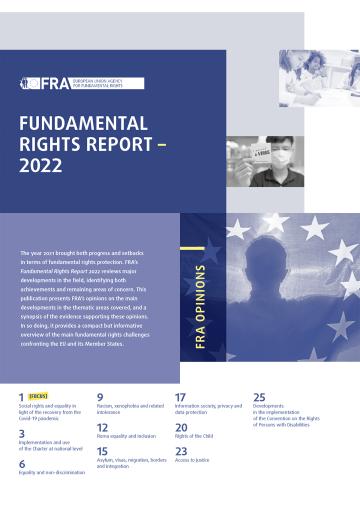
  • Fundamental Rights Report
    8
    June
    2022
    A 2021-es év egyaránt hozott előrelépést és visszaesést az alapvető jogok védelme terén. Az FRA 2022-es Alapjogi jelentése áttekinti a terület főbb fejleményeit, valamint meghatározza az elért eredményeket és a fennmaradó aggályos területeket. Ez a kiadvány bemutatja az FRA véleményét az érintett témakörök főbb fejleményeiről, valamint a véleményeket alátámasztó bizonyítékok összefoglalóját.
  • Report / Paper / Summary
    4
    December
    2025
    Artificial Intelligence comes with both benefits and risks. Safe AI use that accounts for fundamental rights is thus crucial. While the 2024 EU AI Act was a milestone in this regard, its broad definitions regarding AI systems and high-risk AI could introduce loopholes for fundamental rights compliance. This report offers an empirical basis for much-needed practical guidance on the Act’s implementation. Based on interviews with AI developers, sellers, and users, FRA addresses challenges of its use in critical domains, like asylum, education, and employment. Our findings help guide next steps in realising the AI Act’s potential to ensure responsible innovation.
  • Report / Paper / Summary
    2
    October
    2025
    This report examines the fundamental rights and living conditions of Roma and Travellers across 10 EU Member States and
    3 accession countries. The survey evaluates progress towards the EU Roma strategic framework’s 2030 objectives, covering areas such as discrimination, poverty, education, employment, health, and housing.
  • Report / Paper / Summary
    20
    March
    2025
    In recent years, the EU has taken steps to improve child protection, yet some Member States do not have an integrated approach. FRA first produced an overview of child protection systems in the EU in 2014, and an update in 2023. The data is published in FRA’s ‘Mapping of Child Protection Systems in the EU – Update 2023’. This report completements the 2023 update with comparative analysis and provides greater detail on children in vulnerable situations, care and the participation of children in matters affecting them. It also offers guidance on creating comprehensive frameworks that ensure that children’s rights are respected.
  • Report / Paper / Summary
    25
    October
    2024
    Racism towards Muslims is increasing in countries across the EU. Muslims face racial discrimination and racist harassment because of their religion, skin colour or ethnic background. This report shows a sharp rise since the last survey in 2016.
  • Report / Paper / Summary
    19
    December
    2023
    All EU funds must be spent in a way that respect fundamental rights. The EU spends billions of euros on creating jobs, economic growth, sustainable development and improving people’s lives. To prevent funds from being spent in ways that directly violate people’s fundamental rights, the EU strengthened the conditions how funds can be spent in 2021. This report looks at how the newly introduced conditions related to the EU Charter of Fundamental Rights and the United Nations Convention on the Rights of Persons with Disabilities can be upheld in practice. It analyses the potential role of national human rights institutions, ombudsperson institutions and equality bodies. These safeguards can advance compliance with fundamental rights.
  • Report / Paper / Summary
    12
    December
    2023
    Russia’s invasion of Ukraine forced millions of people to flee. Arriving in EU countries, they received protection in EU law under the Temporary Protection Directive. Many have begun to build a new life in their host country and enrich our societies in new ways. Local authorities took the lead in ensuring access to fundamental rights under temporary protection. This report explores the measures to ensure access to housing, education, employment and healthcare in 26 cities and regional authorities across 12 EU Member States. Despite unprecedented coordination and cooperation to overcome challenges, many uncertainties remain. Longer-term solutions will be needed after the directive expires in March 2025. Based on the information collected, the report identifies 12 priority actions and builds on FRA’s bulletins and survey findings on experiences of people displaced from Ukraine.
  • Report / Paper / Summary
    25
    October
    2023
    FRA's first Being Black in the EU report exposed widespread and entrenched racism against people of African descent in Europe. Now updated with new data, this report revisits the situation revealing persistent racial discrimination, harassment and violence. Overall, experiences of racial discrimination increased in the EU countries since 2016, reaching as high as 77%. The lack of progress is alarming despite binding anti-discrimination law in the EU since 2000 and significant EU policy developments since then.