Az Európai Unió Alapjogi Chartája

EU Charter of Fundamental Rights
Highlights
 Report / Paper / Summary8December2025This report examines how human rights impact assessments (HRIAs) are built into lawmaking across the EU and its Member States. It highlights that, although progress has been made, the use of HRIAs remains uneven and often superficial. In many EU countries, the EU Charter of Fundamental Rights is frequently overlooked. The report identifies insufficient consultation with external experts, limited stakeholder participation and a lack of evaluation once laws are in force. To address these gaps, it offers practical recommendations for more systematic, inclusive and evidence-based HRIAs that strengthen human rights protection and ensure better, more accountable legislation throughout the EU.
 PageThe Agency provides support and expertise on the Charter of Fundamental Rights of the European Union at different governance levels by delivering a series of products related to the the Charter.
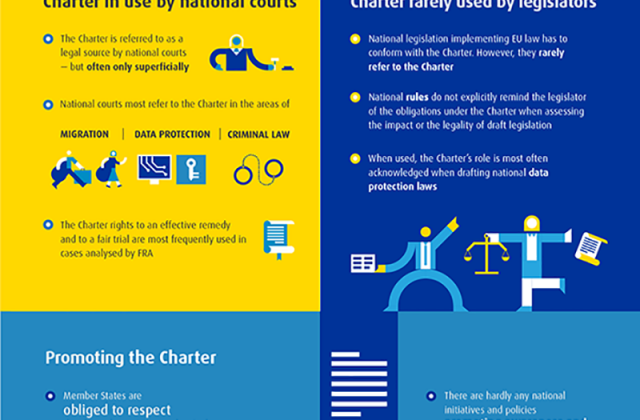
 Fundamental Rights Report11June2020This focus takes a closer look at the application of the Charter of Fundamental Rights of the European Union, which has been legally binding for 10 years. At EU level, it has gained visibility and sparked a new fundamental rights culture. At national level, awareness and use of the Charter are limited. Courts increasingly use the Charter, showing the impact of this modern instrument. But its use by governments and parliaments remains low. For instance, there is little indication of anyone regularly scrutinising national legislation that transposes EU law for compatibility with the Charter.
 Country sheets22March2019A tagállamok kifejezett kötelezettsége a Charta alkalmazásának előmozdítása. Ezek az országismertetők támogatják ezt az erőfeszítést azáltal, hogy példákat mutatnak be a Charta alkalmazására, és rávilágítanak arra, hogy a Charta hogyan képvisel hozzáadott értéket.