The Fundamental Rights Report: Challenges and Achievements in 2025 is FRA’s flagship annual publication. It provides an overview of the state of fundamental rights in the EU and highlights selected critical developments from 2025. This year, it focuses on four areas: rights protection in a rapidly changing digital environment; the housing crisis and rising homelessness rates; employment challenges for people from non-EU countries; and the implementation of the EU Charter of Fundamental Rights. The publication is a valuable resource for those seeking to stay informed about the EU’s shifting landscape of fundamental rights.
This report examines how human rights impact assessments (HRIAs) are built into lawmaking across the EU and its Member States. It highlights that, although progress has been made, the use of HRIAs remains uneven and often superficial. In many EU countries, the EU Charter of Fundamental Rights is frequently overlooked. The report identifies insufficient consultation with external experts, limited stakeholder participation and a lack of evaluation once laws are in force. To address these gaps, it offers practical recommendations for more systematic, inclusive and evidence-based HRIAs that strengthen human rights protection and ensure better, more accountable legislation throughout the EU.
Handbook / Guide / Manual
19
August
2022
CS, DE, ES, FR, HU, IT, NL, PL, RO versions now available
Ο Χάρτης των Θεμελιωδών Δικαιωμάτων της Ευρωπαϊκής Ένωσης («ο Χάρτης») συνιστά τη διακήρυξη δικαιωμάτων της ΕΕ. Λειτουργεί πάντα δεσμευτικά για τα θεσμικά όργανα της ΕΕ καθώς και τα κράτη μέλη, όταν αυτά δρουν εντός του πεδίου εφαρμογής του δικαίου της Ένωσης. Ωστόσο, η εκτίμηση του εάν μια συγκεκριμένη υπόθεση εμπίπτει στο πεδίο εφαρμογής του δικαίου της Ένωσης παρουσιάζει δυσκολίες. Για αυτόν τον λόγο είναι απαραίτητη η κατάρτιση των ασκούντων νομικά επαγγέλματα και η παροχή σε αυτούς εκπαιδευτικού υλικού, ώστε να είναι σε θέση να κατανοούν το πεδίο εφαρμογής του Χάρτη όπως ορίζεται στο άρθρο 51 αυτού. Το παρόν εγχειρίδιο εκπαιδευτή έχει ως στόχο να παρέχει καθοδήγηση τόσο σε επίπεδο οργάνωσης όσο και σε επίπεδο υλοποίησης των εν λόγω προγραμμάτων κατάρτισης με βάση μια σειρά από μελέτες περίπτωσης, οι οποίες θα εμπλουτιστούν μελλοντικά.
This focus takes a closer look at the application of the Charter of Fundamental Rights of the European Union, which has been legally binding for 10 years. At EU level, it has gained visibility and sparked a new fundamental rights culture. At national level, awareness and use of the Charter are limited. Courts increasingly use the Charter, showing the impact of this modern instrument. But its use by governments and parliaments remains low. For instance, there is little indication of anyone regularly scrutinising national legislation that transposes EU law for compatibility with the Charter.
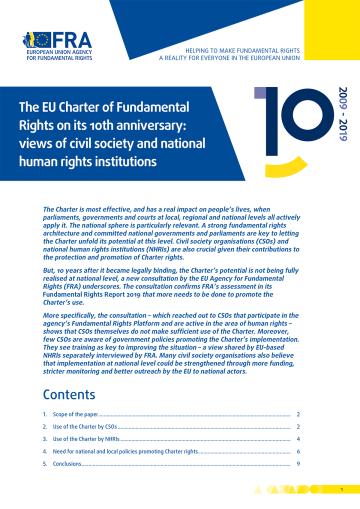
The Charter is most effective, and has a real impact on people’s lives, when parliaments, governments and courts at local, regional and national levels all actively apply it. The national sphere is particularly relevant. A strong fundamental rights architecture and committed national governments and parliaments are key to letting the Charter unfold its potential at this level. Civil society organisations (CSOs) and national human rights institutions (NHRIs) are also crucial given their contributions to the protection and promotion of Charter rights.
Member States have an explicit duty to promote the Charter’s application. These country-sheets
support that effort by giving examples of the Charter’s use and highlighting
how it adds value.
Ως ένας πολύ σύγχρονος κατάλογος ανθρωπίνων δικαιωμάτων ο οποίος περιέχει
πολλά δικαιώματα που δεν υπάρχουν σε θεσπισθείσες διακηρύξεις δικαιωμάτων,
ο Χάρτης φαίνεται πράγματι ικανοποιητικός στη θεωρία. Όσοι είναι εξοικειωμένοι
με τις βασικές αρχές του δικαίου της ΕΕ μπορούν συνήθως να δηλώσουν χωρίς
δεύτερη σκέψη ότι ο Χάρτης είναι πάντα δεσμευτικός για την ΕΕ, και ότι είναι
δεσμευτικός για τα κράτη μέλη μόνον όταν «εφαρμόζουν το δίκαιο της Ένωσης».
Τι σημαίνει όμως στην πραγματικότητα αυτή η συχνά αναφερόμενη φράση του
άρθρου 51 του Χάρτη;
With this Opinion, FRA aims to contribute to the European Parliament's own-initiative report on the “Implementation of the Charter of Fundamental Rights of the European Union in the EU institutional framework”, being prepared in the Parliament’s Committee for Constitutional Affairs (AFCO). The request aims at understanding the interaction between the Charter’s implementation at national and EU level, and whether there are “instruments, mechanisms and practices” available at EU level to assist Member States to better implement the Charter.


 Report / Paper / Summary8December2025