Online terrorist content is a threat to fundamental rights, rule of law and democracy. EU measures to tackle such content aim to prevent terrorism while upholding these values. FRA’s report looks at how online terrorist content is detected and removed under EU legislation. It highlights challenges in interpreting rules, risks of over-removal and potential impacts on freedom of expression. It finds that moderation practices by authorities and platforms can disproportionately affect certain groups, such as Muslims and Arabic speakers, while far-right content often receives less scrutiny. The findings, based on research and expert interviews with those addressing online terrorist content, offer ways to improve transparency in content moderation and to better balance public security and fundamental rights, contributing to wider debates on regulating online content responsibly.
A terrorcselekmények az emberek életére és biztonságára nézve súlyos fenyegetést, az államok számára pedig komoly biztonsági kihívást jelentenek. Ugyanakkor a terrorizmus elleni jogszabályok, politikák és egyéb intézkedések közvetlenül vagy közvetve az alapvető jogok súlyos korlátozásával járhatnak, és hátrányosan érinthetik az egyént, a csoportokat és a társadalom egészét. Ez az összefoglaló az FRA terrorizmus elleni küzdelemről szóló (EU) 2017/541 irányelvről, a terrorizmus elleni küzdelemmel kapcsolatos legfontosabb, uniós szintű büntetőjogi eszközről szóló jelentésében foglalt főbb megállapításokat mutatja be.
This report examines the EU’s main criminal law instrument in the field of counter-terrorism, Directive (EU) 2017/541. Specifically, it considers how the directive engages issues of fundamental rights, affecting individuals, groups and society as a whole.
This paper presents statistical survey data for the EU on how often people are stopped by the police, in what kind of situations they are stopped, the action taken by the police during stops, and views on whether or not the police acted respectfully.
This paper presents people’s concerns and experiences relating to security. It covers worry about crime, including terrorism and online fraud; experience of online fraud; experience of cyberharassment; and concern about illegal access to data.
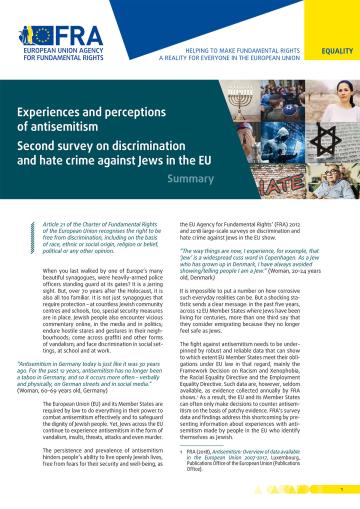
Ez az összefoglaló vázolja az FRA által készített, az Európai Unióban a zsidó emberek gyűlölet-bűncselekményekkel, hátrányos megkülönböztetéssel és antiszemitizmussal kapcsolatos tapasztalatairól szóló második felmérés fő megállapításait. Ez világszerte a legnagyobb, zsidó emberekről szóló felmérés, amelyet valaha is végeztek.
This Opinion aims to inform the European Parliament’s position on the legislative proposal for a Regulation on preventing the dissemination of terrorist content online, presented by the European Commission on 12 September 2018.
This report outlines the main findings of FRA’s second survey on Jewish people’s experiences with hate crime, discrimination and antisemitism in the European Union – the biggest survey of Jewish people ever conducted worldwide. Covering 12 EU Member States, the survey reached almost 16,500 individuals who identify as being Jewish. It follows up on the agency’s first survey, conducted in seven countries in 2012.
Az útmutató ismerteti, mi a profilalkotás, milyen jogi keretek szabályozzák, és miért tekinthető úgy, hogy a profilalkotás jogszerű elvégzése az alapvető jogoknak való megfeleléshez is szükséges, és az eredményes rendészeti fellépés és határigazgatás szempontjából is kulcsfontosságú. Az útmutató emellett gyakorlati iránymutatást kínál azzal kapcsolatban, hogy miként kerülhető el a jogellenes profilalkotás a rendőrségi és a határigazgatási műveletek során.


 Report / Paper / Summary22January2026
 Report / Paper / Summary18November2021