Online terrorist content is a threat to fundamental rights, rule of law and democracy. EU measures to tackle such content aim to prevent terrorism while upholding these values. FRA’s report looks at how online terrorist content is detected and removed under EU legislation. It highlights challenges in interpreting rules, risks of over-removal and potential impacts on freedom of expression. It finds that moderation practices by authorities and platforms can disproportionately affect certain groups, such as Muslims and Arabic speakers, while far-right content often receives less scrutiny. The findings, based on research and expert interviews with those addressing online terrorist content, offer ways to improve transparency in content moderation and to better balance public security and fundamental rights, contributing to wider debates on regulating online content responsibly.
Akty terrorystyczne stanowią poważne zagrożenie dla życia i bezpieczeństwa ludzi, a dla państw są poważnym wyzwaniem w zakresie zapewnienia bezpieczeństwa. Jednocześnie prawodawstwo, polityka i inne środki w zakresie zwalczania terroryzmu mogą wiązać się – bezpośrednio lub pośrednio – z poważnymi ograniczeniami praw podstawowych oraz mieć negatywne skutki dla osób, grup i społeczeństwa jako całości. Niniejsze streszczenie zawiera główne ustalenia FRA ze sprawozdania dotyczącego dyrektywy (UE) 2017/541 w sprawie zwalczania terroryzmu, która jest podstawowym instrumentem prawa karnego na poziomie UE w dziedzinie zwalczania terroryzmu.
This report examines the EU’s main criminal law instrument in the field of counter-terrorism, Directive (EU) 2017/541. Specifically, it considers how the directive engages issues of fundamental rights, affecting individuals, groups and society as a whole.
This paper presents statistical survey data for the EU on how often people are stopped by the police, in what kind of situations they are stopped, the action taken by the police during stops, and views on whether or not the police acted respectfully.
This paper presents people’s concerns and experiences relating to security. It covers worry about crime, including terrorism and online fraud; experience of online fraud; experience of cyberharassment; and concern about illegal access to data.
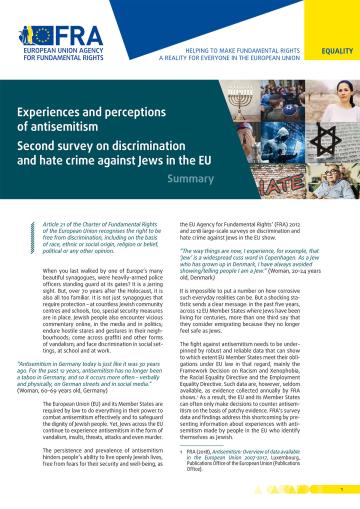
Niniejsze streszczenie przedstawia główne wnioski z drugiego badania przeprowadzonego przez FRA, dotyczącego doświadczeń ludności żydowskiej dotyczących przestępstw z nienawiści, dyskryminacji i antysemityzmu w Unii Europejskiej – największego badania ludności żydowskiej kiedykolwiek przeprowadzonego na świecie.
This Opinion aims to inform the European Parliament’s position on the legislative proposal for a Regulation on preventing the dissemination of terrorist content online, presented by the European Commission on 12 September 2018.
This report outlines the main findings of FRA’s second survey on Jewish people’s experiences with hate crime, discrimination and antisemitism in the European Union – the biggest survey of Jewish people ever conducted worldwide. Covering 12 EU Member States, the survey reached almost 16,500 individuals who identify as being Jewish. It follows up on the agency’s first survey, conducted in seven countries in 2012.
W niniejszym przewodniku wyjaśniono, czym jest profilowanie, które ramy prawne je regulują oraz dlaczego prowadzenie profilowania w sposób zgodny z prawem jest zarówno konieczne, aby przestrzegać praw podstawowych, jak i kluczowe do prowadzenia skutecznych działań policji i skutecznego zarządzania granicami. W przewodniku zawarto również praktyczne wytyczne dotyczące sposobu unikania niezgodnego z prawem profilowania podczas operacji policyjnych i zarządzania granicami.


 Report / Paper / Summary22January2026
 Report / Paper / Summary18November2021