Online terrorist content is a threat to fundamental rights, rule of law and democracy. EU measures to tackle such content aim to prevent terrorism while upholding these values. FRA’s report looks at how online terrorist content is detected and removed under EU legislation. It highlights challenges in interpreting rules, risks of over-removal and potential impacts on freedom of expression. It finds that moderation practices by authorities and platforms can disproportionately affect certain groups, such as Muslims and Arabic speakers, while far-right content often receives less scrutiny. The findings, based on research and expert interviews with those addressing online terrorist content, offer ways to improve transparency in content moderation and to better balance public security and fundamental rights, contributing to wider debates on regulating online content responsibly.
Los actos de terrorismo representan una grave amenaza para la vida y la seguridad de las personas, así como un gran desafío en materia de seguridad para los Estados. Al mismo tiempo, la legislación, las políticas y otras medidas de lucha contra el terrorismo pueden implicar, directa o indirectamente, graves limitaciones a los derechos fundamentales y afectar negativamente a las personas, los grupos y la sociedad en su conjunto. Este resumen presenta las principales conclusiones de la Agencia de los Derechos Fundamentales de la Unión Europea (FRA) de su informe sobre la Directiva (UE) 2017/541 relativa a la lucha contra el terrorismo, el principal instrumento de Derecho penal a escala de la Unión Europea (UE) en el ámbito de la lucha contra el terrorismo.
This report examines the EU’s main criminal law instrument in the field of counter-terrorism, Directive (EU) 2017/541. Specifically, it considers how the directive engages issues of fundamental rights, affecting individuals, groups and society as a whole.
This paper presents statistical survey data for the EU on how often people are stopped by the police, in what kind of situations they are stopped, the action taken by the police during stops, and views on whether or not the police acted respectfully.
This paper presents people’s concerns and experiences relating to security. It covers worry about crime, including terrorism and online fraud; experience of online fraud; experience of cyberharassment; and concern about illegal access to data.
El presente resumen describe las principales conclusiones
de la segunda encuesta de la FRA sobre las
experiencias de los judíos en relación con los delitos
de odio, la discriminación y el antisemitismo en la
Unión Europea. Supone la mayor encuesta en relación
con el pueblo judío jamás realizada a escala mundial.
This Opinion aims to inform the European Parliament’s position on the legislative proposal for a Regulation on preventing the dissemination of terrorist content online, presented by the European Commission on 12 September 2018.
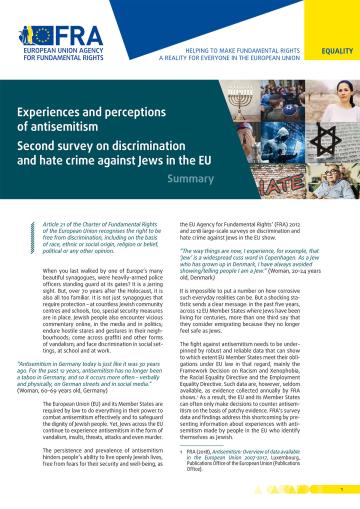
This report outlines the main findings of FRA’s second survey on Jewish people’s experiences with hate crime, discrimination and antisemitism in the European Union – the biggest survey of Jewish people ever conducted worldwide. Covering 12 EU Member States, the survey reached almost 16,500 individuals who identify as being Jewish. It follows up on the agency’s first survey, conducted in seven countries in 2012.
En esta guía se explica qué es la elaboración de perfiles, los marcos jurídicos que la regulan, y por qué llevarla a cabo de manera lícita no solo es necesario para respetar los derechos fundamentales, sino también crucial para la eficacia de la actuación policial y la gestión de fronteras. Esta guía contiene también orientaciones prácticas sobre cómo evitar la utilización ilícita de perfiles en las operaciones de vigilancia policial y gestión de fronteras.


 Report / Paper / Summary22January2026
 Report / Paper / Summary18November2021