Today, a single camera scan from a distance can identify one person in a crowd. Law enforcement authorities in a growing number of EU Member States use or are considering using this AI-driven technique, known as remote biometric identification. While it can support public security and protect people from crime, it also poses serious risks to fundamental rights. FRA’s report draws on legal analysis, interviews with law enforcement practitioners and other experts, observations of police work and a public survey across selected EU Member States. FRA points to the need for a comprehensive legal basis for RBI use for law enforcement, including defined purposes, limits on identifying participants in peaceful assemblies or political gatherings, independent oversight and fundamental rights impact assessments, all of which should be in place before RBI is deployed.
The Fundamental Rights Report: Challenges and Achievements in 2025 is FRA’s flagship annual publication. It provides an overview of the state of fundamental rights in the EU and highlights selected critical developments from 2025. This year, it focuses on four areas: rights protection in a rapidly changing digital environment; the housing crisis and rising homelessness rates; employment challenges for people from non-EU countries; and the implementation of the EU Charter of Fundamental Rights. The publication is a valuable resource for those seeking to stay informed about the EU’s shifting landscape of fundamental rights.
This publication presents findings from an EU-wide survey on public attitudes to children’s use of social media. It presents people’s key concerns and their views on the minimum age limits for accessing social media platforms. The survey draws on the views of both teenagers and adults – those most directly affected. The findings offer a useful evidence base for policy discussions on social media age restrictions in the EU.
Artificial Intelligence comes with both benefits and risks. Safe AI use that accounts for fundamental rights is thus crucial. While the 2024 EU AI Act was a milestone in this regard, its broad definitions regarding AI systems and high-risk AI could introduce loopholes for fundamental rights compliance. This report offers an empirical basis for much-needed practical guidance on the Act’s implementation. Based on interviews with AI developers, sellers, and users, FRA addresses challenges of its use in critical domains, like asylum, education, and employment. Our findings help guide next steps in realising the AI Act’s potential to ensure responsible innovation.
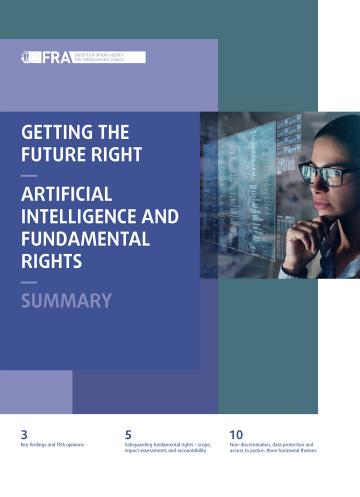
Artificial intelligence is everywhere and affects everyone – from deciding what content people see on their social media feeds to determining who will receive state benefits. AI technologies are typically based on algorithms that make predictions to support or even fully automate decision-making.
En el informe de la Agencia de los Derechos Fundamentales de la Unión Europea sobre inteligencia artificial (IA) y derechos fundamentales se presentan ejemplos concretos de cómo las empresas y las administraciones públicas de la Unión Europea están utilizando o tratan de utilizar la IA. En este resumen se presentan las perspectivas más destacadas del informe. Esto puede servir como fundamento para el intento de las políticas nacionales y de la Unión por regular el uso de las herramientas de IA respetando los derechos fundamentales y humanos.
Artificial intelligence (AI) already plays a role in deciding what unemployment benefits someone gets, where a burglary is likely to take place, whether someone is at risk of cancer, or who sees that catchy advertisement for low mortgage rates. Its use keeps growing, presenting seemingly endless possibilities. But we need to make sure to fully uphold fundamental rights standards when using AI. This report presents concrete examples of how companies and public administrations in the EU are using, or trying to use, AI. It focuses on four core areas – social benefits, predictive policing, health services and targeted advertising.
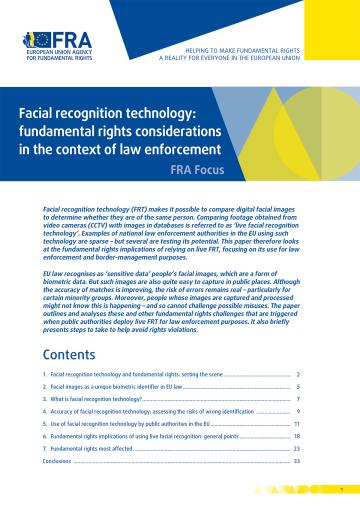
Facial recognition technology (FRT) makes it possible to compare digital facial images to determine whether they are of the same person. Comparing footage obtained from video cameras (CCTV) with images in databases is referred to as ‘live facial recognition technology’. Examples of national law enforcement authorities in the EU using such technology are sparse – but several are testing its potential. This paper therefore looks at the fundamental rights implications of relying on live FRT, focusing on its use for law enforcement and border-management purposes.


 Report / Paper / Summary4December2025
 Report / Paper / Summary8December2022
 Report / Paper / Summary14December2020