eu-charter

Cairt um Chearta Bunúsacha an Aontais Eorpaigh

Airteagal 19 - Cosaint i gcás ina dtarlaíonn aistriú, díbirt nó eiseachadadh

Airteagal 19 - Cosaint i gcás ina dtarlaíonn aistriú, díbirt nó eiseachadadh

1. Toirmiscfear díbirtí comhchoiteanna.
2. Ní fhéadfar aon duine a aistriú, a dhíbirt nó a eiseachadadh chuig Stát ina bhfuil baol tromchúiseach ann go ndéanfar é nó í a chur faoi phionós an bháis nó a chéasadh nó íde nó pionós eile atá mídhaonna nó táireach a chur air nó uirthi.

Mínithe

  • Text:

    Is ionann brí agus raon feidhme do mhír 1 den Airteagal seo agus d'Airteagal 4 de Phrótacal Uimh. 4 a ghabhann leis an CECD maidir leis an díbirt chomhchoiteann. Is é an cuspóir atá leis a ráthú go bhfuil scrúdú sonrach mar bhunús le gach breith agus nach bhféadfar aon bheart aonair a ghlacadh chun na daoine go léir a bhfuil náisiúntacht Stáit ar leith acu a dhíbirt (féach freisin Airteagal 13 den Chúnant um Chearta Sibhialta agus Polaitiúla).
    Tá cásdlí ábhartha na Cúirte Breithiúnais um Chearta an Duine maidir le hAirteagal 3 den CECD ar áireamh i mír 2 (féach Ahmed v. an Ostair, breithiúnas an 17 Nollaig 1996, 1996-VI, lch. 2206, agus Soering, breithiúnas an 7 Iúil 1989).

    Source:
    Iris Oifigiúil an Aontais Eorpaigh C 303/17 - 14.12.2007
    Preamble - Explanations relating to the Charter of Fundamental Rights:
    Ullmhaíodh na mínithe seo i dtosach faoi údarás Praesidium an Choinbhinsiúin a dhréachtaigh an Chairt um Chearta Bunúsacha an Aontais Eorpaigh. Tugadh suas chun dáta iad faoi chúram Praesidium an Choinbhinsiúin Eorpaigh i bhfianaise na gcoigeartuithe dréachtaithe a rinne an Coinbhinsiún sin ar théacs na Cairte (go háirithe ar Airteagail 51 agus 52) agus i bhfianaise an fhoráis a tháinig ar dhlí an Aontais. Cé nach bhfuil stádas dlí acu iontu féin, is mór is fiú iad mar uirlis léirithe arb é is aidhm di forálacha na Cairte a shoiléiriú.

Cásdlí

National Constitutional Law

39 results found

  • 4. Zusatzprotokoll zur Konvention zum Schutze der Menschenrechte und Grundfreiheiten
    Tír:
    Austria

    Artikel 3 (1) Niemand darf aus dem Hoheitsgebiet des Staates, dessen Staatsangehöriger er ist, durch eine Einzel- oder eine Kollektivmaßnahme ausgewiesen werden.
    Artikel 4 Kollektivausweisungen von Fremden sind nicht zulässig.

  • 4th Additional Protocol of the European Convention on Human Rights (ECHR)
    Tír:
    Austria

    Article 3 (1) No one shall be expelled, by means either of an individual or of a collective measure, from the territory of the State of which he is a national.
    Article 4 Colelctive expulsion of aliens is prohibited.

  • Act concerning the Entry and Residence of Aliens in the Territory of the Federal Republic
    Tír:
    Germany

     Sec.51 - Prohibition against expelling victims of political persecution(1) An alien may not be expelled to a State in which his life or freedom is threatened by reason of his race, religion, nationality, membership of a particular social group, or his political convictions.(2) The conditions laid down in paragraph 1 will be deemed to exist in the case of 1. persons with the right of asylum (...)Sec.52 - Expulsion in cases of possible political persecutionSection 51 will apply, mutatis mutandis, to aliens who have made an admissible request for asylum, as long as the request has not been finally rejected or dismissed as groundless, or has not been withdrawn.Sec.53 - Grounds for refusing to expel(1) An alien may not be expelled to a State in which there is actual danger of his being subjected to torture. (...)(3) Where another State has made a formal request for extradition, or for arrest in connection with notification of a request for extradition, the alien may not be expelled to that State until a decision has been made on the extradition.(4) An alien may not be expelled if the expulsion is inadmissible under the Convention on the Protection of Human Rights and Fundamental Freedoms, of 4 November 1950 (BGBl. 1952 II, p. 686).(5) A general risk that an alien may be threatened with criminal prosecution and punishment in another State and, unless otherwise determined by paragraphs 1 to 4, a specific risk of a statutory penalty pursuant to the laws of another State, will not constitute a bar to expulsion.(6) The expulsion of an alien to another State may be waived if there is considerable actual risk to the person, the life or the freedom of the alien in that State. Risks in that State to which the population or population group to which the alien belongs are in general exposed, will be taken into account when decisions are made under section 54.

  • Basic Law for the Federal Republic of Germany
    Tír:
    Germany

    Article 16 (...) (2) No German may be extradited to a foreign country. The law may provide otherwise for extraditions to a member state of the European Union or to an international court, provided that the rule of law is observed. Article 16a  (1) Persons persecuted on political grounds shall have the right of asylum. (2) Paragraph (1) of this Article may not be invoked by a person who enters the federal territory from a member state of the European Communities or from another third state in which application of the Convention Relating to the Status of Refugees and of the Convention for the Protection of Human Rights and Fundamental Freedoms is assured. The states outside the European Communities to which the criteria of the first sentence of this paragraph apply shall be specified by a law requiring the consent of the Bundesrat. In the cases specified in the first sentence of this paragraph, measures to terminate an applicant’s stay may be implemented without regard to any legal challenge that may have been instituted against them. (3) By a law requiring the consent of the Bundesrat, states may be specified in which, on the basis of their laws, enforcement practices and general political conditions, it can be safely concluded that neither political persecution nor inhuman or degrading punishment or treatment exists. It shall be presumed that a foreigner from such a state is not persecuted, unless he presents evidence justifying the conclusion that, contrary to this presumption, he is persecuted on political grounds.

  • Bekendtgørelse af udlændingeloven
    Tír:
    Denmark

    § 31. En udlænding må ikke udsendes til et land, hvor den pågældende risikerer dødsstraf eller at blive underkastet tortur eller umenneskelig eller nedværdigende behandling eller straf, eller hvor udlændingen ikke er beskyttet mod videresendelse til et sådant land. (...)

  • Constitution of Finland
    Tír:
    Finland

    Section 9 Freedom of movement (...) Finnish citizens shall not be prevented from entering Finland or deported or extradited or tranferred from Finland to another country against their will. However, it may be laid down by an Act that due to a criminal act, for the purpose of legal proceedings, or in order to enforce a decision concerning the custody or care of a child, a Finnish citizen can be extradited or transferred to a country in which his or her human rights and legal protection are guaranteed. The right of foreigners to enter Finland and to remain in the country is regulated by an Act. A foreigner shall not be deported, extradited or returned to another country, if in consequence he or she is in danger of a death sentence, torture or other treatment violating human dignity.

  • Constitution of Malta
    Tír:
    Malta

    Article 43 (1) Extradition is only permitted in pursuance of arrangements made by treaty and under the authority of a law. (2) No person shall be extradited for an offence of a political character. (3) No citizen of Malta shall be removed from Malta except as a result of extradition proceedings or under any such law as is referred to in article 44(3) (b) of this Constitution. (4) The provisions made by or under the Extradition Act, as for the time being in force, for the removal of persons from Malta to another Commonwealth country to undergo trial or punishment in that country in respect of an offence committed in that country and any general arrangements for the extradition of persons between Commonwealth countries to which Malta for the time being adheres shall be deemed, for the purposes of sub-article (1) of this article, to be arrangements made by treaty, and sub-article (2) shall not apply in relation to the removal or extradition of a person under such provisions or arrangements.

  • Constitution of the Hellenic Republic
    Tír:
    Greece

    Article 5 (2) All persons living within the Greek territory shall enjoy full protection of their life, honour and liberty irrespective of nationality, race or language and of religious or political beliefs. Exceptions shall be permitted only in cases provided by international law. The extradition of aliens prosecuted for their action as freedom-fighters shall be prohibited.

  • Constitution of the Italian Republic
    Tír:
    Italy

    Art. 10 (…) A foreigner may not be extradited for a political offence. Art. 26. Extradition of a citizen may be granted only if it is expressly envisaged by international conventions. In any case, extradition may not be permitted for political offences.

  • Constitution of the Republic of Bulgaria
    Tír:
    Bulgaria

    Art. 25. [...] (4) (amend., SG 18/05) No Bulgarian citizen may be surrendered to another State or to an international tribunal for the purposes of criminal prosecution, unless the opposite is provided for by international treaty that has been ratified, published and entered into force for the Republic of Bulgaria. Art. 27. (1) Foreigners residing legally in the country shall not be expelled or extradited to another State against their will, except in accordance with the provisions and the procedures established by law. (2) The Republic of Bulgaria shall grant asylum to foreigners persecuted for their opinions or activity in the defence of internationally recognized rights and freedoms. (3) The conditions and procedure for the granting of asylum shall be established by law.

  • Constitution of the Republic of Croatia
    Tír:
    Croatia

    Article 9
    (2)A citizen of the Republic of Croatia may not be forcibly exiled from the Republic of Croatia
    nor deprived of citizenship, nor extradited to another state, except in case of execution of a
    decision on extradition or surrender made in compliance with international treaty or the acquis
    communautaire of the European Union.

    Article 33
    (2) No alien legally in the territory of the Republic of Croatia shall be banished or extradited to another state, except in cases of enforcement of decisions made in compliance with an international treaty or law.

  • Constitution of the Republic of Cyprus
    URL:
    Tír:
    Cyprus

    Appendix D: Part 02 – Fundamental Rights and LibertiesArticle 14 No citizen shall be banished or excluded from the Republic under any circumstances.

  • Constitution of the Republic of Estonia
    Tír:
    Estonia

    Article 36. No citizen of Estonia may be expelled from Estonia or prevented from settling in Estonia.
    No citizen of Estonia may be extradited to a foreign state, except under conditions prescribed by an international treaty and pursuant to a procedure provided by such treaty and by law. Extraditions are decided by the Government of the Republic. Any person who is subject to an extradition order has the right to challenge this order in an Estonian court.
    Every Estonian is entitled to settle in Estonia.

  • Constitution of the Republic of Latvia
    Tír:
    Latvia

    98. Everyone has the right to freely depart from Latvia. Everyone having a Latvian passport shall be protected by the State when abroad and has the right to freely return to Latvia. A citizen of Latvia may not be extradited to a foreign country, except in the cases provided for in international agreements ratified by the Saeima if by the extradition the basic human rights specified in the Constitution are not violated.

  • Constitution of the Republic of Lithuania
    Tír:
    Lithuania

    Article 13. The State of Lithuania shall protect its citizens abroad. It shall be prohibited to extradite a citizen of the Republic of Lithuania to another state unless an international treaty of the Republic of Lithuania establishes otherwise.

  • Constitution of the Republic of Poland
    Tír:
    Poland

    Article 55 1. The extradition of a Polish citizen shall be prohibited, except in cases specified in paras 2 and 3. 2. Extradition of a Polish citizen may be granted upon a request made by a foreign state or an international judicial body if such a possibility stems from an international treaty ratified by Poland or a statute implementing a legal instrument enacted by an international organisation of which the Republic of Poland is a member, provided that the act covered by a request for extradition: 1) was committed outside the territory of the Republic of Poland, and 2) constituted an offence under the law in force in the Republic of Poland or would have constituted an offence under the law in force in the Republic of Poland if it had been committed within the territory of the Republic of Poland, both at the time of its commitment and at the time of the making of the request. 3. Compliance with the conditions specified in para. 2 subparas 1 and 2 shall not be required if an extradition request is made by an international judicial body established under an international treaty ratified by Poland, in connection with a crime of genocide, crime against humanity, war crime or a crime of aggression, covered by the jurisdiction of that body. 4. The extradition of a person suspected of the commission of a crime for political reasons but without the use of force shall be forbidden, so as an extradition which would violate rights and freedoms of persons and citizens. 5. The courts shall adjudicate on the admissibility of extradition.

  • Costituzione della Repubblica Italiana
    Tír:
    Italy

    Art. 10 (...) Non è ammessa l'estradizione dello straniero per reati politici. Art. 26 L'estradizione del cittadino può essere consentita soltanto ove sia espressamente prevista dalle convenzioni internazionali. Non può in alcun caso essere ammessa per reati politici.

  • Czechia / Charter of Fundamental Rights and Freedoms
    Tír:
    Czechia

    Article 14 (5) An alien may be expelled only in cases specified by the law.

  • Eesti Vabariigi Põhiseadus
    Tír:
    Estonia

    § 36. Ühtki Eesti kodanikku ei tohi Eestist välja saata ega takistada Eestisse asumast. Ühtki Eesti kodanikku ei tohi välisriigile välja anda muidu, kui välislepingus ettenähtud juhtudel ning vastavas lepingus ja seaduses sätestatud korras. Väljaandmise otsustab Vabariigi Valitsus. Igal väljaantaval on õigus vaidlustada väljaandmine Eesti kohtus. Igal eestlasel on õigus asuda Eestisse.

  • European Convention on Human Rights - Article 3
    Tír:
    Austria

    Article 3 -  Prohibition of torture

    No one shall be subjected to torture or to inhuman or degrading treatment or punishment.

Dlí an AE

8 results found

  • Regulation (EU) 2016/1953 of the European Parliament and of the Council of 26 October 2016 on the establishment of a European travel document for the return of illegally staying third-country nationals

    Preamble 
    (22)Member States should respect their respective obligations under international and Union law, notably the Charter of Fundamental Rights of the European Union, in particular the protection in the event of removal, expulsion or extradition provided for in Article 19 and the duty referred to in Article 24(2).

  • Directive 2011/95 - Standards for the qualification of third-country nationals or stateless persons as beneficiaries of international protection, for a uniform status for refugees or for persons eligible for subsidiary protection, and for the content of t

    Preamble 

    (10) This Directive respects the fundamental rights and observes the principles recognised in particular by the Charter of Fundamental Rights of the European Union. In particular this Directive seeks to ensure full respect for human dignity and the right to asylum of applicants for asylum and their accompanying family members.

    (16) This Directive respects the fundamental rights and observes the principles recognised in particular by the Charter of Fundamental Rights of the European Union.  In particular this Directive seeks to ensure full respect for  human dignity and the right to asylum of applicants for  asylum and their accompanying family members and to  promote the application of Articles 1, 7, 11, 14, 15, 16, 
    18, 21, 24, 34 and 35 of that Charter, and should  therefore be implemented accordingly.


    (34) With regard to social assistance and health care, the modalities and detail of the provision of core benefits to beneficiaries of subsidiary protection status should be determined by national law. The possibility of limiting the benefits for beneficiaries of subsidiary protection status to core benefits is to be understood in the sense that this notion covers at least minimum income support, assistance in case of illness, pregnancy and parental assistance, in so far as they are granted to nationals according to the legislation of the Member State concerned.

    (35) Access to health care, including both physical and mental health care, should be ensured to beneficiaries of refugee or subsidiary protection status.

    Article 2: Definitions
    For the purposes of this Directive the following definitions shall apply:
    (a) ‘international protection’ means refugee status and subsidiary protection status as defined in points (e) and (g);
    (d) ‘refugee’ means a third-country national who, owing to a well-founded fear of being persecuted for reasons of race, religion, nationality, political opinion or membership of a particular social group, is outside the country of nationality and is unable or, owing to such fear, is unwilling to avail himself or herself of the protection of that country, or a stateless person, who, being outside of the country of former habitual residence for the same reasons as mentioned above, is unable or, owing to such fear, unwilling to return to it, and to whom Article 12 does not apply; [...]
    (e) ‘refugee status’ means the recognition by a Member State of a third-country national or a stateless person as a refugee;
    (f) ‘person eligible for subsidiary protection’ means a third-country national or a stateless person who does not qualify as a refugee but in respect of whom substantial grounds have been shown for believing that the person concerned, if returned to his or her country of origin, or in the case of a stateless person, to his or her country of former habitual residence, would face a real risk of suffering serious harm as defined in Article 15, and to whom Article 17(1) and (2) does not apply, and is unable, or, owing to such risk, unwilling to avail himself or herself of the protection of that country;
    (g) ‘subsidiary protection status’ means the recognition by a Member State of a third-country national or a stateless person as a person eligible for subsidiary protection; [...]

    Article 13: Granting of refugee status
    Member States shall grant refugee status to a third-country national or a stateless person who qualifies as a refugee in accordance with Chapters II and III.‘

    Article 18: Granting of subsidiary protection status
    Member States shall grant subsidiary protection status to a third-country national or a stateless person eligible for subsidiary protection in accordance with Chapters II and V.‘

    Article 21: Protection from refoulement

    1.   Member States shall respect the principle of non-refoulement in accordance with their international obligations.

    2.   Where not prohibited by the international obligations mentioned in paragraph 1, Member States may refoule a refugee, whether formally recognised or not, when:

    (a) there are reasonable grounds for considering him or her as a danger to the security of the Member State in which he or she is present; or

    (b) he or she, having been convicted by a final judgement of a particularly serious crime, constitutes a danger to the community of that Member State.

    3.   Member States may revoke, end or refuse to renew or to grant the residence permit of (or to) a refugee to whom paragraph 2 applies.

    Article 22: Information

    Member States shall provide persons recognised as being in need of international protection, as soon as possible after the respective protection status has been granted, with access to information, in a language likely to be understood by them, on the rights and obligations relating to that status.

    Article 23: Maintaining family unity

    1.   Member States shall ensure that family unity can be maintained.

    2.   Member States shall ensure that family members of the beneficiary of refugee or subsidiary protection status, who do not individually qualify for such status, are entitled to claim the benefits referred to in Articles 24 to 34, in accordance with national procedures and as far as it is compatible with the personal legal status of the family member.

    In so far as the family members of beneficiaries of subsidiary protection status are concerned, Member States may define the conditions applicable to such benefits.

    In these cases, Member States shall ensure that any benefits provided guarantee an adequate standard of living.

    3.   Paragraphs 1 and 2 are not applicable where the family member is or would be excluded from refugee or subsidiary protection status pursuant to Chapters III and V.

    4.   Notwithstanding paragraphs 1 and 2, Member States may refuse, reduce or withdraw the benefits referred therein for reasons of national security or public order.

    5.   Member States may decide that this Article also applies to other close relatives who lived together as part of the family at the time of leaving the country of origin, and who were wholly or mainly dependent on the beneficiary of refugee or subsidiary protection status at that time.

    Article 26: Access to employment

    1.   Member States shall authorise beneficiaries of refugee status to engage in employed or self-employed activities subject to rules generally applicable to the profession and to the public service, immediately after the refugee status has been granted.

    2.   Member States shall ensure that activities such as employment-related education opportunities for adults, vocational training and practical workplace experience are offered to beneficiaries of refugee status, under equivalent conditions as nationals.

    3.   Member States shall authorise beneficiaries of subsidiary protection status to engage in employed or self-employed activities subject to rules generally applicable to the profession and to the public service immediately after the subsidiary protection status has been granted. The situation of the labour market in the Member States may be taken into account, including for possible prioritisation of access to employment for a limited period of time to be determined in accordance with national law. Member States shall ensure that the beneficiary of subsidiary protection status has access to a post for which the beneficiary has received an offer in accordance with national rules on prioritisation in the labour market.

    4.   Member States shall ensure that beneficiaries of subsidiary protection status have access to activities such as employment-related education opportunities for adults, vocational training and practical workplace experience, under conditions to be decided by the Member States.

    5.   The law in force in the Member States applicable to remuneration, access to social security systems relating to employed or self-employed activities and other conditions of employment shall apply.

    Article 27: Access to education

    1.   Member States shall grant full access to the education system to all minors granted refugee or subsidiary protection status, under the same conditions as nationals.

    2.   Member States shall allow adults granted refugee or subsidiary protection status access to the general education system, further training or retraining, under the same conditions as third country nationals legally resident.

    3.   Member States shall ensure equal treatment between beneficiaries of refugee or subsidiary protection status and nationals in the context of the existing recognition procedures for foreign diplomas, certificates and other evidence of formal qualifications.

    Article 28: Social welfare

    1.   Member States shall ensure that beneficiaries of refugee or subsidiary protection status receive, in the Member State that has granted such statuses, the necessary social assistance, as provided to nationals of that Member State.

    2.   By exception to the general rule laid down in paragraph 1, Member States may limit social assistance granted to beneficiaries of subsidiary protection status to core benefits which will then be provided at the same levels and under the same eligibility conditions as nationals.

    Article 29: Health care

    1.   Member States shall ensure that beneficiaries of refugee or subsidiary protection status have access to health care under the same eligibility conditions as nationals of the Member State that has granted such statuses.

    2.   By exception to the general rule laid down in paragraph 1, Member States may limit health care granted to beneficiaries of subsidiary protection to core benefits which will then be provided at the same levels and under the same eligibility conditions as nationals.

    3.   Member States shall provide, under the same eligibility conditions as nationals of the Member State that has granted the status, adequate health care to beneficiaries of refugee or subsidiary protection status who have special needs, such as pregnant women, disabled people, persons who have undergone torture, rape or other serious forms of psychological, physical or sexual violence or minors who have been victims of any form of abuse, neglect, exploitation, torture, cruel, inhuman and degrading treatment or who have suffered from armed conflict.

  • Regulation (EU) 2024/1359 of the European Parliament and of the Council of 14 May 2024 addressing situations of crisis and force majeure in the field of migration and asylum and amending Regulation (EU) 2021/1147

    Preamble 

    (8) This Regulation respects the fundamental rights of third-country nationals and stateless persons and observes the principles recognised by the Charter of Fundamental Rights of the European Union (the ‘Charter’), in particular the respect and protection of human dignity, prohibition of torture and inhuman or degrading treatment or punishment, respect for private and family life, the principle of the best interests of the child, the right to asylum and protection in the event of removal, expulsion or extradition, as well as the Geneva Convention Relating to the Status of Refugees of 28 July 1951, as supplemented by the New York Protocol of 31 January 1967 (the ‘Geneva Convention’). This Regulation should be implemented in compliance with the Charter and general principles of Union law as well as with international law. In order to reflect the primary consideration that must be given to the best interests of the child, in line with the 1989 United Nations Convention on the Rights of the Child, and the need to respect family life, as well as to ensure the protection of the health of the persons concerned, safeguards should be applied in respect of minors and their family members, and of applicants for international protection (‘applicants’) whose state of health requires specific and adequate support. The rules and guarantees set out in Regulation (EU) 2024/1348 should continue to apply in respect of persons subject to the derogations provided for in this Regulation, except where this Regulation provides otherwise. The rules set out in Directive (EU) 2024/1346 of the European Parliament and of the Council (7), including those concerning the detention of applicants, should continue to apply from the moment an application for international protection is made.


    (18) In a situation of instrumentalisation, third-country nationals and stateless persons could apply for international protection at the external border or in a transit zone of a Member State, often being persons apprehended in connection with unauthorised crossings of the external border by land, sea or air or who are disembarked following search and rescue operations. This can lead, in particular, to an unexpected significant increase in the caseload of applications for international protection at the external borders. In that regard, effective and genuine access to the international protection procedure must be ensured in accordance with Article 18 of the Charter and the Geneva Convention.


    (42) In situations of crisis and force majeure, the Member State should be authorised to derogate from Regulation (EU) 2024/1348 in order to register applications for international protection no later than four weeks after they are made. Such an extension should be without prejudice to the rights of asylum applicants guaranteed by the Charter, Regulation (EU) 2024/1348 and Directive (EU) 2024/1346. Without prejudice to the exception provided for during the period between the request and the adoption of the Council implementing decision, in a situation of crisis, characterised by mass arrivals of third-country nationals and stateless persons, the extension of the registration period should only be applied during the time period set out in the initial Council implementing decision.

    Article 1: Subject matter

    2.   Temporary measures adopted pursuant to this Regulation shall meet the requirements of necessity and proportionality, be appropriate to achieving their stated objectives and ensuring the protection of the rights of applicants and beneficiaries of international protection, and be consistent with the obligations of the Member States under the Charter, international law and the Union asylum acquis. This Regulation shall not affect the fundamental principles and guarantees, established by the legislative acts from which derogations are allowed pursuant to this Regulation.

  • Directive 2013/32/EU of the European Parliament and of the Council of 26 June 2013 on common procedures for granting and withdrawing international protection (recast)

    Preamble 
    (33) The best interests of the child should be a primary consideration of Member States when applying this Directive, in accordance with the Charter of Fundamental Rights of the European Union (the Charter) and the 1989 United Nations Convention on the Rights of the Child. In assessing the best interest of the child, Member States should in particular take due account of the minor’s well-being and social development, including his or her background.

    (39) In determining whether a situation of uncertainty prevails in the country of origin of an applicant, Member States should ensure that they obtain precise and up-to-date information from relevant sources such as EASO, UNHCR, the Council of Europe and other relevant international organisations. Member States should ensure that any postponement of conclusion of the procedure fully complies with their obligations under Directive 2011/95/EU and Article 41 of the Charter, without prejudice to the efficiency and fairness of the procedures under this Directive.


    (60) This Directive respects the fundamental rights and observes the principles recognised by the Charter. In particular, this Directive seeks to ensure full respect for human dignity and to promote the application of Articles 1, 4, 18, 19, 21, 23, 24, and 47 of the Charter and has to be implemented accordingly.

    Article 13: Obligations of the applicants

    1. Member States shall impose upon applicants the obligation to cooperate with the competent authorities with a view to establishing their identity and other elements referred to in Article 4(2) of Directive 2011/95/EU. Member States may impose upon applicants other obligations to cooperate with the competent authorities insofar as such obligations are necessary for the processing of the application.

    2. In particular, Member States may provide that:

    (a) applicants are required to report to the competent authorities or to appear before them in person, either without delay or at a specified time;

    (b) applicants have to hand over documents in their possession relevant to the examination of the application, such as their passports;

    (c) applicants are required to inform the competent authorities of their current place of residence or address and of any changes thereof as soon as possible. Member States may provide that the applicant shall have to accept any communication at the most recent place of residence or address which he or she indicated accordingly;

    (d) the competent authorities may search the applicant and the items which he or she is carrying. Without prejudice to any search carried out for security reasons, a search of the applicant’s person under this Directive shall be carried out by a person of the same sex with full respect for the principles of human dignity and of physical and psychological integrity;

    (e) the competent authorities may take a photograph of the applicant; and

    (f) the competent authorities may record the applicant’s oral statements, provided he or she has previously been informed thereof.

    ...

    Article 30: Collection of information on individual cases

    For the purposes of examining individual cases, Member States shall not:

    (a) disclose information regarding individual applications for international protection, or the fact that an application has been made, to the alleged actor(s) of persecution or serious harm;

    (b) obtain any information from the alleged actor(s) of persecution or serious harm in a manner that would result in such actor(s) being directly informed of the fact that an application has been made by the applicant in question, and would jeopardise the physical integrity of the applicant or his or her dependants, or the liberty and security of his or her family members still living in the country of origin.

    ...

    Article 45: Procedural rules

    1. Member States shall ensure that, where the competent authority is considering withdrawing international protection from a third-country national or stateless person in accordance with Article 14 or 19 of Directive 2011/95/EU, the person concerned enjoys the following guarantees:

    (a) to be informed in writing that the competent authority is reconsidering his or her qualification as a beneficiary of international protection and the reasons for such a reconsideration; and

    (b) to be given the opportunity to submit, in a personal interview in accordance with Article 12(1)(b) and Articles 14 to 17 or in a written statement, reasons as to why his or her international protection should not be withdrawn.

    2. In addition, Member States shall ensure that within the framework of the procedure set out in paragraph 1:

    (a) the competent authority is able to obtain precise and up-to-date information from various sources, such as, where appropriate, from EASO and UNHCR, as to the general situation prevailing in the countries of origin of the persons concerned; and

    (b) where information on an individual case is collected for the purposes of reconsidering international protection, it is not obtained from the actor(s) of persecution or serious harm in a manner that would result in such actor(s) being directly informed of the fact that the person concerned is a beneficiary of international protection whose status is under reconsideration, or jeopardise the physical integrity of the person or his or her dependants, or the liberty and security of his or her family members still living in the country of origin.

    3. Member States shall ensure that the decision of the competent authority to withdraw international protection is given in writing. The reasons in fact and in law shall be stated in the decision and information on how to challenge the decision shall be given in writing.

    4. Once the competent authority has taken the decision to withdraw international protection, Article 20, Article 22, Article 23(1) and Article 29 are equally applicable.

    5. By way of derogation from paragraphs 1 to 4 of this Article, Member States may decide that international protection shall lapse by law where the beneficiary of international protection has unequivocally renounced his or her recognition as such. A Member State may also provide that international protection shall lapse by law where the beneficiary of international protection has become a national of that Member State. 

  • Regulation (EU) 2024/1356 of the European Parliament and of the Council of 14 May 2024 introducing the screening of third-country nationals at the external borders and amending Regulations (EC) No 767/2008, (EU) 2017/2226, (EU) 2018/1240 and (EU) 2019/817

    Preamble 
    (25) During the screening, the best interests of the child should always be a primary consideration in accordance with Article 24(2) of the Charter of Fundamental Rights of the European Union (the ‘Charter’). Child protection authorities should, wherever necessary, be closely involved in the screening to ensure that the best interests of the child are duly taken into account throughout the screening. A representative should be appointed to represent and assist the unaccompanied minor during the screening or, where a representative has not been appointed, a person trained to safeguard the best interests and general wellbeing of the minor should be designated. Where applicable, that representative should be the same as the representative appointed in accordance with the rules on unaccompanied minors in Directive (EU) 2024/1346. The trained person should be the person designated to provisionally act as a representative under that Directive, where that person has been designated.


    (37) A preliminary vulnerability check should be carried out with a view to identifying persons with indications of being vulnerable, of being victims of torture or other inhuman or degrading treatment, or of being stateless, or who may have special reception or procedural needs within the meaning of Directive (EU) 2024/1346 and Regulation (EU) 2024/1348, respectively. This should be without prejudice to further assessment in ensuing procedures following the completion of the screening. The vulnerability check should be carried out by specialised personnel of the screening authorities trained for that purpose.


    (38) During the screening, all persons concerned should be guaranteed a standard of living complying with the Charter and have access to emergency health care and essential treatment of illnesses. Particular attention should be paid to individuals with vulnerabilities, such as pregnant women, elderly persons, single-parent families, persons with an immediately identifiable physical or mental disability, persons visibly having suffered psychological or physical trauma and unaccompanied minors. In particular, in the case of a minor, information should be provided in a child-friendly and age-appropriate manner. All the authorities involved in the performance of the tasks related to the screening should report any situation of vulnerabilities observed or reported to them, should respect human dignity and privacy, and should refrain from any discrimination.

    Article 8 : Requirements concerning the screening

    8.   Member States shall ensure that all persons subject to the screening are accorded a standard of living which guarantees their subsistence, protects their physical and mental health and respects their rights under the Charter.

    Article 10 : Monitoring of fundamental rights

    2.   Each Member State shall provide for an independent monitoring mechanism in accordance with the requirements set out in this Article, which shall:

    (a) monitor compliance with Union and international law, including the Charter, in particular as regards access to the asylum procedure, the principle of non-refoulement, the best interest of the child and the relevant rules on detention, including relevant provisions on detention in national law, during the screening; and

    (b) ensure that substantiated allegations of failure to respect fundamental rights in all relevant activities in relation to the screening are dealt with effectively and without undue delay, trigger, where necessary, investigations into such allegations and monitor the progress of such investigations.

    Article 12: Preliminary health checks and vulnerabilities

    3.   Third-country nationals subjected to the screening referred to in Articles 5 and 7 shall be subject to a preliminary vulnerability check by specialised personnel of the screening authorities trained for that purpose, with a view to identifying whether a third-country national might be a stateless person, vulnerable or a victim of torture or other inhuman or degrading treatment, or have special needs within the meaning of Directive 2008/115/EC, Article 25 of Directive (EU) 2024/1346 and Article 20 of Regulation (EU) 2024/1348. For the purpose of that vulnerability check, the screening authorities may be assisted by non-governmental organisations and, where relevant, by qualified medical personnel.

    Article 13: Guarantees for minors

    1.   During the screening, the best interests of the child shall always be a primary consideration in accordance with Article 24(2) of the Charter.

  • Regulation (EU) No 656/2014 of the European Parliament and of the Council of 15 May 2014 establishing rules for the surveillance of the external sea borders in the context of operational cooperation coordinated by Frontex

    Preamble 


    (19) This Regulation respects the fundamental rights and observes the principles recognised by Articles 2 and 6 of the Treaty on European Union (TEU) and by the Charter, in particular respect for human dignity, the right to life, the prohibition of torture and of inhuman or degrading treatment or punishment, the prohibition of trafficking in human beings, the right to liberty and security, the right to the protection of personal data, the right to asylum and to protection against removal and expulsion, the principles of non-refoulement and non-discrimination, the right to an effective remedy and the rights of the child. This Regulation should be applied by Member States and the Agency in accordance with those rights and principles.

  • Regulation (EU) 2021/784 of the European Parliament and of the Council of 29 April 2021 on addressing the dissemination of terrorist content online

    Preamble 


    (20) It should be possible for the competent authority of the Member State where the hosting service provider has its main establishment or where its legal representative resides or is established to scrutinise the removal order issued by competent authorities of another Member State to determine whether it seriously or manifestly infringes this Regulation or the fundamental rights enshrined in the Charter. Both the content provider and the hosting service provider should have the right to request such scrutiny by the competent authority in the Member State where the hosting service provider has its main establishment or where its legal representative resides or is established. Where such a request is made, that competent authority should adopt a decision on whether the removal order comprises such an infringement. Where that decision finds such an infringement, the removal order should cease to have legal effects. The scrutiny should be carried out swiftly so as to ensure that erroneously removed or disabled content is reinstated as soon as possible.


    (23) When putting in place specific measures, hosting service providers should ensure that users’ right to freedom of expression and information as well as the freedom and pluralism of the media as protected under the Charter are preserved. In addition to any requirement laid down in the law, including legislation on the protection of personal data, hosting service providers should act with due diligence and implement safeguards, where appropriate, including human oversight and verifications, to avoid any unintended or erroneous decision leading to the removal of or disabling of access to content that is not terrorist content.

    Article 1: Subject matter and scope

    1. This Regulation lays down uniform rules to address the misuse of hosting services for the dissemination to the public of terrorist content online, in particular on:

    (a) reasonable and proportionate duties of care to be applied by hosting service providers in order to address the dissemination to the public of terrorist content through their services and ensure, where necessary, the expeditious removal of or disabling of access to such content;

    (b) the measures to be put in place by Member States, in accordance with Union law and subject to suitable safeguards to protect fundamental rights, in particular the freedom of expression and information in an open and democratic society, in order to:

    (i) identify and ensure the expeditious removal of terrorist content by hosting service providers; and

    (ii) facilitate cooperation among the competent authorities of Member States, hosting service providers and, where appropriate, Europol.

    2. This Regulation applies to hosting service providers offering services in the Union, irrespective of their place of main establishment, insofar as they disseminate information to the public.

    3. Material disseminated to the public for educational, journalistic, artistic or research purposes or for the purposes of preventing or countering terrorism, including material which represents an expression of polemic or controversial views in the course of public debate, shall not be considered to be terrorist content. An assessment shall determine the true purpose of that dissemination and whether material is disseminated to the public for those purposes.

    4. This Regulation shall not have the effect of modifying the obligation to respect the rights, freedoms and principles referred to in Article 6 TEU and shall apply without prejudice to fundamental principles relating to freedom of expression and information, including freedom and pluralism of the media.

    5. This Regulation shall be without prejudice to Directives 2000/31/EC and 2010/13/EU. For audiovisual media services as defined in point (a) of Article 1(1) of Directive 2010/13/EU, Directive 2010/13/EU shall prevail.

    Article 4: Procedure for cross-borders removal orders 

    3.   The competent authority of the Member State where the hosting service provider has its main establishment or where its legal representative resides or is established may, on its own initiative, within 72 hours of receiving the copy of the removal order in accordance with paragraph 1, scrutinise the removal order to determine whether it seriously or manifestly infringes this Regulation or the fundamental rights and freedoms guaranteed by the Charter.

    Where it finds an infringement, it shall, within the same period, adopt a reasoned decision to that effect. 

  • Regulation (EU) 2019/1896 of the European Parliament and of the Council of 13 November 2019 on the European Border and Coast Guard and repealing Regulations (EU) No 1052/2013 and (EU) 2016/1624

    Preamble

    (103) This Regulation respects the fundamental rights and observes the principles recognised by Articles 2 and 6 TEU and by the Charter of Fundamental Rights of the European Union (‘the Charter’), in particular respect for human dignity, the right to life, the prohibition of torture and inhuman or degrading treatment or punishment, the prohibition of trafficking in human beings, the right to liberty and security, the right to the protection of personal data, the right of access to documents, the right to asylum and to protection against removal and expulsion, non-refoulement, non-discrimination and the rights of the child.

    Article 1: Subject matter

    This Regulation establishes a European Border and Coast Guard to ensure European integrated border management at the external borders with a view to managing those borders efficiently in full compliance with fundamental rights and to increasing the efficiency of the Union return policy.

    This Regulation addresses migratory challenges and potential future challenges and threats at the external borders. It ensures a high level of internal security within the Union in full respect of fundamental rights, while safeguarding the free movement of persons within the Union. It contributes to the detection, prevention and combating of cross-border crime at the external borders.

    Article 43: Instructions to the teams

    4.   Members of the teams shall, in the performance of their tasks and in the exercise of their powers, fully respect fundamental rights, including access to asylum procedures and human dignity, and shall pay particular attention to vulnerable persons. Any measures taken in the performance of their tasks and in the exercise of their powers shall be proportionate to the objectives pursued by such measures. While performing their tasks and exercising their powers, they shall not discriminate against persons on the basis of any grounds such as sex, race, colour, ethnic or social origin, genetic features, language, religion or belief, political or any other opinion, membership of a national minority, property, birth, disability, age or sexual orientation in line with Article 21 of the Charter.

Dlí idirnáisiúnta

0 results found

Táirgí

  • Handbook / Guide / Manual
    19
    August
    2022
    DA, ET, FI, LT, PT, SV versions now available
    30 July 2024
    The Charter of Fundamental Rights of the European Union (CFREU) is the EU’s bill of rights. It always binds the EU institutions and the Member States when they act within the scope of EU law. However, it is far from easy to assess whether a concrete case falls within the scope of EU law. This is why it is necessary to provide training and training material to legal professionals so that they can understand the field of application of the Charter as laid out in its Article 51. This trainer’s manual aims at providing guidance on both the organisation and the implementation of such trainings based on a series of case studies,
    which will be extended in the future.
  • Fundamental Rights Report
    8
    June
    2022
    All language versions now available
    14 September 2022
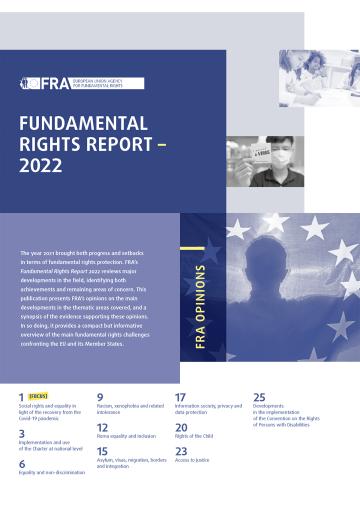
    Tógadh céimeanna chun tosaigh agus céimeanna ar gcúl araon i ndáil le cosaint ceart bunúsach sa bhliain 2021. I dTuarascáil um Chearta Bunúsacha 2022 FRA, déantar athbhreithniú ar mhórfhorbairtí sa réimse agus sainaithnítear éachtaí agus ábhair imní nach mór déileáil leo fós. San fhoilseachán seo, cuirtear i láthair tuairimí ó FRA faoi na príomhfhorbairtí sna réimsí téamacha a chumhdaítear agus déantar achoimre ar an bhfianaise a thacaíonn leis na tuairimí sin.
  • Report / Paper / Summary
    27
    March
    2020
    French version now available
    24 April 2020
    Council of Europe (CoE) and European Union (EU) Member States have an undeniable sovereign right to control the entry of non-nationals into their territory. While exercising border control, states have a duty to protect the fundamental rights of all people under their jurisdiction, regardless of their nationality and/or legal status. Under EU law, this includes providing access to asylum procedures.
  • Periodic updates / Series
    21
    July
    2026
    This is the second bulletin in FRA’s new quarterly series monitoring the situation of migrants, asylum seekers and refugees. It covers key developments and ongoing concerns from 1 April to 30 June 2026.

    Following regular reporting on fundamental rights issues related to migration and asylum from 2015 to 2023, FRA resumed the series in 2026 under the EU's 2024 Asylum and Migration Management Regulation, ahead of the June 2026 implementation of the EU Migration and Asylum Pact. The first bulletin, published in April 2026, covered developments from 1 January 2025 to 31 March 2026.
    FRA, 2026
  • Fundamental Rights Report
    11
    June
    2026
    The Fundamental Rights Report: Challenges and Achievements in 2025 is FRA’s flagship annual publication. It provides an overview of the state of fundamental rights in the EU and highlights selected critical developments from 2025. This year, it focuses on four areas: rights protection in a rapidly changing digital environment; the housing crisis and rising homelessness rates; employment challenges for people from non-EU countries; and the implementation of the EU Charter of Fundamental Rights. The publication is a valuable resource for those seeking to stay informed about the EU’s shifting landscape of fundamental rights.
  • Periodic updates / Series
    21
    April
    2026
    From 2015 to 2023, FRA regularly published bulletins on fundamental rights issues related to migration and asylum. As part of the EU's 2024 Asylum and Migration Management Regulation, FRA is now restarting this reporting ahead of the June 2026 implementation of the EU Migration and Asylum Pact. This first bulletin in the new series takes stock of the situation of migrants, asylum seekers and refugees as of March 2026. It looks at key developments between January 2025 and the end of March 2026, as well as ongoing problems and new areas of concern.
  • Report / Paper / Summary
    4
    December
    2025
    Artificial Intelligence comes with both benefits and risks. Safe AI use that accounts for fundamental rights is thus crucial. While the 2024 EU AI Act was a milestone in this regard, its broad definitions regarding AI systems and high-risk AI could introduce loopholes for fundamental rights compliance. This report offers an empirical basis for much-needed practical guidance on the Act’s implementation. Based on interviews with AI developers, sellers, and users, FRA addresses challenges of its use in critical domains, like asylum, education, and employment. Our findings help guide next steps in realising the AI Act’s potential to ensure responsible innovation.
  • Handbook / Guide / Manual
    8
    October
    2025
    The Entry/Exit System (EES), launching in 2025, will register non-EU nationals crossing the EU’s external borders. This FRA guidance supports managers overseeing the operation of the new system. It helps them to ensure compliance with EU fundamental rights. It outlines operational considerations: clear communication, dignified biometric data collection and data protection. It also addresses staff training needs. Based on fieldwork at 10 border crossing points in 6 Member States, the guidance will ensure rights are respected under the new system. A separate guidance publication for border guards accompanies this publication.
  • Handbook / Guide / Manual
    8
    October
    2025
    The Entry/Exit System (EES), launching in 2025, will register non-EU nationals crossing the EU’s external borders. This FRA guidance helps border guards apply the new rules in line with EU fundamental rights. It offers practical tips on informing people, collecting biometric data and supporting people with specific needs. Based on fieldwork at 10 border crossing points in 6 Member States, the guidance will ensure rights are respected under the new system. A separate guidance publication for managers accompanies this publication.
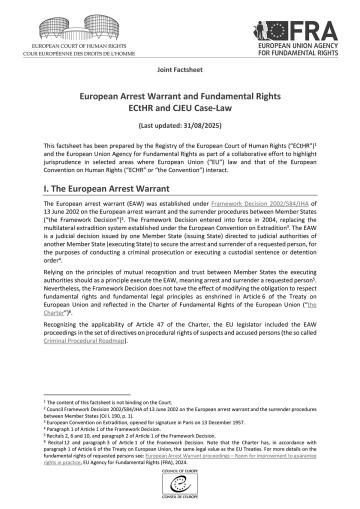
  • In brief / Factsheet
    1
    September
    2025
    This factsheet focuses on the European arrest warrant and EU Member States obligations to respect fundamental rights. EU law and the European Convention on Human Rights sometimes overlap. The publication clarifies where there are similar principles in different legislation and provides examples of case law. In collaboration, the EU Agency for Fundamental Rights and the European Court of Human Rights produced this short publication. It is designed to aid lawyers and policymakers in understanding and applying the jurisprudence in this area. The August 2025 version now contains recent case-law developments.