The events that took place in France and Belgium in January 2015 had tremendous impact across the European Union (EU) and beyond. In the immediate aftermath of the events in Paris, FRA collected responses across Europe, focusing on Jewish and Muslim community organisations, political leaders, civil society and the media. The current paper provides an overview of this material and should be regarded as a snapshot of a rapidly changing situation.
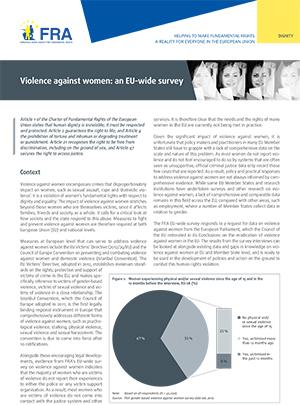
La presente scheda riporta alcuni esempi dei risultati dell’indagine, accanto alle considerazioni generali come possibili «vie da percorrere» per rispondere alla violenza contro le donne.
In 2009, the FRA conducted the first EU-wide study of the role that European memorial sites, museums and exhibitions play with respect to educating young Europeans about the Holocaust and human rights. The findings of the study were presented at a Conference in Auschwitz on the 27 January bringing together Education Ministers from across Europe.
National Human Rights Institutions (NHRIs) protect and promote human rights at the national level, tackling systemic problems and raising fundamental rights awareness. To equip NHRIs to perform their role well, they should have, among other qualities, independence, powers and a broad mandate, in accordance with the so-called ‘Paris Principles’ which were adopted by the United Nations General Assembly in 1993 and set forth the primary minimum standards for an effective NHRI.
The European Agency for Fundamental Rights (FRA) conducted European-wide research in 2009 on the contribution of memorial sites to Holocaust education and human rights education in the European Union (EU). This summary report, derived from the main report 'Discover the past for the future. The role of historical sites and museums in Holocaust education and human rights education in the EU', provides selected findings, discussion points and recommendations.
The EU plays a pioneering role in the protection of personal data. The Charter of Fundamental Rights of the EU enshrines the right to data protection as an autonomous fundamental right. Despite the underlying importance and centrality of the right to data protection in the EU, many deficiencies are present in the data protection system. This study on data protection identifies deficiencies in the EU Member States.


 Report / Paper / Summary31March2026
 Report / Paper / Summary12December2025
 Report / Paper / Summary8December2025
 Report / Paper / Summary11July2023