eu-charter

Χάρτης των Θεμελιωδών Δικαιωμάτων της ΕΕ

Άρθρο 26 - Ένταξη των ατόμων με αναπηρίες

Άρθρο 26 - Ένταξη των ατόμων με αναπηρίες

Η Ένωση αναγνωρίζει και σέβεται το δικαίωμα των ατόμων με αναπηρίες να επωφελούνται μέτρων που θα τους εξασφαλίζουν την αυτονομία, την κοινωνική και επαγγελματική ένταξη και τη συμμετοχή στον κοινοτικό βίο.

Επεξηγήσεισ

  • Text:

    Η αρχή που περιέχεται στο παρόν άρθρο στηρίζεται στο άρθρο 15 του Ευρωπαϊκού Κοινωνικού Χάρτη και εμπνέεται επίσης από το σημείο 26 του κοινοτικού Χάρτη των θεμελιωδών κοινωνικών δικαιωμάτων των εργαζομένων.

    Source:
    Επίσημη Εφημερίδα της Ευρωπαϊκής Ένωσης C 303/17 - 14.12.2007
    Preamble - Explanations relating to the Charter of Fundamental Rights:
    Οι κάτωθι παρατιθέμενες επεξηγήσεις καταρτίσθηκαν αρχικά υπ’ ευθύνη του Προεδρείου της Συνέλευσης που συνέταξε τον Χάρτη των Θεμελιωδών Δικαιωμάτων της Ευρωπαϊκής Ένωσης. Ενημερώθηκαν με ευθύνη του Προεδρείου της Ευρωπαϊκής Συνέλευσης, κατόπιν των αναπροσαρμογών που επήλθαν στο κείμενο του Χάρτη από τη Συνέλευση αυτή (ιδίως στα άρθρα 51 και 52) και των εξελίξεων του δικαίου της Ένωσης. Αν και οι επεξηγήσεις αυτές καθαυτές δεν έχουν νομική ισχύ, αποτελούν πολύτιμο εργαλείο ερμηνείας για την εξήγηση των διατάξεων του Χάρτη.

Nομολογία

Εθνικό συνταγματικό δίκαιο

42 results found

  • Constitution of the Italian Republic
    Χώρα:
    Italy

    Art. 3. All citizens have equal social dignity and are equal before the law, without distinction of sex, race, language, religion, political opinion, personal and
    social conditions. (...) Art. 38(...) Workers have the right to be assured adequate means for their needs and necessities in the case of accidents, illness, disability, old age and involuntary unemployment. Disabled and handicapped persons are entitled to receive education and vocational training. (...)

  • Basic Law for the Federal Republic of Germany
    Χώρα:
    Germany

    Article 3 (3) (…) No person shall be disfavoured because of disability.

  • Bundes-Verfassungsgesetz (B-VG)
    Χώρα:
    Austria

    Artikel 7 (1) Alle Staatsbürger sind vor dem Gesetz gleich. Vorrechte der Geburt, des Geschlechtes, des Standes, der Klasse und des Bekenntnisses sind ausgeschlossen. Niemand darf wegen seiner Behinderung benachteiligt werden. Die Republik (Bund, Länder und Gemeinden) bekennt sich dazu, die Gleichbehandlung von behinderten und nichtbehinderten Menschen in allen Bereichen des täglichen Lebens zu gewährleisten.

  • Constitution of Finland
    Χώρα:
    Finland

    Section 6 Equality (...) No one shall, without an acceptable reason, be treated differently from other persons on the ground of sex, age, origin, language, religion, conviction, opinion, health, disability or other reason that concerns his or her person. Section 17 Right to one's language and culture (...) The rights of persons using sign language and of persons in need of interpretation or translation aid owing to disability shall be guaranteed by an Act. Section 19 The right to social security Everyone shall be guaranteed by an Act the right to basic subsistence in the event of unemployment, illness, and disability and during old age as well as at the birth of a child or the loss of a provider. 

  • Constitution of Ireland
    Χώρα:
    Ireland

    Article 40.1 All citizens shall, as human persons, be held equal before the law. This shall not be held to mean that the State shall not in its enactments have due regard to differences of capacity, physical and moral, and of social function.

  • Constitution of Malta
    Χώρα:
    Malta

    Article 17(…) (2) Workers are entitled to reasonable insurance on a contributory basis for their requirements in case of accident, illness, disability, old-age and involuntary unemployment. (3) Disabled persons and persons incapable of work are entitled to education and vocational training.

  • Constitution of the Hellenic Republic
    Χώρα:
    Greece

    Article 21(2) Families with many children, disabled war and peace-time veterans, war victims, widows and orphans, as well as persons suffering from incurable bodily or mental ailments are entitled to the special care of the State. [...] (6) People with disabilities have the right to benefit from measures ensuring their selfsufficiency, professional integration and participation in the social, economic and political life of the Country.

  • Constitution of the Republic of Austria
    Χώρα:
    Austria

    Article 7(1) All nationals (Austrian citizens) are equal before the law. Privileges based upon birth, sex, estate, class or religion are excluded. No one shall be discriminated against because of his disability. The Republic (Federation, Laender and municipalities) commits itself to ensuring the equal treatment of disabled and non-disabled persons in all spheres of every-day life.

  • Constitution of the Republic of Bulgaria
    Χώρα:
    Bulgaria

     Art. 48 [...] (2) The State shall create conditions conducive to the exercising of the right to work by persons with physical and mental disabilities.

  • Constitution of the Republic of Croatia
    Χώρα:
    Croatia

    Article 58
    (2) The state shall devote special care to the protection of persons with disabilities and their inclusion in social life.
    (3) The state shall devote special care to the protection of Croatian war veterans and disabled Croatian war veterans, as well as the widows, parents and children of fallen Croatian war veterans.

  • Constitution of the Republic of Estonia
    Χώρα:
    Estonia

    Article 28. (…) Families with a large number of children as well as people with disabilities enjoy special care of the national government and of local authorities.

  • Constitution of the Republic of Latvia
    Χώρα:
    Latvia

    110. (..) The State shall provide special support to disabled children, children left without parental care or who have suffered from violence.

  • Constitution of the Republic of Lithuania
    Χώρα:
    Lithuania

    Article 52. The State shall guarantee its citizens the right to receive old-age and disability pensions, as well as social assistance in the event of unemployment, sickness, widowhood, the loss of the breadwinner, and in other cases provided for by law.

  • Constitution of the Republic of Poland
    Χώρα:
    Poland

    Article 68(...) 3. Public authorities shall ensure special health care to children, pregnant women, handicapped people and persons of advanced age.(...) Article 69 Public authorities shall provide, in accordance with statute, aid to disabled persons to ensure their subsistence, adaptation to work and social communication.

  • Constitution of the Republic of Poland
    Χώρα:
    Poland

    Article 68(...) 3. Public authorities shall ensure special health care to children, pregnant women, handicapped people and persons of advanced age.(...) Article 69 Public authorities shall provide, in accordance with statute, aid to disabled persons to ensure their subsistence, adaptation to work and social communication.

  • Costituzione della Repubblica Italiana
    Χώρα:
    Italy

    Art. 3. Tutti i cittadini hanno pari dignità sociale e sono eguali davanti alla legge, senza distinzione di sesso, di razza, di lingua, di religione, di opinioni politiche, di condizioni personali e sociali. Art. 38 (...) I lavoratori hanno diritto che siano preveduti ed assicurati mezzi adeguati alle loro esigenze di vita in caso di infortunio, malattia, invalidità e vecchiaia, disoccupazione involontaria. Gli inabili ed i minorati hanno diritto all'educazione e all'avviamento professionale. (...)

  • Czechia / Charter of Fundamental Rights and Freedoms
    Χώρα:
    Czechia

    Article 29 (1) Women, adolescents, and persons with health problems have the right to increased protection of their health at work and to special work conditions. (2) Adolescents and persons with health problems have the right to special protection in labour relations and to assistance in vocational training. (3) Detailed provisions shall be set by law.

  • Disability Act 2005
    Χώρα:
    Ireland

    An act to enable provision to be made for the assessment of health and education needs occasioned to persons with disabilities by their disabilities, to enable ministers of the government to make provision, consistent with the resources available to them and their obligations in relation to their allocation, for services to meet those needs, to provide for the preparation of plans by the appropriate ministers of the government in relation to the provision of certain of those, and certain other services, to provide for appeals by those persons in relation to the non-provision of those services, to make further and better provision in respect of the use by those persons of public buildings and their employment in the public service and thereby to facilitate generally access by such persons to certain such services and employment and to promote equality and social inclusion and to provide for related matters.

  • Eesti Vabariigi Põhiseadus
    Χώρα:
    Estonia

    § 28. (…) Lasterikkad pered ja puuetega inimesed on riigi ja kohalike omavalitsuste erilise hoole all.

  • Equal Treatment Act
    Χώρα:
    Estonia

    § 1. Purpose and scope of Act
    (1) The purpose of this Act is to ensure the protection of persons against discrimination on grounds of nationality (ethnic origin), race, colour, religion or other beliefs, age, disability or sexual orientation.
    (2) In order to achieve the purpose specified in subsection (1) of this section, this Act provides for:
    1) the principles of equal treatment;
    2) duties upon implementation and promotion of the principle of equal treatment;
    3) resolution of discrimination disputes.
    § 5. Disability
    For the purposes of this Act, disability is the loss of or an abnormality in an anatomical, physiological or mental structure or function of a person which has a significant and long-term unfavourable effect on the performance of everyday activities.

Δίκαιο της ΕΕ

3 results found

  • Community Charter of the Fundamental Social Rights of Workers (not in force)

    Disabled persons
    26. All disabled persons, whatever the origin and nature of their disablement, must be entitled to additional concrete measures aimed at improving their social and professional integration. These measures must concern, in particular, according to the capacities of the beneficiaries, vocational training,
    ergonomics, accessibility, mobility, means of transport and housing.

  • Directive (EU) 2019/882 of the European Parliament and of the Council of 17 April 2019 on the accessibility requirements for products and services

    .

  • Council Directive 2000/78/EC of 27 November 2000 establishing a general framework for equal treatment in employment and occupation

    Preamble  

    (2) The principle of equal treatment between women and men is well established by an important body of Community law, in particular in Council Directive 76/207/EEC of 9 February 1976 on the implementation of the principle of equal treatment for men and women as regards access to employment, vocational training and promotion, and working conditions(5).

    (3) In implementing the principle of equal treatment, the Community should, in accordance with Article 3(2) of the EC Treaty, aim to eliminate inequalities, and to promote equality between men and women, especially since women are often the victims of multiple discrimination.

    (4) The right of all persons to equality before the law and protection against discrimination constitutes a universal right recognised by the Universal Declaration of Human Rights, the United Nations Convention on the Elimination of All Forms of Discrimination against Women, United Nations Covenants on Civil and Political Rights and on Economic, Social and Cultural Rights and by the European Convention for the Protection of Human Rights and Fundamental Freedoms, to which all Member States are signatories. Convention No 111 of the International Labour Organisation (ILO) prohibits discrimination in the field of employment and occupation.

    (6) The Community Charter of the Fundamental Social Rights of Workers recognises the importance of combating every form of discrimination, including the need to take appropriate action for the social and economic integration of elderly and disabled people.

    (8) The Employment Guidelines for 2000 agreed by the European Council at Helsinki on 10 and 11 December 1999 stress the need to foster a labour market favourable to social integration by formulating a coherent set of policies aimed at combating discrimination against groups such as persons with disability. They also emphasise the need to pay particular attention to supporting older workers, in order to increase their participation in the labour force.

    (10) On 29 June 2000 the Council adopted Directive 2000/43/EC(6) implementing the principle of equal treatment between persons irrespective of racial or ethnic origin. That Directive already provides protection against such discrimination in the field of employment and occupation.

    (11) Discrimination based on religion or belief, disability, age or sexual orientation may undermine the achievement of the objectives of the EC Treaty, in particular the attainment of a high level of employment and social protection, raising the standard of living and the quality of life, economic and social cohesion and solidarity, and the free movement of persons.

    (12) To this end, any direct or indirect discrimination based on religion or belief, disability, age or sexual orientation as regards the areas covered by this Directive should be prohibited throughout the Community. This prohibition of discrimination should also apply to nationals of third countries but does not cover differences of treatment based on nationality and is without prejudice to provisions governing the entry and residence of third-country nationals and their access to employment and occupation.

    Article 1: Purpose

    The purpose of this Directive is to lay down a general framework for combating discrimination on the grounds of religion or belief, disability, age or sexual orientation as regards employment and occupation, with a view to putting into effect in the Member States the principle of equal treatment.

    Article 2: Concept of discrimination

    1. For the purposes of this Directive, the "principle of equal treatment" shall mean that there shall be no direct or indirect discrimination whatsoever on any of the grounds referred to in Article 1.

    2. For the purposes of paragraph 1:

    (a) direct discrimination shall be taken to occur where one person is treated less favourably than another is, has been or would be treated in a comparable situation, on any of the grounds referred to in Article 1;

    (b) indirect discrimination shall be taken to occur where an apparently neutral provision, criterion or practice would put persons having a particular religion or belief, a particular disability, a particular age, or a particular sexual orientation at a particular disadvantage compared with other persons unless:

    (i) that provision, criterion or practice is objectively justified by a legitimate aim and the means of achieving that aim are appropriate and necessary, or

    (ii) as regards persons with a particular disability, the employer or any person or organisation to whom this Directive applies, is obliged, under national legislation, to take appropriate measures in line with the principles contained in Article 5 in order to eliminate disadvantages entailed by such provision, criterion or practice.

    3. Harassment shall be deemed to be a form of discrimination within the meaning of paragraph 1, when unwanted conduct related to any of the grounds referred to in Article 1 takes place with the purpose or effect of violating the dignity of a person and of creating an intimidating, hostile, degrading, humiliating or offensive environment. In this context, the concept of harassment may be defined in accordance with the national laws and practice of the Member States.

    Article 5: Reasonable accommodation for disabled persons

    In order to guarantee compliance with the principle of equal treatment in relation to persons with disabilities, reasonable accommodation shall be provided. This means that employers shall take appropriate measures, where needed in a particular case, to enable a person with a disability to have access to, participate in, or advance in employment, or to undergo training, unless such measures would impose a disproportionate burden on the employer. This burden shall not be disproportionate when it is sufficiently remedied by measures existing within the framework of the disability policy of the Member State concerned.

    Article 9: Defence of rights

    1. Member States shall ensure that judicial and/or administrative procedures, including where they deem it appropriate conciliation procedures, for the enforcement of obligations under this Directive are available to all persons who consider themselves wronged by failure to apply the principle of equal treatment to them, even after the relationship in which the discrimination is alleged to have occurred has ended.

    2. Member States shall ensure that associations, organisations or other legal entities which have, in accordance with the criteria laid down by their national law, a legitimate interest in ensuring that the provisions of this Directive are complied with, may engage, either on behalf or in support of the complainant, with his or her approval, in any judicial and/or administrative procedure provided for the enforcement of obligations under this Directive.

    3. Paragraphs 1 and 2 are without prejudice to national rules relating to time limits for bringing actions as regards the principle of equality of treatment.

Διεθνές δίκαιο

8 results found

Προϊοντα

  • Periodic updates / Series
    28
    May
    2020
    The Coronavirus pandemic continues to interrupt everyday life in the EU in unprecedented ways. But the way it affects our societies is shifting. As governments gradually lift some of the measures put in place to contain the spread of COVID-19, new fundamental rights concerns arise: how to ensure that the rights to life and health are upheld as daily life transitions to a ‘new normal’. This Bulletin looks at declarations of states of emergency, or equivalent, and how they came under scrutiny. It considers the impact on fundamental rights in important areas of daily life, and includes a thematic focus on the processing of users’ data to help contain COVID-19, particularly by contact-tracing apps. It covers the period 21 March – 30 April 2020.
  • Report / Paper / Summary
    4
    December
    2018
    The European Union Agency for Fundamental Rights
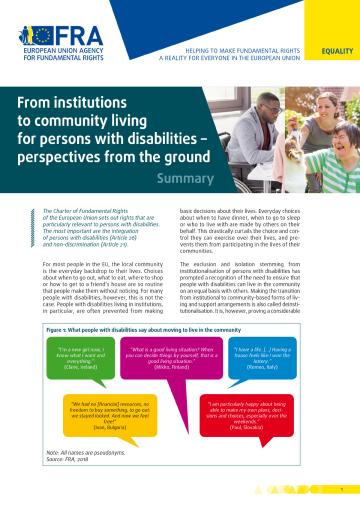
    (FRA) wanted to contribute to making steps to implement
    deinstitutionalisation more effective, by capturing
    concrete evidence of what is and what is
    not working on the ground. To do this, the agency
    conducted extensive fieldwork research in five EU
    Member States at different stages of the deinstitutionalisation
    process.
    This summary report presents the key findings of
    that fieldwork and the FRA opinions stemming from
    them.
  • Report / Paper / Summary
    4
    December
    2018
    The Convention on the Rights of Persons with Disabilities commits both the EU and all of its Member States to realising the right of persons with disabilities to live independently in the community – which includes achieving deinstitutionalisation for those residing in institutional settings. But much remains to be done to make this a reality in practice. This report presents the main insights gained during fieldwork on the drivers of and barriers to deinstitutionalisation. Focusing on the local level, it gives voice to a diverse set of actors – most importantly, to people with disabilities themselves.
  • Report / Paper / Summary
    12
    October
    2017
    This report assesses to what extent Member States have implemented the right to independent living, focusing on the effect commitments and funds are having on persons with disabilities’ daily lives. Taken together, the reports provide important insights that can support ongoing processes of change.
  • Report / Paper / Summary
    12
    October
    2017
    The transition from institution- to community-based support for persons with disabilities is a complex process that requires multifaceted efforts. These include putting in place commitments and structures for achieving deinstitutionalisation and measuring outcomes for persons with disabilities. This report shows that effectively funding the deinstitutionalisation process is a vital element.
  • Report / Paper / Summary
    12
    October
    2017
    Discussions are under way at the European Union (EU) and national levels about how best to realise the transition from institutional to community-based support. This report contributes to these by bringing together some of the key issues that have emerged from the EU Agency for Fundamental Rights’ (FRA) human rights indicators on Member States’ political and practical commitment to deinstitutionalisation.
  • Easy-to-read report
    2
    December
    2015
    This book will tell you about violence and children with disabilities. It looks at violence, where it happens, and why people are violent.
  • Report / Paper / Summary
    2
    December
    2015
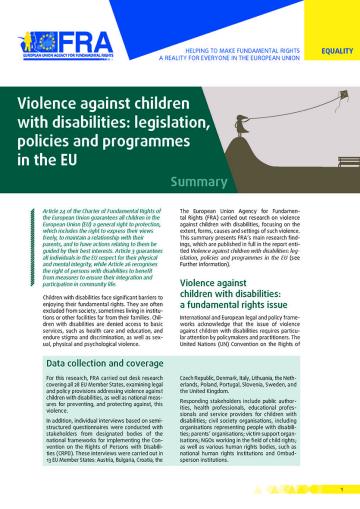
    Children with disabilities face significant barriers to enjoying their fundamental rights. They are often excluded from society, sometimes living in facilities far from their families. They are also denied access to basic services, such as health care and education, and endure stigma and discrimination, as well as sexual, physical and psychological violence. This summary report outlines relevant international and European standards and reviews national legislation and policies addressing violence against children with disabilities. The summary also explores the extent and different causes, settings and forms of such violence, and presents measures and initiatives to prevent it.
  • Report / Paper / Summary
    2
    December
    2015
    Children with disabilities face significant barriers to enjoying their fundamental rights. They are often excluded from society, sometimes living in facilities far from their families. They are also denied access to basic services, such as health care and education, and endure stigma and discrimination, as well as sexual, physical and psychological violence. FRA scrutinised the important but underreported issue of violence against children with disabilities, carrying out desk research and conducting interviews with knowledgeable stakeholders. This report presents the results of that research.
  • Report / Paper / Summary
    11
    May
    2015
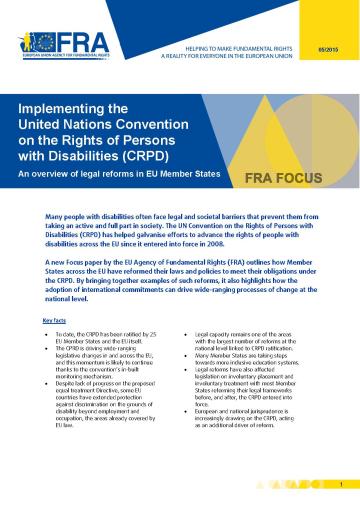
    A new Focus paper by the EU Agency of Fundamental Rights (FRA) outlines how Member States across the EU have reformed their laws and policies to meet their obligations under the CRPD. By bringing together examples of such reforms, it also highlights how the adoption of international commitments can drive wide-ranging processes of change at the national level.