eu-charter

Cairt um Chearta Bunúsacha an Aontais Eorpaigh

Airteagal 8 - Sonraí pearsanta a chosaint

Airteagal 8 - Sonraí pearsanta a chosaint

1. Tá ag gach duine an ceart go ndéanfar na sonraí pearsanta a bhaineann leis nó léi a chosaint.

2. Ní mór sonraí den sórt sin a phróiseáil go cóir ar mhaithe le cuspóirí sonracha agus ar bhonn thoiliú an duine i dtrácht nó ar bhonn dlisteanach éigin eile arna leagan síos le dlí. Tá ag gach duine an ceart chun rochtain a fháil ar shonraí atá bailithe agus a bhaineann leis nó léi, agus an ceart go ndéanfar na sonraí sin a cheartú.

3. Beidh comhlíonadh na rialacha sin faoi réir a rialaithe ag údarás neamhspleách.

Mínithe

  • Text:

    Tá an tAirteagal seo bunaithe ar Airteagal 286 den Chonradh ag bunú an Chomhphobail Eorpaigh agus ar Threoir 95/46/CE ó Pharlaimint na hEorpa agus ón gComhairle maidir le daoine aonair a chosaint i ndáil le sonraí pearsanta a phróiseáil agus maidir le saorghluaiseacht sonraí den sórt sin (IO L 281, 23.11.1995, lch. 31), agus freisin ar Airteagal 8 den CECD agus ar Choinbhinsiún Chomhairle na hEorpa an 28 Eanáir 1981 um Chosaint Daoine Aonair maidir le hUathphróiseáil Sonraí Pearsanta, atá daingnithe ag na Ballstáit uile. Gabhann Airteagal 16 den Chonradh ar Fheidhmiú an Aontais Eorpaigh agus Airteagal 39 den Chonradh ar an Aontas Eorpach ionad Airteagal 286 den Chonradh CE anois. Tagraítear freisin do Rialachán (CE) Uimh. 45/2001 ó Pharlaimint na hEorpa agus ón gComhairle maidir le daoine aonair a chosaint, maidir le sonraí pearsanta a phróiseáil ag institiúidí agus ag comhlachtaí Comhphobail agus maidir le saorghluaiseacht na sonraí sin (IO L 8, 12.1.2001, lch. 1). Tá coinníollacha agus teorainneacha sa Treoir agus sa Rialachán thuasluaite maidir le feidhmiú an chirt chun sonraí pearsanta a chosaint.

    Source:
    Iris Oifigiúil an Aontais Eorpaigh C 303/17 - 14.12.2007
    Preamble - Explanations relating to the Charter of Fundamental Rights:
    Ullmhaíodh na mínithe seo i dtosach faoi údarás Praesidium an Choinbhinsiúin a dhréachtaigh an Chairt um Chearta Bunúsacha an Aontais Eorpaigh. Tugadh suas chun dáta iad faoi chúram Praesidium an Choinbhinsiúin Eorpaigh i bhfianaise na gcoigeartuithe dréachtaithe a rinne an Coinbhinsiún sin ar théacs na Cairte (go háirithe ar Airteagail 51 agus 52) agus i bhfianaise an fhoráis a tháinig ar dhlí an Aontais. Cé nach bhfuil stádas dlí acu iontu féin, is mór is fiú iad mar uirlis léirithe arb é is aidhm di forálacha na Cairte a shoiléiriú.

Cásdlí

National Constitutional Law

68 results found

  • Sweden / Instrument of Government
    Tír:
    Sweden

    Chapter 2 - Fundamental rights and freedoms:

    Article 3 No record in a public register concerning a Swedish citizen may be based without his or her consent solely on his or her political opinions;

    Article 6 Everyone shall likewise be protected against body searches, house searches and other such invasions of privacy, against examination of mail or other confidential correspondence, and against eavesdropping and the recording of telephone conversations or other confidential communications. In addition to what is laid down in paragraph one, everyone shall be protected in their relations with the public institutions against significant invasions of their personal privacy, if these occur without their consent and involve the surveillance or systematic monitoring of the individual’s personal circumstances.

  • 1992. évi LXIII. törvény a személyes adatok védelméről és a közérdekű adatok nyilvánosságáról
    Tír:
    Hungary
  • Act LXIII Of 1992 On the Protection of Personal Data and the Publicity of Data of Public Interest
    Tír:
    Hungary
  • Act n°78-17 of 6 January 1978 on Data Processing, Data Files and Individual Liberties
    Tír:
    France

    Article 1Information technology should be at the service of every citizen. Its development shall take place in the context of international co-operation. It shall not violate human identity, human rights, privacy, or individual or public liberties. Article 2 This Act shall apply to automatic processing of personal data as well as non-automatic processing of personal data that is or may be contained in a personal data filing system, with the exception of processing carried out for the exercise of exclusively private activities, where the data controller meets the conditions provided for in Article 5 (...)

  • Act No. 428 of 2002 on personal data protection
    Tír:
    Slovakia

    Section 1(1) This Act regulatesa) protection of personal data of natural persons in the course of their processing, b) principles of personal data processing, c) security of personal data, d) protection of the rights of data subjects, e) transborder personal data flow, f) registration and keeping of records of filing systems, g) establishment, status and scope of powers of the Office for Personal Data Protection of the Slovak Republic (hereinafter the “Office”) (...)

  • Act of 8 December 1992 on the protection of privacy in relation to the processing of personal data
    URL:
    Tír:
    Belgium


  • Act of August 29, 1997 on the Protection of Personal Data
    Tír:
    Poland

    Article 1 1. Any person has a right to have his/her personal data protected. 2. The processing of personal data can be carried out in the public interest, the interest of the data subject, or the interest of any third party, within the scope and subject to the procedure provided for by the Act.

  • Act on the Protection of Personal Data
    Tír:
    Portugal
  • Bundesdatenschutzgesetz
    Tír:
    Germany

    § 1 BDSG Zweck und Anwendungsbereich des Gesetzes (1) Zweck dieses Gesetzes ist es, den Einzelnen davor zu schützen, dass er durch den Umgang mit seinen personenbezogenen Daten in seinem Persönlichkeitsrecht beeinträchtigt wird. (2) Dieses Gesetz gilt für die Erhebung, Verarbeitung und Nutzung personenbezogener Daten durch 1. öffentliche Stellen des Bundes, 2. öffentliche Stellen der Länder, soweit der Datenschutz nicht durch Landesgesetz geregelt ist und soweit sie a) Bundesrecht ausführen oder b) als Organe der Rechtspflege tätig werden und es sich nicht um Verwaltungsangelegenheiten handelt, 3. nicht-öffentliche Stellen, soweit sie die Daten unter Einsatz von Datenverarbeitungsanlagen verarbeiten, nutzen oder dafür erheben oder die Daten in oder aus nicht automatisierten Dateien verarbeiten, nutzen oder dafür erheben, es sei denn, die Erhebung, Verarbeitung oder Nutzung der Daten erfolgt ausschließlich für persönliche oder familiäre Tätigkeiten. (3) Soweit andere Rechtsvorschriften des Bundes auf personenbezogene Daten einschließlich deren Veröffentlichung anzuwenden sind, gehen sie den Vorschriften dieses Gesetzes vor. Die Verpflichtung zur Wahrung gesetzlicher Geheimhaltungspflichten oder von Berufs- oder besonderen Amtsgeheimnissen, die nicht auf gesetzlichen Vorschriften beruhen, bleibt unberührt. (4) Die Vorschriften dieses Gesetzes gehen denen des Verwaltungsverfahrensgesetzes vor, soweit bei der Ermittlung des Sachverhalts personenbezogene Daten verarbeitet werden. (5) Dieses Gesetz findet keine Anwendung, sofern eine in einem anderen Mitgliedstaat der Europäischen Union oder in einem anderen Vertragsstaat des Abkommens über den Europäischen Wirtschaftsraum belegene verantwortliche Stelle personenbezogene Daten im Inland erhebt, verarbeitet oder nutzt, es sei denn, dies erfolgt durch eine Niederlassung im Inland. Dieses Gesetz findet Anwendung, sofern eine verantwortliche Stelle, die nicht in einem Mitgliedstaat der Europäischen Union oder in einem anderen Vertragsstaat des Abkommens über den Europäischen Wirtschaftsraum belegen ist, personenbezogene Daten im Inland erhebt, verarbeitet oder nutzt. Soweit die verantwortliche Stelle nach diesem Gesetz zu nennen ist, sind auch Angaben über im Inland ansässige Vertreter zu machen. Die Sätze 2 und 3 gelten nicht, sofern Datenträger nur zum Zweck des Transits durch das Inland eingesetzt werden. § 38 Abs. 1 Satz 1 bleibt unberührt.

  • Constitution of Finland
    Tír:
    Finland

    Section 10 The right to privacy Everyone's private life, honour and the sanctity of the home are guaranteed. More detailed provisions on the protection of personal data are laid down by an Act. (...)

  • Constitution of the Hellenic Republic
    Tír:
    Greece

    Article 9A All persons have the right to be protected from the collection, processing and use, especially by electronic means, of their personal data, as specified by law. The protection of personal data is ensured by an independent authority, which is constituted and operates as specified by law.

  • Constitution of the Republic of Estonia
    Tír:
    Estonia

    Article 42. Government agencies, local authorities, and their officials may not gather or store information about the beliefs of a citizen of Estonia against the citizen’s free will.
    Article 44. (…) Pursuant to a procedure provided by law, any citizen of Estonia is entitled to access information about himself or herself held by government agencies and local authorities and in government and local authority archives. This right may be circumscribed pursuant to law to protect the rights and freedoms of others, to protect the confidentiality of a child’s filiation, and in the interests of preventing a criminal offence, apprehending the offender, or of ascertaining the truth in a criminal case.
    Unless otherwise provided by law, citizens of foreign states and stateless persons in Estonia enjoy the rights specified in paragraphs two and three of this section equally with citizens of Estonia.

  • Constitution of the Republic of Lithuania
    Tír:
    Lithuania

    Article 22. Private life shall be inviolable. Personal correspondence, telephone conversations, telegraph messages, and other communications shall be inviolable. Information concerning the private life of a person may be collected only upon a justified court decision and only according to the law. The law and courts shall protect everyone from arbitrary or unlawful interference with his private and family life, as well as from encroachment upon his honour and dignity.

  • Constitution of the Republic of Poland
    Tír:
    Poland

    Article 47 Everyone shall have the right to legal protection of his private life and family life, of his honour and good reputation and to make decisions about his personal life. Article 51 1. No one may be obliged, except on the basis of statute, to disclose information concerning his person. 2. Public authorities shall not acquire, collect or make accessible information on citizens other than that which is necessary in a democratic state ruled by law. 3. Everyone shall have a right of access to official documents and data collections concerning him. Limitations upon such rights may be established by statute. 4. Everyone shall have the right to demand the correction or deletion of untrue or incomplete information, or information acquired by means contrary to statute. 5. Principles and procedures for collection of and access to information shall be specified by statute. 

  • Czechia / Charter of Fundamental Rights and Freedoms
    Tír:
    Czechia

    Article 10 (3) Everyone has the right to be protected from the unauthorized gathering, public revelation,
    or other misuse of her personal data.

  • Data Protection (Amendment) Act 2003
    Tír:
    Ireland
  • Data Protection Act 1988
    Tír:
    Ireland
  • Data Protection Act, Cap. 440 of the Laws of Malta, 2002
    Tír:
    Malta

    3. The provisions of this Act shall apply to the processing of personal data, wholly or partly, by automated means and to such processing other than by automated means where such personal data forms part of a filing system or is intended to form part of a filing system..

  • Datenschutzgesetz 2000 - DSG 2000
    Tír:
    Austria

    § 1. (1) Jedermann hat, insbesondere auch im Hinblick auf die Achtung seines Privat- und Familienlebens, Anspruch auf Geheimhaltung der ihn betreffenden personenbezogenen Daten, soweit ein schutzwürdiges Interesse daran besteht. Das Bestehen eines solchen Interesses ist ausgeschlossen, wenn Daten infolge ihrer allgemeinen Verfügbarkeit oder wegen ihrer mangelnden Rückführbarkeit auf den Betroffenen einem Geheimhaltungsanspruch nicht zugänglich sind. (2) Soweit die Verwendung von personenbezogenen Daten nicht im lebenswichtigen Interesse des Betroffenen oder mit seiner Zustimmung erfolgt, sind Beschränkungen des Anspruchs auf Geheimhaltung nur zur Wahrung überwiegender berechtigter Interessen eines anderen zulässig, und zwar bei Eingriffen einer staatlichen Behörde nur auf Grund von Gesetzen, die aus den in Art. 8 Abs. 2 der Europäischen Konvention zum Schutze der Menschenrechte und Grundfreiheiten (EMRK), BGBl. Nr. 210/1958, genannten Gründen notwendig sind. Derartige Gesetze dürfen die Verwendung von Daten, die ihrer Art nach besonders schutzwürdig sind, nur zur Wahrung wichtiger öffentlicher Interessen vorsehen und müssen gleichzeitig angemessene Garantien für den Schutz der Geheimhaltungsinteressen der Betroffenen festlegen. Auch im Falle zulässiger Beschränkungen darf der Eingriff in das Grundrecht jeweils nur in der gelindesten, zum Ziel führenden Art vorgenommen werden. (3) Jedermann hat, soweit ihn betreffende personenbezogene Daten zur automationsunterstützten Verarbeitung oder zur Verarbeitung in manuell, dh. ohne Automationsunterstützung geführten Dateien bestimmt sind, nach Maßgabe gesetzlicher Bestimmungen 1. das Recht auf Auskunft darüber, wer welche Daten über ihn verarbeitet, woher die Daten stammen, und wozu sie verwendet werden, insbesondere auch, an wen sie übermittelt werden; 2. das Recht auf Richtigstellung unrichtiger Daten und das Recht auf Löschung unzulässigerweise verarbeiteter Daten. (4) Beschränkungen der Rechte nach Abs. 3 sind nur unter den in Abs. 2 genannten Voraussetzungen zulässig. (5) Gegen Rechtsträger, die in Formen des Privatrechts eingerichtet sind, ist, soweit sie nicht in Vollziehung der Gesetze tätig werden, das Grundrecht auf Datenschutz mit Ausnahme des Rechtes auf Auskunft auf dem Zivilrechtsweg geltend zu machen. In allen übrigen Fällen ist die Datenschutzkommission zur Entscheidung zuständig, es sei denn, daß Akte der Gesetzgebung oder der Gerichtsbarkeit betroffen sind.

  • Eesti Vabariigi Põhiseadus
    Tír:
    Estonia

    § 42. Riigiasutused, kohalikud omavalitsused ja nende ametiisikud ei tohi Eesti kodaniku vaba tahte vastaselt koguda ega talletada andmeid tema veendumuste kohta.
    § 44. (...) Eesti kodanikul on õigus seaduses sätestatud korras tutvuda tema kohta riigiasutustes ja kohalikes omavalitsustes ning riigi ja kohalike omavalitsuste arhiivides hoitavate andmetega. Seaduse alusel võib seda õigust piirata teiste inimeste õiguste ja vabaduste ning lapse põlvnemise saladuse kaitseks, samuti kuriteo tõkestamise, kurjategija tabamise või kriminaalmenetluses tõe väljaselgitamise huvides. (...)

Dlí an AE

37 results found

  • Regulation (EU) No 524/2013 of the European Parliament and of the Council of 21 May 2013 on online dispute resolution for consumer disputes and amending Regulation (EC) No 2006/2004 and Directive 2009/22/EC

    Preamble:

    (1) Article 169(1) and point (a) of Article 169(2) of the Treaty on the Functioning of the European Union (TFEU) provide that the Union is to contribute to the attainment of a high level of consumer protection through measures adopted pursuant to Article 114 TFEU. Article 38 of the Charter of Fundamental Rights of the European Union provides that Union policies are to ensure a high level of consumer protection.

    (2) In accordance with Article 26(2) TFEU, the internal market is to comprise an area without internal frontiers in which the free movement of goods and services is ensured. In order for consumers to have confidence in and benefit from the digital dimension of the internal market, it is necessary that they have access to simple, efficient, fast and low-cost ways of resolving disputes which arise from the sale of goods or the supply of services online. This is particularly important when consumers shop cross-border.‘

    (4) Fragmentation of the internal market impedes efforts to boost competitiveness and growth. Furthermore, the uneven availability, quality and awareness of simple, efficient, fast and low-cost means of resolving disputes arising from the sale of goods or provision of services across the Union constitutes a barrier within the internal market which undermines consumers’ and traders’ confidence in shopping and selling across borders.‘

    (13) The definition of ‘consumer’ should cover natural persons who are acting outside their trade, business, craft or profession. However, if the contract is concluded for purposes partly within and partly outside the person’s trade (dual purpose contracts) and the trade purpose is so limited as not to be predominant in the overall context of the supply, that person should also be considered as a consumer.‘

    (14) The definition of ‘online sales or service contract’ should cover a sales or service contract where the trader, or the trader’s intermediary, has offered goods or services through a website or by other electronic means and the consumer has ordered those goods or services on that website or by other electronic means. This should also cover cases where the consumer has accessed the website or other information society service through a mobile electronic device such as a mobile telephone.

    (26) The right to an effective remedy and the right to a fair trial are fundamental rights laid down in Article 47 of the Charter of Fundamental Rights of the European Union. ODR is not intended to and cannot be designed to replace court procedures, nor should it deprive consumers or traders of their rights to seek redress before the courts. This Regulation should not, therefore, prevent parties from exercising their right of access to the judicial system.

    (35) This Regulation respects fundamental rights and observes the principles recognised in particular by the Charter of Fundamental Rights of the European Union and specifically Articles 7, 8, 38 and 47 thereof.

    Article 1: Subject matter
    The purpose of this Regulation is, through the achievement of a high level of consumer protection, to contribute to the proper functioning of the internal market, and in particular of its digital dimension by providing a European ODR platform (‘ODR platform’) facilitating the independent, impartial, transparent, effective, fast and fair out-of-court resolution of disputes between consumers and traders online.

    Article 12: Processing of personal data

    1. Access to information, including personal data, related to a dispute and stored in the database referred to in Article 11 shall be granted, for the purposes referred to in Article 10, only to the ADR entity to which the dispute was transmitted in accordance with Article 9. Access to the same information shall be granted also to ODR contact points, in so far as it is necessary, for the purposes referred to in Article 7(2) and (4).

    2. The Commission shall have access to information processed in accordance with Article 10 for the purposes of monitoring the use and functioning of the ODR platform and drawing up the reports referred to in Article 21. It shall process personal data of the users of the ODR platform in so far as it is necessary for the operation and maintenance of the ODR platform, including for the purposes of monitoring the use of the ODR platform by ADR entities and ODR contact points.

    3. Personal data related to a dispute shall be kept in the database referred to in paragraph 1 of this Article only for the time necessary to achieve the purposes for which they were collected and to ensure that data subjects are able to access their personal data in order to exercise their rights, and shall be automatically deleted, at the latest, six months after the date of conclusion of the dispute which has been transmitted to the ODR platform in accordance with point (iii) of point (c) of Article 10. That retention period shall also apply to personal data kept in national files by the ADR entity or the ODR contact point which dealt with the dispute concerned, except if the procedural rules applied by the ADR entity or any specific provisions of national law provide for a longer retention period.

    4. Each ODR advisor shall be regarded as a controller with respect to its data processing activities under this Regulation, in accordance with point (d) of Article 2 of Directive 95/46/EC, and shall ensure that those activities comply with national legislation adopted pursuant to Directive 95/46/EC in the Member State of the ODR contact point hosting the ODR advisor.

    5. Each ADR entity shall be regarded as a controller with respect to its data processing activities under this Regulation, in accordance with point (d) of Article 2 of Directive 95/46/EC, and shall ensure that those activities comply with national legislation adopted pursuant to Directive 95/46/EC in the Member State where the ADR entity is established.

    6. In relation to its responsibilities under this Regulation and the processing of personal data involved therein, the Commission shall be regarded as a controller in accordance with point (d) of Article 2 of Regulation (EC) No 45/2001.

    Article 13: Data confidentiality and security

    1. ODR contact points shall be subject to rules of professional secrecy or other equivalent duties of confidentiality laid down in the legislation of the Member State concerned.

    2. The Commission shall take the appropriate technical and organisational measures to ensure the security of information processed under this Regulation, including appropriate data access control, a security plan and a security incident management, in accordance with Article 22 of Regulation (EC) No 45/2001.

    Article 14: Consumer information

    1. Traders established within the Union engaging in online sales or service contracts, and online marketplaces established within the Union, shall provide on their websites an electronic link to the ODR platform. That link shall be easily accessible for consumers. Traders established within the Union engaging in online sales or service contracts shall also state their e-mail addresses.

    2. Traders established within the Union engaging in online sales or service contracts, which are committed or obliged to use one or more ADR entities to resolve disputes with consumers, shall inform consumers about the existence of the ODR platform and the possibility of using the ODR platform for resolving their disputes. They shall provide an electronic link to the ODR platform on their websites and, if the offer is made by e-mail, in that e-mail. The information shall also be provided, where applicable, in the general terms and conditions applicable to online sales and service contracts.

    3. Paragraphs 1 and 2 of this Article shall be without prejudice to Article 13 of Directive 2013/11/EU and the provisions on consumer information on out-of-court redress procedures contained in other Union legal acts, which shall apply in addition to this Article.

    4. The list of ADR entities referred to in Article 20(4) of Directive 2013/11/EU and its updates shall be published in the ODR platform.

    5. Member States shall ensure that ADR entities, the centres of the European Consumer Centres Network, the competent authorities defined in Article 18(1) of Directive 2013/11/EU, and, where appropriate, the bodies designated in accordance with Article 14(2) of Directive 2013/11/EU provide an electronic link to the ODR platform.

    6. Member States shall encourage consumer associations and business associations to provide an electronic link to the ODR platform.

    7. When traders are obliged to provide information in accordance with paragraphs 1 and 2 and with the provisions referred to in paragraph 3, they shall, where possible, provide that information together.

  • Directive (EU) 2016/1148 of the European Parliament and of the Council of 6 July 2016 concerning measures for a high common level of security of network and information systems across the Union

    Article 2 - Processing of personal data
    ‘1. Processing of personal data pursuant to this Directive shall be carried out in accordance with Directive 95/46/EC.
    2. Processing of personal data by Union institutions and bodies pursuant to this Directive shall be carried out in accordance with Regulation (EC) No 45/2001.‘

  • Directive (EU) 2016/680 of the European Parliament and of the Council of 27 April 2016 on the protection of natural persons with regard to the processing of personal data by competent authorities for the purposes of the prevention, investigation, detec...

    Article 1 - Subject-matter and objectives
    ‘1. This Directive lays down the rules relating to the protection of natural persons with regard to the processing of personal data by competent authorities for the purposes of the prevention, investigation, detection or prosecution of criminal offences or the execution of criminal penalties, including the safeguarding against and the prevention of threats to public security.
    2. In accordance with this Directive, Member States shall:
    (a) protect the fundamental rights and freedoms of natural persons and in particular their right to the protection of personal data‘
    Article 4
    ‘Principles relating to processing of personal data
    1. Member States shall provide for personal data to be:
    (a) processed lawfully and fairly;
    (b) collected for specified, explicit and legitimate purposes and not processed in a manner that is incompatible with those purposes;
    (c) adequate, relevant and not excessive in relation to the purposes for which they are processed;
    (d) accurate and, where necessary, kept up to date; every reasonable step must be taken to ensure that personal data that are inaccurate, having regard to the purposes for which they are processed, are erased or rectified without delay;
    (e) kept in a form which permits identification of data subjects for no longer than is necessary for the purposes for which they are processed;
    (f) processed in a manner that ensures appropriate security of the personal data, including protection against unauthorised or unlawful processing and against accidental loss, destruction or damage, using appropriate technical or organisational measures.
    2. Processing by the same or another controller for any of the purposes set out in Article 1(1) other than that for which the personal data are collected shall be permitted in so far as:
    (a) the controller is authorised to process such personal data for such a purpose in accordance with Union or Member State law; and
    (b) processing is necessary and proportionate to that other purpose in accordance with Union or Member State law.
    3. Processing by the same or another controller may include archiving in the public interest, scientific, statistical or historical use, for the purposes set out in Article 1(1), subject to appropriate safeguards for the rights and freedoms of data subjects.
    4. The controller shall be responsible for, and be able to demonstrate compliance with, paragraphs 1, 2 and 3.‘

    Article 57. Penalties:
    Member States shall lay down the rules on penalties applicable to infringements of the provisions adopted pursuant to this Directive and shall take all measures necessary to ensure that they are implemented. The penalties provided for shall be effective, proportionate and dissuasive.

  • Directive (EU) 2016/681 of the European Parliament and of the Council of 27 April 2016 on the use of passenger name record (PNR) data for the prevention, detection, investigation and prosecution of terrorist offences and serious crime

    Article 13 - Protection of personal data
    ‘1. Each Member State shall provide that, in respect of all processing of personal data pursuant to this Directive, every passenger shall have the same right to protection of their personal data, rights of access, rectification, erasure and restriction and rights to compensation and judicial redress as laid down in Union and national law and in implementation of Articles 17, 18, 19 and 20 of Framework Decision 2008/977/JHA. Those Articles shall therefore apply.‘

  • Directive 2013/40/EU of the European Parliament and of the Council of 12 August 2013 on attacks against information systems and replacing Council Framework Decision 2005/222/JHA

    Preamble
    (30) The protection of personal data is a fundamental right in accordance with Article 16(1) TFEU and Article 8 of the Charter on Fundamental Rights of the European Union. Therefore, any processing of personal data in the context of the implementation of this Directive should fully comply with the relevant Union law on data protection

    Article 5 - Illegal data interference
    ‘Member States shall take the necessary measures to ensure that deleting, damaging, deteriorating, altering or suppressing computer data on an information system, or rendering such data inaccessible, intentionally and without right, is punishable as a criminal offence, at least for cases which are not minor.‘

    Article 6 - Illegal interception
    ‘Member States shall take the necessary measures to ensure that intercepting, by technical means, non-public transmissions of computer data to, from or within an information system, including electromagnetic emissions from an information system carrying such computer data, intentionally and without right, is punishable as a criminal offence, at least for cases which are not minor.‘

  • Regulation (EU) 2016/679 of the European Parliament and of the Council of 27 April 2016 on the protection of natural persons with regard to the processing of personal data and on the free movement of such data, and repealing Directive 95/46/EC (General...

    Article 1 - Subject-matter and objectives
    ‘1. This Regulation lays down rules relating to the protection of natural persons with regard to the processing of personal data and rules relating to the free movement of personal data.
    2. This Regulation protects fundamental rights and freedoms of natural persons and in particular their right to the protection of personal data.
    3. The free movement of personal data within the Union shall be neither restricted nor prohibited for reasons connected with the protection of natural persons with regard to the processing of personal data.‘

  • Regulation (EU) 2016/794 of the European Parliament and of the Council of 11 May 2016 on the European Union Agency for Law Enforcement Cooperation (Europol) and replacing and repealing Council Decisions 2009/371/JHA, 2009/934/JHA, 2009/935/JHA, 2009/93...

    Article 28 - General data protection principles
    ‘1. Personal data shall be:
    (a) processed fairly and lawfully;
    (b) collected for specified, explicit and legitimate purposes and not further processed in a manner incompatible with those purposes. Further processing of personal data for historical, statistical or scientific research purposes shall not be considered incompatible provided that Europol provides appropriate safeguards, in particular to ensure that data are not processed for any other purposes;
    (c) adequate, relevant, and limited to what is necessary in relation to the purposes for which they are processed;
    (d) accurate and kept up to date; every reasonable step must be taken to ensure that personal data that are inaccurate, having regard to the purposes for which they are processed, are erased or rectified without delay;
    (e) kept in a form which permits identification of data subjects for no longer than necessary for the purposes for which the personal data are processed; and
    (f) processed in a manner that ensures appropriate security of personal data.‘
    Article 31 - Time-limits for the storage and erasure of personal data
    ‘1. Personal data processed by Europol shall be stored by Europol only for as long as is necessary and proportionate for the purposes for which the data are processed.‘
    Article 36 - Right of access for the data subject
    ‘1. Any data subject shall have the right, at reasonable intervals, to obtain information on whether personal data relating to him or her are processed by Europol.‘

Dlí idirnáisiúnta

3 results found

  • European Convention on Human Rights - Article 8

    Article 8 – Right to respect for private and family life

    1. Everyone has the right to respect for his private and family life, his home and his correspondence.

    2. There shall be no interference by a public authority with the exercise of this right except such as is in accordance with the law and is necessary in a democratic society in the interests of national security, public safety or the economic well-being of the country, for the prevention of disorder or crime, for the protection of health or morals, or for the protection of the rights and freedoms of others.

  • Council of Europe, Guidelines on the protection of individuals with regard to the processing of personal data in a world of big data

    ‘The present Guidelines recommend measures that Parties, controllers and processors should take to prevent the potential negative impact of the use of Big Data on human dignity, human rights, and fundamental individual and collective freedoms, in particular with regard to personal data protection.
    Given the nature of Big Data and its uses, the application of some of the traditional principles of data processing (e.g. the principle of data minimisation, purpose limitation, fairness and transparency, and free, specific and informed consent) may be challenging in this technological scenario. These Guidelines therefore suggest a specific application of the principles of Convention 108, to make them more effective in practice in the Big Data context.‘

  • OECD, Guidelines governing the Protection of Privacy and Transborder Flows of Personal Data

    ‘2. These Guidelines apply to personal data, whether in the public or private sectors, which, because of the manner in which they are processed, or because of their nature or the context in which they are used, pose a risk to privacy and individual liberties.‘
    ‘3. The principles in these Guidelines are complementary and should be read as a whole. They should not be interpreted:
    a) as preventing the application of different protective measures to different categories of personal data, depending upon their nature and the context in which they are collected, stored, processed or disseminated; or
    b) in a manner which unduly limits the freedom of expression‘
    ‘7. There should be limits to the collection of personal data and any such data should be obtained by lawful and fair means and, where appropriate, with the knowledge or consent of the data subject.‘
    ‘9. The purposes for which personal data are collected should be specified not later than at the time of data collection and the subsequent use limited to the fulfilment of those purposes or such others as are not incompatible with those purposes and as are specified on each occasion of change of purpose.‘

Táirgí

  • Handbook / Guide / Manual
    19
    August
    2022
    DA, ET, FI, LT, PT, SV versions now available
    30 July 2024
    The Charter of Fundamental Rights of the European Union (CFREU) is the EU’s bill of rights. It always binds the EU institutions and the Member States when they act within the scope of EU law. However, it is far from easy to assess whether a concrete case falls within the scope of EU law. This is why it is necessary to provide training and training material to legal professionals so that they can understand the field of application of the Charter as laid out in its Article 51. This trainer’s manual aims at providing guidance on both the organisation and the implementation of such trainings based on a series of case studies,
    which will be extended in the future.
  • Handbook / Guide / Manual
    25
    May
    2018
    Arabic version now available
    18 July 2024
    The rapid development of information technology has exacerbated the need for robust personal data protection, the right to which is safeguarded by both European Union (EU) and Council of Europe (CoE) instruments. Safeguarding this important right entails new and significant challenges as technological advances expand the frontiers of areas such as surveillance, communication interception and data storage. This handbook is designed to familiarise legal practitioners not specialised in data protection with this emerging area of the law.
  • Fundamental Rights Report
    8
    June
    2022
    All language versions now available
    14 September 2022
    Tógadh céimeanna chun tosaigh agus céimeanna ar gcúl araon i ndáil le cosaint ceart bunúsach sa bhliain 2021. I dTuarascáil um Chearta Bunúsacha 2022 FRA, déantar athbhreithniú ar mhórfhorbairtí sa réimse agus sainaithnítear éachtaí agus ábhair imní nach mór déileáil leo fós. San fhoilseachán seo, cuirtear i láthair tuairimí ó FRA faoi na príomhfhorbairtí sna réimsí téamacha a chumhdaítear agus déantar achoimre ar an bhfianaise a thacaíonn leis na tuairimí sin.
  • Leaflet / Flyer
    16
    January
    2020
    All language versions now available
    16 December 2021
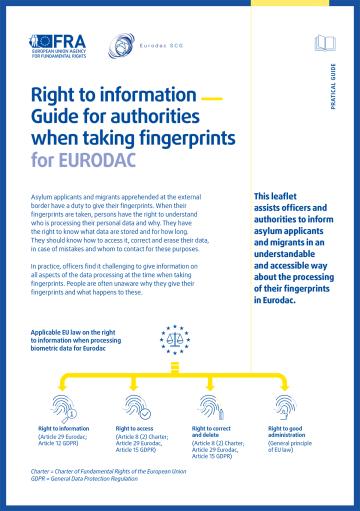
    This leaflet assists officers and authorities to inform asylum applicants and migrants in an understandable and accessible way about the processing of their fingerprints in Eurodac.
  • Report / Paper / Summary
    21
    January
    2021
    All language versions now available
    16 April 2021
    National Human Rights Institutions (NHRIs) are a vital part of the country-level human rights protection system. By raising awareness, providing advice, monitoring and holding authorities to account, they have a central role in navigating the great human rights challenges of our day – tackling both persistent concerns like discrimination and inequality, and novel issues such as the rights implications of artificial intelligence and of the COVID-19 pandemic.
  • Handbook / Guide / Manual
    5
    December
    2018
    Last versions available are EL and NL
    11 March 2021
    This guide explains what profiling is, the legal frameworks that regulate it, and why conducting profiling lawfully is both necessary to comply with fundamental rights and crucial for effective policing and border management. The guide also provides practical guidance on how to avoid unlawful profiling in police and border management operations.
  • Report / Paper / Summary
    3
    September
    2020
    Summary version now available
    21 January 2021
    National Human Rights Institutions (NHRIs) are a vital part of the country-level human rights protection system. This report, published 10 years after FRA’s first in-depth study on NHRIs, looks at such bodies in the EU, as well as the Republic of North Macedonia, the Republic of Serbia, and the United Kingdom of Great Britain and Northern Ireland. It explores relevant developments, challenges to their effectiveness and ways to maximise their impact.
  • Fundamental Rights Report
    11
    June
    2026
    The Fundamental Rights Report: Challenges and Achievements in 2025 is FRA’s flagship annual publication. It provides an overview of the state of fundamental rights in the EU and highlights selected critical developments from 2025. This year, it focuses on four areas: rights protection in a rapidly changing digital environment; the housing crisis and rising homelessness rates; employment challenges for people from non-EU countries; and the implementation of the EU Charter of Fundamental Rights. The publication is a valuable resource for those seeking to stay informed about the EU’s shifting landscape of fundamental rights.
  • In brief / Factsheet
    22
    May
    2026
    This factsheet examines the "right to be forgotten" within the context of EU law and the European Convention on Human Rights. It emphasizes the intersections of these legal frameworks, with particular attention to case law from the Court of Justice of the European Union (CJEU) and the European Court of Human Rights (ECtHR).
  • Report / Paper / Summary
    11
    May
    2026
    The ability to communicate freely and privately online is protected under Article 7 of the EU Charter; it is a crucial enabler of other fundamental rights, particularly as the world becomes increasingly digital. This paper presents results from an EU-wide survey about people’s views on encryption of their private online communication. It looks, for example, at concern regarding access by outside actors to information shared when using private messaging applications. The results indicate that people highly value encryption and at the same time have concerns about online communications being accessed without their knowledge or permission. It provides a timely evidence base to shape policy discussions on internal security and digital privacy.
    FRA, 2026