Search and rescue operations in the Central Mediterranean and fundamental rights - June 2026 update

TABLE OF CONTENT
Search inside this publication
At least 1,430 people died or went missing while attempting to cross the Mediterranean during the first six months of 2026, according to the International Organization for Migration (IOM). The first six weeks of 2026 marked the deadliest start of the year in the Mediterranean since IOM began collecting data in 2014 (see FRA, Migration and fundamental rights bulletin – 1/2026).
The IOM recorded over 35,000 dead or missing migrants in the Mediterranean between 2014 and mid-2026. These figures are likely an underestimation, due to underreporting and limited official data. The data denote that search and rescue (SAR) capacity at sea is not sufficient to respond effectively to the great number of migrants and refugees trying to reach Europe on unseaworthy boats.
Respect for fundamental rights in the context of SAR operations also requires adherence to the principle of non-refoulement. It bans Member States from returning rescued migrants to a risk of persecution, torture or other serious harm.
Such risk is particularly high in Libya. A February 2026 report on human rights violations against migrants and refugees in Libya by the office of the United Nations High Commissioner for Human Rights and the United Nations Support Mission in Libya called for a moratorium on interceptions at sea and returns to Libya until adequate human rights safeguards are put in place. Still, the number of migrants intercepted by Libya at sea and brought back to Libyan ports increased from 21,800 in 2024 to 27,000 in 2025, according to IOM’s 11-17 January 2026 weekly update.
EU Member States on the other side of the Mediterranean have supported Libya in strengthening its SAR capacity for the past several years. The United Nations Special Rapporteur on the Human Rights of Migrants recommended in August 2025 that cooperation agreements should strengthen the SAR regime. He noted that they must also include safe disembarkation of rescued people in accordance with international human rights and refugee law.
The European Court of Human Rights (ECtHR), in S.S. and Others v. Italy (No. 21660/18, 20 May 2025), examined the financial and logistical support provided by Italy to Libya in managing immigration. It found that this support did not trigger its responsibility for the alleged ill-treatment of migrants whom the Libyan coastguards rescued in international waters. It also concluded that the Italian Maritime Rescue Coordination Centre in Rome – which allowed a Libyan ship to carry out the rescue operation – did not have control over the Libyan crew’s conduct. Though it was noted that refugees and migrants in Libya were at risk of torture, slavery and discrimination, in this specific case, Italy, lacked effective control over the persons concerned. The ECtHR found the case inadmissible.
The nature of the law relating to cooperation with third countries in border management is continuously evolving. As a result, FRA published practical guidance in 2016 for Member States on how to mitigate the risk of being held accountable for violations of the principle of non-refoulement. The guidance focuses on border management situations where the responsibility for possible violations of fundamental rights is unclear. This particularly includes activities that are carried out with the assistance of third countries.
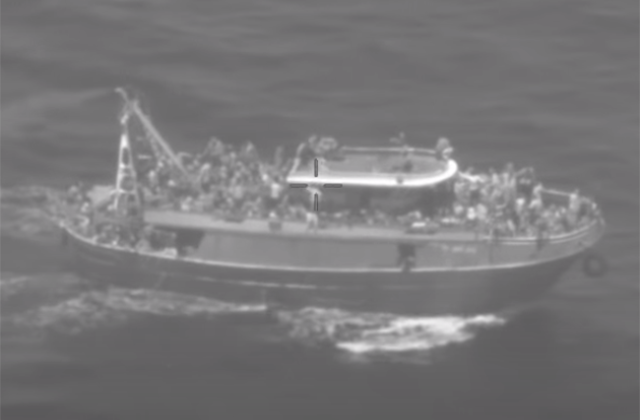
The European Border and Coast Guard Agency (Frontex) operates small airplanes and drones for maritime surveillance over the high sea of the Central Mediterranean. When it spots a boat with migrants in distress, it informs the relevant maritime rescue coordination centres in both the EU and the responsible third countries. Depending on the incident location, this may trigger a rescue by the Libyan coast guard and disembarkation in Libya.
To mitigate the risk of Frontex being found in violation of the non-refoulement principle, the Frontex fundamental rights officer proposed, among other things, that information on sightings also be transferred to non-governmental organisation (NGO) SAR vessels in the vicinity (see Frontex, 2023 Annual report of the fundamental rights officer, at 1.7). In his 2025 annual report, the fundamental rights officer informed that Frontex’s sharing of sightings with third countries accused of committing serious human rights violations against migrants continued to be an issue of serious concern.
NGOs deploying SAR vessels informed FRA that they increasingly receive alerts from Frontex. The fundamental rights officer deploys fundamental rights monitors to the Frontex operation room in charge of maritime surveillance. The monitors advise Frontex on how to act in compliance with fundamental rights.
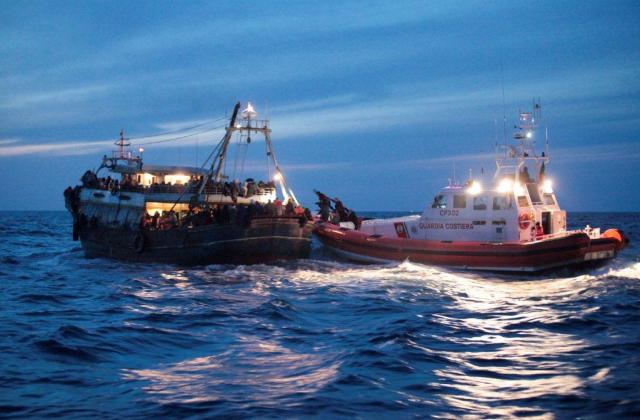
SAR vessels deployed by NGOs in the Central Mediterranean continue to play a life-saving role. They rescue migrants and refugees in emergency situations at sea and bring them to a safe port, in most cases in Italy. At sea, NGOs are increasingly exposed to use of force by Libyan authorities for not following their orders to stop the rescue as soon as Libyan vessels arrive or to bring the rescued migrants to Libya. Examples of such incidents involved the vessels Ocean Viking in August 2025, Sea-Watch 5 in September 2025 and May 2026 as well as the Louise Michel in December 2025. An alliance of 13 NGOs, the Justice Fleet, declared in November 2025 not to follow orders by the Libyan coast guard, which they deemed contrary to international law.
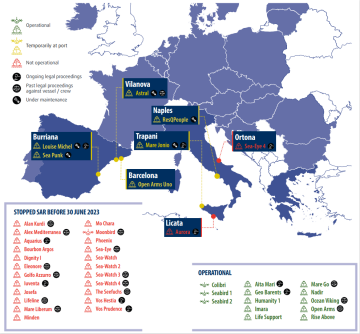
NGO SAR vessels continue to face administrative and criminal proceedings in the EU. In July 2025, a coalition of 32 NGOs denounced the systematic obstruction of their SAR operations which has resulted in fines and the administrative detention of their vessels in Italian ports.
This FRA update provides an overview of the administrative and criminal proceedings against NGOs engaged in SAR activities in the Central Mediterranean.
FRA has been issuing such annual overviews since 2018. The report series reflects broader concerns about shrinking civic space, as highlighted in FRA’s 2026 civic space update and specifically concerning SAR actors in FRA’s 2023 civic space report.
This update is compiled based on desk research and information FRA received from NGOs deploying SAR vessels and reconnaissance aircraft. Public sources are hyperlinked. All links were checked on 20 July 2026.
The report covers only the Central Mediterranean. The other example in Europe, where civil society rescues migrants and refugees in distress at sea, is the English Channel. There, the Royal National Lifeboat Institution (RNLI) —a 200-year-old British charity established to save lives at sea— carries out rescue operations to assist people possibly in danger at sea when tasked by the British Coastguard. The RNLI is not facing any legal proceedings for their rescue work, unlike NGOs deploying SAR vessels in the Mediterranean. This shows that a different approach and attitude is possible.