Highlights

  • Report / Paper / Summary
    27
    January
    2026
    This report looks at antisemitism in the EU, focusing on what can be done to address gaps in recording and inconsistencies in data collection. It highlights existing tools and guidance for Member States to improve their recording systems. The analysis is based on official administrative data and information from publicly available sources across EU Member States, as well as Albania, North Macedonia, and Serbia. Detailed country overviews are available for all countries covered. Antisemitism has been monitored by FRA since 2004. This report builds on the 2024 publication, ‘Jewish People’s Experiences and Perceptions of Antisemitism’.
  • Report / Paper / Summary
    27
    November
    2025
    This report looks at the breadth and depth of violence and neglect faced by people with disabilities living in institutions. It highlights the shortcomings by EU Member States in preventing violence and protecting those who are at a higher risk of experiencing it, in line with the UN Convention on the Rights of Persons with Disabilities. Based on research across all EU Member States and FRA observer candidate countries, the report calls for better protection, stronger prevention of violence, and clear accountability. It urges the EU and its Member States to implement their obligations around equality and fundamental rights.
  • Data explorer
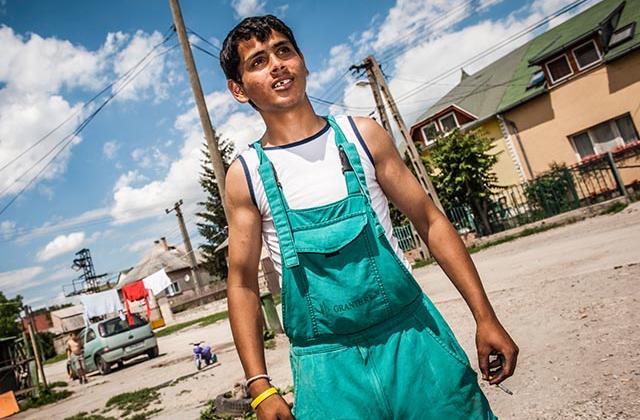
    FRA’s 2024 survey on Roma and Travellers in Albania, Bulgaria, Czechia, France, Greece, Hungary, Ireland, Italy, North Macedonia, Portugal, Romania, Serbia and Spain collected information from 10,126 respondents living in private households who self-identify as Roma or Traveller, are 16 or older and have lived in the survey countries for at least the 12 months before the survey.
  • Report / Paper / Summary
    25
    October
    2024
    Racism towards Muslims is increasing in countries across the EU. Muslims face racial discrimination and racist harassment because of their religion, skin colour or ethnic background. This report shows a sharp rise since the last survey in 2016.
    Prodotti
    23
    September
    2020
    This report presents findings from FRA’s 2019 survey on Roma and Travellers in Belgium, France, Ireland, the Netherlands, Sweden and the United Kingdom. The survey included interviews with almost 4,700 Roma and Travellers, collecting information on more than 8,200 individuals living in their households.
    Although many steps have been taken in recent years to change LGBTI people’s lives for the better in the EU, there is still a long way to go, notes FRA Director Michael O'Flaherty in this video message to Athens Pride 2020.
    In his latest vlog, FRA Director Michael O'Flaherty speaks about the devastating effects of the Covid-19 pandemic on the Roma community. Roma children are in danger of losing almost a whole year of schooling. It’s like losing a generation. It’s robbing children of the one place where they can have hope and dream the same dreams of every other child.
    10
    September
    2020
    Antisemitism can be expressed in the form of verbal and physical attacks, threats, harassment, discrimination and unequal treatment, property damage and graffiti or other forms of speech or text, including on the internet. Antisemitic incidents and hate crimes violate fundamental rights, especially the right to human dignity, the right to equality of treatment and the freedom of thought, conscience and religion.
    28
    August
    2020
    FRA’s second survey on LGBTI people in the EU, North Macedonia and Serbia surveyed almost 140,000 participants. This technical report presents a detailed overview of the survey methodology used by FRA when collecting the survey data.
    29
    July
    2020
    As we enter the second half of 2020, the constraints on our daily lives brought about by the Coronavirus pandemic have become a firm reality. New local lockdowns and the reintroduction of restrictive measures prompted by fresh outbreaks of the virus are a stark reminder that COVID-19 continues to shape our lives – and our enjoyment of fundamental rights – in profound ways. There is compelling evidence of how the pandemic has exacerbated existing challenges in our societies. This FRA Bulletin outlines some of the measures EU Member States adopted to safely reopen their societies and economies while continuing to mitigate the spread of COVID-19. It highlights the impact these measures may have on civil, political and socioeconomic rights.
    30
    June
    2020
    The Coronavirus pandemic continues to interrupt everyday life in the EU in unprecedented ways. But the way it affects our societies is shifting. As governments gradually lift some of the measures put in place to contain the spread of COVID-19, new fundamental rights concerns arise: how to ensure that the rights to life and health are upheld as daily life transitions to a ‘new normal’. This Bulletin looks at declarations of states of emergency, or equivalent, and how they came under scrutiny. It considers
    the impact on fundamental rights in important areas of daily life, and includes a thematic focus on the pandemic's impact on older people.
    In this video message to the Equality2020 conference on 29 June, FRA Director Michael O'Flaherty speaks about our shared struggle for a Europe that honours everybody in their diversity, in their equality and in their dignity.
    In this video message FRA Director Michael O'Flaherty speaks about LGBTI equality on the occasion of the Global Pride 2020:
    https://www.globalpride2020.org/
    11
    June
    2020
    Now available in all 24 official EU languages
    12 August 2020
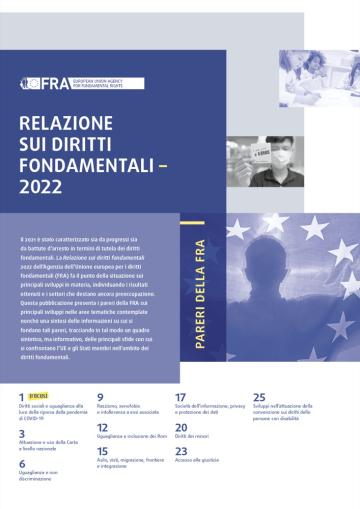
    Il 2019 è stato caratterizzato sia da progressi che da
    battute d’arresto in termini di tutela dei diritti
    fondamentali. La Relazione sui diritti fondamentali
    2020 dell’Agenzia dell’Unione europea per i diritti
    fondamentali (FRA) fa il punto della situazione sui
    principali sviluppi in materia, individuando i risultati
    ottenuti e i settori che destano ancora preoccupazione.
    Questa pubblicazione presenta i pareri della FRA sui
    principali sviluppi nelle aree tematiche contemplate
    nonché una sintesi delle informazioni su cui si fondano
    tali pareri, tracciando così un quadro sintetico ma
    informativo delle principali sfide con cui si confrontano
    l’UE e gli Stati membri nell’ambito dei diritti
    fondamentali.
    11
    June
    2020
    FRA’s Fundamental Rights Report 2020 reviews major developments in the field in 2019, identifying both achievements and areas of concern. It also presents FRA’s opinions on these developments, including a synopsis of the evidence supporting these opinions. This year’s focus chapter explores how to unlock the full potential of the EU Charter of Fundamental Rights.
    28
    May
    2020
    The Coronavirus pandemic continues to interrupt everyday life in the EU in unprecedented ways. But the way it affects our societies is shifting. As governments gradually lift some of the measures put in place to contain the spread of COVID-19, new fundamental rights concerns arise: how to ensure that the rights to life and health are upheld as daily life transitions to a ‘new normal’. This Bulletin looks at declarations of states of emergency, or equivalent, and how they came under scrutiny. It considers the impact on fundamental rights in important areas of daily life, and includes a thematic focus on the processing of users’ data to help contain COVID-19, particularly by contact-tracing apps. It covers the period 21 March – 30 April 2020.
    Today, the European Union Agency for Fundamental Rights launches the second LGBTI survey, mapping the experience of what it is to be LGBTI in the EU.
    A total of 139,799 persons aged 15 years or older who describe themselves as lesbian, gay, bisexual, trans or intersex (LGBTI) completed the online EU-LGBTI II Survey in all EU Member States and the candidate countries of North Macedonia and Serbia.
    In 2019 the EU Agency for Fundamental Rights (FRA) carried out the world’s biggest ever survey of lesbian, gay, bisexual, trans and intersex people’s life experiences. Almost 140,000 LGBTI people told us about their lives – in their own words.
    11
    May
    2020
    In recent years, thousands of girls and boys have reached Europe without their parents, and sought international protection. Many of them experienced violence, abuse and neglect in their home countries, and while in transit. They have the right to be protected in line with the provisions of the UN Convention on the Rights of the Child, the European Convention on Human Rights, and European Union law. This report explores the challenges and good practices gathered in the implementation of such relocation programmes. Based on information FRA collected in 10 EU Member States, it aims to help national authorities to support the relocation of unaccompanied children by taking measures that are fully rights compliant and practically feasible.
    Based on the lessons learned from relocation
    experiences and on existing international and EU legal
    standards, FRA has developed a number of practical
    suggestions for the adjustment of relocation efforts to
    the protection needs of unaccompanied children. This
    guidance aims to be a practical tool for Member States
    that wish to engage in the relocation of unaccompanied
    children and in any future responsibility-sharing
    mechanisms, and to gain knowledge on how this can
    be done while respecting the child’s best interests.
    8
    April
    2020
    The outbreak of COVID-19 affects people’s daily life in the 27 EU Member States. As the number of infected people in the EU territory began to mount rapidly in February and March, governments put in place a raft of measures – often introduced in a period of only a few days – in an effort to contain the spread of the virus. Many of these measures reflect how, in exceptional emergency situations, the urgent need to save lives justifies restrictions on other rights, such as the freedom of movement and of assembly. This report outlines some of the measures EU Member States have put in place to protect public health during the COVID-19 pandemic. It covers the period 1 February – 20 March 2020.
    Michael O'Flaherty talks in his vlog about the human rights aspects in the context of the Coronavirus epidemic and introduces FRA's new report.
    17
    March
    2020
    The EU Agency for Fundamental Rights (FRA) urges Member States to agree on a simple and practical workflow as soon as possible, to avoid lack of clarity and delays in the relocation process. This paper provides practical suggestions on relocation of unaccompanied children from Greece, building on lessons learned from previous mandatory and voluntary relocation schemes. The paper provides FRA input on the initiative of the European Commission and a group of Member States to relocate unaccompanied children.