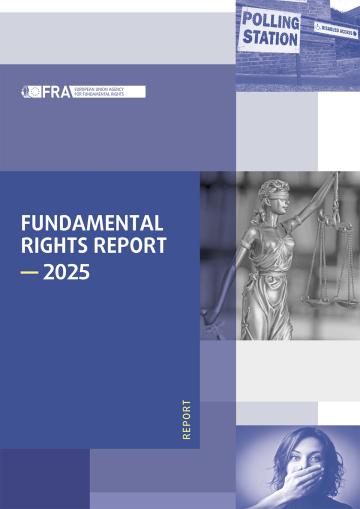
This publication is an excerpt from the Fundamental Rights Report 2025, the annual report of the European Union Agency for Fundamental Rights (FRA). It presents selected critical developments in fundamental rights in 2024, as well as the key findings and FRA opinions from the report’s chapters.
The Fundamental Rights Report 2025 is the annual report of the European Union Agency for Fundamental Rights (FRA). It provides an overview of the state of fundamental rights in the EU and highlights selected critical developments and trends in 2024. The report covers issues such as inclusive elections, gender-based violence, and the implementation of the EU Charter of Fundamental Rights. It presents FRA’s opinions on these developments, setting out the actions that the EU and Member States should take. This annual publication is a valuable resource for those seeking to stay informed about the EU’s shifting landscape of fundamental rights.
In recent years, the EU has taken steps to improve child protection, yet some Member States do not have an integrated approach. FRA first produced an overview of child protection systems in the EU in 2014, and an update in 2023. The data is published in FRA’s ‘Mapping of Child Protection Systems in the EU – Update 2023’. This report completements the 2023 update with comparative analysis and provides greater detail on children in vulnerable situations, care and the participation of children in matters affecting them. It also offers guidance on creating comprehensive frameworks that ensure that children’s rights are respected.
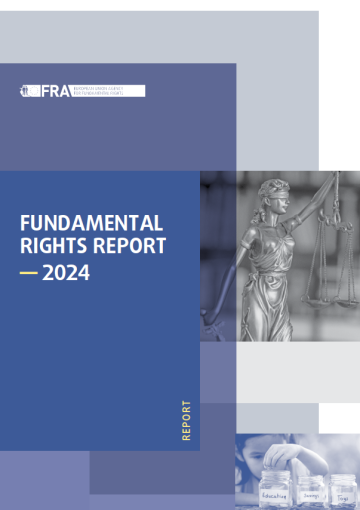
FRA’s Fundamental Rights Report 2024 analyses the year’s developments in fundamental rights. It focuses on the most pressing fundamental rights concerns facing Europe in 2023: the cost-of-living crisis, rights concerns at the EU’s external borders and migration, and threats to democracy. Re-structured, this year’s new approach is a shorter and sharper analysis. It also presents FRA’s opinions on these developments, including a summary of the evidence supporting these opinions.
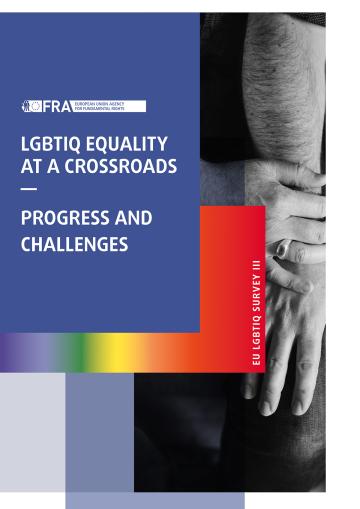
FRA’s third LGBTIQ survey shows that people still experience hate-motivated violence and discrimination. Trans and intersex people face even greater victimisation. Yet, signs of progress show that the EU’s and Member States’ efforts can positively affect people’s lives. More LGBTIQ people are open about their sexual orientation, gender identity, gender expression and sex characteristics.
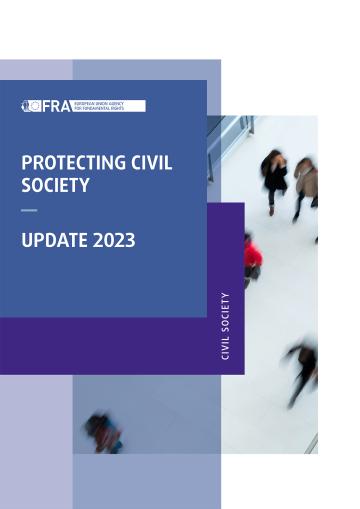
Civil society organisations struggle to maintain an environment safe from threats and attacks. FRA’s sixth annual update on civic space explores the challenges for organisations across the EU. While there has been significant development since FRA began monitoring the situation in 2018, civil society organisations remain under immense pressure. Abusive lawsuits and attacks against those involved in migrant search and rescue at sea are just some of the challenges identified. This report presents ways forward to protect civil society and human rights.
Across the world, human rights defenders protect and uphold human rights in some of the most challenging situations. In some countries they face worrying levels of threats and attacks, intimidation and harassment. This report outlines how human rights defenders can enter and stay in the EU when they need protection. It suggests how EU institutions and Member States could use the flexibility in existing legal provisions and provide shelter for defenders who seek protection.
Following yet another recent tragic shipwreck and loss of life in the Mediterranean, this short report sets out examples of actions the EU could take to meet its obligations to protect the right to life and prevent more deaths at sea. As part of the work that the EU Agency for Fundamental Rights (FRA) does on upholding fundamental rights in asylum and return procedures, this report calls for better protection for shipwreck survivors, and prompt and independent investigations. It sets out measures that EU Member States should take to improve search and rescue efforts and provide legal pathways to safety to prevent deaths at sea.
FRA’s Fundamental Rights Report 2023 reviews major developments in the field in 2022, identifying both achievements and areas of concern. It also presents FRA’s opinions on these developments, including a synopsis of the evidence supporting these opinions.
This report provides a partial update on the findings of the 2017 European Union Agency for Fundamental Rights (FRA) report Surveillance by intelligence services: Fundamental rights safeguards and remedies in the EU. It was prepared at the request of the European Parliament, which asked FRA to update its 2017 findings to support the work of its committee of inquiry to investigate the use of Pegasus and equivalent surveillance spyware (PEGA).
Directive 2012/29/EU represents a milestone in the development of victims’ rights. It establishes minimum standards for the rights, support and protection of victims of crime. It defines the scope of support services, guarantees the right to effective protection against secondary victimisation and comprehensively regulates the measures required for this purpose. This report covers three core components underpinning victims’ rights: support services, crime reporting, and protection from secondary and repeat victimisation. Examples highlight the relevant legal provisions in Member States and how specific rights under the Victims’ Rights Directive work in practice.
Artificial intelligence is everywhere and affects everyone – from deciding what content people see on their social media feeds to determining who will receive state benefits. AI technologies are typically based on algorithms that make predictions to support or even fully automate decision-making.
Civil society organisations face diverse challenges across the European Union. FRA’s report on Protecting civic space in the EU presents the agency’s findings on these challenges. It was issued in September of 2021. This summary presents the Key findings and FRA opinions outlined in the report.
Civil society is a key component of Europe’s fundamental rights architecture. From supporting people affected by the pandemic to helping those fleeing the war in Ukraine, civil society plays a crucial role in upholding people’s rights. In so doing, it contributes to a healthy rule of law culture. FRA’s civic space report provides an overview of the many ways in which civil society contributes to the checks and balances that underpin the rule of law.
Children are full-fledged holders of rights. They are beneficiaries of all human and fundamental rights and subjects of special regulations, given their specific characteristics. This handbook aims to illustrate how European law and case law accommodate the specific interests and needs of children. It also considers the importance of parents and guardians or other legal representatives and makes reference, where appropriate, to situations in which rights and responsibilities are most prominently vested in children’s carers. It is a point of reference on both European Union (EU) and Council of Europe (CoE) law related to these subjects, explaining how each issue is regulated under EU law, including the Charter of Fundamental Rights of the European Union, as well as under the European Convention on Human Rights, the European Social Charter and other CoE instruments.
Civil society organisations play a vital role in promoting fundamental rights, but they face diverse challenges across the European Union. This report presents FRA’s findings on a range of such challenges. The findings are based on research, and on two online consultations with civil society organisations, carried out in 2020.
This paper presents statistical survey data for the EU on how often people are stopped by the police, in what kind of situations they are stopped, the action taken by the police during stops, and views on whether or not the police acted respectfully.
This summary presents the main insights from FRA’s second main report based on its Fundamental Rights Survey. The survey collected data from around 35,000 people about their experiences, perceptions and opinions on a range of issues that are variously encompassed by human rights.
This is the second main report from FRA’s Fundamental Rights Survey, which collected data from 35,000 people on a range of issues. This report focuses on respondents’ experiences as victims of selected types of crime, including violence, harassment, and property crime. The report also examines how often these crimes are reported to the police, and presents further details relating to harassment and violence, such as the perpetrators and where the incidents took place.
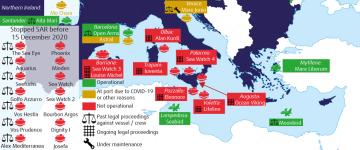
In 2020 (until 15 December), the International Organization for Migration estimated that about 1,054 people have died or gone missing while crossing the Mediterranean Sea to reach Europe to escape war or persecution or to pursue a better life. This is an average of almost three people per day. In the past years, a significant number of migrants in distress at sea have been rescued by civil society vessels deployed with a humanitarian mandate to reduce fatalities and bring rescued migrants to safety. Since 2018, however, national authorities initiated some 50 administrative and criminal proceedings against crew members or vessels, also seizing the latter. In some cases, rescue vessels were blocked in harbours due to flag issues or the inability to meet maritime safety-related and other technical requirements.