Prezentul ghid explică ce este crearea de profiluri, cadrele juridice care o reglementează și motivele pentru care utilizarea profilurilor în mod legal este necesară pentru respectarea drepturilor fundamentale și, totodată, esențială pentru eficiența activității polițienești și de gestionare a frontierelor. De asemenea, ghidul oferă îndrumări practice care să ajute la evitarea situațiilor în care utilizarea profilurilor în cadrul operațiunilor poliției și ale autorităților de gestionare a frontierelor este ilegală.
V tejto príručke sa vysvetľuje, čo je profilovanie, akými právnymi rámcami sa riadi, a prečo vykonávanie profilovania v súlade so zákonom je nutné na dodržiavanie základných práv, ako aj na účely efektívnej policajnej práce a riadenia hraníc. V príručke sa uvádzajú tiež praktické usmernenia týkajúce sa toho, ako zabrániť nezákonnému profilovaniu v policajných operáciách a operáciách riadenia hraníc.
V tem priročniku je pojasnjeno, kaj je profiliranje, kateri pravni okviri ga urejajo ter zakaj je zakonitost profiliranja potrebna zaradi spoštovanja temeljnih pravic ter ključna za učinkovito policijsko delo in upravljanje meja. Priročnik vsebuje tudi praktične smernice o tem, kako se izogniti nezakonitemu profiliranju pri policijskih operacijah in operacijah upravljanja meja.
I denna vägledning förklaras vad profilering innebär, vilken rättslig ram som utgör dess grund och varför en laglig profilering både är nödvändig för att uppfylla de grundläggande rättigheterna och helt avgörande för att effektivisera polisarbetet och gränsförvaltningen. Vägledningen innehåller även praktiska riktlinjer om hur olaglig profilering kan undvikas vid insatser inom polisverksamheten och gränsförvaltningen.
The Convention on the Rights of Persons with Disabilities commits both the EU and all of its Member States to realising the right of persons with disabilities to live independently in the community – which includes achieving deinstitutionalisation for those residing in institutional settings. But much remains to be done to make this a reality in practice. This report presents the main insights gained during fieldwork on the drivers of and barriers to deinstitutionalisation. Focusing on the local level, it gives voice to a diverse set of actors – most importantly, to people with disabilities themselves.
Almost twenty years after adoption of EU laws forbidding discrimination, people of African descent in the EU face widespread and entrenched prejudice and exclusion. This report outlines selected results from FRA's second large-scale EU-wide survey on migrants and minorities (EU-MIDIS II) carried out in 2016. It examines the experiences of almost 6,000 people of African descent in 12 EU Member States.
This report presents the main insights gained during the EU Fundamental Rights Agency’s project on local engagement for Roma inclusion, which explores how to best involve Roma in integration efforts at the local level. Bringing together local authorities and residents, especially Roma, it investigated what aspects work, which ones do not, and why this is the case.
Antisemitism can be expressed in the form of verbal and physical attacks, threats,
harassment, discrimination and unequal treatment, property damage and graffiti or other
forms of speech or text, including on the internet. The present report provides an overview of data on antisemitism as recorded by
international organisations and by official and unofficial sources in the 28 European
Union (EU) Member States, based on their own definitions and categorisations.
The EU Agency for Fundamental Rights’ 2018 Fundamental Rights Forum
brought together more than 700 human rights champions at a time of
widening social divisions and increasingly polarised politics across
Europe.
Le Forum des droits 2018 de l’Agence des
droits fondamentaux de l’Union européenne
a rassemblé plus de 700 champions des
droits de l’homme à l’heure où les divisions
sociales s’élargissent et où les politiques
sont de plus en plus polarisées en Europe.
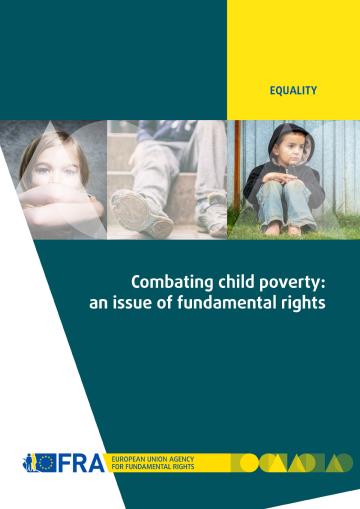
Almost 25 million children under 18 are at risk of poverty or social exclusion in the EU. Poverty deprives children of educational
opportunities, childcare, access to health care, adequate food and housing, family support and even protection from violence.
This report outlines data and survey findings that highlight the magnitude of child poverty in the EU, but also presents tools
available to counter this phenomenon and keep track of progress made.
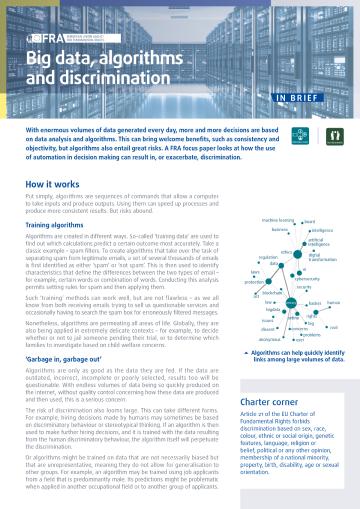
With enormous volumes of data generated every day, more and more decisions are based on data analysis and algorithms. This can bring welcome benefits, such as consistency and objectivity, but algorithms also entail great risks. A FRA focus paper looks at how the use of automation in decision making can result in, or exacerbate, discrimination.
In November 2017, the European Commission requested FRA’s support in evaluating the impact on fundamental rights of the European Border Surveillance System (Eurosur) Regulation. Further to this request, FRA reviewed the work of the European Border and Coast Guard Agency (Frontex) and analysed cooperation agreements concluded by EU Member States with third countries which are relevant for the exchange of information for the purposes of Eurosur. This report presents the main findings of such review.
The founding treaties, the EU Charter of Fundamental Rights and secondary EU law all provide for EU citizens’ freedom to move and reside freely in any EU country of their choice. Growing numbers of citizens, and their family members, are making use of this freedom and related rights, such as the right not to be discriminated against based on nationality and the right to vote in certain elections in the host Member State. But making these rights a reality remains a challenge. This report presents an EU-wide, comparative overview of the application of the Free Movement Directive (2004/38/EC) across the 28 Member States based on a review of select case law at national level.
Across the European Union, Member States are faced with the challenge of integrating Europe’s most deprived
and disenfranchised minority groups. As a follow up to the EU-MIDIS II findings on Roma, this report presents
FRA’s findings relating to the issues of education and employment. Encouraging Roma participation in education
and employment equips communities with higher incomes, better life opportunities and greater social inclusion.
Across the European Union, people face hatred because of their skin colour, ethnicity, religion, gender or sexuality. In response, the EU and its Member States have introduced laws against hate crime and support services for victims. But these will only fulfil their potential if victims report hate-motivated harassment and violence to the police, and if police officers record such incidents as hate crimes. This report provides rich and detailed information on hate crime recording and data collection systems across the EU, including any systemic cooperation with civil society.
European societies are not getting any younger! It is a simple truth we must face both about ourselves and Europe as a whole. In two generations, by 2080, those aged 65 or above will account for almost 30% of the European Union’s population.
L’année 2017 a été marquée à la fois par des avancées et des régressions en matière de protection des droits fondamentaux. Le rapport sur les droits fondamentaux 2018 de la FRA examine les principales évolutions intervenues dans l’Union entre janvier et décembre 2017 et présente les avis de la FRA à cet égard.