eu-charter

Carta dei diritti fondamentali dell’Unione europea

Articolo 34 - Sicurezza sociale e assistenza sociale

Articolo 34 - Sicurezza sociale e assistenza sociale

1. L'Unione riconosce e rispetta il diritto di accesso alle prestazioni di sicurezza sociale e ai servizi sociali che assicurano protezione in casi quali la maternità, la malattia, gli infortuni sul lavoro, la dipendenza o la vecchiaia, oltre che in caso di perdita del posto di lavoro, secondo le modalità stabilite dal diritto dell'Unione e le legislazioni e prassi nazionali.
2. Ogni persona che risieda o si sposti legalmente all'interno dell'Unione ha diritto alle prestazioni di sicurezza sociale e ai benefici sociali, conformemente al diritto dell'Unione e alle legislazioni e prassi nazionali.
3. Al fine di lottare contro l'esclusione sociale e la povertà, l'Unione riconosce e rispetta il diritto all'assistenza sociale e all'assistenza abitativa volte a garantire un'esistenza dignitosa a tutti coloro che non dispongano di risorse sufficienti, secondo le modalità stabilite dal diritto dell'Unione e le legislazioni e prassi nazionali.

Spiegazioni

  • Text:

    Il principio enunciato nel paragrafo 1 dell'articolo 34 è basato sugli articoli 153 e 156 del trattato sul funzionamento dell'Unione europea, nonché sull'articolo 12 della Carta sociale europea e sul punto 10 della Carta comunitaria dei diritti sociali fondamentali dei lavoratori. Esso deve essere rispettato dall'Unione quando questa si avvale dei poteri ad essa conferiti dagli articoli 153 e 156 del trattato sul funzionamento dell'Unione europea. Il riferimento ai servizi sociali riguarda i casi in cui siffatti servizi sono stati istituiti per garantire determinate prestazioni, ma non implica in alcun modo che essi debbano essere creati laddove non esistono. Il termine `maternità` deve essere inteso come nell'articolo precedente.
    Il paragrafo 2 è basato sull'articolo 12, paragrafo 4 e sull'articolo 13, paragrafo 4 della Carta sociale europea nonché sul punto 2 della Carta comunitaria dei diritti sociali fondamentali dei lavoratori e rispecchia le norme derivanti dal regolamento (CEE) n. 1408/71 e dal regolamento (CEE) n. 1612/68.

    Il paragrafo 3 è ispirato all'articolo 13 della Carta sociale europea e agli articoli 30 e 31 della Carta sociale riveduta nonché al punto 10 della Carta comunitaria dei diritti sociali fondamentali dei lavoratori. Esso deve essere rispettato dall'Unione nel quadro delle politiche fondate sull'articolo 153 del trattato sul funzionamento dell'Unione europea.

    Source:
    Gazzetta ufficiale dell'Unione europea C 303/17 - 14.12.2007
    Preamble - Explanations relating to the Charter of Fundamental Rights:
    Le presenti spiegazioni erano state elaborate, nella versione iniziale, sotto l'autorità del praesidium della Convenzione che aveva redatto la Carta dei diritti fondamentali dell’Unione europea e sono ora state aggiornate sotto la responsabilità del praesidium della Convenzione europea, sulla scorta degli adeguamenti redazionali che quest’ultima Convenzione ha apportato al testo della Carta (in particolare agli articoli 51 e 52) e dell’evoluzione del diritto dell’Unione. Benché non abbiano di per sé status di legge, esse rappresentano un prezioso strumento d’interpretazione destinato a chiarire le disposizioni della Carta.

Giurisprudenza

Diritto costituzionale nazionale

45 results found

  • The Fundamental Law of Hungary
    Paese:
    Hungary

    Article XIX (Freedom and Responsibility) (1) Hungary shall strive to provide social security to all of its citizens. Every Hungarian citizen shall be entitled to assistance in the case of maternity, illness, invalidity, disability, widowhood, orphanage and unemployment for reasons outside of his or her control, as provided for by an Act.
    (2) Hungary shall implement social security for the persons referred to in Paragraph (1) and for others in need through a system of social institutions and measures.
    (3) The nature and extent of social measures may be determined in an Act in accordance with the usefulness to the community of the beneficiary’s activity.
    (4) Hungary shall contribute to ensuring a life of dignity for the elderly by maintaining a
    general state pension system based on social solidarity and by allowing for the operation of voluntarily established social institutions. An Act may lay down the conditions for entitlement to state pension also with regard to the requirement for stronger protection for women.

    Article XXII (Freedom and Responsibility) (1) Hungary shall strive to ensure decent housing conditions and access to public services for everyone.
    (2) The State and local governments shall also contribute to creating decent housing conditions by striving to ensure accommodation for all persons without a dwelling.
    (3) In order to protect public order, public safety, public health and cultural artefacts, an Act or a local government decree may, with respect to a specific part of public space, provide that using a public space as a habitual dwelling shall be illegal.

  • Tο Σύνταγμα της Κυπριακής Δημοκρατίας
    Paese:
    Cyprus

    ΑΡΘΡΟΝ 9
    Έκαστος έχει το δικαίωμα αξιοπρεπούς διαβιώσεως και κοινωνικής ασφαλείας. Ο νόμος θα προβλέψη περί προστασίας των εργατών, αρωγής προς τους πτωχούς και συστήματος κοινωνικών ασφαλίσεων.

  • Ustav Republike Hrvatske
    Paese:
    Croatia

    Članak 57.
    Pravo zaposlenih i članova njihovih obitelji na socijalnu sigurnost i socijalno osiguranje uređuje se zakonom i kolektivnim ugovorom.
    Prava u svezi s porođajem, materinstvom i njegom djece uređuju se zakonom

    Članak 58.
    (1) Slabim, nemoćnima i drugim, zbog nezaposlenosti ili nesposobnosti za rad, nezbrinutim osobama država osigurava pravo na pomoć za podmirenje osnovnih životnih potreba.
    (4)Ne može se zabraniti primanje humanitarne pomoći iz inozemstva.

  • Το Σύνταγμα της Ελλάδας
    Paese:
    Greece

     Άρθρο 22 (5). Το Κράτος μεριμνά για την κοινωνική ασφάλιση των εργαζομένων, όπως νόμος ορίζει.

  • КОНСТИТУЦИЯ на Република България
    Paese:
    Bulgaria

     Чл. 51(1) Гражданите имат право на обществено осигуряване и социално подпомагане.(2) Лицата, останали временно без работа, се осигуряват социално при условия и по ред, определени със закон.(3) Старите хора, които нямат близки и не могат да се издържат от своето имущество, както и лицата с физически и психически увреждания, се намират под особена закрила на държавата и обществото.

Diritto dell'UE

14 results found

  • Regulation (EU) 2021/1057 of the European Parliament and of the Council of 24 June 2021 establishing the European Social Fund Plus (ESF+) and repealing Regulation (EU) No 1296/2013

    Article 8

    Respect for the Charter

    1. All operations shall be selected and implemented while respecting the Charter of Fundamental Rights of the European Union (the ‘Charter’) and in accordance with the relevant provisions of Regulation (EU) 2021/1060.

    2. In accordance with Article 69(7) of Regulation (EU) 2021/1060, Member States shall ensure the effective examination of complaints. This is without prejudice to the general possibility of citizens and stakeholders to address complaints to the Commission, including with regard to infringements of the Charter.

    3. Where the Commission finds that there has been an infringement of the Charter, the Commission shall take into account the gravity of the infringement in its determination of the corrective measures to be applied in line with the relevant provisions of Regulation (EU) 2021/1060.

  • Directive 2014/36/EU of the European Parliament and of the Council of 26 February 2014 on the conditions of entry and stay of third-country nationals for the purpose of employment as seasonal workers

    Preamble

    ‘(46) Third-country national seasonal workers should be granted equal treatment in respect of those branches of social security listed in Article 3 of Regulation (EC) No 883/2004 of the European Parliament and of the Council (13). This Directive does not harmonise the social security legislation of Member States and does not cover social assistance. It is limited to applying the principle of equal treatment in the field of social security to the persons falling within its scope. This Directive should not confer more rights than those already provided in existing Union legislation in the field of social security for third-country nationals who have cross-border interests between Member States.
    Due to the temporary nature of the stay of seasonal workers and without prejudice to Regulation (EU) No 1231/2010 of the European Parliament and of the Council (14), Member States should be able to exclude family benefits and unemployment benefits from equal treatment between seasonal workers and their own nationals and should be able to limit the application of equal treatment in relation to education and vocational training, as well as tax benefits.
    This Directive does not provide for family reunification. Furthermore, this Directive does not grant rights in relation to situations which lie outside the scope of Union law such as, for example, situations where family members reside in a third country. That should not, however, affect the right of survivors who derive rights from the seasonal worker to receive survivor’s pensions when residing in a third country. This should be without prejudice to the non-discriminatory application by Member States of national law providing for de minimis rules on contributions to pension systems. Mechanisms should be in place in order to ensure effective social security coverage during the stay and the exporting of acquired rights of the seasonal workers, where applicable.
    (47) Union law does not limit the power of the Member States to organise their social security schemes. In the absence of harmonisation at Union level, it is for each Member State to lay down the conditions under which social security benefits are granted, as well as the amount of such benefits and the period for which they are granted. However, when exercising that power, Member States should comply with Union law.‘

    (52) This Directive respects the fundamental rights and observes the principles recognised by the Charter of Fundamental Rights of the European Union, in particular, Articles 7, 15(3), 17, 27, 28, 31 and 33(2) thereof, in accordance with Article 6 TEU

    Article 23 - Right to equal treatment

    ‘1. Seasonal workers shall be entitled to equal treatment with nationals of the host Member State at least with regard to:
    (a) terms of employment, including the minimum working age, and working conditions, including pay and dismissal, working hours, leave and holidays, as well as health and safety requirements at the workplace;
    (b) the right to strike and take industrial action, in accordance with the host Member State’s national law and practice, and freedom of association and affiliation and membership of an organisation representing workers or of any organisation whose members are engaged in a specific occupation, including the rights and benefits conferred by such organisations, including the right to negotiate and conclude collective agreements, without prejudice to the national provisions on public policy and public security;
    (c) back payments to be made by the employers, concerning any outstanding remuneration to the third-country national;
    (d) branches of social security, as defined in Article 3 of Regulation (EC) No 883/2004;
    (e) access to goods and services and the supply of goods and services made available to the public, except housing, without prejudice to the freedom of contract in accordance with Union and national law;
    (f) advice services on seasonal work afforded by employment offices;
    (g) education and vocational training;
    (h) recognition of diplomas, certificates and other professional qualifications in accordance with the relevant national procedures;
    (i) tax benefits, in so far as the seasonal worker is deemed to be resident for tax purposes in the Member State concerned.
    Seasonal workers moving to a third country, or the survivors of such seasonal workers residing in a third-country deriving rights from the seasonal worker, shall receive statutory pensions based on the seasonal worker’s previous employment and acquired in accordance with the legislation set out in Article 3 of Regulation (EC) No 883/2004, under the same conditions and at the same rates as the nationals of the Member States concerned when they move to a third country.
    2. Member States may restrict equal treatment:
    (i) under point (d) of the first subparagraph of paragraph 1 by excluding family benefits and unemployment benefits, without prejudice to Regulation (EU) No 1231/2010;
    (ii) under point (g) of the first subparagraph of paragraph 1 by limiting its application to education and vocational training which is directly linked to the specific employment activity and by excluding study and maintenance grants and loans or other grants and loans;
    (iii) under point (i) of the first subparagraph of paragraph 1 with respect to tax benefits by limiting its application to cases where the registered or usual place of residence of the family members of the seasonal worker for whom he/she claims benefits, lies in the territory of the Member State concerned.
    3. The right to equal treatment provided for in paragraph 1 shall be without prejudice to the right of the Member State to withdraw or to refuse to extend or renew the authorisation for the purpose of seasonal work in accordance with Articles 9 and 15.‘

  • Directive (EU) 2016/801 of the European Parliament and of the Council of 11 May 2016 on the conditions of entry and residence of third-country nationals for the purposes of research, studies, training, voluntary service, pupil exchange schemes or educa...

    Preamble:
    ‘(55) Equal treatment as granted to researchers and students, as well as trainees, volunteers and au pairs when they are considered to be in an employment relationship in the Member State concerned, includes equal treatment in respect of those branches of social security listed in Article 3 of Regulation (EC) No 883/2004 of the European Parliament and of the Council (13). This Directive does not harmonise the social security legislation of Member States. It is limited to applying the principle of equal treatment in the field of social security to the third-country nationals falling within its scope. In addition, this Directive does not grant rights in relation to situations which lie outside the scope of Union law, such as in relation to family members residing in a third country. That should not affect, however, the right of survivors who derive rights from third-country nationals falling under the scope of this Directive, where applicable, to receive survivors' pensions when residing in a third country.
    (56) In many Member States, the right to family benefits is conditional upon a certain connection with that Member State since the benefits are designed to support a positive demographic development in order to secure the future work force in that Member State. Therefore, this Directive should not affect the right of a Member State to restrict, under certain conditions, equal treatment in respect of family benefits when the researcher and the accompanying family members are staying temporarily in that Member State.
    (57) In the event of mobility between Member States, Regulation (EU) No 1231/2010 of the European Parliament and of the Council (14) applies. This Directive should not confer more rights than those already provided for in existing Union law in the field of social security for third-country nationals who have cross-border interests between Member States.‘

  • Directive 2014/66/EU of the European Parliament and of the Council of 15 May 2014 on the conditions of entry and residence of third-country nationals in the framework of an intra-corporate transfer

    Preamble:
    ‘(38) Adequate social security coverage for intra-corporate transferees, including, where relevant, benefits for their family members, is important for ensuring decent working and living conditions while staying in the Union. Therefore, equal treatment should be granted under national law in respect of those branches of social security listed in Article 3 of Regulation (EC) No 883/2004 of the European Parliament and of the Council (10). This Directive does not harmonise the social security legislation of Member States. It is limited to applying the principle of equal treatment in the field of social security to the persons falling within its scope. The right to equal treatment in the field of social security applies to third-country nationals who fulfil the objective and non-discriminatory conditions laid down by the law of the Member State where the work is carried out with regard to affiliation and entitlement to social security benefits.
    In many Member States, the right to family benefits is conditional upon a certain connection with that Member State since the benefits are designed to support a positive demographic development in order to secure the future work force in that Member State. Therefore, this Directive should not affect the right of a Member State to restrict, under certain conditions, equal treatment in respect of family benefits, since the intra-corporate transferee and the accompanying family members are staying temporarily in that Member State. Social security rights should be granted without prejudice to provisions of national law and/or bilateral agreements providing for the application of the social security legislation of the country of origin. However, bilateral agreements or national law on social security rights of intra-corporate transferees which are adopted after the entry into force of this Directive should not provide for less favourable treatment than the treatment granted to nationals of the Member State where the work is carried out. As a result of national law or such agreements, it may be, for example, in the interests of the intra-corporate transferees to remain affiliated to the social security system of their country of origin if an interruption of their affiliation would adversely affect their rights or if their affiliation would result in their bearing the costs of double coverage. Member States should always retain the possibility to grant more favourable social security rights to intra-corporate transferees. Nothing in this Directive should affect the right of survivors who derive rights from the intra-corporate transferee to receive survivor's pensions when residing in a third country.
    (39) In the event of mobility between Member States, Regulation (EU) No 1231/2010 of the European Parliament and of the Council (11) should apply accordingly. This Directive should not confer more rights than those already provided for in existing Union law in the field of social security for third-country nationals who have cross-border interests between Member States.‘
    Article 18 Right to equal treatment
    ‘2. Intra-corporate transferees shall enjoy equal treatment with nationals of the Member State where the work is carried out as regards:
    (c) provisions in national law regarding the branches of social security defined in Article 3 of Regulation (EC) No 883/2004, unless the law of the country of origin applies by virtue of bilateral agreements or the national law of the Member State where the work is carried out, ensuring that the intra-corporate transferee is covered by the social security legislation in one of those countries. In the event of intra-EU mobility, and without prejudice to bilateral agreements ensuring that the intra-corporate transferee is covered by the national law of the country of origin, Regulation (EU) No 1231/2010 shall apply accordingly; [...]‘

Diritto internazionale

5 results found

  • Committee on Economic, Social and Cultural Rights General comment No. 20 (2009) Non-discrimination in economic, social and cultural rights (art. 2, para. 2, of the International Covenant on Economic, Social and Cultural Rights)

    Marital and family status
    ‘31. Marital and family status may differ between individuals because, inter alia, they are married or unmarried, married under a particular legal regime, in a de facto relationship or one not recognized by law, divorced or widowed, live in an extended family or kinship group or have differing kinds of responsibility for children and dependants or a particular number of children. Differential treatment in access to social security benefits on the basis of whether an individual is married must be justified on reasonable and objective criteria. In certain cases, discrimination can also occur when an individual is unable to exercise a right protected by the Covenant because of his or her family status or can only do so with spousal consent or a relative’s concurrence or guarantee.‘

  • Committee on Economic, Social and Cultural Rights, General comment No. 19 (2007) - The right to social security (art. 9)
  • Committee on the Elimination of Discrimination against Women, General recommendation No. 34 (2016) on the rights of rural women

    ‘17. States parties should promote inclusive and sustainable economic development which enables rural women to enjoy their rights, and: [...] (c) Ensure that they are able to effectively and directly benefit from economic and social programmes by involving them in the design and development of all relevant plans and strategies, such as those related to health, education, employment, social security, etc.‘
    ‘40. Article 14, paragraph 2(c) requires States parties to ensure that rural women benefit directly from social security. However, a majority of rural women have limited opportunities in the formal labour market, and are more likely to be engaged in activities not regulated by labour codes and social security legislation linked with formal employment. They are therefore exposed to increased risks and need measures of social protection taking their situation into account.
    41. In order to eliminate discrimination against rural women in economic and social life, States parties should:
    (a) Ensure that rural women engaged in unpaid work and/or in the informal sector have access to non-contributory social protection in line with GR 16 (1991) on unpaid women workers in rural and urban family enterprises, and that those employed in the formal sector have access to contributory social security benefits in their own right, irrespective of their marital status;
    (b) Adopt gender-responsive social protection floors to ensure that all rural women have access to essential health care, childcare facilities and income security, in line with article 14, paragraph 2 (b) and (h) and ILO Recommendation No. 202 (2012) on social protection floors.‘

  • Committee on the Protection of the Rights of All Migrant Workers and Members of Their Families, General comment No. 2 on the rights of migrant workers in an irregular situation and members of their families

    2. Right to social security
    ‘67. With respect to social security, article 27, paragraph 1, of the Convention provides that all migrant workers and members of their families shall have the right to the same treatment granted to nationals of the State of employment, insofar as they fulfil the requirements provided for by the applicable legislation of that State and the applicable bilateral and multilateral treaties. When a State party enacts legislation providing for the payment of a social benefit, whether conditional or not on the prior payment of contributions, and if the migrant worker concerned fulfils the requirements provided for in such legislation, it cannot arbitrarily exclude him or her from that benefit or limit his or her access to such benefit, as the prohibition of discrimination applies to the right to social security. Accordingly, any distinction based on nationality or migration status must be prescribed by law, pursue a legitimate aim under the Convention, be necessary in the specific circumstances, and be proportionate to the legitimate aim pursued. While States parties enjoy a certain margin of discretion in assessing whether and to what extent differences in otherwise similar situations justify different treatment, they must explain how such different treatment, based exclusively on nationality or migration status, is compatible with articles 7 and 27. [...]‘

  • ILO R202 - Social Protection Floors Recommendation, 2012 (No. 202)

    ‘4. Members should, in accordance with national circumstances, establish as quickly as possible and maintain their social protection floors comprising basic social security guarantees. The guarantees should ensure at a minimum that, over the life cycle, all in need have access to essential health care and to basic income security which together secure effective access to goods and services defined as necessary at the national level.
    5. The social protection floors referred to in Paragraph 4 should comprise at least the following basic social security guarantees:
    (a) access to a nationally defined set of goods and services, constituting essential health care, including maternity care, that meets the criteria of availability, accessibility, acceptability and quality;
    (b) basic income security for children, at least at a nationally defined minimum level, providing access to nutrition, education, care and any other necessary goods and services;
    (c) basic income security, at least at a nationally defined minimum level, for persons in active age who are unable to earn sufficient income, in particular in cases of sickness, unemployment, maternity and disability; and
    (d) basic income security, at least at a nationally defined minimum level, for older persons.
    6. Subject to their existing international obligations, Members should provide the basic social security guarantees referred to in this Recommendation to at least all residents and children, as defined in national laws and regulations.
    7. Basic social security guarantees should be established by law. National laws and regulations should specify the range, qualifying conditions and levels of the benefits giving effect to these guarantees. Impartial, transparent, effective, simple, rapid, accessible and inexpensive complaint and appeal procedures should also be specified. Access to complaint and appeal procedures should be free of charge to the applicant. Systems should be in place that enhance compliance with national legal frameworks.
    8. When defining the basic social security guarantees, Members should give due consideration to the following:
    (a) persons in need of health care should not face hardship and an increased risk of poverty due to the financial consequences of accessing essential health care. Free prenatal and postnatal medical care for the most vulnerable should also be considered;
    (b) basic income security should allow life in dignity. Nationally defined minimum levels of income may correspond to the monetary value of a set of necessary goods and services, national poverty lines, income thresholds for social assistance or other comparable thresholds established by national law or practice, and may take into account regional differences;
    (c) the levels of basic social security guarantees should be regularly reviewed through a transparent procedure that is established by national laws, regulations or practice, as appropriate; and
    (d) in regard to the establishment and review of the levels of these guarantees, tripartite participation with representative organizations of employers and workers, as well as consultation with other relevant and representative organizations of persons concerned, should be ensured. [...]‘

Prodotti

  • Report / Paper / Summary
    28
    February
    2023
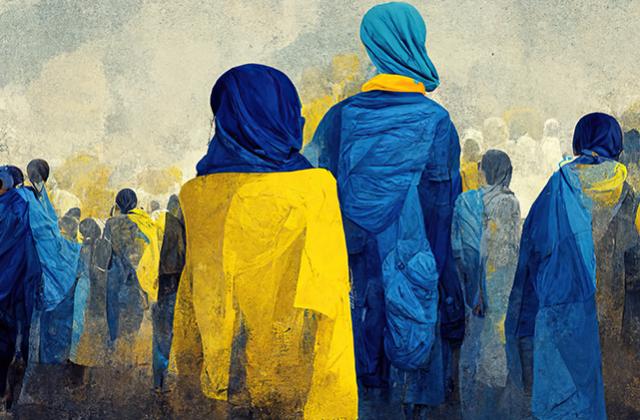
    L’aggressione militare della Russia contro l’Ucraina ha scatenato scenari che l’Europa non viveva da decenni. Da allora ha causato morte, distruzioni massicce e indicibili sofferenze. Ha inoltre innescato spostamenti di massa di persone che non si vedevano dalla seconda guerra mondiale. Per tutelare i profughi, l’UE ha attivato per la prima volta la direttiva sulla protezione temporanea. In tal modo, tutti gli Stati membri dell’UE devono offrire protezione agli sfollati in fuga dall’Ucraina.
  • Report / Paper / Summary
    25
    October
    2022
    02 November 2022
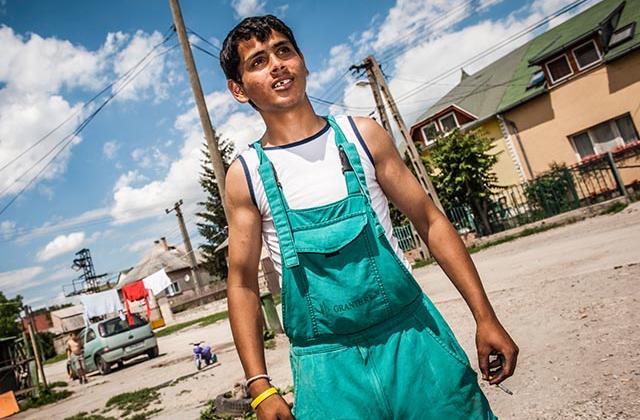
    This report presents findings from FRA’s 2021 survey on Roma in Croatia, Czechia, Greece, Hungary, Italy, Portugal, Romania and Spain, as well as in North Macedonia and Serbia. The survey includes interviews with more than 8,400 Roma, collecting information on more than 20,000 individuals living in their households. By focusing on Roma, the survey provides unique data and information that are not available from European general population surveys, which do not disaggregate on grounds of ethnic origin. The findings present a bleak but familiar picture of exclusion, deprivation, discrimination and racism.
  • Report / Paper / Summary
    16
    December
    2020
    22 Language versions now available
    23 April 2021
    La presente sintesi illustra le principali indicazioni
    contenute nella prima relazione della FRA basata
    sull’indagine sui diritti fondamentali. Ai fini
    dell’indagine sono stati raccolti dati intervistando
    circa 35 000 persone sulle loro esperienze,
    percezioni e opinioni riguardanti una serie di
    questioni variamente correlate con i diritti umani.
  • Report / Paper / Summary
    24
    June
    2020
    Summary version now available
    07 December 2020
    FRA’s Fundamental Rights Survey collected data from 35,000 people about their experiences, perceptions and opinions on a range of issues that are variously encompassed by human rights. This report presents a small selection of the survey results. It focuses on findings with respect to respondents’ opinions about human – or fundamental rights; their views and perceptions on the functioning of democratic societies – as a pillar on which human rights can flourish; and on their thoughts on and engagement with public services that have a duty to enforce human rights law and to protect people’s rights.
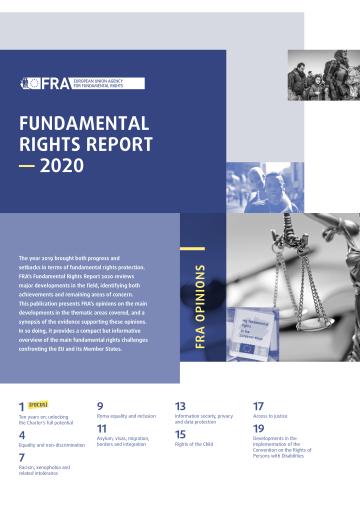
  • Fundamental Rights Report
    11
    June
    2020
    Now available in all 24 official EU languages
    12 August 2020
    Il 2019 è stato caratterizzato sia da progressi che da
    battute d’arresto in termini di tutela dei diritti
    fondamentali. La Relazione sui diritti fondamentali
    2020 dell’Agenzia dell’Unione europea per i diritti
    fondamentali (FRA) fa il punto della situazione sui
    principali sviluppi in materia, individuando i risultati
    ottenuti e i settori che destano ancora preoccupazione.
    Questa pubblicazione presenta i pareri della FRA sui
    principali sviluppi nelle aree tematiche contemplate
    nonché una sintesi delle informazioni su cui si fondano
    tali pareri, tracciando così un quadro sintetico ma
    informativo delle principali sfide con cui si confrontano
    l’UE e gli Stati membri nell’ambito dei diritti
    fondamentali.
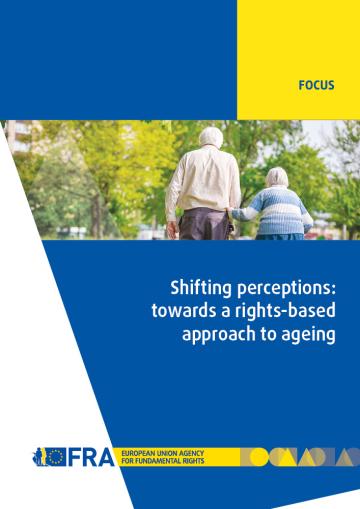
  • Fundamental Rights Report
    6
    June
    2018
    Finnish version now available
    27 January 2020
    European societies are not getting any younger! It is a simple truth we must face both about ourselves and Europe as a whole. In two generations, by 2080, those aged 65 or above will account for almost 30% of the European Union’s population.
  • Fundamental Rights Report
    11
    June
    2026
    The Fundamental Rights Report: Challenges and Achievements in 2025 is FRA’s flagship annual publication. It provides an overview of the state of fundamental rights in the EU and highlights selected critical developments from 2025. This year, it focuses on four areas: rights protection in a rapidly changing digital environment; the housing crisis and rising homelessness rates; employment challenges for people from non-EU countries; and the implementation of the EU Charter of Fundamental Rights. The publication is a valuable resource for those seeking to stay informed about the EU’s shifting landscape of fundamental rights.
  • Report / Paper / Summary
    24
    February
    2026
    The start of Russia’s war of aggression against Ukraine on 24 February 2022 shocked the global community and gave rise to a
    series of urgent fundamental rights challenges across Europe. While much attention has focused on the scale of devastation and its wider impact on all Ukrainians, the war has also inflicted profound personal harm. This report sheds light on the violence, sexual harassment and exploitation experienced by women displaced from Ukraine. Drawing on a survey and in-depth interviews with women from Ukraine, the report documents the prevalence, forms and patterns of gender-based violence and sets out practical measures to improve safety, access to justice and support.