This report looks at five core aspects of detention conditions in EU Member States: the size of cells; the amount of time detainees can spend outside of these cells, including outdoors; sanitary conditions; access to healthcare; and whether detainees are protected from violence. For each of these aspects of detention conditions, the report first summarises the minimum standards at international and European levels. It then looks at how these standards are translated into national laws and other rules of the EU Member States.
Over 2.5 million people applied for international protection in the 28 EU Member States in 2015 and 2016. Many of those who were granted some form of protection are young people, who are likely to stay and settle in the EU. The EU Agency for Fundamental Rights interviewed some of them, as well as professionals working with them in 15 locations across six EU Member States: Austria, France, Germany, Greece, Italy and Sweden. This report presents the result of FRA’s fieldwork research, focusing on young people between the
ages of 16 and 24.
Based on its findings and research FRA provides practical guidance to support the implementation of fundamental rights in the EU Member States. This series contains practical guidance on: Initial-reception facilities at external borders; Apprehension of migrants in an irregular situation; Guidance on how to reduce the risk of refoulement in external border management when working in or together with third countries; Fundamental rights implications of the obligation to provide fingerprints for Eurodac; Twelve operational fundamental rights considerations for law enforcement when processing Passenger Name Record (PNR) data and Border controls and fundamental rights at external land borders.
Les droits de l’enfant sont notre priorité. Les mesures visant à garantir la protection et
la participation des enfants s’appliquent à TOUS les enfants au sein de l’UE.
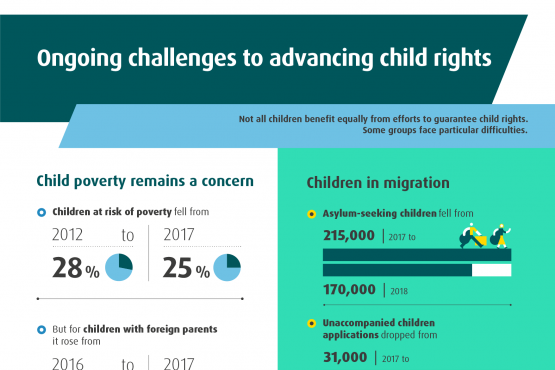
Child rights come first. Measures to ensure child protection and participation apply to all children in the EU. This brochure guides you to relevant FRA reports and tools that can support you when promoting and protecting the rights of all children in the EU.
This annual overview provides an update of the most recent figures on antisemitic incidents, covering the period 1 January 2008 – 31 December 2018, across the EU Member States, where data are available. It includes a section that presents evidence from international organisations. In addition, for the first time, it provides an overview of how Member States that have adopted or endorsed the non-legally binding working definition of antisemitism adopted by the International Holocaust Remembrance Alliance (IHRA) (2016) use or intend to use it.
The EU Agency for Fundamental Rights has been regularly collecting data on asylum and
migration since September 2015. This report focuses on the fundamental rights situation
of people arriving in Member States and EU candidate countries particularly affected by
migration. It addresses fundamental rights concerns between 1 July and 30 September 2019.
In this edition Michael O'Flaherty reports back from his visit to the asylum seeker facility in Lesbos and calls for the support of all EU Member States to improve in particular the situation of unaccompanied children.
Protecting the rights of anyone suspected or accused of a crime is an essential element of the rule of law. Courts, prosecutors and police officers need certain powers to enforce the law – but trust in the outcomes of their efforts will quickly erode without effective safeguards. Such safeguards take on various forms, and include the right to certain information and to a lawyer.
Individuals who are not entitled to stay in the European Union are typically subject to being returned to their home countries. This includes children who are not accompanied by their parents or by another primary caregiver. But returning such children, or finding another durable solution, is a delicate matter, and doing so in full compliance with fundamental rights protections can be difficult. This focus paper therefore aims to help national authorities involved in return-related tasks, including child-protection services, to ensure full rights compliance.
The EU Agency for Fundamental Rights has been regularly collecting data on migration since September 2015. This report focuses on the fundamental rights situation of people arriving in Member States and EU candidate countries particularly affected by migration movements. It addresses fundamental rights concerns between 1 April and 30 June 2019.
Based on FRA’s second large-scale survey on experiences and perceptions of antisemitism, this report focuses on the perspectives of young Jewish Europeans (aged 16-34) living in twelve EU Member States. It first describes this particular group and takes a look at defining antisemitism and understanding the place of Israel in it.
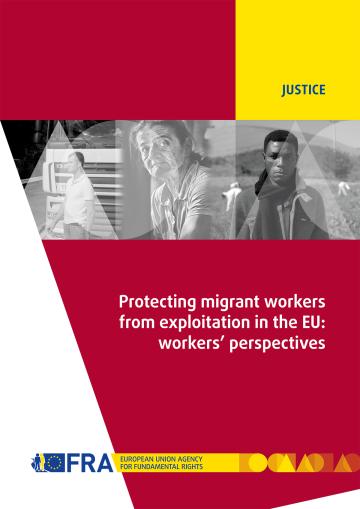
This report is the EU Fundamental Rights Agency’s fourth on the topic of severe labour exploitation. Based on interviews with 237 exploited workers, it paints a bleak picture of severe exploitation and abuse. The workers include both people who came to the EU, and EU nationals who moved to another EU country. They were active in diverse sectors, and their legal status also varied.
In 2018, some 2,299 people are estimated to have died or gone missing at sea while crossing the sea to reach Europe to escape war or persecution or to pursue a better life. This is on average more than six people per day. Before mid-2017, a significant share of migrants in distress at sea have been rescued by civil society vessels deployed with a humanitarian mandate to reduce fatalities and bring rescued migrants to safety. In 2018, however, authorities in some Member States viewed civil society-deployed rescue vessels with hostility. As a reaction, they seized rescue vessels, arrested crew members, and initiated legal procedures against them (more than a dozen altogether). In some cases, rescue vessels were blocked in harbours due to flag issues.
This technical report presents in detail all the stages
of the survey and the relevant information needed to
assess the quality and reliability of the data, as well
as considerations for interpreting the survey results.
The following chapters of the report cover the procedures
used in the development and administration
of the survey.
Деца, лишени от родителски грижи, открити в друга държава — членка на ЕС, различна
от тяхната собствена има за цел да засили реакцията на всички съответни участници за
закрила на детето. Закрилата на тези момичета и момчета е от първостепенно значение и е
задължение за държавите — членки на ЕС, произтичащо от международната и европейската
правна рамка. Ръководството включва акцент върху децата — жертви на трафик, и децата
в риск, в изпълнение на заложеното в съобщението от 2017 г. „Засилване на действията
на ЕС срещу трафика на хора“ действие и като са взети предвид установените модели,
включително по отношение на свързаната с пола специфика на престъплението.
Cílem příručky Děti bez rodičovské péče, které se nacházejí v jiném členském státě EU než ve
svém vlastním, je zlepšit schopnost všech příslušných subjektů reagovat v zájmu ochrany dětí.
Ochrana těchto dívek a chlapců je prvořadou povinností členských států EU, která vyplývá
z mezinárodního a evropského právního rámce. Příručka se zaměřuje na dětské oběti obchodování
s lidmi a ohrožené děti, a provádí tak opatření uvedená ve sdělení z roku 2017 o posílení opatření
EU v oblasti boje proti obchodování s lidmi, přičemž zohledňuje identifikované vzorce, mimo jiné
s ohledem na genderovou specifičnost této trestné činnosti.
Der Leitfaden Kinder ohne elterliche Fürsorge, die in einem anderen EU-Mitgliedstaat als ihrem
eigenen angetroffen werden hat das Ziel, die Handlungsfähigkeit aller im Bereich Kinderschutz
tätigen Akteure zu stärken. Der Schutz dieser Mädchen und Jungen ist von höchster Bedeutung und
stellt für die EU-Mitgliedstaaten eine Verpflichtung dar, die sich aus dem internationalen und dem
europäischen Rechtsrahmen ableitet. Der vorliegende Leitfaden legt den Schwerpunkt auf Kinder,
die Opfer von Menschenhandel geworden sind oder Gefahr laufen, dies zu werden, indem auf die
Umsetzung der Ziele eingegangen wird, die in der Mitteilung der Kommission zur Berichterstattung
über die Folgemaßnahmen zur Strategie der EU zur Beseitigung des Menschenhandels von
2017 beschrieben wurden. Dabei werden ermittelte Muster beleuchtet, auch im Hinblick auf die
geschlechtsspezifischen Besonderheiten von Straftaten.