FRA’s second EU Minorities and Discrimination survey (EU-MIDIS II) collected information from over 25,000 respondents with different ethnic minority and immigrant backgrounds across all 28 EU Member States. The main findings from the survey, published in 2017, pointed to a number of differences in the way women and men with immigrant backgrounds across the European Union (EU) experience how their rights are respected. This report summarises some of the most relevant survey findings in this regard, which show the need for targeted, gender-sensitive measures that promote the integration of – specifically – women who are immigrants or descendants of immigrants.
The EU Agency for Fundamental Rights has been regularly collecting data on migration since September 2015. This report focuses on the fundamental rights situation of people arriving in Member States and EU candidate countries particularly affected by migration movements. It addresses fundamental rights concerns between 1 April and 30 June 2019.
Based on FRA’s second large-scale survey on experiences and perceptions of antisemitism, this report focuses on the perspectives of young Jewish Europeans (aged 16-34) living in twelve EU Member States. It first describes this particular group and takes a look at defining antisemitism and understanding the place of Israel in it.
This report is the EU Fundamental Rights Agency’s fourth on the topic of severe labour exploitation. Based on interviews with 237 exploited workers, it paints a bleak picture of severe exploitation and abuse. The workers include both people who came to the EU, and EU nationals who moved to another EU country. They were active in diverse sectors, and their legal status also varied.
This technical report presents in detail all the stages
of the survey and the relevant information needed to
assess the quality and reliability of the data, as well
as considerations for interpreting the survey results.
The following chapters of the report cover the procedures
used in the development and administration
of the survey.
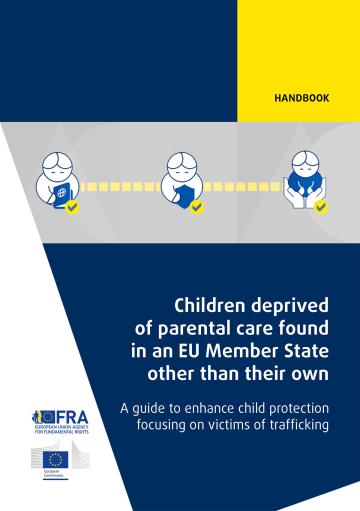
Children deprived of parental care found in another EU Member State other than their own aims to strengthen the response of all relevant actors for child protection. The protection of those girls and boys is paramount and an obligation for EU Member States, derived from the international and European legal framework. The guide includes a focus on child victims of trafficking and children at risk, implementing an action set forth in the 2017 Communication stepping up EU action against trafficking in human beings, and takes into account identified patterns, including with respect to the gender specificity of the crime.
The General Data Protection Regulation (GDPR) has applied across the European Union (EU) since 25 May 2018. One year on, this paper looks at how the new regulation has affected the daily work of civil society organisations (CSOs).
How much progress can we expect in a decade? Various rights-related instruments had been in place for 10 years in 2018, prompting both sobering and encouraging reflection on this question.
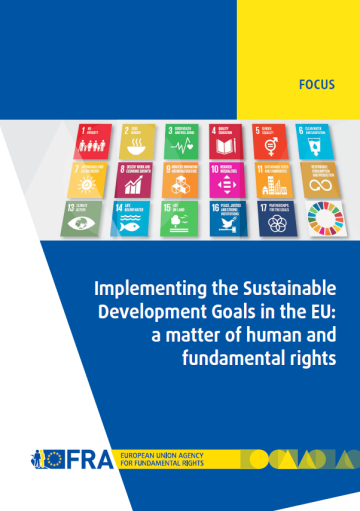
This year’s focus explores the interrelationship between the human and fundamental rights framework and the Sustainable
Development Goals (SDGs) of the global Agenda 2030 in the context of Member States’ and the EU’s internal policies.
It takes a closer look at the SDGs related to reducing inequality (SDG 10) and promoting peace, justice and strong
institutions (SDG 16).
The year 2018 brought both progress and setbacks in terms of fundamental rights protection. FRA’s Fundamental Rights Report 2019 reviews major developments in the field, identifying both achievements and remaining areas of concern. This publication presents FRA’s opinions on the main developments in the thematic areas covered, and a synopsis of the evidence supporting these
opinions.
The EU Agency for Fundamental Rights has been regularly collecting data on migration since
September 2015. This report focuses on the fundamental rights situation of people arriving in
Member States and EU candidate countries particularly affected by migration movements.
It addresses fundamental rights concerns between 1 January and 31 March 2019.
Victims of violent crime have various rights, including to protection and to access justice. But how are these rights playing out in practice? Are victims of violent crime properly seen, informed, empowered and heard? Do they tend to feel that justice has been done? Our four-part report series takes a closer look at these questions, based on interviews with victims, people working for victim support organisations, police officers, attorneys, prosecutors and judges.
Victims of violent crime have various rights, including to protection and to access justice. But how are these rights playing out in practice? Are victims of violent crime properly seen, informed, empowered and heard? Do they tend to feel that justice has been done? Our four-part report series takes a closer look at these questions, based on interviews with victims, people working for victim support organisations, police officers, attorneys, prosecutors and judges.
Victims of violent crime have various rights, including to protection and to access justice. But how are these rights playing out in practice? Are victims of violent crime properly seen, informed, empowered and heard? Do they tend to feel that justice has been done? Our four-part report series takes a closer look at these questions, based on interviews with victims, people working for victim support organisations, police officers, attorneys, prosecutors and judges.
Victims of violent crime have various rights, including to protection and to access justice. But how are these rights playing out in practice? Are victims of violent crime properly seen, informed, empowered and heard? Do they tend to feel that justice has been done? Our four-part report series takes a closer look at these questions, based on interviews with victims, people working for victim support organisations, police officers, attorneys, prosecutors and judges.
In the light of the events in New Zealand, Michael O'Flaherty talks about discrimination and hate crime against Muslims in the EU and makes 4 proposals on how to make Muslims feel more safe.
This summary outlines the main findings of FRA’s second survey on Jewish people’s experiences with hate crime, discrimination and antisemitism in the European Union – the biggest survey of Jewish people ever conducted worldwide.
Le présent document expose les principales conclusions
de la deuxième enquête de la FRA sur les
expériences des personnes juives en rapport avec
le crime de haine, la discrimination et l’antisémitisme
dans l’Union européenne.
The EU Agency for Fundamental Rights has been regularly collecting data on migration since
September 2015. This report focuses on the fundamental rights situation of people arriving in
Member States and EU candidate countries particularly affected by large migration movements.