Online fraud - people's experiences across the EU
The survey respondents were asked whether they had ever been tricked via instant messages or email into transferring money, paying for something or giving their own personal data. The question asked in the survey was as follows: ‘Have you ever been tricked, by instant messages or emails, into transferring money, paying for something, or giving your personal data by people belonging to one or more of the following categories?’.
The respondents could select one or more of the following categories, depending on their experiences: someone pretending to be a member of the respondent’s family or asking for help on behalf of a family member; someone pretending to be a business or work contact; someone promising an investment with great benefits; someone pretending to be a representative of a bank or the police; someone pretending to sell goods or services; someone pretending to be in a romantic relationship with the respondent and demanding money; or someone else. They could also indicate that they had never encountered any of these situations or that they do not use email or instant messaging, or they could select the category “Don’t know”.
Overall, 24 % of people in the EU – one in four – fell victim to online fraud (Figure 1).
Among those in the survey who indicated they were victims, 35 % have been defrauded by someone pretending to be selling goods or services (Figure 2). Other widespread types of fraud (experienced by 25 to 20 % of victims) involved perpetrators pretending to be: a family member (or speaking on behalf of a family member) asking for help; a business or work contact; a representative of a bank; or promising investment opportunities with great benefits. 11 % of victims experienced romance fraud and 10 % of victims were defrauded by someone pretending to be the police. 18 % of victims experienced other types of fraud that were not specifically listed in the survey.
When the results are examined in terms of the experiences of people in the EU in general with respect to overall prevalence rates for different types of online fraud, the results range from 8 % of people in the EU who have been defrauded by someone pretending to sell goods or services, to 3 % defrauded by someone pretending to be in a romantic relationship with the victim and demanding money, and 2 % defrauded by someone pretending to be the police.
In the survey, victims could select one or more types of online fraud, depending on their experiences, which could have taken place over the respondent’s lifetime (or, rather, the time during which they have been using online tools and services such as email or instant messaging).
Figure 1 – Prevalence of online fraud overall across the EU-27 (%)

Alternative text: This pie chart shows the prevalence of online fraud across the EU-27. 24 % of people in the EU have been victims of some type of online fraud, while 69 % have not experienced online fraud. 8 % do not use emails or instant messaging, while the “Don’t know” category corresponds to zero per cent.
NB: n = 26,453
Question: “Have you ever been tricked, by instant messages or emails, into transferring money, paying for something, or giving your personal data by people belonging to one or more of the following categories?”. For the full list of the answer categories, see Figure 2. In the chart, respondents who have selected one or more categories indicating that they have been defrauded are included in the category “Victims of fraud of any type”.
Source: FRA, 2026
Figure 2 – Prevalence of different types of online fraud among those who indicated they were victims (%)
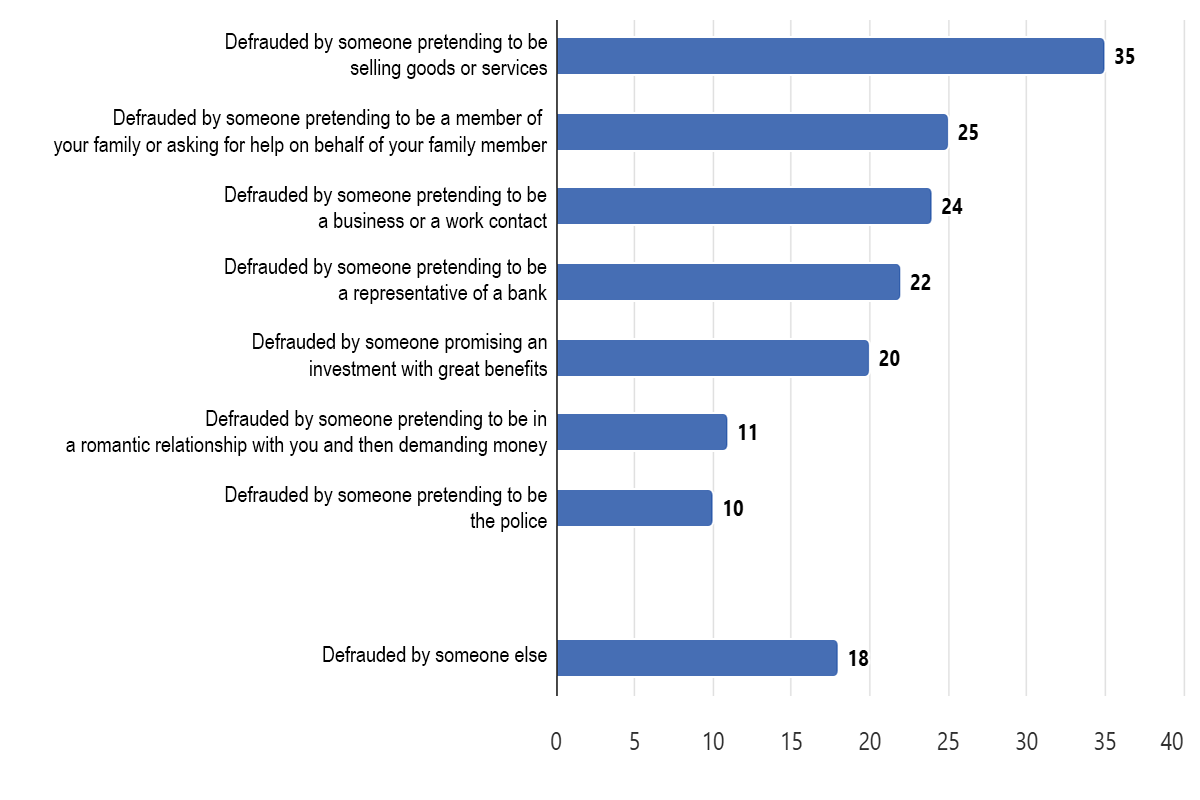
Alternative text: This bar chart shows the prevalence rates of different types of online fraud experienced by victims. The most common type of online fraud from those listed in the survey is to be defrauded by someone pretending to be selling goods or services (35 % of victims of online fraud indicated this). The other types of online fraud range from 25 % of victims being defrauded by someone pretending to be a member of their family or asking for help on behalf of a family member) to 10 % being defrauded by someone pretending to be the police, while 18 % of victims indicated that they were defrauded by someone else (that is, a type of person not specifically mentioned in the survey).
NB: n = 5,887 (respondents who were victims of online fraud). Because some victims (37 %) indicated that they have experienced two or more types of online fraud, the sum total of the categories in the figure above exceeds 100 %.
Question: “Have you ever been tricked, by instant messages or emails, into transferring money, paying for something, or giving your personal data by people belonging to one or more of the following categories?”. The respondents could answer by selecting one or more types of online fraud as listed in the bar chart above. In addition, they could indicate that they don’t use email or online messaging, or answer by selecting “Don’t know”.
Source: FRA, 2026
More than one in three (37 %) victims experienced two or more types of fraud, which corresponds to 9 % of people in the EU having experienced two or more types of online fraud. This could involve separate incidents or a single incident of fraud with two or more different elements, as indicated in the survey. For example, such as someone pretending to be a representative of a bank and promising an investment with great benefits.
Results vary by country, with Luxembourg, Estonia, Belgium, France, and Lithuania showing the highest rates of victimisation, while Hungary, Portugal, Poland, Greece, and Romania had the lowest rates. Figure 3 shows the prevalence of online fraud by country.
Figure 3 – Prevalence of online fraud, by EU Member State (%)
Alternative text: This chart shows the prevalence of online fraud in each EU Member State and the EU-27 average. Results range from 39 % of respondents in Luxembourg and Estonia indicating they have been victims of online fraud, to 11 % in Greece and Romania. The EU-27 average is 24 %.
NB: n = 26,453. The results above refer to respondents who have experienced one or more types of online fraud. For details on the question asked, see the note under Figure 2.
Source: FRA, 2026
While people of all ages fall victim to online fraud, ‘young adults’ (aged 25 to 39) are more likely to experience it than people from other age groups. Therefore, at first glance, age appears to be linked to vulnerability to online fraud. People aged 25 to 39 are the most affected, with almost one in three (30 %) in this group falling victim to online fraud. This compares with an overall total of 25 % of people younger than 55 experiencing online fraud. People aged 55 and older tend to fall victim less often, at 19 %, which still amounts to almost one in five. However, because more people (13 %, as according to the current survey) in the oldest age range do not use email or instant messaging, the rate of fraud among people 55 years and older who use these services is closer to the rate of online fraud in the younger age groups. When it comes to the type of online fraud experienced, there are no notable differences between people from different age groups.