• Easy-to-read report
    7
    July
    2026
    This report talks about the situation of people with disabilities who live in institutions. Institutions are places where people with disabilities often live away from other people. Our report is based on a study we made in 30 countries in Europe. This text is a short version of the report in easy language.
  • Report / Paper / Summary
    23
    June
    2026
    Gewalt gegen Menschen mit Behinderung in Einrichtungen ist nach wie vor weit verbreitet, wird aber in ganz Europa kaum gemeldet. Gewalttaten umfassen ein breites Spektrum ausbeuterischer, missbräuchlicher und erniedrigender Handlungen, die gegen die Verpflichtungen der Europäischen Union (EU) und der EU-Mitgliedstaaten gemäß internationalen und europäischen Menschenrechtsnormen verstoßen. Der Schutz vor Gewalt basiert auf dem Übereinkommen der Vereinten Nationen über die Rechte von Menschen mit Behinderungen (im Folgenden „Behindertenrechtskonvention“), dem wichtigsten Menschenrechtsvertrag für die gleichberechtigte Wahrnehmung aller Menschenrechte und Grundfreiheiten durch Menschen mit Behinderung.
  • Report / Paper / Summary
    23
    June
    2026
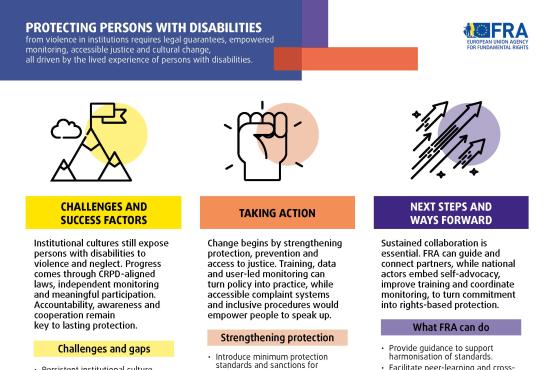
    The publication is an excerpt from the full report: Places of care = places of safety? Violence against persons with disabilities in institutions. The report looks at the breadth and depth of violence and neglect faced by people with disabilities living in institutions. It includes key findings and calls for better protection, greater prevention of violence, and clear accountability. It urges the EU and its Member States to implement their obligations on equality and fundamental rights. It is available in English, German, Croatian, Italian, Latvian, Polish, Portuguese, Slovakian and Slovenian.

  • Report / Paper / Summary
    23
    June
    2026
    Nasilje nad osobama s invaliditetom u ustanovama i dalje je rašireno, ali se o njemu u pravilu nedovoljno izvještava u cijeloj Europi. Nasilje uključuje širok spektar izrabljivanja te zlonamjernih i ponižavajućih postupaka koji su u suprotnosti s obvezama Europske unije (EU) i njenih država članica preuzetih na temelju međunarodnog prava prava i propisa EU-a u području ljudskih prava. Zaštita od nasilja temelji se na Konvenciji UN-a o pravima osoba s invaliditetom (UN KPOSI), primarnom međunarodnom ugovoru o ljudskim pravima za ravnopravno uživanje svih ljudskih prava i temeljnih sloboda svih osoba s invaliditetom.
  • Report / Paper / Summary
    23
    June
    2026
    Pur rimanendo un fenomeno diffuso, la violenza contro le persone con disabilità negli istituti è largamente sottostimata in Europa. Gli atti di violenza comprendono un ampio spettro di atti degradanti, di sfruttamento e abuso che violano gli obblighi dell’Unione europea (UE) e degli Stati membri dell’UE ai sensi del diritto internazionale ed europeo in materia di diritti umani. La protezione contro la violenza si fonda sulla Convenzione delle Nazioni Unite sui diritti delle persone con disabilità (CRPD), il principale trattato in materia di diritti umani che garantisce il pari godimento di tutti i diritti umani e di tutte le libertà fondamentali da parte delle persone con disabilità.
  • Report / Paper / Summary
    23
    June
    2026
    Vardarbība pret personām ar invaliditāti aprūpes iestādēs joprojām ir plaši izplatīta, taču Eiropā par to tiek ziņots nepietiekami. Vardarbīga rīcība ietver plašu ekspluatējošas, ļaunprātīgas un pazemojošas rīcības spektru, kas ir pretrunā Eiropas Savienības (ES) un ES dalībvalstu pienākumiem saskaņā ar starptautiskajām un Eiropas cilvēktiesībām. Aizsardzība pret vardarbību ir balstīta uz ANO Konvenciju par personu ar invaliditāti tiesībām (CRPD), kas ir primārais cilvēktiesību līgums, lai personas ar invaliditāti varētu vienlīdzīgi izmantot visas cilvēktiesības un pamatbrīvības.
  • Report / Paper / Summary
    23
    June
    2026
    Przemoc wobec osób z niepełnosprawnościami w placówkach opiekuńczych jest nadal szeroko rozpowszechniona w całej Europie i w większości przypadków jest niedostatecznie zgłaszana. Akty przemocy obejmują szeroki zakres działań polegających na wykorzystywaniu, znęcaniu się i poniżaniu, które są sprzeczne ze zobowiązaniami Unii Europejskiej (UE) i państw członkowskich UE wynikającymi z międzynarodowego i europejskiego prawa dotyczącego praw człowieka. Ochrona przed przemocą opiera się na Konwencji ONZ o prawach osób niepełnosprawnych, która jest podstawowym traktatem dotyczącym praw człowieka, zapewniającym osobom z niepełnosprawnościami równe korzystanie ze wszystkich praw człowieka i podstawowych wolności.
  • Report / Paper / Summary
    23
    June
    2026
    A violência contra as pessoas com deficiência nas instituições continua a ser generalizada, mas muito pouco denunciada em toda a Europa. Os atos de violência incluem um vasto leque de atos exploratórios, abusivos e degradantes que violam as obrigações da União Europeia (UE) e dos Estados-Membros da UE ao abrigo do direito internacional e europeu em matéria de direitos humanos. A proteção contra a violência baseia-se na Convenção das Nações Unidas sobre os Direitos das Pessoas com Deficiência (CNUDPD), o principal tratado de direitos humanos para o gozo igualitário de todos os direitos humanos e liberdades fundamentais pelas pessoas com deficiência.
  • Report / Paper / Summary
    23
    June
    2026
    Násilie voči osobám so zdravotným postihnutím v zariadeniach inštitucionálnej starostlivosti stále existuje, ale na území celej Európy je z veľkej časti nedostatočne nahlasované. Akty násilia zahŕňajú široké spektrum vykorisťujúcich, násilných a ponižujúcich činov, ktoré sú v rozpore s povinnosťami Európskej únie (EÚ) a členských štátov EÚ podľa medzinárodného a európskeho práva v oblasti ľudských práv. Ochrana pred násilím je zakotvená v Dohovore Organizácie Spojených národov (OSN) o právach osôb so zdravotným postihnutím (UNCRPD), primárnej zmluve o ľudských právach, na základe ktorej osoby so zdravotným postihnutím môžu na rovnocennom základe uplatňovať všetky ľudské práva a základné slobody.
  • Report / Paper / Summary
    23
    June
    2026
    Nasilje nad invalidi v socialnovarstvenih zavodih je po vsej Evropi še vedno zelo razširjeno, vendar se o njem večinoma premalo poroča. Nasilna dejanja vključujejo najrazličnejša izkoriščevalska, zlonamerna in ponižujoča dejanja, ki so v nasprotju z obveznostmi Evropske unije (EU) in držav članic EU na podlagi mednarodnega in evropskega prava o človekovih pravicah. Zaščita pred nasiljem temelji na Konvenciji Združenih narodov o pravicah invalidov, ki je glavni sporazum o človekovih pravicah za enakopravno uživanje vseh človekovih pravic in temeljnih svoboščin invalidov.
  • Report / Paper / Summary
    27
    November
    2025
    This report looks at the breadth and depth of violence and neglect faced by people with disabilities living in institutions. It highlights the shortcomings by EU Member States in preventing violence and protecting those who are at a higher risk of experiencing it, in line with the UN Convention on the Rights of Persons with Disabilities. Based on research across all EU Member States and FRA observer candidate countries, the report calls for better protection, stronger prevention of violence, and clear accountability. It urges the EU and its Member States to implement their obligations around equality and fundamental rights.
  • In brief / Factsheet
    30
    October
    2025
    This factsheet summarises key Court of Justice of the European Union (CJEU) and European Court of Human Rights (ECtHR) cases on reasonable accommodation for persons with disabilities. Building on Article 2 of the United Nations Convention on the Rights of Persons with Disabilities (UNCRPD), the courts address employment, physical accessibility, and education. In collaboration, the EU Agency for Fundamental Rights and the European Court of Human Rights produced this short publication. It is designed to aid lawyers and policymakers in understanding and applying the jurisprudence in this area.
  • Report / Paper / Summary
    29
    May
    2024
    Ahead of the EU elections, this report explores the political participation of people with disabilities. Although some Member States removed restrictions on the right to vote and to stand for elections, barriers still exist. This report is an update of new developments following FRA’s last report published in 2014. It sets out ways forward to ensure people with disabilities have equal opportunities, in line with the EU Charter of Fundamental Rights and the Convention on the Rights of Persons with Disabilities.
  • Handbook / Guide / Manual
    20
    March
    2023
    This guide helps independent national monitoring frameworks to fulfil their monitoring responsibility set out in Article 33 of the Convention on the Rights of Persons with Disabilities (CRPD). It focuses on the use of indicators. It does not deal with aspects such as compliance with the Paris Principles or the efficiency of complaints mechanisms. Its objective is to support national monitoring frameworks in designing or improving indicators for assessing progress of CRPD implementation at national level.
  • Fundamental Rights Report
    6
    June
    2019
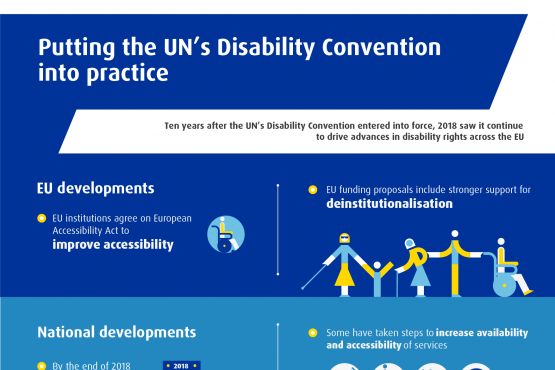
    How much progress can we expect in a decade? Various rights-related instruments had been in place for 10 years in 2018, prompting both sobering and encouraging reflection on this question.