• Report / Paper / Summary
    3
    September
    2015
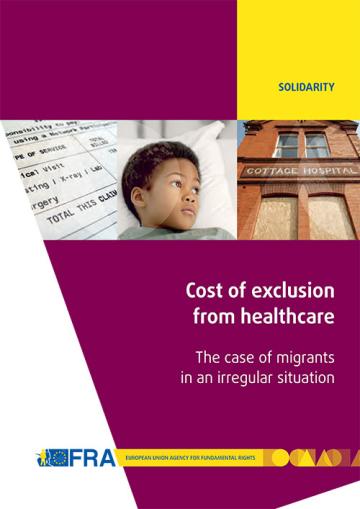
    This report aims to estimate the economic cost of providing timely access to screening and treatment for migrants in an irregular situation, compared with providing treatment only in emergency cases. It presents an economic model to calculate such costs for two medical conditions: hypertension and prenatal care. To better illustrate its application in practice, the model is applied to three European Union (EU) Member States – Germany, Greece and Sweden.
  • Report / Paper / Summary
    5
    August
    2015
    This report seeks to demonstrate that the fulfilment of fundamental rights can help to improve the situation and achieve the strategic goals set out in the Europe 2020 growth strategy, which aims to establish a smart, sustainable and inclusive economy.
  • Fundamental Rights Report
    25
    June
    2015
    Im Jahr 2014 stellten die Mitgliedstaaten und Institutionen der Europäische Union (EU) eine Reihe von rechtlichen und politischen
    Maßnahmen vor, um die Grundrechte in der EU zu gewährleisten. Trotz dieser Bemühungen bleibt immer noch viel
    zu tun. In einigen Bereichen ist die Situation beunruhigend: die Zahl der MigrantInnen, die gerettet oder auf See festgenommen
    wurden, als sie die Grenzen der EU versuchten zu erreichen, vervierfachte sich seit 2013; mehr als ein Viertel der Kinder
    in der EU sind von Armut oder sozialer Ausgrenzung bedroht; immer mehr politische Parteien verwenden fremdenfeindliche
    und gegen MigrantInnen gerichtete Rhetorik in ihren Kampagnen, was dazu führen kann, dass mehr Personen anfälliger
    werden, Opfer von Straftaten oder Hassverbrechen zu werden.

  • Fundamental Rights Report
    25
    June
    2015
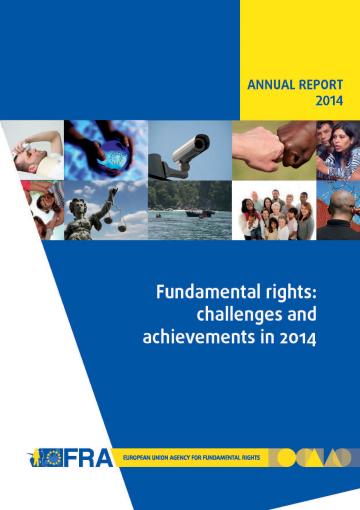
    European Union (EU) Member States and institutions introduced a number of legal and policy measures in 2014 to safeguard fundamental rights in the EU. Notwithstanding these efforts, a great deal remains to be done, and it can be seen that the situation in some areas is alarming: the number of migrants rescued or apprehended at sea as they were trying to reach Europe’s borders quadrupled over 2013; more than a quarter of children in the EU are at risk of poverty or social exclusion; and an increasing number of political parties use xenophobic and anti-immigrant rhetoric in their campaigns, potentially increasing some people’s vulnerability to becoming victims of crime or hate crime.
  • Fundamental Rights Report
    25
    June
    2015
    Les États Membres et les institutions de l’Union européenne (UE) ont introduit en 2014 un nombre de mesures juridiques et politiques pour garantir la protection des droits fondamentaux dans l’UE. Malgré ces efforts, beaucoup reste à accomplir, et il est clair que dans certains domaines la situation est alarmante : le nombre de migrants sauvés ou appréhendés en mer alors qu’ils essayaient de rejoindre les frontières de l’UE a quadruplé par rapport à 2013 ; plus d’un quart des enfants dans l’UE encourent un risque de pauvreté ou d’exclusion sociale ; et un nombre croissant de partis politiques recourent dans leurs campagnes à une rhétorique xénophobe et hostile aux immigrés, ce qui peut potentiellement augmenter le risque de certaines personnes d’être victimes de criminalité ou de crimes de haine.
  • Report / Paper / Summary
    19
    June
    2015
    Der Situation an Grenzübergangsstellen der Landgrenzen zur Einreise in die EU wird weniger Auf‑
    merksamkeit gewidmet als der Lage an Europas südlichen Seegrenzen, wo das Leben von Migran‑
    ten und Migrantinnen gefährdet ist. An den Landgrenzen werden die Grenzübertrittskontrollen von
    Drittstaatsangehörigen im Allgemeinen routinemäßig durchgeführt und verlaufen ohne Zwischen‑
    fälle. Die Forschungsarbeiten der FRA zeigen jedoch, dass es auch hier eine Reihe von Herausfor‑
    derungen gibt, die die Grundrechte von Reisenden beeinträchtigen. Diese reichen von respektloser
    Behandlung bis hin zur Nichterkennung von Personen, die Schutz benötigen. Solche Herausforde‑
    rungen dürfen nicht außer Acht gelassen werden.
  • Report / Paper / Summary
    19
    June
    2015
    The situation at land border crossing points into the EU has received less attention than
    Europe’s southern sea borders, where migrants’ lives are at risk. Although FRA research
    shows that land border checks of third-country nationals are generally conducted routinely
    and take place without incident, a number of challenges affect travellers’ fundamental
    rights.
  • Rapport / Publication / Résumé
    19
    June
    2015
    La situation aux points de passage frontaliers terrestres de l’UE a bénéficié de moins d’attention
    que celle aux frontières maritimes méridionales de l’Europe, où la vie des migrants est menacée.
    Bien que les recherches de terrain de la FRA aient révélé que les contrôles aux frontières s’effectuent,
    dans l’ensemble, de façon routinière et sans incident, les voyageurs peuvent rencontrer des
    difficultés ayant une incidence sur leurs droits fondamentaux, qui ne devraient pas être négligées.
  • Fundamental Rights Report
    15
    June
    2015
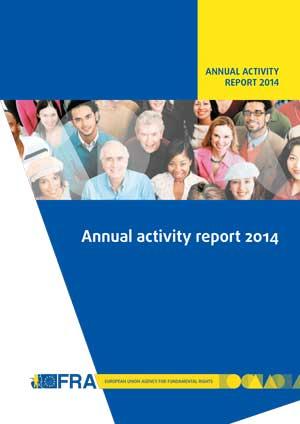
    This consolidated annual activity report provides an overview of the European Union Agency for Fundamental Rights (FRA) activities and achievements in 2014. It follows the guidelines of the EU Agencies Performance Development Network.
  • Fundamental Rights Report
    15
    June
    2015
    Le présent rapport d’activité annuel consolidé présente
    un aperçu des activités et réalisations de l’Agence des
    droits fondamentaux de l’Union européenne (FRA)
    en 2014. Il suit les lignes directrices du réseau de développement
    des agences de l’UE.
  • Report / Paper / Summary
    2
    June
    2015
    Worker exploitation is not an isolated or marginal phenomenon. But despite its pervasiveness in everyday life, severe labour exploitation and its adverse effects on third-country nationals and EU citizens - as workers, but also as consumers - have to date not received much attention from researchers.
  • Report / Paper / Summary
    12
    May
    2015
    Trans* Personen, deren Geschlechtsidentität oder Ausdrucksformen des Geschlechts von dem bei der Geburt zugewiesenen Geschlecht abweichen, sind heute in der Europäischen Union (EU) häufig Diskriminierung, Belästigung und Gewalt ausgesetzt. Diese Realität löst Ängste aus, die viele von ihnen veranlassen, ihr eigentliches Selbst zu verstecken oder zu verschleiern. Dieser Bericht untersucht die Fragen Gleichbehandlung und Diskriminierung aus zwei Perspektiven, nämlich sexuelle Orientierung und Geschlechtsidentität.
  • Report / Paper / Summary
    12
    May
    2015
    Trans persons, or those whose gender identity and/or gender expression differs from the sex assigned them at birth, face frequent discrimination, harassment and violence across the European Union (EU) today. This reality triggers fears that persuade many to hide or disguise their true selves. This report examines issues of equal treatment and discrimination on two grounds, namely sexual orientation and gender identity.
  • Rapport / Publication / Résumé
    12
    May
    2015
    Les personnes trans, ou celles dont l’identité et/ou l’expression de genre diffère du sexe qui leur a été attribué à la naissance, sont souvent victimes de discrimination, de harcèlement et de violence dans l’Union européenne (UE) aujourd’hui. Cette réalité engendre des peurs qui peuvent pousser un grand nombre d’entre elles à cacher ou masquer leur vraie identité. Le présent rapport se penche sur l’égalité de traitement et sur la discrimination fondée sur deux motifs : l’orientation sexuelle et l’identité de genre.
  • Report / Paper / Summary
    12
    May
    2015
    This paper examines the legal situation of intersex people from a fundamental rights perspective. It draws on evidence from the Agency’s updated legal analysis on homophobia, transphobia, and discrimination on grounds of sexual orientation and gender identity, which now includes a section on intersex issues.
  • Report / Paper / Summary
    11
    May
    2015
    A new Focus paper by the EU Agency of Fundamental Rights (FRA) outlines how Member States across the EU have reformed their laws and policies to meet their obligations under the CRPD. By bringing together examples of such reforms, it also highlights how the adoption of international commitments can drive wide-ranging processes of change at the national level.
  • Report / Paper / Summary
    5
    May
    2015
    Making justice systems more child‑friendly improves
    the protection of children, enhances their meaningful
    participation and at the same time improves
    the operation of justice. The findings in this summary
    can provide Member States with useful tools
    to identify barriers, gaps or weaknesses in their
    judicial proceedings, especially in the process of
    transposing and implementing relevant EU directives. Also available in BG - CS - DA - DE - EL - ES - ET - FI - FR - HR - HU - IT - LV - LT - MT - PL - PT - RO - SK - SK - SV
  • Report / Paper / Summary
    5
    May
    2015
    Each year thousands of children take part in criminal and civil judicial proceedings, affected by parental divorce
    or as victims or witnesses to crime. Such proceedings can be stressful for anyone. The European Union Agency
    for Fundamental Rights (FRA) investigated whether children’s rights are respected in these proceedings.