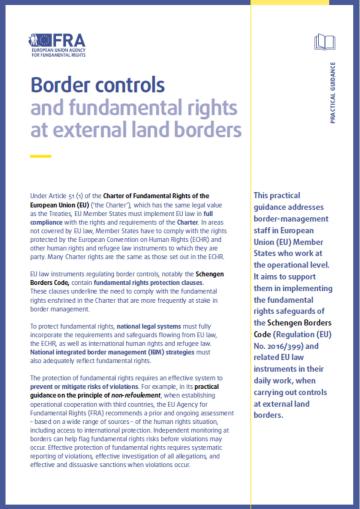
La presente guía se dirige al personal de gestión fronteriza de los Estados miembros de la Unión Europea (UE) que trabaja a nivel operativo. Su objetivo es ayudarles a aplicar, en su trabajo diario, las salvaguardias de los derechos fundamentales del Código de fronteras Schengen [Reglamento (UE) 2016/399] y la legislación de la UE relacionada.
Käesolev juhend on ELi liikmesriikide piirivalveametnikele, kes töötavad operatiivtasandil. Juhendi eesmärk on aidata neil rakendada oma igapäevatöös Schengeni piirieeskirjades (määrus (EL) 2016/399) ja seotud ELi õiguses sätestatud põhiõiguste kaitsemeetmeid.
Nämä ohjeet on tarkoitettu EU:n jäsenvaltioiden operatiivisella tasolla työskentelevälle rajavalvontahenkilöstölle. Niiden tarkoituksena on auttaa sitä toteuttamaan päivittäisessä työssään Schengenin rajasäännöstön (asetus (EU) 2016/399) ja siihen liittyvän EU:n lainsäädännön perusoikeuksia koskevia takeita.
Ez az útmutató az EU tagállamaiban műveleti szinten határigazgatást végző személyzetnek készült. Célja, hogy segítséget nyújtson napi munkájuk során abban, hogy az alapjogoknak a Schengeni határ-ellenőrzési kódexben (2016/399/EU rendelet) és a kapcsolódó uniós jogban előírt védelmét biztosítani tudják.
Šios gairės skirtos ES valstybių narių sienų valdymo pareigūnams, dirbantiems operatyviniu lygmeniu. Jomis siekiama padėti jiems kasdieniame darbe įgyvendinti Šengeno sienų kodekse (Reglamentas (ES) 2016/399) ir susijusiuose ES teisės aktuose nustatytas pagrindinių teisių apsaugos priemones.
Niniejsze wskazówki są skierowane do personelu zarządzającego granicami w państwach członkowskich UE pracującego na poziomie operacyjnym. Mają pomóc mu wdrażać w codziennej pracy środki zabezpieczające prawa podstawowe, przewidziane w kodeksie granicznym Schengen (rozporządzenie (UE) 2016/399) oraz w powiązanych aktach prawa UE.
Esta orientação destina-se ao pessoal de gestão de fronteiras nos Estados-Membros da União Europeia (UE) que trabalha a nível operacional. Visa ajudá-los a implementar, no seu trabalho diário, as salvaguardas dos direitos fundamentais do Código das Fronteiras Schengen [Regulamento (UE) 2016/399] e a legislação conexa da UE.
Acest ghid se adresează membrilor personalului responsabil de gestionarea frontierelor statelor membre ale UE care își desfășoară activitatea la nivel operațional. Ghidul își propune să îi ajute să pună în aplicare, în activitatea lor zilnică, garanțiile privind drepturile fundamentale prevăzute de Codul Frontierelor Schengen [Regulamentul (UE) 2016/399] și de legislația conexă a UE.
Denna vägledning riktar sig till gränsförvaltningspersonal i EU:s medlemsstater som arbetar på operativ nivå. Syftet är att de i sitt dagliga arbete ska få hjälp att genomföra de skyddsåtgärder för grundläggande rättigheter som fastställs i kodexen om Schengengränserna (förordning (EU) 2016/399) och i relaterad EU-lagstiftning.
This paper presents people’s concerns and experiences relating to security. It covers worry about crime, including terrorism and online fraud; experience of online fraud; experience of cyberharassment; and concern about illegal access to data.
FRA’s Fundamental Rights Survey collected data from 35,000 people about their experiences, perceptions and opinions on a range of issues that are variously encompassed by human rights. This report presents a small selection of the survey results. It focuses on findings with respect to respondents’ opinions about human – or fundamental rights; their views and perceptions on the functioning of democratic societies – as a pillar on which human rights can flourish; and on their thoughts on and engagement with public services that have a duty to enforce human rights law and to protect people’s rights.
In 2019, the International Organization for Migration estimated that 1,866 people have died or gone missing while crossing the Mediterranean Sea to reach Europe to escape war or persecution or to pursue a better life. This is an average of five people per day. In recent years, a significant proportion of migrants in distress at sea have been rescued by civil society vessels deployed with a humanitarian mandate to reduce fatalities and bring rescued migrants to safety. Since 2018, however, authorities in some EU Member States started viewing civil society-deployed rescue vessels with hostility. As a reaction, national authorities initiated about 40 administrative and criminal proceedings against crew members or vessels, including seizing the latter. In some cases, rescue vessels were blocked in harbours due to flag issues or the inability to meet technical requirements.
This document presents data from the FRA Fundamental Rights Survey. It includes data on opinions and experiences of people in the European Union (EU) linked to data protection and technology.
This focus takes a closer look at the application of the Charter of Fundamental Rights of the European Union, which has been legally binding for 10 years. At EU level, it has gained visibility and sparked a new fundamental rights culture. At national level, awareness and use of the Charter are limited. Courts increasingly use the Charter, showing the impact of this modern instrument. But its use by governments and parliaments remains low. For instance, there is little indication of anyone regularly scrutinising national legislation that transposes EU law for compatibility with the Charter.
W niniejszym dokumencie zwraca się szczególną uwagę
na stosowanie Karty praw podstawowych Unii Europejskiej,
która jest prawnie wiążąca od 10 lat. Na szczeblu unijnym
stała się ona bardziej widoczna i zapoczątkowała nową
kulturę praw podstawowych. Na szczeblu krajowym
świadomość i stosowanie Karty są ograniczone. Sądy w coraz
większym stopniu stosują Kartę, co pokazuje znaczenie tego
nowoczesnego instrumentu. Niemniej jednak jego stosowanie
przez rządy i parlamenty pozostaje na niskim poziomie.
Przykładowo niewiele wskazuje na to, by ktokolwiek
regularnie kontrolował przepisy krajowe dokonujące
transpozycji prawa Unii pod kątem ich zgodności z Kartą.
O presente Destaque aborda mais de perto a aplicação da
Carta dos Direitos Fundamentais da União Europeia, que se
tornou juridicamente vinculativa há 10 anos. Ao nível da UE,
a Carta ganhou visibilidade e deu origem a uma nova cultura
de direitos fundamentais. No plano nacional, a sensibilização
para a Carta e a sua utilização têm sido limitadas. Os tribunais
utilizam cada vez mais a Carta, evidenciando o impacto deste
moderno instrumento. Mas a sua utilização pelos governos
e parlamentos continua a ser modesta. Por exemplo, há
poucas indicações sobre a existência ou não de pessoas
que se dedicam a examinar regularmente se as legislações
nacionais que transpõem a legislação da UE são compatíveis
com a Carta.
The year 2019 brought both progress and setbacks in terms of fundamental rights protection. FRA’s Fundamental Rights Report 2020 reviews major developments in the field, identifying both achievements and remaining areas of concern. This publication presents FRA’s opinions on the main developments in the thematic areas covered, and a synopsis of the evidence supporting these opinions. In so doing, it provides a compact but informative overview of the main fundamental rights challenges confronting the EU and its Member States.
FRA’s Fundamental Rights Report 2020 reviews major developments in the field in 2019, identifying both achievements and areas of concern. It also presents FRA’s opinions on these developments, including a synopsis of the evidence supporting these opinions. This year’s focus chapter explores how to unlock the full potential of the EU Charter of Fundamental Rights.
The EU Agency for Fundamental Rights has been regularly collecting data on migration since September 2015. This report focuses on the fundamental rights situation of people arriving in Member States and EU candidate countries particularly affected by large migration movements. It addresses key fundamental rights concerns between 1 January and 31 March 2020.
In recent years, thousands of girls and boys have reached Europe without their parents, and sought international protection. Many of them experienced violence, abuse and neglect in their home countries, and while in transit. They have the right to be protected in line with the provisions of the UN Convention on the Rights of the Child, the European Convention on Human Rights, and European Union law. This report explores the challenges and good practices gathered in the implementation of such relocation programmes. Based on information FRA collected in 10 EU Member States, it aims to help national authorities to support the relocation of unaccompanied children by taking measures that are fully rights compliant and practically feasible.