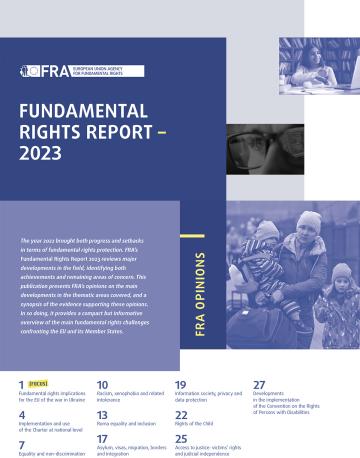
Το 2022 σημειώθηκε πρόοδος αλλά και οπισθοδρόμηση στην προστασία των θεμελιωδών δικαιωμάτων. Στην Έκθεση για τα Θεμελιώδη Δικαιώματα 2023 του FRA εξετάζονται οι σημαντικότερες εξελίξεις στον τομέα και προσδιορίζονται τόσο τα επιτεύγματα όσο και τα ζητήματα που εξακολουθούν να προκαλούν ανησυχία. Στην παρούσα δημοσίευση παρουσιάζονται οι γνώμες του FRA σχετικά με τις κυριότερες εξελίξεις στους εξεταζόμενους θεματικούς τομείς και συνοψίζεται η τεκμηρίωση στην οποία στηρίχθηκαν οι εν λόγω γνώμες.
The year 2022 brought both progress and setbacks in terms of fundamental rights protection. FRA’s Fundamental Rights Report 2023 reviews major developments in the field, identifying both achievements and remaining areas of concern. This publication presents FRA’s opinions on the main developments in the thematic areas covered, and a synopsis of the evidence supporting these opinions.
Il 2022 è stato caratterizzato sia da progressi sia da battute d’arresto in termini di tutela dei diritti fondamentali. Il Fundamental Rights Report 2023 (Relazione sui diritti fondamentali per il 2023) dell’Agenzia dell’Unione europea per i diritti fondamentali (FRA) fa il punto della situazione sui principali sviluppi in materia, individuando i risultati ottenuti e i settori che destano ancora preoccupazione.
Over the span of nearly eight years, there have been developments in showing respect for the human rights of those who arrive at the EU’s borders. Russia’s war of aggression against Ukraine has shown how a large and sudden influx of people can be managed effectively and respectfully. Notwithstanding the improvements, the growing number of people crossing or attempting to enter the EU pose a wide range of fundamental rights challenges.
In this bulletin, FRA takes stock of concerns and improvements regarding the fundamental rights of migrants, asylum seekers and refugees. It highlights the EU Member States’ legal and practical responses. It identifies key trends, promising practices, long-standing and emerging patterns, and persistent concerns.
This report provides a partial update on the findings of the 2017 European Union Agency for Fundamental Rights (FRA) report Surveillance by intelligence services: Fundamental rights safeguards and remedies in the EU. It was prepared at the request of the European Parliament, which asked FRA to update its 2017 findings to support the work of its committee of inquiry to investigate the use of Pegasus and equivalent surveillance spyware (PEGA).
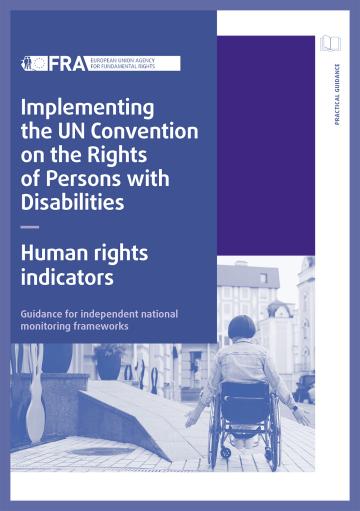
This guide helps independent national monitoring frameworks to fulfil their monitoring responsibility set out in Article 33 of the Convention on the Rights of Persons with Disabilities (CRPD). It focuses on the use of indicators. It does not deal with aspects such as compliance with the Paris Principles or the efficiency of complaints mechanisms. Its objective is to support national monitoring frameworks in designing or improving indicators for assessing progress of CRPD implementation at national level.
Russia’s military aggression against Ukraine triggered scenes not seen in Europe for decades. It has since caused death, immense destruction, and unspeakable suffering. It also set in motion a mass movement of people not seen since World War II. To protect them, the EU activated the Temporary Protection Directive for the first time. In doing so, all EU Member States must offer protection to those displaced from Ukraine.
L’aggressione militare della Russia contro l’Ucraina ha scatenato scenari che l’Europa non viveva da decenni. Da allora ha causato morte, distruzioni massicce e indicibili sofferenze. Ha inoltre innescato spostamenti di massa di persone che non si vedevano dalla seconda guerra mondiale. Per tutelare i profughi, l’UE ha attivato per la prima volta la direttiva sulla protezione temporanea. In tal modo, tutti gli Stati membri dell’UE devono offrire protezione agli sfollati in fuga dall’Ucraina.
Directive 2012/29/EU represents a milestone in the development of victims’ rights. It establishes minimum standards for the rights, support and protection of victims of crime. It defines the scope of support services, guarantees the right to effective protection against secondary victimisation and comprehensively regulates the measures required for this purpose. This report covers three core components underpinning victims’ rights: support services, crime reporting, and protection from secondary and repeat victimisation. Examples highlight the relevant legal provisions in Member States and how specific rights under the Victims’ Rights Directive work in practice.
National Human Rights Institutions (NHRIs) continue to play a key role in upholding fundamental rights. FRA keeps track of the accreditation status and the mandates of the NHRIs. In 2022, the NHRI in Cyprus was upgraded to an ‘A-status’ institution. In addition, the mandates of six NHRIs changed to include child protection or the protection of LGBTI people.
Artificial intelligence is everywhere and affects everyone – from deciding what content people see on their social media feeds to determining who will receive state benefits. AI technologies are typically based on algorithms that make predictions to support or even fully automate decision-making.
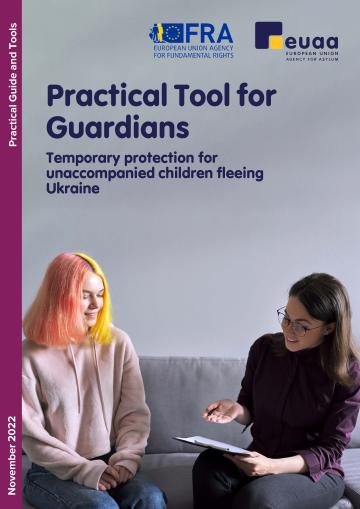
Ο Οργανισμός της Ευρωπαϊκής Ένωσης για το Άσυλο (EUAA) και ο Οργανισμός Θεμελιωδών Δικαιωμάτων της Ευρωπαϊκής Ένωσης (FRA) ένωσαν τις δυνάμεις τους για την ανάπτυξη σειράς πρακτικών εργαλείων για τους επιτρόπους ασυνόδευτων παιδιών με ανάγκες διεθνούς προστασίας. Στόχος είναι να υποστηριχθούν οι επίτροποι στα καθημερινά τους καθήκοντα και ευθύνες κατά τη διάρκεια της διαδικασίας χορήγησης ασύλου, της διαδικασίας του Δουβλίνου και της προσωρινής προστασίας.
The European Union Agency for Fundamental Rights (FRA) and the European Union Agency for Asylum (EUAA) joined forces to create this tool focusing on temporary protection for unaccompanied children fleeing Ukraine.
L’Agenzia dell’Unione europea per l’asilo (EUAA) e l’Agenzia dell’Unione europea per i diritti fondamentali (FRA) hanno unito le loro forze nello sviluppo di una serie di strumenti pratici per i tutori di minori non accompagnati con esigenze di protezione internazionale. L’obiettivo è sostenere i tutori nei loro compiti e responsabilità quotidiani durante la procedura di asilo, compresa la procedura Dublino e la protezione temporanea.
Automation and AI have radically transformed how we work, live and play. In this video, Director of the EU Agency for Fundamental Rights, Michael O'Flaherty, discusses the implications of AI for our most basic of human rights.
Antisemitic incidents and hate crimes violate fundamental rights, especially the right to human dignity, the right to equality of treatment and the freedom of thought, conscience and religion. This report provides an overview of available data on antisemitism as recorded by official and unofficial sources in the EU Member States and in Albania, North Macedonia and Serbia. The data provided by the countries are supplemented with information from international organisations.
This report presents findings from FRA’s 2021 survey on Roma in Croatia, Czechia, Greece, Hungary, Italy, Portugal, Romania and Spain, as well as in North Macedonia and Serbia. The survey includes interviews with more than 8,400 Roma, collecting information on more than 20,000 individuals living in their households. By focusing on Roma, the survey provides unique data and information that are not available from European general population surveys, which do not disaggregate on grounds of ethnic origin. The findings present a bleak but familiar picture of exclusion, deprivation, discrimination and racism.
The Russian invasion of Ukraine triggered solidarity from EU governments, local authorities and society as they welcomed more than 7 million people fleeing the aggression. The European Union’s rapid response, activating the EU Temporary Protection Directive, offered welcome relief and much-needed support to those in need. It allowed displaced persons the opportunity to quickly settle and to work, travel and access services across the EU. But other pressing human rights issues have come to the fore and remain high on the EU’s agenda, such as human trafficking, sexual and gender-based violence, hate crime and hate-fuelled disinformation.
Οι τρομοκρατικές επιθέσεις συνιστούν σοβαρή απειλή για τη ζωή και την ασφάλεια των πολιτών, αλλά και τεράστια πρόκληση για την ασφάλεια των κρατών. Ταυτόχρονα, η αντιτρομοκρατική νομοθεσία, οι αντιτρομοκρατικές πολιτικές και τα λοιπά μέτρα μπορεί να συνεπάγονται, αμέσως ή εμμέσως, σοβαρούς περιορισμούς στα θεμελιώδη δικαιώματα και αρνητικές επιπτώσεις για τα άτομα, τις ομάδες και την κοινωνία στο σύνολό της. Η παρούσα σύνοψη παρουσιάζει τα κύρια ευρήματα της έκθεσης του FRA σχετικά με την οδηγία (ΕΕ) 2017/541 για την καταπολέμηση της τρομοκρατίας, την κύρια νομική πράξη της Ευρωπαϊκής Ένωσης (ΕΕ) στον τομέα του ποινικού δικαίου για την καταπολέμηση της τρομοκρατίας.