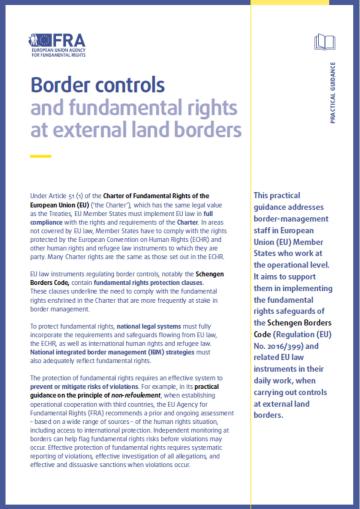
Ez az útmutató az EU tagállamaiban műveleti szinten határigazgatást végző személyzetnek készült. Célja, hogy segítséget nyújtson napi munkájuk során abban, hogy az alapjogoknak a Schengeni határ-ellenőrzési kódexben (2016/399/EU rendelet) és a kapcsolódó uniós jogban előírt védelmét biztosítani tudják.
I presenti orientamenti sono destinati al personale addetto alla gestione delle frontiere negli Stati membri dell’Unione europea (UE) che lavora a livello operativo e mirano ad assisterli nell’attuare nel loro lavoro quotidiano, le tutele in materia di diritti fondamentali previste dal codice frontiere Schengen [regolamento (UE) 2016/399] e dal relativo diritto dell’UE.
Šios gairės skirtos ES valstybių narių sienų valdymo pareigūnams, dirbantiems operatyviniu lygmeniu. Jomis siekiama padėti jiems kasdieniame darbe įgyvendinti Šengeno sienų kodekse (Reglamentas (ES) 2016/399) ir susijusiuose ES teisės aktuose nustatytas pagrindinių teisių apsaugos priemones.
Šie norādījumi ir paredzēti robežu pārvaldības darbiniekiem ES dalībvalstīs, kuri strādā operatīvajā līmenī. Norādījumu mērķis ir palīdzēt viņiem ikdienas darbā īstenot Šengenas Robežu kodeksā (Regula (ES) 2016/399) un saistītajos ES tiesību aktos paredzētos pamattiesību aizsardzības pasākumus.
Din il-gwida hija għall-persunal tal-ġestjoni tal-fruntieri fl-Istati Membri tal-UE li jaħdem fuq livell operazzjonali. Din għandha l-għan li tgħinhom jimplimentaw, fil-ħidma tagħhom ta’ kuljum, is-salvagwardji tad-drittijiet fundamentali tal-Kodiċi tal-Fruntieri ta’ Schengen (ir-Regolament (UE) Nru. 2016/399) u l-liġi tal-UE relatata.
Deze richtsnoeren zijn bestemd voor grensbeheerpersoneel in de lidstaten van de Europese Unie (EU) dat op operationeel niveau werkt. Ze zijn bedoeld om deze medewerkers
te helpen bij hun dagelijkse werkzaamheden om de waarborgen op het gebied van de grondrechten van de Schengengrenscode (Verordening (EU) 2016/399) en de daarmee verband houdende EU-wetgeving uit te voeren.
This paper presents people’s concerns and experiences relating to security. It covers worry about crime, including terrorism and online fraud; experience of online fraud; experience of cyberharassment; and concern about illegal access to data.
The EU Return Directive (2008/115/EC) in Article 8 (6) introduced an important fundamental rights safeguard for third-country nationals ordered to leave the EU because they do not or no longer fulfil the conditions for entry and/or stay. According to the directive, Member States must provide for an effective forced-return monitoring system.
The Coronavirus pandemic continues to interrupt everyday life in the EU in unprecedented ways. But the way it affects our societies is shifting. As governments gradually lift some of the measures put in place to contain the spread of COVID-19, new fundamental rights concerns arise: how to ensure that the rights to life and health are upheld as daily life transitions to a ‘new normal’. This Bulletin looks at declarations of states of emergency, or equivalent, and how they came under scrutiny. It considers
the impact on fundamental rights in important areas of daily life, and includes a thematic focus on the pandemic's impact on older people.
FRA’s Fundamental Rights Survey collected data from 35,000 people about their experiences, perceptions and opinions on a range of issues that are variously encompassed by human rights. This report presents a small selection of the survey results. It focuses on findings with respect to respondents’ opinions about human – or fundamental rights; their views and perceptions on the functioning of democratic societies – as a pillar on which human rights can flourish; and on their thoughts on and engagement with public services that have a duty to enforce human rights law and to protect people’s rights.
In 2019, the International Organization for Migration estimated that 1,866 people have died or gone missing while crossing the Mediterranean Sea to reach Europe to escape war or persecution or to pursue a better life. This is an average of five people per day. In recent years, a significant proportion of migrants in distress at sea have been rescued by civil society vessels deployed with a humanitarian mandate to reduce fatalities and bring rescued migrants to safety. Since 2018, however, authorities in some EU Member States started viewing civil society-deployed rescue vessels with hostility. As a reaction, national authorities initiated about 40 administrative and criminal proceedings against crew members or vessels, including seizing the latter. In some cases, rescue vessels were blocked in harbours due to flag issues or the inability to meet technical requirements.
In diesem Fokus wird die Anwendung der Charta der Grundrechte
der Europäischen Union, die seit zehn Jahren rechtsverbindlich
ist, näher beleuchtet. Auf EU-Ebene hat sie an Außenwirkung
gewonnen und Impulse für eine neue Grundrechtekultur
gesetzt. Auf nationaler Ebene sind der Bekanntheitsgrad und die
Anwendung der Charta begrenzt. Die Gerichte nutzen die Charta in
zunehmendem Maße, was deutlich macht, welche Wirkung dieses
moderne Instrument besitzt. Von Regierungen und Parlamenten
wird sie jedoch kaum genutzt. So gibt es beispielsweise nur wenige
Anhaltspunkte dafür, dass die einzelstaatlichen Rechtsvorschriften,
mit denen EU-Recht umgesetzt wird, regelmäßig daraufhin
überprüft werden, ob sie mit der Charta im Einklang stehen.
This focus takes a closer look at the application of the Charter of Fundamental Rights of the European Union, which has been legally binding for 10 years. At EU level, it has gained visibility and sparked a new fundamental rights culture. At national level, awareness and use of the Charter are limited. Courts increasingly use the Charter, showing the impact of this modern instrument. But its use by governments and parliaments remains low. For instance, there is little indication of anyone regularly scrutinising national legislation that transposes EU law for compatibility with the Charter.
W niniejszym dokumencie zwraca się szczególną uwagę
na stosowanie Karty praw podstawowych Unii Europejskiej,
która jest prawnie wiążąca od 10 lat. Na szczeblu unijnym
stała się ona bardziej widoczna i zapoczątkowała nową
kulturę praw podstawowych. Na szczeblu krajowym
świadomość i stosowanie Karty są ograniczone. Sądy w coraz
większym stopniu stosują Kartę, co pokazuje znaczenie tego
nowoczesnego instrumentu. Niemniej jednak jego stosowanie
przez rządy i parlamenty pozostaje na niskim poziomie.
Przykładowo niewiele wskazuje na to, by ktokolwiek
regularnie kontrolował przepisy krajowe dokonujące
transpozycji prawa Unii pod kątem ich zgodności z Kartą.
O presente Destaque aborda mais de perto a aplicação da
Carta dos Direitos Fundamentais da União Europeia, que se
tornou juridicamente vinculativa há 10 anos. Ao nível da UE,
a Carta ganhou visibilidade e deu origem a uma nova cultura
de direitos fundamentais. No plano nacional, a sensibilização
para a Carta e a sua utilização têm sido limitadas. Os tribunais
utilizam cada vez mais a Carta, evidenciando o impacto deste
moderno instrumento. Mas a sua utilização pelos governos
e parlamentos continua a ser modesta. Por exemplo, há
poucas indicações sobre a existência ou não de pessoas
que se dedicam a examinar regularmente se as legislações
nacionais que transpõem a legislação da UE são compatíveis
com a Carta.
Ta osrednja tema podrobneje obravnava uporabo Listine
Evropske unije o temeljnih pravicah, ki je pravno zavezujoča
že 10 let. Na ravni EU je postala prepoznavnejša, spodbudila
pa je tudi novo kulturo spoštovanja temeljnih pravic. Na
nacionalni ravni sta uporaba Listine in ozaveščenost o njej
omejeni. Na sodiščih se uporaba tega sodobnega instrumenta
povečuje, kar kaže, da ima vpliv, vlade in parlamenti pa ga
še naprej uporabljajo le redko. Tako na primer skoraj nič ne
kaže na to, da kdo redno podrobno preverja, ali je nacionalna
zakonodaja za prenos prava EU skladna z Listino.
Το 2019 υπήρξε έτος προόδου αλλά και προβλημάτων
όσον αφορά την προστασία των θεμελιωδών
δικαιωμάτων. Στην Έκθεση για τα Θεμελιώδη
Δικαιώματα 2020 του FRA εξετάζονται οι
σημαντικότερες εξελίξεις στον τομέα και
προσδιορίζονται όχι μόνο τα επιτεύγματα, αλλά και
τα ζητήματα που εξακολουθούν να προκαλούν
ανησυχία. Στην παρούσα δημοσίευση
παρουσιάζονται οι γνώμες του FRA σχετικά με τις
κυριότερες εξελίξεις στους εξεταζόμενους θεματικούς
τομείς και συνοπτική τεκμηρίωση των γνωμών
αυτών. Με αυτόν τον τρόπο, παρέχεται μια συνοπτική
και ταυτόχρονα κατατοπιστική επισκόπηση των
βασικών προκλήσεων τις οποίες αντιμετωπίζουν η ΕΕ
και τα κράτη μέλη στον τομέα των θεμελιωδών
δικαιωμάτων.
The year 2019 brought both progress and setbacks in terms of fundamental rights protection. FRA’s Fundamental Rights Report 2020 reviews major developments in the field, identifying both achievements and remaining areas of concern. This publication presents FRA’s opinions on the main developments in the thematic areas covered, and a synopsis of the evidence supporting these opinions. In so doing, it provides a compact but informative overview of the main fundamental rights challenges confronting the EU and its Member States.
En el año 2019 se produjeron tanto avances como
retrocesos en materia de protección de los derechos
fundamentales. El Informe sobre los derechos
fundamentales 2020 de la Agencia de los Derechos
Fundamentales de la Unión Europea (FRA) analiza
los principales acontecimientos en este ámbito,
destacando tanto los progresos realizados como
las dificultades que todavía persisten. La publicación
presenta los dictámenes de la FRA sobre los
principales avances realizados en los ámbitos
temáticos contemplados, así como un resumen
de las pruebas que respaldan tales dictámenes.
Esto permite disponer de una visión de conjunto,
compacta, pero muy ilustrativa, de los principales
desafíos en materia de derechos fundamentales
a los que se enfrentan la UE y sus Estados miembros.
Bhí idir dul chun cinn agus dul ar gcúl le tabhairt faoi
deara i ndáil le cosaint na gceart bunúsach in 2019.
Déantar athbhreithniú i dTuarascáil um Chearta
Bunúsacha 2020 FRA ar mhórfhorbairtí san earnáil,
agus tarraingítear aird ar éachtaí agus ar réimsí ar
ábhair imní iad go fóill. San fhoilseachán seo cuirtear
i láthair tuairimí FRA maidir leis na príomhfhorbairtí
sna réimsí téamacha atá curtha san áireamh, mar aon
le hachoimre ar an bhfianaise atá ag tacú leis na
tuairimí seo. Ar an gcaoi sin, soláthraítear
forbhreathnú gairid, ach faisnéiseach, ar na
príomhdhúshláin i dtaca le cearta bunúsacha atá os
comhair an AE agus a Bhallstáit.