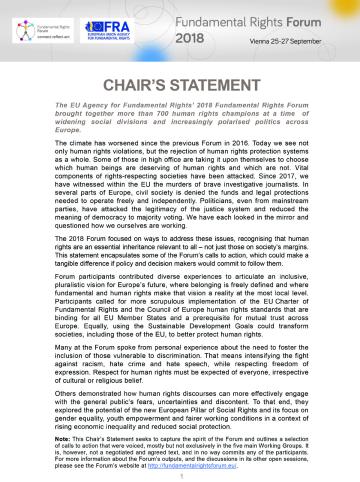
The EU Agency for Fundamental Rights’ 2018 Fundamental Rights Forum
brought together more than 700 human rights champions at a time of
widening social divisions and increasingly polarised politics across
Europe.
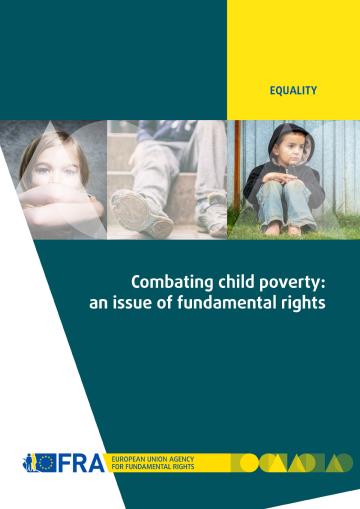
Almost 25 million children under 18 are at risk of poverty or social exclusion in the EU. Poverty deprives children of educational
opportunities, childcare, access to health care, adequate food and housing, family support and even protection from violence.
This report outlines data and survey findings that highlight the magnitude of child poverty in the EU, but also presents tools
available to counter this phenomenon and keep track of progress made.
With this Opinion, FRA aims to contribute to the European Parliament's own-initiative report on the “Implementation of the Charter of Fundamental Rights of the European Union in the EU institutional framework”, being prepared in the Parliament’s Committee for Constitutional Affairs (AFCO). The request aims at understanding the interaction between the Charter’s implementation at national and EU level, and whether there are “instruments, mechanisms and practices” available at EU level to assist Member States to better implement the Charter.
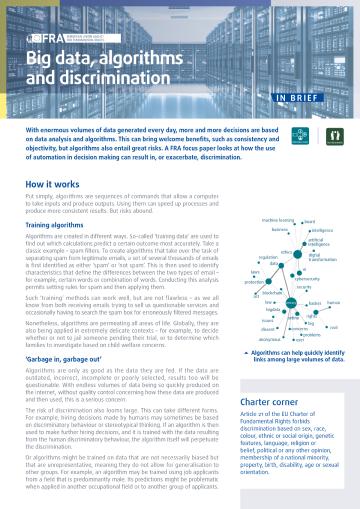
With enormous volumes of data generated every day, more and more decisions are based on data analysis and algorithms. This can bring welcome benefits, such as consistency and objectivity, but algorithms also entail great risks. A FRA focus paper looks at how the use of automation in decision making can result in, or exacerbate, discrimination.
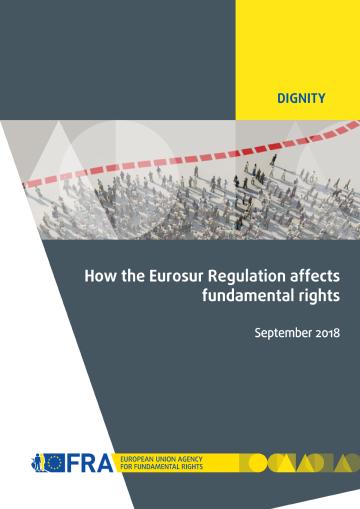
In November 2017, the European Commission requested FRA’s support in evaluating the impact on fundamental rights of the European Border Surveillance System (Eurosur) Regulation. Further to this request, FRA reviewed the work of the European Border and Coast Guard Agency (Frontex) and analysed cooperation agreements concluded by EU Member States with third countries which are relevant for the exchange of information for the purposes of Eurosur. This report presents the main findings of such review.
This Opinion aims to
inform the European Parliament’s position on the legislative proposal amending the
Visa Information System, the Visa Code and other related provisions of EU law. The
European Commission presented the proposal on 16 May 2018 and EU legislators are
currently discussing it.
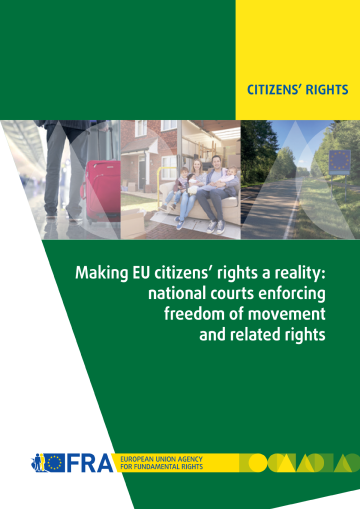
The founding treaties, the EU Charter of Fundamental Rights and secondary EU law all provide for EU citizens’ freedom to move and reside freely in any EU country of their choice. Growing numbers of citizens, and their family members, are making use of this freedom and related rights, such as the right not to be discriminated against based on nationality and the right to vote in certain elections in the host Member State. But making these rights a reality remains a challenge. This report presents an EU-wide, comparative overview of the application of the Free Movement Directive (2004/38/EC) across the 28 Member States based on a review of select case law at national level.
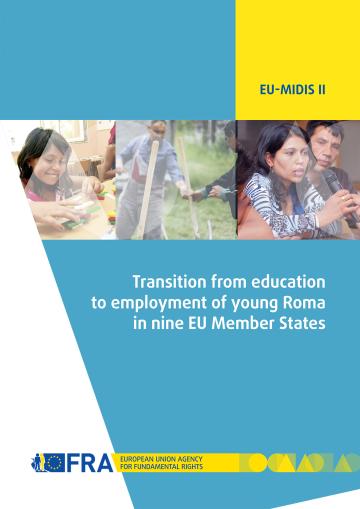
Across the European Union, Member States are faced with the challenge of integrating Europe’s most deprived
and disenfranchised minority groups. As a follow up to the EU-MIDIS II findings on Roma, this report presents
FRA’s findings relating to the issues of education and employment. Encouraging Roma participation in education
and employment equips communities with higher incomes, better life opportunities and greater social inclusion.
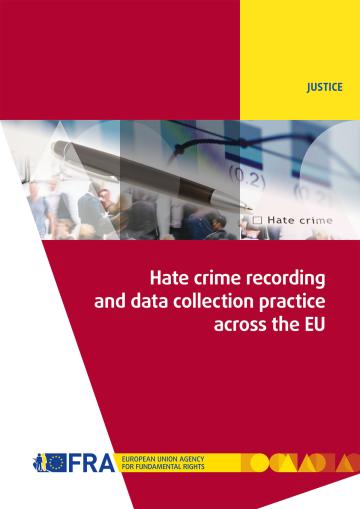
Across the European Union, people face hatred because of their skin colour, ethnicity, religion, gender or sexuality. In response, the EU and its Member States have introduced laws against hate crime and support services for victims. But these will only fulfil their potential if victims report hate-motivated harassment and violence to the police, and if police officers record such incidents as hate crimes. This report provides rich and detailed information on hate crime recording and data collection systems across the EU, including any systemic cooperation with civil society.
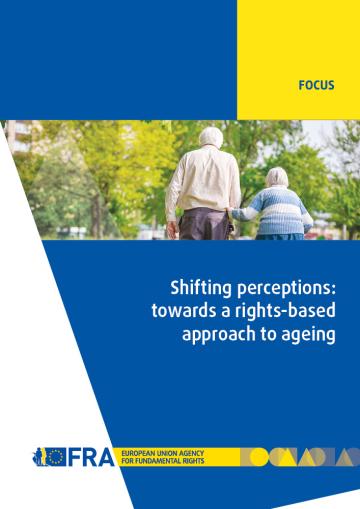
European societies are not getting any younger! It is a simple truth we must face both about ourselves and Europe as a whole. In two generations, by 2080, those aged 65 or above will account for almost 30% of the European Union’s population.
The year 2017 brought both progress and setbacks in terms of rights protection. The European Pillar of Social Rights marked an important move towards a more ‘social Europe’. But, as experiences with the EU Charter of Fundamental Rights underscore, agreement on a text is merely a first step. Even in its eighth year as the EU's binding bill of rights, the Charter's potential was not fully exploited, highlighting the need to more actively promote its use.
2017 година донесе както напредък, така и неуспехи по отношение на защитата на основните права. В Доклада на FRA относно основните права от 2018 г. е извършен преглед на важните развития в областта, като са посочени както постиженията, така и областите, които все още будят притеснение.
Rok 2017 přinesl v oblasti ochrany základních práv pokrok i nezdary. Zpráva o základních právech 2018 agentury FRA přináší přehled hlavního vývoje v této oblasti a upozorňuje jak na úspěchy, tak na oblasti, které i nadále vzbuzují obavy.
I 2017 skete der både fremgang og tilbagegang med hensyn til beskyttelsen af grundlæggende rettigheder. FRA’s rapport om grundlæggende rettigheder, Fundamental Rights Report 2018, gennemgår den vigtigste udvikling på området, herunder både de opnåede resultater og områder, der fortsat giver anledning til bekymring.
Το 2017 υπήρξε έτος προόδου αλλά και προβλημάτων όσον αφορά την προστασία των θεμελιωδών δικαιωμάτων. Στην Έκθεση για τα Θεμελιώδη Δικαιώματα 2018 του FRA εξετάζονται οι σημαντικές εξελίξεις στον τομέα και προσδιορίζονται όχι μόνο τα επιτεύγματα, αλλά και τα ζητήματα που εξακολουθούν να προκαλούν ανησυχία.
The year 2017 brought both progress and setbacks in terms of fundamental rights protection. FRA’s Fundamental Rights Report 2018 reviews major developments in the field, identifying both achievements and remaining areas of concern.
En el año 2017 hubo tantos avances como retrocesos en materia de protección de derechos fundamentales. El Informe sobre los derechos fundamentales 2018 de la FRA analiza los principales acontecimientos en este ámbito, destacando tanto los progresos realizados como los obstáculos que se siguen encontrando.
2017. aasta tähendas põhiõiguste kaitse jaoks nii edusamme kui ka tagasilööke. Euroopa Liidu Põhiõiguste Ameti (FRA) 2018. aasta põhiõiguste aruandes esitatakse ülevaade valdkonna peamistest arengusuundadest, tuues esile nii saavutused kui ka püsivad muret tekitavad valdkonnad.
Vuonna 2017 perusoikeuksien suojelussa tapahtui sekä edistystä että vastoinkäymisiä. Euroopan unionin perusoikeusviraston (FRA) vuoden 2018 perusoikeusraportissa tarkastellaan perusoikeuksien tilanteen kehitystä pääpiirteissään ja tuodaan esiin sekä saavutuksia että jäljellä olevia huolenaiheita.
Godina 2017. sa sobom je donijela i napredovanja i nazadovanja u pogledu zaštite temeljnih prava. U Izvješću agencije FRA o temeljnim pravima 2018. daje se pregled važnih novih događaja i postignuća u tom području te se ističu područja koja još izazivaju zabrinutost.