• Report / Paper / Summary
    9
    December
    2014
    Trans persons, or those whose gender identity and/or gender expression differs from the sex assigned them at birth, face frequent discrimination, harassment and violence across the European Union (EU) today. This reality triggers fears that persuade many to hide or disguise their true selves. This report examines issues of equal treatment and discrimination on two grounds, namely sexual orientation and gender identity. It analyses data on the experiences of 6,579 trans respondents from the EU Lesbian, gay, bisexual and transgender (LGBT) survey, the largest body of empirical evidence of its kind to date.
  • Report / Paper / Summary
    28
    October
    2014
    In light of a lack of comparable data on the respect, protection and fulfilment of the fundamental rights of lesbian, gay, bisexual and transgender (LGBT) persons, FRA launched in 2012 its European Union (EU) online survey of LGBT persons’ experiences of discrimination, violence and harassment.
  • Report / Paper / Summary
    6
    January
    2014
    This Technical report describes how the FRA Roma Pilot survey was carried out and the fieldwork outcomes in 11 EU Member States.
  • Report / Paper / Summary
    8
    November
    2013
    Im Rahmen dieser Erhebung der FRA wurden erstmals
    in einer Reihe von Mitgliedstaaten – Belgien, Deutschland, Frankreich, Italien, Lettland, Schweden, Ungarn und
    Vereinigtes Königreich – vergleichbare Daten über die Erfahrungen und Wahrnehmungen der jüdischen Bevölkerung
    im Zusammenhang mit Antisemitismus, Hasskriminalität und Diskriminierung zusammengetragen. Ihre Ergebnisse
    belegen eine beunruhigend starke Diskriminierung, insbesondere in den Bereichen Beschäftigung und Bildung,
    eine weitverbreitete Furcht vor Viktimisierung und eine zunehmende Besorgnis angesichts des Antisemitismus im
    Internet.
  • Report / Paper / Summary
    8
    November
    2013
    This FRA survey is the first-ever to collect comparable data on Jewish people’s experiences and perceptions of antisemitism, hate-motivated crime and discrimination across a number of EU Member States, specifically in Belgium, France, Germany, Hungary, Italy, Latvia, Sweden and the United Kingdom. Its findings reveal a worrying level of discrimination, particularly in employment and education, a widespread fear of victimisation and heightening concern about antisemitism online.

  • Rapport / Publication / Résumé
    8
    November
    2013
    Cette enquête de la
    FRA est la première enquête jamais réalisée visant à collecter des données comparables sur les expériences et
    perceptions des personnes juives de l’antisémitisme, du crime motivé par la haine et de la discrimination dans un
    certain nombre d’États membres de l’UE, à savoir l’Allemagne, la Belgique, la France, la Hongrie, l’Italie, la Lettonie,
    le Royaume-Uni et la Suède. Ses conclusions révèlent un niveau inquiétant de discrimination, notamment dans les
    domaines de l’emploi et de l’enseignement, une peur répandue de la victimisation et une inquiétude croissante de
    l’antisémitisme en ligne.
  • Report / Paper / Summary
    17
    May
    2013
    This technical report sheds light on the research process that lies behind the key findings of
    the EU LGBT survey.
  • Report / Paper / Summary
    17
    May
    2013
    Da kaum vergleichbare Daten über die Wahrung, den Schutz und die Verwirklichung der Grundrechte von Lesben, Schwulen, Bisexuellen und Transgender-Personen (LGBT) verfügbar waren, ließ die Agentur der Europäischen Union für Grundrechte (FRA) eine EU-weite Online-Erhebung über die Erfahrungen von LGBT-Personen mit Diskriminierung, Gewalt und Belästigungen durchführen.
  • Report / Paper / Summary
    17
    May
    2013
    In light of a lack of comparable data on the respect, protection and fulfilment of the fundamental rights of lesbian, gay, bisexual and transgender (LGBT) persons, the European Union Agency for Fundamental Rights (FRA) launched in 2012 its European Union (EU) online survey of LGBT persons’ experiences of discrimination, violence and harassment.
  • Rapport / Publication / Résumé
    17
    May
    2013
    En raison du manque de données comparables sur le respect, la protection et l’exercice des droits fondamentaux des personnes lesbiennes, gays, bisexuelles et transgenres (LGBT), l’Agence des droits fondamentaux de l’Union européenne
    (FRA) a lancé en 2012 une enquête en ligne sur les expériences des personnes LGBT en matière de discrimination, de violence et de harcèlement dans l’Union européenne.
  • In brief / Factsheet
    17
    May
    2013
    Im Jahr 2010 ersuchte die Europäische Kommission die Agentur der Europäischen Union für Grundrechte (FRA), vergleichbare Daten zu den Erfahrungen von LGBT-Personen mit Diskriminierung und Hassverbrechen in allen EU-Mitgliedstaaten und Kroatien zu erheben. Daraufhin startete die FRA im Jahr 2012 eine EU-weite LGBT Online-Umfrage, bei der 93 079 Antworten eingingen.
  • In brief / Factsheet
    17
    May
    2013
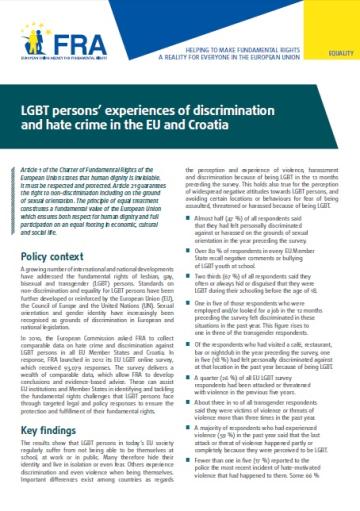
    In 2010, the European Commission asked FRA to collect comparable data on discrimination and hate crime experienced by LGBT persons in all EU Member States and Croatia. In response, FRA launched in 2012 its EU LGBT online survey, which received 93,079 responses.
  • In brief / Factsheet
    17
    May
    2013
    En 2010, la Commission européenne a demandé à la FRA de recueillir des données comparables sur la discrimination et les crimes de haine dont sont victimes les personnes LGBT dans les différents États membres de l’UE et en Croatie. Suite à cette demande, la FRA a lancé en 2012 son enquête en ligne sur les personnes LGBT dans l’UE et la Croatie, à laquelle 93 079 personnes ont répondu.
  • Handbook / Guide / Manual
    15
    October
    2012
    National Human Rights Institutions (NHRIs) protect and promote human rights at the national level, tackling systemic problems and raising fundamental rights awareness. To equip NHRIs to perform their role well, they should have, among other qualities, independence, powers and a broad mandate, in accordance with the so-called ‘Paris Principles’ which were adopted by the United Nations General Assembly in 1993 and set forth the primary minimum standards for an effective NHRI.
  • Report / Paper / Summary
    23
    May
    2012
    Die Roma – mit 10 bis 12 Millionen Menschen die größte Minderheit in Europa – werden nach wie vor Opfer von Diskriminierung und sozialer Ausgrenzung. Ihre Rechte, die durch EU-Rechtsvorschriften wie die Richtlinie zur Gleichbehandlung ohne Unterschied der Rasse geschützt werden, sind den Roma nicht ausreichend bekannt. Dieser Bericht legt die ersten Ergebnisse der Pilotumfrage der FRA und der regionalen Umfrage der UNDP, der Weltbank und der Europäischen Kommission zur Situation der Roma aus dem Jahr 2011 vor.
  • Report / Paper / Summary
    23
    May
    2012
    Roma - Europe's largest minority of 10-12 million people - continue to experience discrimination and social exclusion; and they are not sufficiently aware of their rights guaranteed by EU law, such as the Racial Equality Directive. This report presents the first results of the FRA Roma pilot survey and the UNDP/World Bank/European Commission regional Roma survey carried out in 2011.
  • Rapport / Publication / Résumé
    23
    May
    2012
    Les Roms, au nombre de 10 à 12 millions, constituent la plus grande minorité en Europe et continuent à faire l’objet de discriminations et d’exclusion sociale. Ils ne sont pas suffisamment conscients des droits qui leur sont garantis par la législation de l’UE, par exemple par la directive relative à l’égalité raciale. Ce rapport présente les premiers résultats de l’enquête pilote de la FRA sur les Roms et de l’enquête régionale du PNUD, de la Banque mondiale et de la Commission européenne menées en 2011.
  • In brief / Factsheet
    30
    November
    2010
    The EU Agency for Fundamental Rights examined law and practice in the EU 27 on the deprivation of liberty of irregular migrants pending their removal against the applicable international human rights law framework.
  • Report / Paper / Summary
    7
    May
    2010
    Human rights are first and foremost to be addressed at the national level. National human rights institutions (NHRIs) play an important role in the human rights architecture at the national level. This report by the European Union Agency for Fundamental Rights (FRA), is intended to identify gaps and concerns in the fundamental rights architecture in the European Union.