• Report / Paper / Summary
    2026
    This guide provides practical instructions on how to integrate fundamental rights in foresight exercises. It is for policymakers and practitioners, and explains how to consider fundamental rights throughout the foresight process: from scanning for future changes to building potential scenarios, as well as stress-testing ideas and communicating results. It accompanies the FRA report, ‘Fundamental rights in an uncertain future: Strategic foresight for Europe 2040’, which explores how future changes could affect fundamental rights and sets out ways to protect rights in the face of major transitions.
  • Report / Paper / Summary
    2026
    Europe’s future will be shaped by technology, climate and economic pressures, demographic changes and challenges to democracy and security, and by the choices we make in response. Strategic foresight explores how these changes could unfold. FRA’s strategic foresight work aims to bring fundamental rights into decisions while there is still time to shape them.
    This report explores how future changes could affect fundamental rights. It sets out ways to protect rights in the face of major transitions and helps institutions prepare before decisions become urgent. It is accompanied by practical guidance, ‘Embedding fundamental rights in foresight: A guide for practitioners’, designed to support practitioners integrate fundamental rights in foresight exercises.
  • Periodic updates / Series
    15
    October
    2026
    EU law requires independent monitoring of certain migration-related activities such as screening, the asylum border procedure and forced returns. This publication provides an overview and an update on the functioning of this EU-mandated monitoring. The report also provides an update on investigations into reported incidents of ill-treatment at borders and shows that there are still significant gaps when it comes to investigating promptly and effectively rights violations at borders.
  • Periodic updates / Series
    22
    October
    2026
    This is the third bulletin in FRA’s new quarterly series monitoring the situation of migrants, asylum seekers and refugees. It covers key developments and ongoing concerns between 1 July and 30 September 2026. FRA reported regularly on fundamental rights issues related to migration and asylum from 2015 to 2023. FRA resumed its quarterly bulletins on migration in 2026 as envisaged in the EU's 2024 Asylum and Migration Management Regulation, ahead of the implementation of the EU Migration and Asylum Pact in June 2026.
    Publication series: Migration Bulletins
  • Report / Paper / Summary
    9
    October
    2026
    Criminal investigations rely on large amounts of personal data processed by law enforcement authorities. This sensitive information must be handled in line with EU data protection rules and people’s rights. The Law Enforcement Directive sets out rules for how authorities can process data in a way that safeguards fundamental rights and freedoms. This report looks at how data protection rules are applied in practice in all EU Member States. It highlights challenges concerning understanding and compliance, the role and resources of data protection officers, and effective supervision. The results contribute to an EU-level assessment of how the directive is applied in practice, pointing to areas for future improvement.
  • Report / Paper / Summary
    5
    October
    2026
    FRA and EIGE conducted the European Union gender-based violence survey (EU-GBV survey) in eight EU Member States – Cyprus, Czechia, Germany, Hungary, Ireland, Luxembourg, Romania and Sweden. This report describes the measures taken to carry out the survey, which resulted in a final dataset of 15,447 interviews across the eight survey countries.
  • Report / Paper / Summary
    30
    September
    2026
    Today, a single camera scan from a distance can identify one person in a crowd. Law enforcement authorities in a growing number of EU Member States use or are considering using this AI-driven technique, known as remote biometric identification. While it can support public security and protect people from crime, it also poses serious risks to fundamental rights. FRA’s report draws on legal analysis, interviews with law enforcement practitioners and other experts, observations of police work and a public survey across selected EU Member States. FRA points to the need for a comprehensive legal basis for RBI use for law enforcement, including defined purposes, limits on identifying participants in peaceful assemblies or political gatherings, independent oversight and fundamental rights impact assessments, all of which should be in place before RBI is deployed.
  • Report / Paper / Summary
    18
    August
    2026
    The Roma Survey 2024 and its predecessors describe discrimination and bias-motivated harassment and violence experienced by Roma and Travellers across Europe. The Survey provides data which policy makers can use to address these high-priority agenda issues and most importantly assess progress over time as regards equality and non-discrimination in key areas of life. This technical report provides a detailed overview of the survey methodology used by FRA when collecting the survey data.
  • Periodic updates / Series
    28
    July
    2026
    The EU Agency for Fundamental Rights regularly collects data on the operations of NGO vessels involved in search and rescue in the Mediterranean. This includes any legal proceedings against them, as well as any difficulties in disembarking migrants in safe ports. This paper provides an overview of criminal investigations and other legal proceedings initiated by European Union Member States against civil society organisations deploying search and rescue vessels and aircraft in the Mediterranean and/or against crew members. The latest update covers the period from 2018 up until 30 June 2026.
  • Periodic updates / Series
    21
    July
    2026
    This is the second bulletin in FRA’s new quarterly series monitoring the situation of migrants, asylum seekers and refugees. It covers key developments and ongoing concerns from 1 April to 30 June 2026.

    Following regular reporting on fundamental rights issues related to migration and asylum from 2015 to 2023, FRA resumed the series in 2026 under the EU's 2024 Asylum and Migration Management Regulation, ahead of the June 2026 implementation of the EU Migration and Asylum Pact. The first bulletin, published in April 2026, covered developments from 1 January 2025 to 31 March 2026.
    Publication series: Migration Bulletins
  • Easy-to-read report
    7
    July
    2026
    This report talks about the situation of people with disabilities who live in institutions. Institutions are places where people with disabilities often live away from other people. Our report is based on a study we made in 30 countries in Europe. This text is a short version of the report in easy language.
  • In brief / Factsheet
    30
    June
    2026
    This factsheet examines case law on cross-border child abduction, meaning the unlawful removal of a child from one EU Member State to another. Jointly published by the European Court of Human Rights and the EU Agency for Fundamental Rights, it explains how courts handle issues where EU law and human rights law overlap. It highlights key court decisions from the Court of Justice of the European Union (CJEU) and the European Court of Human Rights (ECtHR) to show how these two legal systems work together on issues of child abduction and prioritising the best interests of the child.
    Publication series: ECtHR-FRA Joint Factsheets
  • In brief / Factsheet
    30
    June
    2026
    This factsheet examines the importance of freedom of religion in the workplace as one of the foundations of a democratic society. Jointly published by FRA and the European Court of Human Rights, it examines relevant EU law on the topic, and explains how courts handle issues where EU law and human rights law overlap. It highlights key court decisions from the Court of Justice of the European Union (CJEU) and the European Court of Human Rights (ECtHR) to show how these two legal systems work together on aspects of religious freedom in the workplace, such as wearing religious symbols to work and time off for religious holidays.
    Publication series: ECtHR-FRA Joint Factsheets
  • Handbook / Guide / Manual
    29
    June
    2026
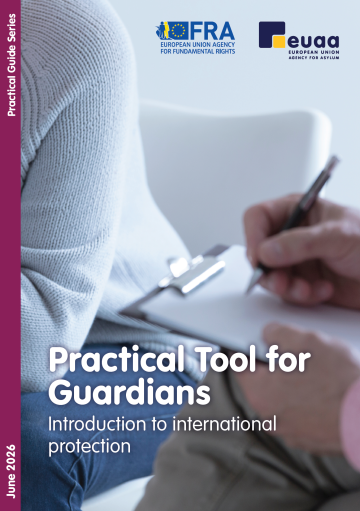
    This guidance explains the role of a guardian assigned to a child during the screening and asylum procedure. It provides an overview of the different phases of the process and outlines a child’s legal rights throughout. The guidance includes topics such as lodging an application for international protection, preparing for the application interview and appealing against a negative decision. The European Union Agency for Asylum (EUAA) and the European Union Agency for Fundamental Rights (FRA) have developed a series of practical tools for guardians of unaccompanied children with international protection needs.
  • Handbook / Guide / Manual
    29
    June
    2026
    This guidance is for newly appointed guardians supporting a child who is applying for or has obtained international protection. It explains key terms, such as refugee status and subsidiary protection, as well as the legal framework for children’s rights in this context. The guidance also covers how to ensure the child’s participation and best interests during the asylum procedure. It is part of a series of practical tools developed by the European Union Agency for Asylum (EUAA) and the European Union Agency for Fundamental Rights (FRA) for guardians of unaccompanied children with international protection needs.
  • Report / Paper / Summary
    23
    June
    2026
    Gewalt gegen Menschen mit Behinderung in Einrichtungen ist nach wie vor weit verbreitet, wird aber in ganz Europa kaum gemeldet. Gewalttaten umfassen ein breites Spektrum ausbeuterischer, missbräuchlicher und erniedrigender Handlungen, die gegen die Verpflichtungen der Europäischen Union (EU) und der EU-Mitgliedstaaten gemäß internationalen und europäischen Menschenrechtsnormen verstoßen. Der Schutz vor Gewalt basiert auf dem Übereinkommen der Vereinten Nationen über die Rechte von Menschen mit Behinderungen (im Folgenden „Behindertenrechtskonvention“), dem wichtigsten Menschenrechtsvertrag für die gleichberechtigte Wahrnehmung aller Menschenrechte und Grundfreiheiten durch Menschen mit Behinderung.
  • Report / Paper / Summary
    23
    June
    2026
    The publication is an excerpt from the full report: Places of care = places of safety? Violence against persons with disabilities in institutions. The report looks at the breadth and depth of violence and neglect faced by people with disabilities living in institutions. It includes key findings and calls for better protection, greater prevention of violence, and clear accountability. It urges the EU and its Member States to implement their obligations on equality and fundamental rights. It is available in English, German, Croatian, Italian, Latvian, Polish, Portuguese, Slovakian and Slovenian.
  • Report / Paper / Summary
    23
    June
    2026
    Nasilje nad osobama s invaliditetom u ustanovama i dalje je rašireno, ali se o njemu u pravilu nedovoljno izvještava u cijeloj Europi. Nasilje uključuje širok spektar izrabljivanja te zlonamjernih i ponižavajućih postupaka koji su u suprotnosti s obvezama Europske unije (EU) i njenih država članica preuzetih na temelju međunarodnog prava prava i propisa EU-a u području ljudskih prava. Zaštita od nasilja temelji se na Konvenciji UN-a o pravima osoba s invaliditetom (UN KPOSI), primarnom međunarodnom ugovoru o ljudskim pravima za ravnopravno uživanje svih ljudskih prava i temeljnih sloboda svih osoba s invaliditetom.
  • Report / Paper / Summary
    23
    June
    2026
    Pur rimanendo un fenomeno diffuso, la violenza contro le persone con disabilità negli istituti è largamente sottostimata in Europa. Gli atti di violenza comprendono un ampio spettro di atti degradanti, di sfruttamento e abuso che violano gli obblighi dell’Unione europea (UE) e degli Stati membri dell’UE ai sensi del diritto internazionale ed europeo in materia di diritti umani. La protezione contro la violenza si fonda sulla Convenzione delle Nazioni Unite sui diritti delle persone con disabilità (CRPD), il principale trattato in materia di diritti umani che garantisce il pari godimento di tutti i diritti umani e di tutte le libertà fondamentali da parte delle persone con disabilità.