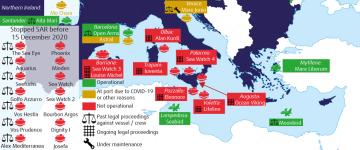
In 2020 (until 15 December), the International Organization for Migration estimated that about 1,054 people have died or gone missing while crossing the Mediterranean Sea to reach Europe to escape war or persecution or to pursue a better life. This is an average of almost three people per day. In the past years, a significant number of migrants in distress at sea have been rescued by civil society vessels deployed with a humanitarian mandate to reduce fatalities and bring rescued migrants to safety. Since 2018, however, national authorities initiated some 50 administrative and criminal proceedings against crew members or vessels, also seizing the latter. In some cases, rescue vessels were blocked in harbours due to flag issues or the inability to meet maritime safety-related and other technical requirements.
La convention européenne des droits de l’homme (CEDH) et la législation de l’Union européenne
(UE) fournissent un cadre de plus en plus important pour la protection des droits
des ressortissants étrangers. La législation de l’UE relative à l’asile, aux frontières et à l’immigration
se développe rapidement. Il existe un impressionnant corpus de jurisprudence de
la Cour européenne des droits de l’homme qui porte, en particulier, sur les articles 3, 5, 8 et
13 de la CEDH. La Cour de justice de l’Union européenne (CJUE) est également de plus en
plus souvent appelée à se prononcer sur l’interprétation des dispositions de la législation de
l’UE en la matière. La troisième édition du présent manuel, mise à jour jusqu’en juillet 2020,
expose de manière accessible cette législation et la jurisprudence des deux cours européennes
dans ce domaine.
The European Convention on Human Rights and European Union law provide an increasingly important framework for the protection of the rights of foreigners. European Union legislation relating to asylum, borders and immigration is developing fast. There is an impressive body of case law by the European Court of Human Rights relating in particular to Articles 3, 5, 8 and 13 of the ECHR. The Court of Justice of the European Union is increasingly asked to pronounce on the interpretation of European Union law provisions in this field. The third edition of this handbook, updated up to July 2020, presents this European Union legislation and the body of case law by the two European courts in an accessible way.
The EU is founded on the values of democracy, rule of law and respect for human rights. Yet these values, and discussions on fundamental rights at the EU and Member State level, can seem remote in people’s daily lives. With this in mind, FRA explored what people understand, know and experience with respect to their fundamental rights in practice. The resulting data provide comprehensive and comparable evidence on these aspects.
Artificial intelligence (AI) already plays a role in deciding what unemployment benefits someone gets, where a burglary is likely to take place, whether someone is at risk of cancer, or who sees that catchy advertisement for low mortgage rates. Its use keeps growing, presenting seemingly endless possibilities. But we need to make sure to fully uphold fundamental rights standards when using AI. This report presents concrete examples of how companies and public administrations in the EU are using, or trying to use, AI. It focuses on four core areas – social benefits, predictive policing, health services and targeted advertising.
This report looks at fundamental rights compliance at the European Union (EU)’s external land borders, including rivers and lakes. On 30 January 2020, the European Parliament requested the EU Agency for Fundamental Rights (FRA) to prepare a report on these borders. It noted that the report should focus on the correct application of the safeguards in the European asylum acquis and the provisions of the Schengen Borders Code (Regulation (EU) 2016/399).
Die Europäische Menschenrechtskonvention (EMRK) und das Recht der Europäischen Union
bieten einen zunehmend bedeutenden Rahmen für den Schutz der Rechte von Ausländern.
Das Unionsrecht zu Asyl, Grenzen und Einwanderung entwickelt sich in hoher Geschwindigkeit
weiter. Der Umfang der Rechtsprechung des Europäischen Gerichtshofs für Menschenrechte,
insbesondere zu den Artikeln 3, 5, 8 und 13 EMRK, ist beträchtlich. Der Gerichtshof
der Europäischen Union wird immer häufiger aufgefordert, sich zur Auslegung der diesbezüglichen
Bestimmungen des EU-Rechts zu äußern. Die dritte Ausgabe dieses Handbuchs
wurde im Juli 2020 fertiggestellt. Es stellt das Unionsrecht sowie die Rechtsprechung der
beiden europäischen Gerichtshöfe auf verständliche Art und Weise vor.
La Convenzione europea dei diritti dell’uomo (CEDU) e il diritto dell’Unione europea (UE)
forniscono un quadro di riferimento sempre più importante per la protezione dei diritti degli
stranieri. La legislazione dell’UE in materia di asilo, frontiere e immigrazione è in rapido sviluppo.
Esiste un cospicuo corpus di giurisprudenza formato dalla Corte europea dei diritti
dell’uomo (Corte EDU) riguardante, in particolare, gli articoli 3, 5, 8 e 13 CEDU. La Corte di
giustizia dell’Unione europea (CGUE) è chiamata con sempre maggiore frequenza a pronunciarsi
sull’interpretazione delle disposizioni legislative dell’UE in quest’ambito. La presente
terza edizione del manuale, aggiornata a luglio 2020, presenta in modo accessibile la legislazione
dell’UE e la giurisprudenza delle due corti europee, è rivolto a professionisti legali,
giudici, pubblici ministeri, funzionari dell’immigrazione e organizzazioni non governative
negli Stati membri dell’Unione europea e del Consiglio d’Europa.
This report outlines some of the measures EU Member States have put in place to protect public health as Europe faces the ‘second wave’ of the Coronavirus pandemic. It highlights how these may affect fundamental rights, especially social rights.
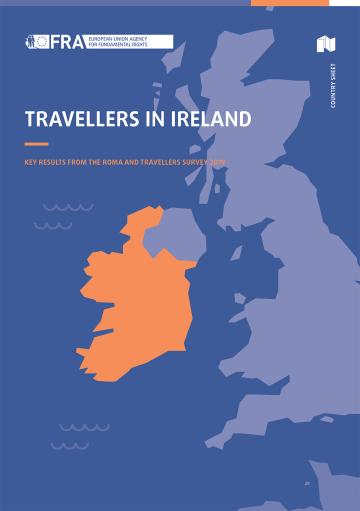
Roma and Travellers living in western EU countries are less often in the limelight than those living in central, eastern and southern EU countries. While they represent a smaller proportion of the population in the west, they also face problems with social exclusion, marginalisation and discrimination. These country sheets present findings from the survey conducted by FRA in 2019 covering Roma and Travellers populations in Belgium, France, Ireland, the Netherlands, Sweden and the United Kingdom. The survey included interviews with almost 4,700 Roma and Travellers, collecting information on more than 8,200 individuals living in their households.