eu-charter

Carta de los Derechos Fundamentales de la Unión Europea

Artículo 21 - No discriminación

Artículo 21 - No discriminación

1. Se prohíbe toda discriminación, y en particular la ejercida por razón de sexo, raza, color, orígenes étnicos o sociales, características genéticas, lengua, religión o convicciones, opiniones políticas o de cualquier otro tipo, pertenencia a una minoría nacional, patrimonio, nacimiento, discapacidad, edad u orientación sexual.
2. Se prohíbe toda discriminación por razón de nacionalidad en el ámbito de aplicación de los Tratados y sin perjuicio de sus disposiciones particulares.

Explicaciones

  • Text:

    El apartado 1 se inspira en el artículo 13 del Tratado CE, sustituido ahora por el artículo 19 del Tratado de Funcionamiento de la Unión Europea, en el artículo 14 del CEDH y en el artículo 11 del Convenio relativo a los derechos humanos y la biomedicina, referente al patrimonio genético. En la medida en que coincide con el artículo 14 del CEDH, se aplica de acuerdo con éste.
    No existe contradicción ni incompatibilidad entre el apartado 1 y el artículo 19 del Tratado de Funcionamiento de la Unión Europea, que tiene objetivos y alcance diferentes: el artículo 19 confiere competencias a la Unión para adoptar actos legislativos, incluida la armonización de las disposiciones legales y reglamentarias de los Estados miembros, con el fin de combatir determinadas formas de discriminación que se especifican de forma exhaustiva en el citado artículo. Dicha legislación podría cubrir la acción de las autoridades de los Estados miembros (así como las relaciones entre los particulares) en cualquier ámbito dentro de los límites de las competencias de la Unión. Las disposiciones del apartado 1 del artículo 21 no confieren, sin embargo, competencias para adoptar leyes con el fin de combatir formas de discriminación en ámbitos de acción de los Estados miembros o en la esfera privada, ni constituyen una prohibición generalizada de la discriminación en dichos ámbitos. Se refieren solamente a las discriminaciones por parte de las instituciones y órganos de la Unión en el ejercicio de las competencias que les confieren los Tratados, y por parte de los Estados miembros cuando apliquen el Derecho de la Unión solamente. Por consiguiente, el apartado 1 no modifica el alcance de las competencias conferidas por el artículo 19 ni la interpretación de dicho artículo.
    El apartado 2 corresponde al párrafo primero del artículo 18 del Tratado de Funcionamiento de la Unión Europea y debe aplicarse de acuerdo con este último.

    Source:
    Diario Oficial de la Unión Europea C 303/17 - 14.12.2007
    Preamble - Explanations relating to the Charter of Fundamental Rights:
    Las presentes explicaciones fueron elaboradas inicialmente bajo la responsabilidad del Praesidium de la Convención que redactó la Carta de los Derechos Fundamentales de la Unión Europea. Han sido actualizadas bajo la responsabilidad del Praesidium de la Convención Europea, a la vista de las adaptaciones de la redacción del texto de la Carta realizadas por la Convención (en particular, los artículos 51 y 52) y de la evolución del Derecho de la Unión. Si bien no tienen por sí mismas valor jurídico, constituyen un valioso instrumento de interpretación con objeto de aclarar las disposiciones de la Carta.

Jurisprudencia

Derecho constitucional nacional

57 results found

  • Constitution of the Republic of Lithuania
    País:
    Lithuania

    Article 29. All persons shall be equal before the law, the court, and other State institutions and officials. The rights of the human being may not be restricted, nor may he be granted any privileges on the ground of gender, race, nationality, language, origin, social status, belief, convictions, or views.

  • Constitution of the Republic of Poland
    País:
    Poland

    Article 32 1. All persons shall be equal before the law. All persons shall have the right to equal treatment by public authorities. 2. No one shall be discriminated against in political, social or economic life for any reason whatsoever.

  • Costituzione della Repubblica Italiana
    País:
    Italy

    Art. 3. Tutti i cittadini hanno pari dignità sociale e sono eguali davanti alla legge, senza distinzione di sesso, di razza, di lingua, di religione, di opinioni politiche, di condizioni personali e sociali. È compito della Repubblica rimuovere gli ostacoli di ordine economico e sociale, che, limitando di fatto la libertà e la uguaglianza dei cittadini, impediscono il pieno sviluppo della persona umana e l'effettiva partecipazione di tutti i lavoratori all'organizzazione politica, economica e sociale del Paese. Art. 10. (...) La condizione giuridica dello straniero è regolata dalla legge in conformità delle norme e dei trattati internazionali (...)

  • Czechia / Charter of Fundamental Rights and Freedoms
    País:
    Czechia

    Article 3 (1) Everyone is guaranteed the enjoyment of her fundamental rights and basic freedoms without regard to gender, race, colour of skin, language, faith and religion, political or other conviction, national or social origin, membership in a national or ethnic minority, property, birth, or other status.

  • Danmarks Riges Grundlov
    País:
    Denmark

    § 70. Ingen kan på grund af sin trosbekendelse eller afstamning berøves adgang til den fulde nydelse af borgerlige og politiske rettigheder eller unddrage sig opfyldelsen af nogen almindelig borgerpligt.
    § 71. Stk. 1. Den personlige frihed er ukrænkelig. Ingen dansk borger kan på grund af sin politiske eller religiøse overbevisning eller sin afstamning underkastes nogen form for frihedsberøvelse.
    § 83. Enhver i lovgivningen til adel, titel og rang knyttet forret er afskaffet.

  • De Belgische Grondwet
    País:
    Belgium

    Artikel 11Het genot van de rechten en vrijheden aan de Belgen toegekend moet zonder discriminatie verzekerd worden. Te dien einde waarborgen de wet en het decreet inzonderheid de rechten en vrijheden van de ideologische en filosofische minderheden.Artikel 131De wet stelt de regelen vast ter voorkoming van elke discriminatie om ideologische en filosofische redenen.

  • Eesti Vabariigi Põhiseadus
    País:
    Estonia

    § 12. Kõik on seaduse ees võrdsed. Kedagi ei tohi diskrimineerida rahvuse, rassi, nahavärvuse, soo, keele, päritolu, usutunnistuse, poliitiliste või muude veendumuste, samuti varalise ja sotsiaalse seisundi või muude asjaolude tõttu. Rahvusliku, rassilise, usulise või poliitilise vihkamise, vägivalla ja diskrimineerimise õhutamine on seadusega keelatud ja karistatav. Samuti on seadusega keelatud ja karistatav õhutada vihkamist, vägivalda ja diskrimineerimist ühiskonnakihtide vahel.

  • Equal Treatment Act
    País:
    Estonia

    § 1. Purpose and scope of Act
    (1) The purpose of this Act is to ensure the protection of persons against discrimination on grounds of nationality (ethnic origin), race, colour, religion or other beliefs, age, disability or sexual orientation.
    (2) In order to achieve the purpose specified in subsection (1) of this section, this Act provides for:
    1) the principles of equal treatment;
    2) duties upon implementation and promotion of the principle of equal treatment;
    3) resolution of discrimination disputes.

  • Federal Constitutional Act on Elimination of racial discrimination
    País:
    Austria

    Article 1 §1 (1) Any form of racial discrimination – also to the extent not already in contradiction with Article 7 of the Federal Constitutional Act as amended 1929 and Article 14 of the Convention for the Protection of Human Rights and Fundamental Liberties, Federal Law Gazette No. 210/1958 – is forbidden. Legislation and execution shall refrain from any discrimination for the sole reason of race, colour of skin, descent or national or ethnic origin. (2) Para 1 shall not prevent granting special rights to Austrian citizens or imposing
    special obligations on them, unless contradicted by Article 14 of the Convention for the Protection of Human Rights and Fundamental Liberties.

  • General Equal Treatment Act
    País:
    Germany


  • Grundgesetz für die Bundesrepublik Deutschland
    País:
    Germany

    Artikel 3 (...) (3) Niemand darf wegen seines Geschlechtes, seiner Abstammung, seiner Rasse, seiner Sprache, seiner Heimat und Herkunft, seines Glaubens, seiner religiösen oder politischen Anschauungen benachteiligt oder bevorzugt werden. Niemand darf wegen seiner Behinderung benachteiligt werden. Artikel 33 (1) Jeder Deutsche hat in jedem Lande die gleichen staatsbürgerlichen Rechte und Pflichten. (2) Jeder Deutsche hat nach seiner Eignung, Befähigung und fachlichen Leistung gleichen Zugang zu jedem öffentlichen Amte. (3) Der Genuß bürgerlicher und staatsbürgerlicher Rechte, die Zulassung zu öffentlichen Ämtern sowie die im öffentlichen Dienste erworbenen Rechte sind unabhängig von dem religiösen Bekenntnis. Niemandem darf aus seiner Zugehörigkeit oder Nichtzugehörigkeit zu einem Bekenntnisse oder einer Weltanschauung ein Nachteil erwachsen.

  • Konstytucja Rzeczypospolitej Polskiej
    País:
    Poland

    Art. 32. 1. Wszyscy są wobec prawa równi. Wszyscy mają prawo do równego traktowania przez władze publiczne.2. Nikt nie może być dyskryminowany w życiu politycznym, społecznym lub gospodarczym z jakiejkolwiek przyczyny.

  • Konvention zum Schutze der Menschenrechte und Grundfreiheiten
    País:
    Austria

    Artikel 14 Der Genuß der in der vorliegenden Konvention festgelegten Rechte und Freiheiten ist ohne Benachteiligung zu gewährleisten, die insbesondere im Geschlecht, in der Rasse, Hautfarbe, Sprache, Religion, in den politischen oder sonstigen Anschauungen, in nationaler oder sozialer Herkunft, in der Zugehörigkeit zu einer nationalen Minderheit, im Vermögen, in der Geburt oder im sonstigen Status begründet ist.

  • La Constitution Belge
    País:
    Belgium

    Article 11La jouissance des droits et libertés reconnus aux Belges doit être assurée sans discrimination. A cette fin, la loi et le décret garantissent notamment les droits et libertés des minorités idéologiques et philosophiques.Article 131La loi arrête les mesures en vue de prévenir toute discrimination pour des raisons idéologiques et philosophiques.

  • Latvijas Republikas Satversme
    País:
    Latvia

    91. Visi cilvēki Latvijā ir vienlīdzīgi likuma un tiesas priekšā. Cilvēka tiesības tiek īstenotas bez jebkādas diskriminācijas.

  • Lietuvos Respublikos Konstitucija
    País:
    Lithuania

    29 straipsnis Įstatymui, teismui ir kitoms valstybės institucijoms ar pareigūnams visi asmenys lygūs. Žmogaus teisių negalima varžyti ir teikti jam privilegijų dėl jo lyties, rasės, tautybės, kalbos, kilmės, socialinės padėties, tikėjimo, įsitikinimų ar pažiūrų pagrindu.

  • Luxembourg / Constitution of the Grand Ducal of Luxembourg
    País:
    Luxembourg

    Art. 15.  ... (2) Nul ne peut être discriminé en raison de sa situation ou de circonstances personnelles. 

    ...

  • Magyarország Alaptörvénye
    País:
    Hungary

    XV. cikk (SZABADSÁG ÉS FELELŐSSÉG) [...] (2) Magyarország az alapvető jogokat mindenkinek bármely megkülönböztetés, nevezetesen faj, szín, nem, fogyatékosság, nyelv, vallás, politikai vagy más vélemény , nemzeti vagy társadalmi származás, vagyoni, születési vagy egyéb helyzet szerinti kűlönbségtétel nélkül biztosítja. [...] (4)Magyarország az esélyegyenlőség és a társadalmi felzárkózás megvalósulását külön intézkedésekkel segíti.

  • Netherlands / Constitution of the Kingdom of the Netherlands
    País:
    Netherlands

    Article 1 All persons in the Netherlands shall be treated equally in equal circumstances. Discrimination on the grounds of religion, belief, political opinion, race or sex, disability, sexual orientation or on any other grounds whatsoever shall not be permitted.

  • Non-Discrimination Act (21/2004)
    País:
    Finland

Derecho de la UE

33 results found

  • Directive 2006/54/EC of the European Parliament and of the Council of 5 July 2006 on the implementation of the principle of equal opportunities and equal treatment of men and women in matters of employment and occupation (recast)

    Preamble 


    (5) Articles 21 and 23 of the Charter of Fundamental Rights of the European Union also prohibit any discrimination on grounds of sex and enshrine the right to equal treatment between men and women in all areas, including employment, work and pay.


    (6) Harassment and sexual harassment are contrary to the principle of equal treatment between men and women and constitute discrimination on grounds of sex for the purposes of this Directive. These forms of discrimination occur not only in the workplace, but also in the context of access to employment, vocational training and promotion. They should therefore be prohibited and should be subject to effective, proportionate and dissuasive penalties.

    (7) In this context, employers and those responsible for vocational training should be encouraged to take measures to combat all forms of discrimination on grounds of sex and, in particular, to take preventive measures against harassment and sexual harassment in the workplace and in access to employment, vocational training and promotion, in accordance with national law and practice.

    (8) The principle of equal pay for equal work or work of equal value as laid down by Article 141 of the Treaty and consistently upheld in the case-law of the Court of Justice constitutes an important aspect of the principle of equal treatment between men and women and an essential and indispensable part of the acquis communautaire, including the case-law of the Court concerning sex discrimination. It is therefore appropriate to make further provision for its implementation.


    (11) The Member States, in collaboration with the social partners, should continue to address the problem of the continuing gender-based wage differentials and marked gender segregation on the labour market by means such as flexible working time arrangements which enable both men and women to combine family and work commitments more successfully. This could also include appropriate parental leave arrangements which could be taken up by either parent as well as the provision of accessible and affordable child-care facilities and care for dependent persons.


    (26) In the Resolution of the Council and of the Ministers for Employment and Social Policy, meeting within the Council, of 29 June 2000 on the balanced participation of women and men in family and working life , Member States were encouraged to consider examining the scope for their respective legal systems to grant working men an individual and non‐transferable right to paternity leave, while maintaining their rights relating to employment.

    Article 2: Definitions

    1.   For the purposes of this Directive, the following definitions shall apply:

    (a) ‘direct discrimination’: where one person is treated less favourably on grounds of sex than another is, has been or would be treated in a comparable situation;

    (b) ‘indirect discrimination’: where an apparently neutral provision, criterion or practice would put persons of one sex at a particular disadvantage compared with persons of the other sex, unless that provision, criterion or practice is objectively justified by a legitimate aim, and the means of achieving that aim are appropriate and necessary;

    (c) ‘harassment’: where unwanted conduct related to the sex of a person occurs with the purpose or effect of violating the dignity of a person, and of creating an intimidating, hostile, degrading, humiliating or offensive environment;

    (d) ‘sexual harassment’: where any form of unwanted verbal, non-verbal or physical conduct of a sexual nature occurs, with the purpose or effect of violating the dignity of a person, in particular when creating an intimidating, hostile, degrading, humiliating or offensive environment;

    (e)‘pay’: the ordinary basic or minimum wage or salary and any other consideration, whether in cash or in kind, which the worker receives directly or indirectly, in respect of his/her employment from his/her employer;

    (f) ‘occupational social security schemes’: schemes not governed by Council Directive 79/7/EEC of 19 December 1978 on the progressive implementation of the principle of equal treatment for men and women in matters of social security (16) whose purpose is to provide workers, whether employees or self-employed, in an undertaking or group of undertakings, area of economic activity, occupational sector or group of sectors with benefits intended to supplement the benefits provided by statutory social security schemes or to replace them, whether membership of such schemes is compulsory or optional.

    2.   For the purposes of this Directive, discrimination includes:

    (a) harassment and sexual harassment, as well as any less favourable treatment based on a person's rejection of or submission to such conduct;

    (b) instruction to discriminate against persons on grounds of sex;

    (c) any less favourable treatment of a woman related to pregnancy or maternity leave within the meaning of Directive 92/85/EEC.

    CHAPTER 1: Equal pay

    Article 4: Prohibition of discrimination

    For the same work or for work to which equal value is attributed, direct and indirect discrimination on grounds of sex with regard to all aspects and conditions of remuneration shall be eliminated.

    In particular, where a job classification system is used for determining pay, it shall be based on the same criteria for both men and women and so drawn up as to exclude any discrimination on grounds of sex.

    CHAPTER 2 : Equal treatment in occupational social security schemes

    Article 5: Prohibition of discrimination

    Without prejudice to Article 4, there shall be no direct or indirect discrimination on grounds of sex in occupational social security schemes, in particular as regards:

    (a) the scope of such schemes and the conditions of access to them;

    (b) the obligation to contribute and the calculation of contributions;

    (c) the calculation of benefits, including supplementary benefits due in respect of a spouse or dependants, and the conditions governing the duration and retention of entitlement to benefits.

    Article 7: Material scope

    1.   This Chapter applies to:

    (a) occupational social security schemes which provide protection against the following risks:

    (i) sickness,

    (ii)invalidity,

    (iii) old age, including early retirement,

    (iv) industrial accidents and occupational diseases,

    (v) unemployment;

    (b) occupational social security schemes which provide for other social benefits, in cash or in kind, and in particular survivors' benefits and family allowances, if such benefits constitute a consideration paid by the employer to the worker by reason of the latter's employment.

    2.   This Chapter also applies to pension schemes for a particular category of worker such as that of public servants if the benefits payable under the scheme are paid by reason of the employment relationship with the public employer. The fact that such a scheme forms part of a general statutory scheme shall be without prejudice in that respect.

    CHAPTER 3 : Equal treatment as regards access to employment, vocational training and promotion and working conditions

    Article 14: Prohibition of discrimination

    1.   There shall be no direct or indirect discrimination on grounds of sex in the public or private sectors, including public bodies, in relation to:

    (a) conditions for access to employment, to self-employment or to occupation, including selection criteria and recruitment conditions, whatever the branch of activity and at all levels of the professional hierarchy, including promotion;

    (b) access to all types and to all levels of vocational guidance, vocational training, advanced vocational training and retraining, including practical work experience;

    (c) employment and working conditions, including dismissals, as well as pay as provided for in Article 141 of the Treaty;

    (d) membership of, and involvement in, an organisation of workers or employers, or any organisation whose members carry on a particular profession, including the benefits provided for by such organisations.

    2.   Member States may provide, as regards access to employment including the training leading thereto, that a difference of treatment which is based on a characteristic related to sex shall not constitute discrimination where, by reason of the nature of the particular occupational activities concerned or of the context in which they are carried out, such a characteristic constitutes a genuine and determining occupational requirement, provided that its objective is legitimate and the requirement is proportionate.

  • Action plan on Integration and Inclusion 2021-2027

    .

  • A Union of Equality: EU anti-racism action plan 2020–2025

    .

  • Union of Equality: EU Roma strategic framework on equality, inclusion and participation

    .

  • European Parliament resolution on the need for a strengthened post-2020 Strategic EU Framework for National Roma Inclusion Strategies and stepping up the fight against anti-Gypsyism (2019/2509(RSP))

    .

  • Treaty on the Functioning of the European Union

    Article 18

    (ex Article 12 TEC)

    Within the scope of application of the Treaties, and without prejudice to any special provisions contained therein, any discrimination on grounds of nationality shall be prohibited.

    The European Parliament and the Council, acting in accordance with the ordinary legislative procedure, may adopt rules designed to prohibit such discrimination.

  • Treaty on the Functioning of the European Union

    Article 19

    (ex Article 13 TEC)

    1. Without prejudice to the other provisions of the Treaties and within the limits of the powers conferred by them upon the Union, the Council, acting unanimously in accordance with a special legislative procedure and after obtaining the consent of the European Parliament, may take appropriate action to combat discrimination based on sex, racial or ethnic origin, religion or belief, disability, age or sexual orientation.

    2. By way of derogation from paragraph 1, the European Parliament and the Council, acting in accordance with the ordinary legislative procedure, may adopt the basic principles of Union incentive measures, excluding any harmonisation of the laws and regulations of the Member States, to support action taken by the Member States in order to contribute to the achievement of the objectives referred to in paragraph 1.

  • Directive (EU) 2018/1808 of the European Parliament and of the Council of 14 November 2018 amending Directive 2010/13/EU on the coordination of certain provisions laid down by law, regulation or administrative action in Member States concerning the provis

    .

  • Directive (EU) 2019/882 of the European Parliament and of the Council of 17 April 2019 on the accessibility requirements for products and services

    .

  • Directive (EU) 2018/1808 of the European Parliament and of the Council of 14 November 2018 amending Directive 2010/13/EU on the coordination of certain provisions laid down by law

    Article 6

    1. Without prejudice to the obligation of Member States to respect and protect human dignity, Member States shall ensure by appropriate means that audiovisual media services provided by media service providers under their jurisdiction do not contain any:

    (a) incitement to violence or hatred directed against a group of persons or a member of a group based on any of the grounds referred to in Article 21 of the Charter;

    (b) public provocation to commit a terrorist offence as set out in Article 5 of Directive (EU) 2017/541.

    2. The measures taken for the purposes of this Article shall be necessary and proportionate and shall respect the rights and observe principles set out in the Charter.’;

    [...]

    Article 28b

    ...

    (b) the general public from programmes, user-generated videos and audiovisual commercial communications containing incitement to violence or hatred directed against a group of persons or a member of a group based on any of the grounds referred to in Article 21 of the Charter;

Derecho internacional

4 results found

  • Committee on the Elimination of Racial Discrimination, General recommendation No. 35 Combating racist hate speech

    ‘24. Article 5 of the Convention enshrines the obligation of States parties to prohibit and eliminate racial discrimination and to guarantee the right of everyone, without distinction as to race, colour, or national or ethnic origin, to equality before the law, notably in the enjoyment of civil, political, economic, social and cultural rights, including the rights to freedom of thought, conscience and religion, freedom of opinion and expression, and freedom of peaceful assembly and association.‘
    ‘25. The Committee considers that the expression of ideas and opinions made in the context of academic debates, political engagement or similar activity, and without incitement to hatred, contempt, violence or discrimination, should be regarded as legitimate exercises of the right to freedom of expression, even when such ideas are controversial.‘
    ‘26. In addition to its inclusion in article 5, freedom of opinion and expression is recognized as a fundamental right in a broad range of international instruments, including the Universal Declaration of Human Rights, which affirm that everyone has the right to hold opinions and to seek, receive and impart information and ideas of all kinds through any media and regardless of frontiers. The right to freedom of expression is not unlimited but carries with it special duties and responsibilities. It may therefore be subject to certain restrictions, but only if they are provided by law and are necessary for protection of the rights or reputations of others and for the protection of national security or of public order, or of public health or morals. Freedom of expression should not aim at the destruction of the rights and freedoms of others, including the right to equality and non-discrimination.‘

  • Human Rights Council Resolution 26/15 (2014) - Accelerating efforts to eliminate all forms of violence against women: violence against women as a barrier to women’s political and economic empowerment

    ‘6. Emphasizes that the prohibition of discrimination against women on grounds of sex, pregnancy, maternity, parenthood or care work should be enforced for all women in all areas of work, including in the informal sector;
    7. Requests States to take measures to overcome the barriers to women’s economic opportunities resulting from maternity and the disproportionate burden of unpaid care work in order to permit choice by women and men as to how they allocate work and family duties and in order to enable the complementarity of work and family between women and men;
    8. Urges States to take measures to reduce informal work for women, with a focus on female participation in economic life and by increasing women’s economic opportunities, particularly in formal employment, in order to promote gender equality; [...]‘

  • Human Rights Council Resolution 26/5 (2014) - Elimination of discrimination against women
  • Human Rights Council Resolution 35/18 (2017) - Elimination of discrimination against women and girls

Productos

  • Report / Paper / Summary
    25
    January
    2012
    The Racial Equality Directive (2000/43/EC) is the key piece of EU legislation for combating discrimination on the grounds of racial or ethnic origin and for giving effect to the principle of equal treatment. The present report discusses the application of the directive through the laws and practices in the 27 EU Member States.
  • In brief / Factsheet
    25
    January
    2012
    The Racial Equality Directive (2000/43/EC), adopted in 2000, has made important changes to the way that racial discrimination is combated in the European Union. Only a handful of EU Member States already had detailed laws and mechanisms to prohibit racial discrimination before the directive was adopted; the vast majority have had to make significant
    improvements to comply with the directive.
  • In brief / Factsheet
    28
    October
    2011
    In 2011—2012, the European Union Agency for Fundamental Rights (FRA) will conduct an EU-wide survey on violence against women. This is the first survey of its kind to randomly sample and interview 40,000 women across the 27 EU Member States and Croatia. It will therefore furnish the robust, comparable data that policy makers need to shape informed, targeted policies to combat such violence.
  • Report / Paper / Summary
    25
    October
    2011
    This report is the second publication from the legal study carried out in the context of the European Union Agency for Fundamental Rights' (FRA) project on the ‘Fundamental rights of persons with intellectual disabilities and persons with mental health problems'.
  • Report / Paper / Summary
    29
    September
    2011
    This report examines what the Treaty of Lisbon means for the protection of minorities, and the policies the EU has recently adopted in this field. It provides evidence of the still persistent phenomenon of discrimination found in many areas of life, including employment, housing, healthcare and education.
  • Leaflet / Flyer
    13
    September
    2011
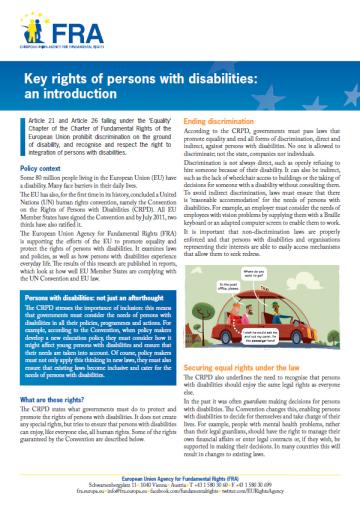
    Under the United Nations Convention on the Rights of Persons with Disabilities (CRPD), people with disabilities are no longer being considered as being unable to play an active role in society. Instead of people with disabilities being viewed as the problems, the barriers they face are clearly recognised as being the source of the problem.
  • Leaflet / Flyer
    13
    September
    2011
    This poster introduces the work of the FRA disability project.
  • In brief / Factsheet
    7
    August
    2011
    This factsheet looks at some of the rights guaranteed by the United Nations (UN) human rights convention, namely the Convention on the Rights of Persons with Disabilities (CRPD).
  • Report / Paper / Summary
    21
    July
    2011
    The 2003-2008 update on the exclusion and discrimination of migrants, minorities and employment in the 27 EU Member States provides a comparative overview and analysis of data and information documenting discrimination in the workplaces and labour markets across the European Union.
  • Report / Paper / Summary
    23
    June
    2011
    The European Union (EU) is founded on the values of equality and non-discrimination, and through its policies works to combat discrimination, including discrimination based on sexual orientation or gender identity. This report of the European Union Agency for Fundamental Rights (FRA) twins its research findings in the field with the relevant EU standards in a short and easy-to-read publication designed to equip those who shape policy with the information they need to develop a coherent and systematic approach to the protection of lesbian, gay, bisexual and transsexual (LGBT) rights.