eu-charter

Carta de los Derechos Fundamentales de la Unión Europea

Artículo 24 - Derechos del niño

Artículo 24 - Derechos del niño

1. Los niños tienen derecho a la protección y a los cuidados necesarios para su bienestar. Podrán expresar su opinión libremente. Ésta será tenida en cuenta para los asuntos que les afecten, en función de su edad y madurez.
2. En todos los actos relativos a los niños llevados a cabo por autoridades públicas o instituciones privadas, el interés superior del niño constituirá una consideración primordial.
3. Todo niño tiene derecho a mantener de forma periódica relaciones personales y contactos directos con su padre y con su madre, salvo si ello es contrario a sus intereses.

Explicaciones

  • Text:

    Este artículo está basado en la Convención de Nueva York sobre los Derechos del Niño, firmada el 20 de noviembre de 1989 y ratificada por todos los Estados miembros, y, en particular, en sus artículos 3, 9, 12 y 13. En el apartado 3 se toma en consideración el hecho de que, como parte del establecimiento de un espacio de libertad, seguridad y justicia, la legislación de la Unión en asuntos civiles con repercusiones transfronterizas, para la cual el artículo 81 del Tratado de Funcionamiento de la Unión Europea confiere competencias, puede incluir en particular el derecho de visita que garantiza a los niños poder mantener de forma periódica contacto personal y directo con su padre y con su madre.

    Source:
    Diario Oficial de la Unión Europea C 303/17 - 14.12.2007
    Preamble - Explanations relating to the Charter of Fundamental Rights:
    Las presentes explicaciones fueron elaboradas inicialmente bajo la responsabilidad del Praesidium de la Convención que redactó la Carta de los Derechos Fundamentales de la Unión Europea. Han sido actualizadas bajo la responsabilidad del Praesidium de la Convención Europea, a la vista de las adaptaciones de la redacción del texto de la Carta realizadas por la Convención (en particular, los artículos 51 y 52) y de la evolución del Derecho de la Unión. Si bien no tienen por sí mismas valor jurídico, constituyen un valioso instrumento de interpretación con objeto de aclarar las disposiciones de la Carta.

Jurisprudencia

Derecho constitucional nacional

45 results found

  • Sweden / Instrument of Government
    País:
    Sweden

    Chapter 1 - Basic principles of the form of government:

    Article 2 The public institutions shall promote the opportunity for all to attain participation and equality in society and for the rights of the child to be safeguarded. The public institutions shall combat discrimination of persons on grounds of gender, colour, national or ethnic origin, linguistic or religious affiliation, functional disability, sexual orientation, age or other circumstance affecting the individual (...);

    Chapter 2. Fundamental rights and freedoms

    Article 18 All children covered by compulsory schooling shall be entitled to a free basic education in the public education system. (...)

  • Basic Law for the Federal Republic of Germany
    País:
    Germany

    Article 6 (3) Children may be separated from their families against the will of their parents or guardians only pursuant to a law, and only if the parents or guardians fail in their duties or the children are otherwise in danger of serious neglect. (...) (5) Children born outside of marriage shall be provided by legislation with the same opportunities for physical and mental development and for their position in society as are enjoyed by those born within marriage.

  • Bundes-Verfassungsgesetz (B-VG)
    País:
    Austria

    Artikel 14 (5a) […] Im partnerschaftlichen Zusammenwirken von Schülern, Eltern und Lehrern ist Kindern und Jugendlichen die bestmögliche geistige, seelische und körperliche Entwicklung zu ermöglichen, damit sie zu gesunden, selbstbewussten,
    glücklichen, leistungsorientierten, pflichttreuen, musischen und kreativen Menschen werden, die befähigt sind, an den sozialen, religiösen und moralischen Werten orientiert Verantwortung für sich selbst, Mitmenschen, Umwelt und nachfolgende Generationen zu übernehmen. Jeder Jugendliche soll seiner Entwicklung und seinem Bildungsweg entsprechend zu selbständigem Urteil und sozialem Verständnis geführt werden, dem politischen, religiösen und weltanschaulichen Denken anderer aufgeschlossen sein sowie befähigt werden, am Kultur- und Wirtschaftsleben Österreichs, Europas und der Welt teilzunehmen und in Freiheits- und Friedensliebe an den gemeinsamen Aufgaben der Menschheit mitzuwirken.

  • Bundesverfassungsgesetz über die Rechte von Kindern
    País:
    Austria

    Artikel 1 Jedes Kind hat Anspruch auf den Schutz und die Fürsorge, die für sein Wohlergehen notwendig sind, auf bestmögliche Entwicklung und Entfaltung sowie auf die Wahrung seiner Interessen auch unter dem Gesichtspunkt der Generationengerechtigkeit. Bei allen Kinder betreffenden Maßnahmen öffentlicher und privater Einrichtungen muss das Wohl des Kindes eine vorrangige Erwägung sein. Artikel 2 (1) Jedes Kind hat Anspruch auf regelmäßige persönliche Beziehungen und direkte Kontakte zu beiden Elternteilen, es sei denn, dies steht seinem Wohl entgegen. Artikel 4 Jedes Kind hat das Recht auf angemessene Beteiligung und Berücksichtigung seiner Meinung in allen das Kind betreffenden Angelegenheiten, in einer seinem Alter und seiner Entwicklung entsprechenden Weise.

  • Child Protection Act
    País:
    Estonia

    § 2. Purpose of Act
    This Act shall be established in order to form behaviour and way of life which value and promote the development of children in the society, to create a supporting environment for children, to set the best interests of children as primary consideration, to improve the quality of life of children, to support the comprehensive development of children and to ensure the necessary assistance and care in a timely manner for children whose health and well-being is in danger in conformity with the United Nations Convention on the Rights of the Child and the optional protocols thereto (hereinafter the convention) and the EU Charter of Fundamental Rights and other relevant legislation.
    § 3. Scope of application of Act
    (1) The provisions of this Act shall be applied to state and local government agencies and the officials thereof, legal persons in public and private law and natural persons who are in contact with children and child protection in their activities.
    (2) For the purposes of this Act, a child means every human being below the age of eighteen years. If the age of a person is unknown and there is reason to believe that the person is below the age of eighteen years, the person shall be deemed to be a child until proven otherwise.

  • Children Act 2001 (as amended)
    País:
    Ireland

    An act to make further provision in relation to The care, protection and control of children and, in particular, to replace the Children Act, 1908, and other enactments relating to juvenile offenders, to amend and extend The Child Care Act, 1991, and to provide for related matters.

  • Constitution of Finland
    País:
    Finland

    Section 6 Equality (...) Children shall be treated equally and as individuals and they shall be allowed to influence matters pertaining to themselves to a degree corresponding to their level of development. Section 12 Freedom of expression and right of access to information Everyone has the freedom of expression. Freedom of expression entails the right to express, disseminate and receive information, opinions and other communications without prior prevention by anyone. More detailed provisions on the exercise of the freedom of expression are laid down by an Act. Provisions on restrictions relating to pictorial programmes that are necessary for the protection of children may be laid down by an Act. Section 19 The right to social security (...) Everyone shall be guaranteed by an Act the right to basic subsistence in the event of unemployment, illness, and disability and during old age as well as at the birth of a child or the loss of a provider. The public authorities shall guarantee for everyone, as provided in more detail by an Act, adequate social, health and medical services and promote the health of the population. Moreover, the public authorities shall support families and others responsible for providing for children so that they have the ability to ensure the wellbeing and personal development of the children. (...)

  • Constitution of Ireland
    País:
    Ireland

    Article 42A.1. The state recognises and affirms the natural and imprescriptible rights of all children and shall, as far as practicable, by its laws protect and
    vindicate those rights.
    Article 42A.2.1. In exceptional cases, where the parents, regardless of their marital status, fail in their duty towards their chidren to such extent that the safety or welfare of any of their children is likely to be prejudicially affected, the state as guardian of the common good shall, by proportionate means as provided by law, endeavour to supply
    the place of the parents, but always with due
    regard for the natural and imprescriptible rights of the child.
    Article 42A.2.2. Provision shall be made by law for the adoption of any child where the parents have failed for such a period of time as may be prescribed by law in their duty towards the child and where the best interests of the child so require.
    Article 42A.3 Provision shall be made by law for the voluntary placement for adoption and the adoption of any child.
    Article 42A.4.1. Provision shall be made by law that in the resolution of all proceedings – i brought by the state, as guardian of the
    common good, for the purpose of
    preventing the safety and welfare of any
    child from being prejudically affected, or
    ii concerning the adoption, guardianship or
    custody of, or access to, any child,
    the best interests of the child shall be the
    paramount consideration.
    Article 42A.4.2. Provision shall be made by law for securing, as far as practicable, that in all proceedings referred to in subsection 1° of this section in respect of any child who is capable of forming his or her own
    views, the views of the child shall be ascertained and given due weight having regard to the age and maturity of the child. Article 44.2.4. Legislation providing state aid for schools shall not discriminate between schools under the management of different religious denominations, nor be such as to affect prejudicially the right of any child to attend a school receiving public money
    without attending religious instruction at that
    school. Article 45.4.2. The state shall endeavour to ensure that the strength and health of workers, men and women, and the tender age of children shall not be abused
    and that citizens shall not be forced by economic necessity to enter avocations unsuited to their sex, age or strength.

  • Constitution of Ireland
    País:
    Ireland

    Article 42 (...) (5). In exceptional cases, where the parents for physical or moral reasons fail in their duty towards their children, the State as guardian of the common good, by appropriate means shall endeavour to supply the place of the parents, but always with due regard for the natural and imprescriptible rights of the child.

  • Constitution of the Hellenic Republic
    País:
    Greece

    Article 21 (1). The family, being the cornerstone of the preservation and the advancement of the Nation, as well as marriage, motherhood and childhood, shall be under the protection of the State (2). Families with many children, disabled war and peace-time veterans, war victims, widows and orphans, as well as persons suffering from incurable bodily or mental ailments are entitled to the special care of the State [...]

  • Constitution of the Italian Republic
    País:
    Italy

    Art. 30. It is the duty and right of parents to support, raise and educate their children, even if born out of wedlock. In the case of incapacity of the parents, the law provides for the fulfilment of their duties. The law ensures such legal and social protection measures as are compatible with the rights of the members of the legitimate family to any children born out of wedlock. The law shall establish rules and constraints for the determination of paternity. Art. 31. (...) The Republic protects mothers, children and the young by adopting necessary provisions. Art. 34. Schools are open to everyone. Primary education, given for at least eight years, is compulsory and free of
    tuition. Capable and deserving pupils, including those lacking financial resources, have the right to attain the highest levels of education. The Republic renders this right effective through scholarships, allowances to families and other benefits, which shall be assigned through competitive examinations.

  • Constitution of the Republic of Austria
    País:
    Austria

    Article 14 (5a) […] In a partnership - like cooperation between pupils, parents and teachers, children and juveniles are to be allowed the optimal intellectual, mental and physical development to let them become healthy, self-confident, happy, performance-oriented, dutiful, talented and creative humans capable to take over responsibility for themselves, fellow human beings, environment and following generations, oriented in social, religious and moral values. Any juvenile shall in accordance with his development and educational course be led to independent judgement and social understanding, be open to political, religious and ideological thinking of others and become capable to participate in the cultural and economic life of Austria, Europe and the world and participate in the common tasks of mankind, in love for freedom and peace.

  • Constitution of the Republic of Bulgaria
    País:
    Bulgaria

    Art. 14. The family, motherhood and children shall enjoy the protection of the State and society. Art. 47. (1) The raising and upbringing of children until they come of legal age shall be a right and obligation of their parents and shall be assisted by the State.(2) Mothers shall be the object of special protection on the part of the State and shall be guaranteed prenatal and postnatal leave, free obstetric care, alleviated working conditions and other social assistance.(3) Children born out of wedlock shall enjoy equal rights with those born in wedlock.(4) Abandoned children shall enjoy the protection of the State and society.(5) The conditions and procedure for the restriction or suspension of parental rights shall be established by law.

  • Constitution of the Republic of Croatia
    País:
    Croatia

    Article 63
    The state shall protect maternity, children and youth, and shall create social, cultural, educational, material and other conditions promoting the achievement of the right to a dignified life.

    Article 64
    Parents shall bear responsibility for the upbringing, welfare and education of their children,and they shall have the right and freedom to make independent decisions concerning the upbringing of their children.
    Parents shall be responsible for ensuring the right of their children to the full and harmonious development of their personalities.
    Physically and mentally disabled and socially neglected children shall be entitled to special care, education and welfare.
    Children shall be obliged to take care of their elderly and infirm parents.
    The state shall devote special care to orphans and minors neglected by their parents.

    Article 65
    Everyone shall have the duty to protect children and infirm persons.
    Children shall not be employed before reaching the age specified by law, nor shall they be forced or allowed to do any work that is harmful to their health or morality.
    Young people, mothers and disabled persons shall be entitled to special protection at work.

  • Constitution of the Republic of Estonia
    País:
    Estonia

    Article 26. Everyone is entitled to inviolability of his or her private and family life. Government agencies, local authorities, and their officials may not interfere with any person’s private or family life, except in the cases and pursuant to a procedure provided by law to protect public health, public morality, public order or the rights and freedoms of others, to prevent a criminal offence, or to apprehend the offender.
    Article 27. The family, which is fundamental to the preservation and growth of the nation and which constitutes the foundation of society, enjoys the protection of the government.
    Spouses have equal rights.
    Parents have the right and the duty to raise their children and to provide for them.
    The protection of parents and children is provided by law.
    The family is required to provide for its members who are in need.

  • Constitution of the Republic of Latvia
    País:
    Latvia

    110. The State shall protect and support marriage – a union between a man and a woman, the family, the rights of parents and rights of the child. The State shall provide special support to disabled children, children left without parental care or who have suffered from violence.

  • Constitution of the Republic of Lithuania
    País:
    Lithuania

    Article 26. Parents and guardians shall, without restrictions, take care of the religious and moral education of their children and wards according to their own convictions. Article 38. The family shall be the basis of society and the State. Family, motherhood, fatherhood, and childhood shall be under the protection and care of the State. The right and duty of parents shall be to bring up their children to be honest people and faithful citizens, and to support them until they reach the age of majority. The duty of children shall be to respect their parents, to take care of them in their old age, and to preserve their heritage. Article 39. Under-age children shall be protected by law.

  • Constitution of the Republic of Lithuania
    País:
    Lithuania

    Article 26 (...) Parents and guardians shall, without restrictions, take care of the religious and moral education of their children and wards according to their own convictions.Article 38The family shall be the basis of society and the State.Family, motherhood, fatherhood and childhood shall be under the protection and care of the State.(...) The right and duty of parents is to bring up their children to be honest people and faithful citizens and to support them until they come of age.The duty of children is to respect their parents, to take care of them in their old age, and to cherish their heritage.Article 39 (...) Minors shall be protected by law.

  • Constitution of the Republic of Poland
    País:
    Poland

    Article 48.1. Parents shall have the right to rear their children in accordance with their own convictions. Such upbringing shall respect the degree of maturity of a child as well as his freedom of conscience and belief and also his convictions.2. Limitation or deprivation of parental rights may be effected only in the instances specified by statute and only on the basis of a final court judgment. Article 68(...) 3. Public authorities shall ensure special health care to children, pregnant women, handicapped people and persons of advanced age.(...) 5. Public authorities shall support the development of physical culture, particularly amongst children and young persons.Article 72.1. The Republic of Poland shall ensure protection of the rights of the child. Everyone shall have the right to demand of organs of public authority that they defend children against violence, cruelty, exploitation and actions which undermine their moral sense.2. A child deprived of parental care shall have the right to care and assistance provided by public authorities.3. Organs of public authority and persons responsible for children, in the course of establishing the rights of a child, shall consider and, insofar as possible, give priority to the views of the child.4. The competence and procedure for appointment of the Commissioner for Children's Rights shall be specified by statute.

  • Constitution of the Republic of Poland
    País:
    Poland

    Article 48.1. Parents shall have the right to rear their children in accordance with their own convictions. Such upbringing shall respect the degree of maturity of a child as well as his freedom of conscience and belief and also his convictions.2. Limitation or deprivation of parental rights may be effected only in the instances specified by statute and only on the basis of a final court judgment. Article 68(...) 3. Public authorities shall ensure special health care to children, pregnant women, handicapped people and persons of advanced age.(...) 5. Public authorities shall support the development of physical culture, particularly amongst children and young persons.Article 721. The Republic of Poland shall ensure protection of the rights of the child. Everyone shall have the right to demand of organs of public authority that they defend children against violence, cruelty, exploitation and actions which undermine their moral sense.2. A child deprived of parental care shall have the right to care and assistance provided by public authorities.3. Organs of public authority and persons responsible for children, in the course of establishing the rights of a child, shall consider and, insofar as possible, give priority to the views of the child.4. The competence and procedure for appointment of the Commissioner for Children's Rights shall be specified by statute.

Derecho de la UE

28 results found

  • Directive (EU) 2016/800 of the European Parliament and of the Council of 11 May 2016 on procedural safeguards for children who are suspects or accused persons in criminal proceedings

    Preamble

    (31) Member States should be able to derogate temporarily from the obligation to provide assistance by a lawyer in the pre-trial phase for compelling reasons, namely where there is an urgent need to avert serious adverse consequences for the life, liberty or physical integrity of a person, or where immediate action by the investigating authorities is imperative to prevent substantial jeopardy to criminal proceedings in relation to a serious criminal offence, inter alia, with a view to obtaining information concerning the alleged co-perpetrators of a serious criminal offence, or in order to avoid the loss of important evidence regarding a serious criminal offence. During a temporary derogation for one of those compelling reasons, the competent authorities should be able to question children without the lawyer being present, provided that they have been informed of their right to remain silent and can exercise that right, and that such questioning does not prejudice the rights of the defence, including the right not to incriminate oneself. It should be possible to carry out questioning, to the extent necessary, for the sole purpose of obtaining information that is essential to avert serious adverse consequences for the life, liberty or physical integrity of a person, or to prevent substantial jeopardy to criminal proceedings. Any abuse of this temporary derogation would, in principle, irretrievably prejudice the rights of the defence.‘
     

    (33) Confidentiality of communication between children and their lawyer is key to ensuring the effective exercise of the rights of the defence and is an essential part of the right to a fair trial. Member States should therefore respect the confidentiality of meetings and other forms of communication between the lawyer and the child in the context of the assistance by a lawyer provided for in this Directive, without derogation.

    (35) Children who are suspects or accused persons in criminal proceedings should have the right to an individual assessment to identify their specific needs in terms of protection, education, training and social integration, to determine if and to what extent they would need special measures during the criminal proceedings, the extent of their criminal responsibility and the appropriateness of a particular penalty or educative measure.

    Article 3: Definitions
    For the purposes of this Directive the following definitions apply:
    (1) ‘child’ means a person below the age of 18;
    (2) ‘holder of parental responsibility’ means any person having parental responsibility over a child;  [...]
    With regard to point (1) of the first paragraph, where it is uncertain whether a person has reached the age of 18, that person shall be presumed to be a child.


    Article 4: Right to information
    1.   Member States shall ensure that when children are made aware that they are suspects or accused persons in criminal proceedings, they are informed promptly about their rights [...].


    Article 5 - Right of the child to have the holder of parental responsibility informed
    1.   Member States shall ensure that the holder of parental responsibility is provided, as soon as possible, with the information that the child has a right to receive in accordance with Article 4.

    Article 6: Assistance by a lawyer
    2.   Member States shall ensure that children are assisted by a lawyer in accordance with this Article in order to allow them to exercise the rights of the defence effectively.


    Article 10: Limitation of deprivation of liberty
    1.   Member States shall ensure that deprivation of liberty of a child at any stage of the proceedings is limited to the shortest appropriate period of time. Due account shall be taken of the age and individual situation of the child, and of the particular circumstances of the case.
    2.   Member States shall ensure that deprivation of liberty, in particular detention, shall be imposed on children only as a measure of last resort. Member States shall ensure that any detention is based on a reasoned decision, subject to judicial review by a court. Such a decision shall also be subject to periodic review, at reasonable intervals of time, by a court, either ex officio or at the request of the child, of the child's lawyer, or of a judicial authority which is not a court. Without prejudice to judicial independence, Member States shall ensure that decisions to be taken pursuant to this paragraph are taken without undue delay. 
     

    Article 11: Alternative measures
    Member States shall ensure that, where possible, the competent authorities have recourse to measures alternative to detention (alternative measures).
     

    Article 12: Specific treatment in the case of deprivation of liberty
    1.   Member States shall ensure that children who are detained are held separately from adults, unless it is considered to be in the child's best interests not to do so.
    2.   Member States shall also ensure that children who are kept in police custody are held separately from adults, unless:
    (a) it is considered to be in the child's best interests not to do so; or
    (b) in exceptional circumstances, it is not possible in practice to do so, provided that children are held together with adults in a manner that is compatible with the child's best interests.
    3.   Without prejudice to paragraph 1, when a detained child reaches the age of 18, Member States shall provide for the possibility to continue to hold that person separately from other detained adults where warranted, taking into account the circumstances of the person concerned, provided that this is compatible with the best interests of children who are detained with that person.
    4.   Without prejudice to paragraph 1, and taking into account paragraph 3, children may be detained with young adults, unless this is contrary to the child's best interests.
    5.   When children are detained, Member States shall take appropriate measures to:
    (a) ensure and preserve their health and their physical and mental development;
    (b) ensure their right to education and training, including where the children have physical, sensory or learning disabilities;
    (c) ensure the effective and regular exercise of their right to family life;
    (d) ensure access to programmes that foster their development and their reintegration into society; and
    (e) ensure respect for their freedom of religion or belief.
    The measures taken pursuant to this paragraph shall be proportionate and appropriate to the duration of the detention.
    Points (a) and (e) of the first subparagraph shall also apply to situations of deprivation of liberty other than detention. The measures taken shall be proportionate and appropriate to such situations of deprivation of liberty.
    Points (b), (c), and (d) of the first subparagraph shall apply to situations of deprivation of liberty other than detention only to the extent that is appropriate and proportionate in the light of the nature and duration of such situations.
    6.   Member States shall endeavour to ensure that children who are deprived of liberty can meet with the holder of parental responsibility as soon as possible, where such a meeting is compatible with investigative and operational requirements. This paragraph shall be without prejudice to the nomination or designation of another appropriate adult pursuant to Article 5 or 15.

     

  • Regulation (EU) 2021/1232 of the European Parliament and of the Council of 14 July 2021 on a temporary derogation from certain provisions of Directive 2002/58/EC as regards the use of technologies by providers

    Article 1

    Subject matter and scope

    1. This Regulation lays down temporary and strictly limited rules derogating from certain obligations laid down in Directive 2002/58/EC, with the sole objective of enabling providers of certain number-independent interpersonal communications services (‘providers’) to use, without prejudice to Regulation (EU) 2016/679, specific technologies for the processing of personal and other data to the extent strictly necessary to detect online child sexual abuse on their services and report it and to remove online child sexual abuse material from their services.

    2. This Regulation does not apply to the scanning of audio communications.

  • Regulation (EU) 2021/692 of the European Parliament and of the Council of 28 April 2021 establishing the Citizens, Equality, Rights and Values Programme and repealing Regulation (EU) No 1381/2013

    Article 4

    Equality, rights and gender equality strand

    Within the general objective set out in Article 2(1) and within the specific objective set out in point (b) of Article 2(2), the Programme shall focus on:

    (1) promoting equality and preventing and combating inequalities and discrimination based on sex, racial or ethnic origin, religion or belief, disability, age or sexual orientation, and respecting the principle of non-discrimination on the grounds provided for in Article 21 of the Charter;

    [...]

  • Regulation (EU) 2022/2065 of the European Parliament and of the Council of 19 October 2022 on a Single Market For Digital Services and amending Directive 2000/31/EC (Digital Services Act)

    Article 34: Risk assessment

    1. Providers of very large online platforms and of very large online search engines shall diligently identify, analyse and assess any systemic risks in the Union stemming from the design or functioning of their service and its related systems, including algorithmic systems, or from the use made of their services.

    They shall carry out the risk assessments by the date of application referred to in Article 33(6), second subparagraph, and at least once every year thereafter, and in any event prior to deploying functionalities that are likely to have a critical impact on the risks identified pursuant to this Article. This risk assessment shall be specific to their services and proportionate to the systemic risks, taking into consideration their severity and probability, and shall include the following systemic risks:

    [...]

    (b) any actual or foreseeable negative effects for the exercise of fundamental rights, in particular the fundamental rights to human dignity enshrined in Article 1 of the Charter, to respect for private and family life enshrined in Article 7 of the Charter, to the protection of personal data enshrined in Article 8 of the Charter, to freedom of expression and information, including the freedom and pluralism of the media, enshrined in Article 11 of the Charter, to non-discrimination enshrined in Article 21 of the Charter, to respect for the rights of the child enshrined in Article 24 of the Charter and to a high-level of consumer protection enshrined in Article 38 of the Charter;

  • Regulation (EU) 2021/692 of the European Parliament and of the Council of 28 April 2021 establishing the Citizens, Equality, Rights and Values Programme and repealing Regulation (EU) No 1381/2013 of the European Parliament

    Article 1

    Subject matter

    This Regulation establishes the Citizens, Equality, Rights and Values Programme (the ‘Programme’) for the duration of the multiannual financial framework 2021-2027, as laid down in Regulation (EU, Euratom) 2020/2093.

    It lays down the objectives of the Programme, the budget for the period 2021–2027, the forms of Union funding and the rules for providing such funding.

  • Regulation (EU) 2019/1896 of the European Parliament and of the Council of 13 November 2019 on the European Border and Coast Guard and repealing Regulations (EU) No 1052/2013 and (EU) 2016/1624

    Preamble

    (103) This Regulation respects the fundamental rights and observes the principles recognised by Articles 2 and 6 TEU and by the Charter of Fundamental Rights of the European Union (‘the Charter’), in particular respect for human dignity, the right to life, the prohibition of torture and inhuman or degrading treatment or punishment, the prohibition of trafficking in human beings, the right to liberty and security, the right to the protection of personal data, the right of access to documents, the right to asylum and to protection against removal and expulsion, non-refoulement, non-discrimination and the rights of the child.

    Article 1: Subject matter

    This Regulation establishes a European Border and Coast Guard to ensure European integrated border management at the external borders with a view to managing those borders efficiently in full compliance with fundamental rights and to increasing the efficiency of the Union return policy.

    This Regulation addresses migratory challenges and potential future challenges and threats at the external borders. It ensures a high level of internal security within the Union in full respect of fundamental rights, while safeguarding the free movement of persons within the Union. It contributes to the detection, prevention and combating of cross-border crime at the external borders.

    Article 43: Instructions to the teams

    4.   Members of the teams shall, in the performance of their tasks and in the exercise of their powers, fully respect fundamental rights, including access to asylum procedures and human dignity, and shall pay particular attention to vulnerable persons. Any measures taken in the performance of their tasks and in the exercise of their powers shall be proportionate to the objectives pursued by such measures. While performing their tasks and exercising their powers, they shall not discriminate against persons on the basis of any grounds such as sex, race, colour, ethnic or social origin, genetic features, language, religion or belief, political or any other opinion, membership of a national minority, property, birth, disability, age or sexual orientation in line with Article 21 of the Charter.

  • Directive 2014/66/EU of the European Parliament and of the Council of 15 May 2014 on the conditions of entry and residence of third-country nationals in the framework of an intra-corporate transfer

    Article 1 - Subject-matter
    ‘This Directive lays down:
    (a) the conditions of entry to, and residence for more than 90 days in, the territory of the Member States, and the rights, of third-country nationals and of their family members in the framework of an intra-corporate transfer; [...]
    Article 19 - Family members
    1. Directive 2003/86/EC shall apply in the first Member State and in second Member States which allow the intra-corporate transferee to stay and work on their territory in accordance with Article 22 of this Directive, subject to the derogations laid down in this Article.
    2. By way of derogation from Article 3(1) and Article 8 of Directive 2003/86/EC, family reunification in the Member States shall not be made dependent on the requirement that the holder of the permit issued by those Member States on the basis of this Directive has reasonable prospects of obtaining the right of permanent residence and has a minimum period of residence.
    3. By way of derogation from the third subparagraph of Article 4(1) and from Article 7(2) of Directive 2003/86/EC, the integration measures referred to therein may be applied by the Member States only after the persons concerned have been granted family reunification.
    4. By way of derogation from the first subparagraph of Article 5(4) of Directive 2003/86/EC, residence permits for family members shall be granted by a Member State, if the conditions for family reunification are fulfilled, within 90 days from the date on which the complete application was submitted. The competent authority of the Member State shall process the residence permit application for the intra-corporate transferee's family members at the same time as the application for the intra-corporate transferee permit or the permit for long-term mobility, in cases where the residence permit application for the intra-corporate transferee's family members is submitted at the same time. The procedural safeguards laid down in Article 15 shall apply accordingly.
    5. By way of derogation from Article 13(2) of Directive 2003/86/EC, the duration of validity of the residence permits of family members in a Member State shall, as a general rule, end on the date of expiry of the intra-corporate transferee permit or the permit for long-term mobility issued by that Member State.
    6. By way of derogation from Article 14(2) of Directive 2003/86/EC and without prejudice to the principle of preference for Union citizens as expressed in the relevant provisions of the relevant Acts of Accession, the family members of the intra-corporate transferee who have been granted family reunification shall be entitled to have access to employment and self-employed activity in the territory of the Member State which issued the family member residence permit.‘

  • Directive 2012/29/EU of the European Parliament and of the Council of 25 October 2012 establishing minimum standards on the rights, support and protection of victims of crime, and replacing Council Framework Decision 2001/220/JHA

    Preamble:

    (14) In applying this Directive, children's best interests must be a primary consideration, in accordance with the Charter of Fundamental Rights of the European Union and the United Nations Convention on the Rights of the Child adopted on 20 November 1989. Child victims should be considered and treated as the full bearers of rights set out in this Directive and should be entitled to exercise those rights in a manner that takes into account their capacity to form their own views.
    (16) Victims of terrorism have suffered attacks that are intended ultimately to harm society. They may therefore need special attention, support and protection due to the particular nature of the crime that has been committed against them. Victims of terrorism can be under significant public scrutiny and often need social recognition and respectful treatment by society. Member States should therefore take particular account of the needs of victims of terrorism, and should seek to protect their dignity and security.’
    ‘(38) [...] A main task of these services and their staff, which play an important role in supporting the victim to recover from and overcome potential harm or trauma as a result of a criminal offence, should be to inform victims about the rights set out in this Directive so that they can take decisions in a supportive environment that treats them with dignity, respect and sensitivity. The types of support that such specialist support services should offer could include providing shelter and safe accommodation, immediate medical support, referral to medical and forensic examination for evidence in cases of rape or sexual assault, short and long-term psychological counselling, trauma care, legal advice, advocacy and specific services for children as direct or indirect victims.’
    ‘(52) Measures should be available to protect the safety and dignity of victims and their family members from secondary and repeat victimisation, from intimidation and from retaliation, such as interim injunctions or protection or restraining orders.’

    (66) This Directive respects fundamental rights and observes the principles recognised by the Charter of Fundamental Rights of the European Union. In particular, it seeks to promote the right to dignity, life, physical and mental integrity, liberty and security, respect for private and family life, the right to property, the principle of non-discrimination, the principle of equality between women and men, the rights of the child, the elderly and persons with disabilities, and the right to a fair trial.

    Article 18 - Right to protection
    ‘Without prejudice to the rights of the defence, Member States shall ensure that measures are available to protect victims and their family members from secondary and repeat victimisation, from intimidation and from retaliation, including against the risk of emotional or psychological harm, and to protect the dignity of victims during questioning and when testifying. When necessary, such measures shall also include procedures established under national law for the physical protection of victims and their family members.’

Derecho internacional

6 results found

  • Committee on the Protection of the Rights of All Migrant Workers and Members of Their Families, Committee on the Rights of the Child, Joint general comment No. 4 (2017) of the Committee on the Protection of the Rights of All Migrant Workers and Members...
  • Committee on the Rights of the Child General comment No. 15 (2013) on the right of the child to the enjoyment of the highest attainable standard of health (art. 24)
  • Committee on the Rights of the Child General comment No. 17 (2013) on the right of the child to rest, leisure, play, recreational activities, cultural life and the arts (art. 31)
  • Committee on the Rights of the Child, General comment No. 14 (2013) on the right of the child to have his or her best interests taken as a primary consideration (art. 3, para. 1 )
  • Committee on the Rights of the Child, General comment No. 20 (2016) on the implementation of the rights of the child during adolescence
  • Committee on the Protection of the Rights of All Migrant Workers and Members of Their Families, Committee on the Rights of the Child, Joint general comment No. 3 (2017) of the Committee on the Protection of the Rights of All Migrant Workers and Members...

Productos

  • Report / Paper / Summary
    18
    September
    2019
    Individuals who are not entitled to stay in the European Union are typically subject to being returned to their home countries. This includes children who are not accompanied by their parents or by another primary caregiver. But returning such children, or finding another durable solution, is a delicate matter, and doing so in full compliance with fundamental rights protections can be difficult. This focus paper therefore aims to help national authorities involved in return-related tasks, including child-protection services, to ensure full rights compliance.
  • Report / Paper / Summary
    17
    October
    2018
    Almost 25 million children under 18 are at risk of poverty or social exclusion in the EU. Poverty deprives children of educational
    opportunities, childcare, access to health care, adequate food and housing, family support and even protection from violence.
    This report outlines data and survey findings that highlight the magnitude of child poverty in the EU, but also presents tools
    available to counter this phenomenon and keep track of progress made.
  • Report / Paper / Summary
    12
    September
    2018
    In November 2017, the European Commission requested FRA’s support in evaluating the impact on fundamental rights of the European Border Surveillance System (Eurosur) Regulation. Further to this request, FRA reviewed the work of the European Border and Coast Guard Agency (Frontex) and analysed cooperation agreements concluded by EU Member States with third countries which are relevant for the exchange of information for the purposes of Eurosur. This report presents the main findings of such review.
  • Report / Paper / Summary
    25
    April
    2018
    The methods used to determine the age of
    an applicant may include “invasive” medical tests which interfere with the rights of the child, including their right to dignity,
    integrity and privacy. It is often a challenge to find the right balance between protecting children from harm and promoting
    their participation in these procedures. This report provides important insights and identifies the implications of collecting
    children’s biometric data and conducting age assessments.
  • Report / Paper / Summary
    25
    April
    2018
    This report outlines Member States’ approaches to age requirements and limits
    regarding child participation in judicial proceedings; procedural safeguards for, and rights of, children involved in criminal
    proceedings; as well as issues related to depriving children of their liberty.
  • Report / Paper / Summary
    28
    March
    2018
    This report outlines the fundamental rights implications of collecting, storing and using
    biometric and other data in EU IT systems in the area of asylum and migration.
  • Report / Paper / Summary
    5
    February
    2018
    EU Member States’ legal and practical responses to migrants and refugees implicate several of their fundamental rights, as enshrined in the Charter of Fundamental Rights of the European Union (EU). The EU Agency for Fundamental Rights (FRA) has regularly reported on these issues since September 2015. This report highlights key trends and persistent concerns between October 2016 and December 2017. It focuses on five areas: access to territory, reception conditions, asylum procedures, unaccompanied children and immigration detention.
  • Report / Paper / Summary
    16
    January
    2018
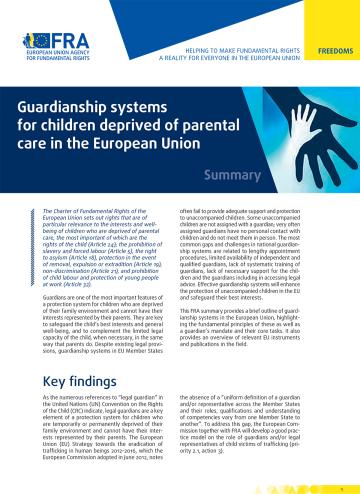
    Guardians are a key element of a protection system for children who are temporarily or
    permanently deprived of their family environment and cannot have their interests represented
    by their parents. Great disparities exist between the types of guardianship provided
    to children in and within European Union (EU) Member States. This report explores the key
    features of guardianship systems put in place to cater for the needs of all children in need
    of protection, including child victims and those at risk of becoming victims of trafficking in
    human beings or of other forms of exploitation.
  • Easy-to-read report
    3
    January
    2018
    Inside this book you will read about the justice system and the problems in justice for children and how to fix the problems.
  • Report / Paper / Summary
    20
    November
    2017
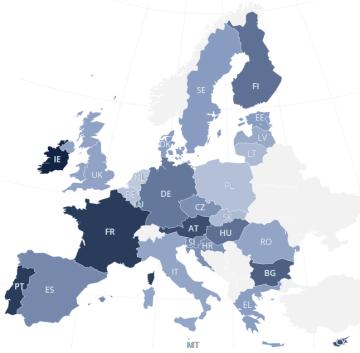
    International treaties, the Charter of Fundamental Rights of the European Union, European Union (EU) secondary law and national legislation provide a number of rights to citizens. The maps and tables presented show the various patterns concerning age requirements for children to acquire rights in the EU. They also identify inconsistencies, protection gaps and restrictions deriving from different age thresholds. The reference period was until April 2016. Any legislative developments since then have been included whenever relevant or if known.