eu-charter

Karta tad-Drittijiet Fundamentali tal-Unjoni Ewropea

Artikolu 8 - Il-protezzjoni tad-data personali

Artikolu 8 - Il-protezzjoni tad-data personali

1. Kull persuna għandha d-dritt għall-protezzjoni ta' data personali li tirrigwardaha.

2. Din id-data għandha tiġi trattata b'mod ġust għal finijiet determinati u abbażi tal-kunsens tal-persuna kkonċernata jew fuq bażi oħra leġittima stabbilita mil-liġi. Kull persuna għandha d-dritt ta' aċċess għad-data miġbura li għandha x'taqsam magħha u d-dritt li tikseb ir-rettifika tagħha.

3. L-osservanza ta' dawn ir-regoli għandha titqiegħed taħt il-kontroll ta' awtorità indipendenti.

Spjegazzjonijiet

  • Text:

    Dan l-Artikolu huwa bbażat fuq l-Artikolu 286 tat-Trattat li jistabbilixxi l-Komunità Ewropea u fuq id-Direttiva 95/46/KE tal-Parlament Ewropew u tal-Kunsill dwar il-protezzjoni ta' individwi fir-rigward ta' l-ipproċessar ta' data personali u dwar il-moviment liberu ta' dik id-data (ĠU L 281, 23.11.1995, p. 31) kif ukoll fuq l-Artikolu 8 tal-KEDB u l-Konvenzjoni tal-Kunsill ta' l-Ewropa tat- 28 ta' Jannar 1981 dwar il-Protezzjoni ta' Individwi fir-rigward ta' l-Ipproċessar Awtomatiku ta' Data Personali, li ġiet ratifikata mill-Istati Membri kollha. L-Artikolu 286 tat-Trattat KE huwa issa ssostitwit bl-Artikolu 16 tat-Trattat dwar il-Funzjonament ta' l-Unjoni Ewropea u l-Artikolu 39 tat-Trattat dwar l-Unjoni Ewropea. Qed issir ukoll referenza għar-Regolament (KE) Nru 45/2001 tal-Parlament Ewropew u tal-Kunsill dwar il-protezzjoni ta' individwu fir-rigward ta' l-ipproċessar ta' data personali mill-istituzzjonijiet u l-korpi tal-Komunità u dwar il-moviment liberu ta' dak id-data (ĠU L 8, 12.1.2001, p. 1). Id-Direttiva u r-Regolament hawn fuq imsemmija fihom kondizzjonijiet u limitazzjonijiet għall-eżerċizzju tad-dritt għall-protezzjoni tad-data personali.

    Source:
    Il-Ġurnal Uffiċjali ta’ l-Unjoni Ewropea C 303/17 - 14.12.2007
    Preamble - Explanations relating to the Charter of Fundamental Rights:
    Dawn l-ispjegazzjonijiet ġew imħejjija oriġinarjament taħt ir-responsabbiltà tal-Praesidium tal-Konvenzjoni li abbozza l-Karta tad-Drittijiet Fundamentali ta' l-Unjoni Ewropea. Huma ġew aġġornati taħt ir-responsabbiltà tal-Praesidium tal-Konvenzjoni Ewropea, fid-dawl ta' l-aġġustamenti li saru għat-test tal-Karta minn dik il-Konvenzjoni (partikolarment fl-Artikoli (51 U 52) u ta' l-evoluzzjoni fil-liġi ta' l-Unjoni. Għalkemm dawn l-ispjegazzjonijiet m'għandhomx fihom infushom l-istatus ta' liġi, huma mezz siewi ta' interpretazzjoni intiż sabiex ikunu ċċarati d-dispożizzjonijiet tal-Karta.

Każistika

Liġi kostituzzjonali nazzjonali

68 results found

  • Ustawa z dnia 29 sierpnia 1997 r. o ochronie danych osobowych
    Pajjiż:
    Poland

    Rozdział 1 1. Każdy ma prawo do ochrony dotyczących go danych osobowych.2. Przetwarzanie danych osobowych może mieć miejsce ze względu na dobro publiczne, dobro osoby, której dane dotyczą, lub dobro osób trzecich w zakresie i trybie określonym ustawą.

  • Wet bescherming persoonsgegevens
    Pajjiż:
    Netherlands

    Artikel 4 1. Deze wet is van toepassing op de verwerking van persoonsgegevens in het kader van activiteiten van een vestiging van een verantwoordelijke in Nederland. 2. Deze wet is van toepassing op de verwerking van persoonsgegevens door of ten behoeve van een verantwoordelijke die geen vestiging heeft in de Europese Unie, waarbij gebruik wordt gemaakt van al dan niet geautomatiseerde middelen die zich in Nederland bevinden, tenzij deze middelen slechts worden gebruikt voor de doorvoer van persoonsgegevens. 3. Het is een verantwoordelijke als bedoeld in het tweede lid, verboden persoonsgegevens te verwerken, tenzij hij in Nederland een persoon of instantie aanwijst die namens hem handelt overeenkomstig de bepalingen van deze wet. Voor de toepassing van deze wet en de daarop berustende bepalingen, wordt hij aangemerkt als de verantwoordelijke.

  • Wet van 8 december 1992 voor de bescherming van de persoonlijke levenssfeer ten opzichte van de verwerking van persoonsgegevens
    Pajjiż:
    Belgium


  • Zákon o ochraně osobních údajů
    Pajjiż:
    Czechia
  • Zakon o varstvu osebnih podatkov
    Pajjiż:
    Slovenia
  • Νόμοι 138(Ι) του 2001 και 37(Ι) του 2003
    Pajjiż:
    Cyprus

    Πεδίο εφαρμογής.3.-(1) Οι διατάξεις του παρόντος Νόμου εφαρμόζονται στην αυτοματοποιημένη εν όλω ή εν μέρει επεξεργασία, καθώς και στη μη αυτοματοποιημένη επεξεργασία δεδομένων προσωπικού χαρακτήρα, τα οποία περιλαμβάνονται (...).

  • Το Σύνταγμα της Ελλάδας
    Pajjiż:
    Greece

    Άρθρο 9A Καθένας έχει δικαίωμα προστασίας από τη συλλογή, επεξεργασία και χρήση, ιδίως με ηλεκτρονικά μέσα, των προσωπικών του δεδομένων, όπως νόμος ορίζει. Η προστασία των προσωπικών δεδομένων διασφαλίζεται από ανεξάρτητη αρχή, που συγκροτείται και λειτουργεί, όπως νόμος ορίζει.

  • Закон за защита на личните данни
    Pajjiż:
    Bulgaria

    Чл. 1. (Изм. - ДВ, бр. 103 от 2005 г.) (1) Този закон урежда защитата на правата на физическите лица при обработването на личните им данни. (2) Целта на закона е гарантиране на неприкосновеността на личността и личния живот чрез осигуряване на защита на физическите лица при неправомерно обработване на свързаните с тях лични данни в процеса на свободното движение на данните. (3) (Нова - ДВ, бр. 91 от 2006 г.) Този закон се прилага за обработването на лични данни със: 1. автоматични средства; 2. неавтоматични средства, когато тези данни съставляват или са предназначени да съставляват част от регистър. (...)

Liġi tal-UE

37 results found

  • Regulation (EU) 2021/692 of the European Parliament and of the Council of 28 April 2021 establishing the Citizens, Equality, Rights and Values Programme and repealing Regulation (EU) No 1381/2013

    Article 4

    Equality, rights and gender equality strand

    Within the general objective set out in Article 2(1) and within the specific objective set out in point (b) of Article 2(2), the Programme shall focus on:

    (1) promoting equality and preventing and combating inequalities and discrimination based on sex, racial or ethnic origin, religion or belief, disability, age or sexual orientation, and respecting the principle of non-discrimination on the grounds provided for in Article 21 of the Charter;

    [...]

  • Regulation (EU) 2018/1725 of the European Parliament and of the Council of 23 October 2018 on the protection of natural persons with regard to the processing of personal data, repealing Regulation (EC) No 45/2001 and Decision No 1247/2002/EC

    Preamble

    (1) The protection of natural persons in relation to the processing of personal data is a fundamental right. Article 8(1) of the Charter of Fundamental Rights of the European Union (the ‘Charter’) and Article 16(1) of the Treaty on the Functioning of the European Union (TFEU) provide that everyone has the right to the protection of personal data concerning him or her. This right is also guaranteed under Article 8 of the European Convention for the Protection of Human Rights and Fundamental Freedoms.

    [...]

    (74) The supervisory competence of the European Data Protection Supervisor should not cover the processing of personal data by the Court of Justice when acting in its judicial capacity, in order to safeguard the independence of the Court in the performance of its judicial tasks, including decision-making. For such processing operations, the Court should establish independent supervision, in accordance with Article 8(3) of the Charter, for example through an internal mechanism.

    Article 1 Subject matter and objectives

    1. This Regulation lays down rules relating to the protection of natural persons with regard to the processing of personal data by the Union institutions and bodies and rules relating to the free movement of personal data between them or to other recipients established in the Union.

    2. This Regulation protects fundamental rights and freedoms of natural persons and in particular their right to the protection of personal data.

    3. The European Data Protection Supervisor shall monitor the application of the provisions of this Regulation to all processing operations carried out by a Union institution or body.

  • Regulation (EU) 2022/2065 of the European Parliament and of the Council of 19 October 2022 on a Single Market For Digital Services and amending Directive 2000/31/EC (Digital Services Act)

    Article 34: Risk assessment

    1. Providers of very large online platforms and of very large online search engines shall diligently identify, analyse and assess any systemic risks in the Union stemming from the design or functioning of their service and its related systems, including algorithmic systems, or from the use made of their services.

    They shall carry out the risk assessments by the date of application referred to in Article 33(6), second subparagraph, and at least once every year thereafter, and in any event prior to deploying functionalities that are likely to have a critical impact on the risks identified pursuant to this Article. This risk assessment shall be specific to their services and proportionate to the systemic risks, taking into consideration their severity and probability, and shall include the following systemic risks:

    [...]

    (b) any actual or foreseeable negative effects for the exercise of fundamental rights, in particular the fundamental rights to human dignity enshrined in Article 1 of the Charter, to respect for private and family life enshrined in Article 7 of the Charter, to the protection of personal data enshrined in Article 8 of the Charter, to freedom of expression and information, including the freedom and pluralism of the media, enshrined in Article 11 of the Charter, to non-discrimination enshrined in Article 21 of the Charter, to respect for the rights of the child enshrined in Article 24 of the Charter and to a high-level of consumer protection enshrined in Article 38 of the Charter;

  • Treaty on European Union - Article 39

    Article 39

    In accordance with Article 16 of the Treaty on the Functioning of the European Union and by way of derogation from paragraph 2 thereof, the Council shall adopt a decision laying down the rules relating to the protection of individuals with regard to the processing of personal data by the Member States when carrying out activities which fall within the scope of this Chapter, and the rules relating to the free movement of such data. Compliance with these rules shall be subject to the control of independent authorities.

  • Treaty on the Functioning of the European Union - Article 16 (ex Article 286 TEC)

    Article 16 (ex Article 286 TEC)

    1. Everyone has the right to the protection of personal data concerning them.

    2. The European Parliament and the Council, acting in accordance with the ordinary legislative procedure, shall lay down the rules relating to the protection of individuals with regard to the processing of personal data by Union institutions, bodies, offices and agencies, and by the Member States when carrying out activities which fall within the scope of Union law, and the rules relating to the free movement of such data. Compliance with these rules shall be subject to the control of independent authorities. The rules adopted on the basis of this Article shall be without prejudice to the specific rules laid down in Article 39 of the Treaty on European Union.


  • Directive (EU) 2019/1153 of the European Parliament and of the Council of 20 June 2019 laying down rules facilitating the use of financial and other information for the prevention, detection, investigation or prosecution of certain criminal offences ...

    Article 1 Subject matter

    1. This Directive lays down measures to facilitate access to and the use of financial information and bank account information by competent authorities for the prevention, detection, investigation or prosecution of serious criminal offences. It also lays down measures to facilitate access to law enforcement information by Financial Intelligence Units (‘FIUs’) for the prevention and combating of money laundering, associate predicate offences and terrorist financing and measures to facilitate cooperation between FIUs.

    2. This Directive is without prejudice to:

    (a) Directive (EU) 2015/849 and the related provisions of national law, including the organisational status conferred on FIUs under national law as well as their operational independence and autonomy;

    (b) channels for the exchange of information between competent authorities or the powers of competent authorities under Union or national law to obtain information from obliged entities;

    (c) Regulation (EU) 2016/794; (d) the obligations resulting from Union instruments on mutual legal assistance or on mutual recognition of decisions regarding criminal matters and from Framework Decision 2006/960/JHA.

    ...

  • Directive (EU) 2019/1024 of the European Parliament and of the Council of 20 June 2019 on open data and the re-use of public sector information

    Article 1 Subject matter and scope

    1. In order to promote the use of open data and stimulate innovation in products and services, this Directive establishes a set of minimum rules governing the re-use and the practical arrangements for facilitating the re-use of:

    (a) existing documents held by public sector bodies of the Member States;

    (b) existing documents held by public undertakings that are:

    (i) active in the areas defined in Directive 2014/25/EU;

    (ii) acting as public service operators pursuant to Article 2 of Regulation (EC) No 1370/2007;

    (iii) acting as air carriers fulfilling public service obligations pursuant to Article 16 of Regulation (EC) No 1008/2008; or

    (iv) acting as Community shipowners fulfilling public service obligations pursuant to Article 4 of Regulation (EEC) No 3577/92;

    (c) research data pursuant to the conditions set out in Article 10.

    2. This Directive does not apply to:

    (a) documents the supply of which is an activity falling outside the scope of the public task of the public sector bodies concerned as defined by law or by other binding rules in the Member State, or, in the absence of such rules, as defined in accordance with common administrative practice in the Member State in question, provided that the scope of the public tasks is transparent and subject to review;

    (b) documents held by public undertakings:

    (i) produced outside the scope of the provision of services in the general interest as defined by law or other binding rules in the Member State;

    (ii) related to activities directly exposed to competition and therefore, pursuant to Article 34 of Directive 2014/25/EU, not subject to procurement rules;

    (c) documents for which third parties hold intellectual property rights;

    (d) documents, such as sensitive data, which are excluded from access by virtue of the access regimes in the Member State, including on grounds of:

    (i) the protection of national security (namely, State security), defence, or public security;

    (ii) statistical confidentiality;

    (iii) commercial confidentiality (including business, professional or company secrets);

    (e) documents access to which is excluded or restricted on grounds of sensitive critical infrastructure protection related information as defined in point (d) of Article 2 of Directive 2008/114/EC;

    (f) documents access to which is restricted by virtue of the access regimes in the Member States, including cases whereby citizens or legal entities have to prove a particular interest to obtain access to documents;

    (g) logos, crests and insignia;

    (h) documents, access to which is excluded or restricted by virtue of the access regimes on grounds of protection of personal data, and parts of documents accessible by virtue of those regimes which contain personal data the re-use of which has been defined by law as being incompatible with the law concerning the protection of individuals with regard to the processing of personal data or as undermining the protection of privacy and the integrity of the individual, in particular in accordance with Union or national law regarding the protection of personal data;

    (i) documents held by public service broadcasters and their subsidiaries, and by other bodies or their subsidiaries for the fulfilment of a public service broadcasting remit;

    (j) documents held by cultural establishments other than libraries, including university libraries, museums and archives;

    (k) documents held by educational establishments of secondary level and below, and, in the case of all other educational establishments, documents other than those referred to in point (c) of paragraph 1;

    (l) documents other than those referred to in point (c) of paragraph 1 held by research performing organisations and research funding organisations, including organisations established for the transfer of research results.

    3. This Directive builds on, and is without prejudice to, Union and national access regimes.

    4. This Directive is without prejudice to Union and national law on the protection of personal data, in particular Regulation (EU) 2016/679 and Directive 2002/58/EC and the corresponding provisions of national law.

    5. The obligations imposed in accordance with this Directive shall apply only insofar as they are compatible with the provisions of international agreements on the protection of intellectual property rights, in particular the Berne Convention, the TRIPS Agreement and the WCT.

    6. The right for the maker of a database provided for in Article 7(1) of Directive 96/9/EC shall not be exercised by public sector bodies in order to prevent the re-use of documents or to restrict re-use beyond the limits set by this Directive.

    7. This Directive governs the re-use of existing documents held by public sector bodies and public undertakings of the Member States, including documents to which Directive 2007/2/EC applies.

    ...

  • Regulation (EU) 2019/818 of the European Parliament and of the Council of 20 May 2019 on establishing a framework for interoperability between EU information systems in the field of police and judicial cooperation, asylum and migration and amending Regula

    Article 1 Subject matter and scope

    1. In order to promote the use of open data and stimulate innovation in products and services, this Directive establishes a set of minimum rules governing the re-use and the practical arrangements for facilitating the re-use of:

    (a) existing documents held by public sector bodies of the Member States;

    (b) existing documents held by public undertakings that are:

    (i) active in the areas defined in Directive 2014/25/EU;

    (ii) acting as public service operators pursuant to Article 2 of Regulation (EC) No 1370/2007;

    (iii) acting as air carriers fulfilling public service obligations pursuant to Article 16 of Regulation (EC) No 1008/2008; or

    (iv) acting as Community shipowners fulfilling public service obligations pursuant to Article 4 of Regulation (EEC) No 3577/92; (c) research data pursuant to the conditions set out in Article 10.


    2. This Directive does not apply to:

    (a) documents the supply of which is an activity falling outside the scope of the public task of the public sector bodies concerned as defined by law or by other binding rules in the Member State, or, in the absence of such rules, as defined in accordance with common administrative practice in the Member State in question, provided that the scope of the public tasks is transparent and subject to review;

    (b) documents held by public undertakings:

    (i) produced outside the scope of the provision of services in the general interest as defined by law or other binding rules in the Member State;

    (ii) related to activities directly exposed to competition and therefore, pursuant to Article 34 of Directive 2014/25/EU, not subject to procurement rules;

    (c) documents for which third parties hold intellectual property rights;

    (d) documents, such as sensitive data, which are excluded from access by virtue of the access regimes in the Member State, including on grounds of:

    (i) the protection of national security (namely, State security), defence, or public security;

    (ii) statistical confidentiality;

    (iii) commercial confidentiality (including business, professional or company secrets);

    (e) documents access to which is excluded or restricted on grounds of sensitive critical infrastructure protection related information as defined in point (d) of Article 2 of Directive 2008/114/EC;

    (f) documents access to which is restricted by virtue of the access regimes in the Member States, including cases whereby citizens or legal entities have to prove a particular interest to obtain access to documents;

    (g) logos, crests and insignia;

    (h) documents, access to which is excluded or restricted by virtue of the access regimes on grounds of protection of personal data, and parts of documents accessible by virtue of those regimes which contain personal data the re-use of which has been defined by law as being incompatible with the law concerning the protection of individuals with regard to the processing of personal data or as undermining the protection of privacy and the integrity of the individual, in particular in accordance with Union or national law regarding the protection of personal data;

    (i) documents held by public service broadcasters and their subsidiaries, and by other bodies or their subsidiaries for the fulfilment of a public service broadcasting remit;

    (j) documents held by cultural establishments other than libraries, including university libraries, museums and archives;

    (k) documents held by educational establishments of secondary level and below, and, in the case of all other educational establishments, documents other than those referred to in point (c) of paragraph 1;

    (l) documents other than those referred to in point (c) of paragraph 1 held by research performing organisations and research funding organisations, including organisations established for the transfer of research results.

    3. This Directive builds on, and is without prejudice to, Union and national access regimes.

    4. This Directive is without prejudice to Union and national law on the protection of personal data, in particular Regulation (EU) 2016/679 and Directive 2002/58/EC and the corresponding provisions of national law.

    5. The obligations imposed in accordance with this Directive shall apply only insofar as they are compatible with the provisions of international agreements on the protection of intellectual property rights, in particular the Berne Convention, the TRIPS Agreement and the WCT.

    6. The right for the maker of a database provided for in Article 7(1) of Directive 96/9/EC shall not be exercised by public sector bodies in order to prevent the re-use of documents or to restrict re-use beyond the limits set by this Directive.

    7. This Directive governs the re-use of existing documents held by public sector bodies and public undertakings of the Member States, including documents to which Directive 2007/2/EC applies.

    ...

  • Regulation (EU) 2019/816 of the European Parliament and of the Council of 17 April 2019 establishing a centralised system for the identification of Member States holding conviction information on third-country nationals and stateless persons (ECRIS-TCN) t

    Article 1 Subject matter

    This Regulation establishes: (a) a system to identify the Member States holding information on previous convictions of third-country nationals (‘ECRIS-TCN’); (b) the conditions under which ECRIS-TCN shall be used by the central authorities in order to obtain information on such previous convictions through the European Criminal Records Information System (ECRIS) established by Decision 2009/316/JHA, as well as the conditions under which Eurojust, Europol and the EPPO shall use ECRIS-TCN.

    ...

  • Regulation (EU) 2019/1896 of the European Parliament and of the Council of 13 November 2019 on the European Border and Coast Guard and repealing Regulations (EU) No 1052/2013 and (EU) 2016/1624

    Preamble

    (103) This Regulation respects the fundamental rights and observes the principles recognised by Articles 2 and 6 TEU and by the Charter of Fundamental Rights of the European Union (‘the Charter’), in particular respect for human dignity, the right to life, the prohibition of torture and inhuman or degrading treatment or punishment, the prohibition of trafficking in human beings, the right to liberty and security, the right to the protection of personal data, the right of access to documents, the right to asylum and to protection against removal and expulsion, non-refoulement, non-discrimination and the rights of the child.

    Article 1: Subject matter

    This Regulation establishes a European Border and Coast Guard to ensure European integrated border management at the external borders with a view to managing those borders efficiently in full compliance with fundamental rights and to increasing the efficiency of the Union return policy.

    This Regulation addresses migratory challenges and potential future challenges and threats at the external borders. It ensures a high level of internal security within the Union in full respect of fundamental rights, while safeguarding the free movement of persons within the Union. It contributes to the detection, prevention and combating of cross-border crime at the external borders.

    Article 43: Instructions to the teams

    4.   Members of the teams shall, in the performance of their tasks and in the exercise of their powers, fully respect fundamental rights, including access to asylum procedures and human dignity, and shall pay particular attention to vulnerable persons. Any measures taken in the performance of their tasks and in the exercise of their powers shall be proportionate to the objectives pursued by such measures. While performing their tasks and exercising their powers, they shall not discriminate against persons on the basis of any grounds such as sex, race, colour, ethnic or social origin, genetic features, language, religion or belief, political or any other opinion, membership of a national minority, property, birth, disability, age or sexual orientation in line with Article 21 of the Charter.

Dritt internazzjonali

3 results found

  • European Convention on Human Rights - Article 8

    Article 8 – Right to respect for private and family life

    1. Everyone has the right to respect for his private and family life, his home and his correspondence.

    2. There shall be no interference by a public authority with the exercise of this right except such as is in accordance with the law and is necessary in a democratic society in the interests of national security, public safety or the economic well-being of the country, for the prevention of disorder or crime, for the protection of health or morals, or for the protection of the rights and freedoms of others.

  • Council of Europe, Guidelines on the protection of individuals with regard to the processing of personal data in a world of big data

    ‘The present Guidelines recommend measures that Parties, controllers and processors should take to prevent the potential negative impact of the use of Big Data on human dignity, human rights, and fundamental individual and collective freedoms, in particular with regard to personal data protection.
    Given the nature of Big Data and its uses, the application of some of the traditional principles of data processing (e.g. the principle of data minimisation, purpose limitation, fairness and transparency, and free, specific and informed consent) may be challenging in this technological scenario. These Guidelines therefore suggest a specific application of the principles of Convention 108, to make them more effective in practice in the Big Data context.‘

  • OECD, Guidelines governing the Protection of Privacy and Transborder Flows of Personal Data

    ‘2. These Guidelines apply to personal data, whether in the public or private sectors, which, because of the manner in which they are processed, or because of their nature or the context in which they are used, pose a risk to privacy and individual liberties.‘
    ‘3. The principles in these Guidelines are complementary and should be read as a whole. They should not be interpreted:
    a) as preventing the application of different protective measures to different categories of personal data, depending upon their nature and the context in which they are collected, stored, processed or disseminated; or
    b) in a manner which unduly limits the freedom of expression‘
    ‘7. There should be limits to the collection of personal data and any such data should be obtained by lawful and fair means and, where appropriate, with the knowledge or consent of the data subject.‘
    ‘9. The purposes for which personal data are collected should be specified not later than at the time of data collection and the subsequent use limited to the fulfilment of those purposes or such others as are not incompatible with those purposes and as are specified on each occasion of change of purpose.‘

Prodotti

  • Handbook / Guide / Manual
    19
    August
    2022
    DA, ET, FI, LT, PT, SV versions now available
    30 July 2024
    The Charter of Fundamental Rights of the European Union (CFREU) is the EU’s bill of rights. It always binds the EU institutions and the Member States when they act within the scope of EU law. However, it is far from easy to assess whether a concrete case falls within the scope of EU law. This is why it is necessary to provide training and training material to legal professionals so that they can understand the field of application of the Charter as laid out in its Article 51. This trainer’s manual aims at providing guidance on both the organisation and the implementation of such trainings based on a series of case studies,
    which will be extended in the future.
  • Handbook / Guide / Manual
    25
    May
    2018
    Arabic version now available
    18 July 2024
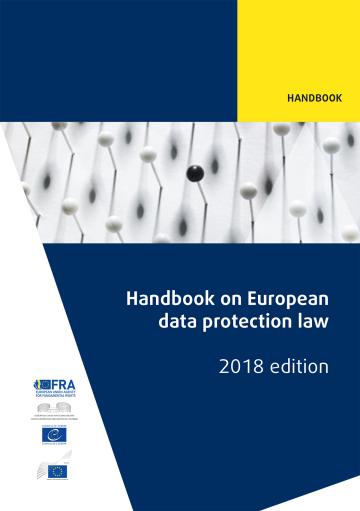
    The rapid development of information technology has exacerbated the need for robust personal data protection, the right to which is safeguarded by both European Union (EU) and Council of Europe (CoE) instruments. Safeguarding this important right entails new and significant challenges as technological advances expand the frontiers of areas such as surveillance, communication interception and data storage. This handbook is designed to familiarise legal practitioners not specialised in data protection with this emerging area of the law.
  • Fundamental Rights Report
    8
    June
    2022
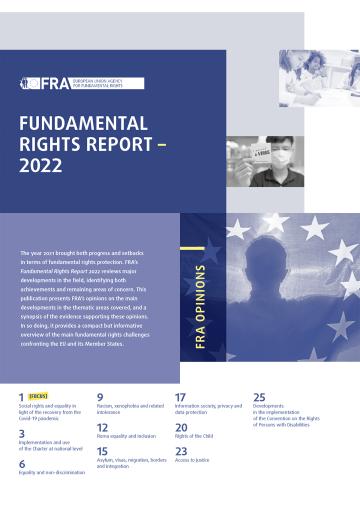
    Is-sena 2021 ġabet magħha kemm progress kif ukoll ostakli f’termini ta’ protezzjoni tad-drittijiet fundamentali. Ir-Rapport dwar id-Drittijiet Fundamentali 2022 tal FRA jirrieżamina l-iżviluppi ewlenin fil-qasam, filwaqt li jidentifika kemm ilkisbiet kif ukoll l-oqsma ta’ tħassib li fadal. Din ilpubblikazzjoni tippreżenta l-opinjonijiet tal-FRA dwar l-iżviluppi ewlenin fl-oqsma tematiċi koperti u taqsira tal-evidenza li tappoġġja dawn l-opinjonijiet.
  • Leaflet / Flyer
    16
    January
    2020
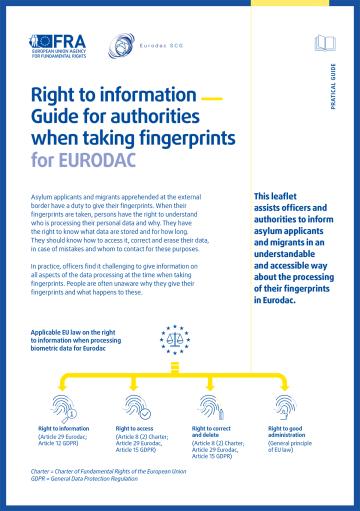
    Dan il-fuljett jassisti lill-uffiċjali u l-awtoritajiet sabiex jinfurmaw lill-applikanti għall-ażil u lill-immigranti b’mod li jinftiehem u li hu aċċessibbli dwar l-ipproċessar tal-marki tas-swaba tagħhom fil-Eurodac.
  • Report / Paper / Summary
    21
    January
    2021
    German language version now available
    26 January 2021
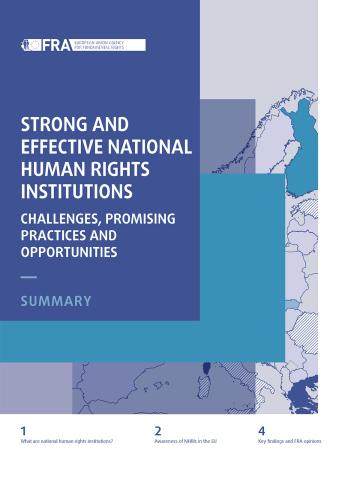
    L-Istituzzjonijiet Nazzjonali għad-Drittijiet tal-Bniedem (NHRIs) huma parti vitali mis-sistema ta’ protezzjoni tad-drittijiet tal-bniedem fil-livell ta’ pajjiż. Billi jqajmu kuxjenza, jipprovdu pariri, jimmonitorjaw u jżommu lill-awtoritajiet responsabbli, huma għandhom rwol ċentrali fin-navigazzjoni tal-isfidi l-kbar tad-drittijiet tal-bniedem tal-ġurnata tal-lum – billi jindirizzaw kemm it-tħassib persistenti bħad-diskriminazzjoni kif ukoll l-inugwaljanza, u kwistjonijiet ġodda bħall-implikazzjonijiet tad-drittijiet tal-intelliġenza artifiċjali u talpandemija tal-COVID-19.
  • Handbook / Guide / Manual
    5
    December
    2018
    Last versions available are EL and NL
    11 March 2021
    This guide explains what profiling is, the legal frameworks that regulate it, and why conducting profiling lawfully is both necessary to comply with fundamental rights and crucial for effective policing and border management. The guide also provides practical guidance on how to avoid unlawful profiling in police and border management operations.
  • Report / Paper / Summary
    3
    September
    2020
    Summary version now available
    21 January 2021
    National Human Rights Institutions (NHRIs) are a vital part of the country-level human rights protection system. This report, published 10 years after FRA’s first in-depth study on NHRIs, looks at such bodies in the EU, as well as the Republic of North Macedonia, the Republic of Serbia, and the United Kingdom of Great Britain and Northern Ireland. It explores relevant developments, challenges to their effectiveness and ways to maximise their impact.
  • Fundamental Rights Report
    11
    June
    2026
    The Fundamental Rights Report: Challenges and Achievements in 2025 is FRA’s flagship annual publication. It provides an overview of the state of fundamental rights in the EU and highlights selected critical developments from 2025. This year, it focuses on four areas: rights protection in a rapidly changing digital environment; the housing crisis and rising homelessness rates; employment challenges for people from non-EU countries; and the implementation of the EU Charter of Fundamental Rights. The publication is a valuable resource for those seeking to stay informed about the EU’s shifting landscape of fundamental rights.
  • In brief / Factsheet
    22
    May
    2026
    This factsheet examines the "right to be forgotten" within the context of EU law and the European Convention on Human Rights. It emphasizes the intersections of these legal frameworks, with particular attention to case law from the Court of Justice of the European Union (CJEU) and the European Court of Human Rights (ECtHR).
  • Report / Paper / Summary
    11
    May
    2026
    The ability to communicate freely and privately online is protected under Article 7 of the EU Charter; it is a crucial enabler of other fundamental rights, particularly as the world becomes increasingly digital. This paper presents results from an EU-wide survey about people’s views on encryption of their private online communication. It looks, for example, at concern regarding access by outside actors to information shared when using private messaging applications. The results indicate that people highly value encryption and at the same time have concerns about online communications being accessed without their knowledge or permission. It provides a timely evidence base to shape policy discussions on internal security and digital privacy.
    FRA, 2026