eu-charter

Handvest van de grondrechten van de Europese Unie

Artikel 4 - Het verbod van folteringen en van onmenselijke of vernederende behandelingen of bestraffingen

Artikel 4 - Het verbod van folteringen en van onmenselijke of vernederende behandelingen of bestraffingen

Niemand mag worden onderworpen aan folteringen of aan onmenselijke of vernederende behandelingen of bestraffingen.

Toelichtingen

  • Text:

    Het recht van artikel 4 correspondeert met het recht dat in het gelijkluidende artikel 3 van het EVRM is gewaarborgd: `Niemand mag worden onderworpen aan folteringen of aan onmenselijke of vernederende behandelingen of bestraffingen.`. Overeenkomstig artikel 52, lid 3, van het Handvest heeft het derhalve dezelfde inhoud en reikwijdte als voornoemd artikel.

    Source:
    Publicatieblad van de Europese Unie C 303/17 - 14.12.2007
    Preamble - Explanations relating to the Charter of Fundamental Rights:
    Deze toelichtingen werden oorspronkelijk opgesteld onder de verantwoordelijkheid van het praesidium van de Conventie die het Handvest van de grondrechten van de Europese Unie heeft opgesteld. Zij zijn bijgewerkt onder de verantwoordelijkheid van het praesidium van de Europese Conventie, in het licht van de wijzigingen die door laatstgenoemde Conventie in het Handvest zijn aangebracht (met name in artikel 51 en 52) en van verdere ontwikkelingen in het recht van de Unie. Hoewel zij op zich geen juridische waarde hebben, vormen zij een waardevol hulpmiddel voor de interpretatie, bedoeld om de bepalingen van het Handvest te verduidelijken.

Jurisprudentie

Nationaal constitutioneel recht

34 results found

  • Luxembourg / Constitution of the Grand Ducal of Luxembourg
    Land:
    Luxembourg

    Art. 13. ... (2) Nul ne peut être soumis à la torture ni à des peines ou traitements inhumains et dégradants. 

    La peine de mort ne peut pas être établie.

  • Magyarország Alaptörvénye
    Land:
    Hungary

    III. cikk (SZABADSÁG ÉS FELELŐSSÉG)(1) Senkit nem lehet kínzásnak, embertelen, megalázó bánásmódnak vagy büntetésnek alávetni, valamint szolgaságban tartani. […] IV. Cikk (SZABADSÁG ÉS FELELŐSSÉG) […] (2) […] Tényleges életfogytig tartó szabadságvesztés csak szándékos, erőszakos bűncselekmény elkövetése miatt szabható ki. [...]

  • Nederland / Grondwet voor het Koninkrijk der Nederlanden
    Land:
    Nederland

    Artikel 11 Ieder heeft, behoudens bij of krachtens de wet te stellen beperkingen, recht op onaantastbaarheid van zijn lichaam

  • Portugal / Constitution of the Portuguese Republic
    Land:
    Portugal

    Article 25 (Right to personal integrity) (2) No one shall be subjected to torture or to cruel, degrading or inhuman treatment or punishment.

  • Romania / Constitution of Romania
    Land:
    Romania

    Article 22(...) (2) No one may be subjected to torture or to any kind of inhuman or degrading punishment or treatment.

  • Slovakia / Constitution of the Slovak Republic
    Land:
    Slovakia

    Article 16 (...) (2) No one shall be subjected to torture or cruel, inhuman or degrading treatment or punishment.

  • Slovenia / Constitution of the Republic of Slovenia
    Land:
    Slovenia

    Article 18 No one may be subjected to torture, inhuman or degrading punishment or treatment. The conducting of medical or other scientific experiments on any person without his free consent is prohibited.

    Article 21 Respect for human personality and dignity shall be guaranteed in criminal and in all other legal proceedings, as well as during the deprivation of liberty and enforcement of punitive sanctions. Violence of any form on any person whose liberty has been restricted in any way is prohibited, as is the use of any form of coercion in obtaining confessions and statements.

  • Spain / Constitution of the Kingdom of Spain
    Land:
    Spain

    Section 15 Everyone has the right to life and to physical and moral integrity, and under no circumstances may be subjected to torture or to inhuman or degrading punishment or treatment. Death penalty is hereby abolished, except as provided for by military criminal law in times of war.

  • Suomen perustuslaki
    Land:
    Finland

    7 § Oikeus elämään sekä henkilökohtaiseen vapauteen ja koskemattomuuteen Jokaisella on oikeus elämään sekä henkilökohtaiseen vapauteen, koskemattomuuteen ja turvallisuuteen. Ketään ei saa tuomita kuolemaan, kiduttaa eikä muutoinkaan kohdella ihmisarvoa loukkaavasti. (...) 9 § Liikkumisvapaus (...) Ulkomaalaisen oikeudesta tulla Suomeen ja oleskella maassa säädetään lailla. Ulkomaalaista ei saa karkottaa, luovuttaa tai palauttaa, jos häntä tämän vuoksi uhkaa kuolemanrangaistus, kidutus tai muu ihmisarvoa loukkaava kohtelu.

  • The Constitution of the Republic of Cyprus
    Land:
    Cyprus

    Article 8
    No person shall be subjected to torture or to inhuman or degrading punishment or treatment.

  • The Fundamental Law of Hungary
    Land:
    Hungary

    Article III (Freedom and Responsibility) (1) No one shall be subject to torture, inhuman or degrading treatment or punishment […] Article IV (Freedom and Responsibility) […] (2) […] Life imprisonment without parole may only be
    imposed for the commission of intentional and violent criminal offences. [...]

  • Tο Σύνταγμα της Κυπριακής Δημοκρατίας
    Land:
    Cyprus

    ΑΡΘΡΟΝ 8:
    Ουδείς υποβάλλεται εις βασανιστήρια ή εις απάνθρωπον ή ταπεινωτικήν τιμωρίαν ή μεταχείρισιν

  • Το Σύνταγμα της Ελλάδας
    Land:
    Greece

    Άρθρο 7(2) Tα βασανιστήρια, oπoιαδήπoτε σωματική κάκωση, βλάβη υγείας, ή άσκηση ψυχoλoγικής βίας, καθώς και κάθε άλλη πρoσβoλή της ανθρώπινης αξιoπρέπειας απαγoρεύoνται και τιμωρoύνται, όπως νόμoς oρίζει. […]

  • КОНСТИТУЦИЯ на Република България
    Land:
    Bulgaria

    Чл.29.(1) Никой не може да бъде подлаган на мъчение, на жестоко, безчовечно или унижаващо отношение, както и на насилствена асимилация. [...]

EU-recht

13 results found

  • Regulation (EU) 2019/1896 of the European Parliament and of the Council of 13 November 2019 on the European Border and Coast Guard and repealing Regulations (EU) No 1052/2013 and (EU) 2016/1624

    Preamble

    (103) This Regulation respects the fundamental rights and observes the principles recognised by Articles 2 and 6 TEU and by the Charter of Fundamental Rights of the European Union (‘the Charter’), in particular respect for human dignity, the right to life, the prohibition of torture and inhuman or degrading treatment or punishment, the prohibition of trafficking in human beings, the right to liberty and security, the right to the protection of personal data, the right of access to documents, the right to asylum and to protection against removal and expulsion, non-refoulement, non-discrimination and the rights of the child.

    Article 1: Subject matter

    This Regulation establishes a European Border and Coast Guard to ensure European integrated border management at the external borders with a view to managing those borders efficiently in full compliance with fundamental rights and to increasing the efficiency of the Union return policy.

    This Regulation addresses migratory challenges and potential future challenges and threats at the external borders. It ensures a high level of internal security within the Union in full respect of fundamental rights, while safeguarding the free movement of persons within the Union. It contributes to the detection, prevention and combating of cross-border crime at the external borders.

    Article 43: Instructions to the teams

    4.   Members of the teams shall, in the performance of their tasks and in the exercise of their powers, fully respect fundamental rights, including access to asylum procedures and human dignity, and shall pay particular attention to vulnerable persons. Any measures taken in the performance of their tasks and in the exercise of their powers shall be proportionate to the objectives pursued by such measures. While performing their tasks and exercising their powers, they shall not discriminate against persons on the basis of any grounds such as sex, race, colour, ethnic or social origin, genetic features, language, religion or belief, political or any other opinion, membership of a national minority, property, birth, disability, age or sexual orientation in line with Article 21 of the Charter.

  • Regulation (EU) 2019/125 of the European Parliament and of the Council of 16 January 2019 concerning trade in certain goods which could be used for capital punishment, torture or other cruel, inhuman or degrading treatment or punishment

    Article 1 Subject matter

    This Regulation lays down Union rules governing trade with third countries in goods that could be used for the purpose of capital punishment or for the purpose of torture or other cruel, inhuman or degrading treatment or punishment, and rules governing the supply of brokering services, technical assistance, training and advertising related to such goods.

    ...

  • Directive 2013/33/EU of the European Parliament and of the Council of 26 June 2013 laying down standards for the reception of applicants for international protection

    Article 25 Victims of torture and violence
    ‘(1) Member States shall ensure that persons who have been subjected to torture, rape or other serious acts of violence receive the necessary treatment for the damage caused by such acts, in particular access to appropriate medical and psychological treatment or care.
    (2) Those working with victims of torture, rape or other serious acts of violence shall have had and shall continue to receive appropriate training concerning their needs, and shall be bound by the confidentiality rules provided for in national law, in relation to any information they obtain in the course of their work.‘

Internationaal recht

9 results found

  • Global Compact for Safe, Orderly and Regular Migration

    Resolution adopted by the General Assembly on 19 December 2018

  • European Convention for the Prevention of Torture and Inhuman or Degrading Treatment or Punishment

    Article 1

    There shall be established a European Committee for the Prevention of Torture and Inhuman or Degrading Treatment or Punishment (hereinafter referred to as “the Committee”). The Committee shall, by means of visits, examine the treatment of persons deprived of their liberty with a view to strengthening, if necessary, the protection of such persons from torture and from inhuman or degrading treatment or punishment.

    ...

  • European Convention on Human Rights - Article 3

    Article 3 – Prohibition of torture

    No one shall be subjected to torture or to inhuman or degrading treatment or punishment.

  • Convention on the Rights of the Child

    Article 37

    States Parties shall ensure that:

    (a) No child shall be subjected to torture or other cruel, inhuman or degrading treatment or punishment. Neither capital punishment nor life imprisonment without possibility of release shall be imposed for offences committed by persons below eighteen years of age;

    (b) No child shall be deprived of his or her liberty unlawfully or arbitrarily. The arrest, detention or imprisonment of a child shall be in conformity with the law and shall be used only as a measure of last resort and for the shortest appropriate period of time;

    (c) Every child deprived of liberty shall be treated with humanity and respect for the inherent dignity of the human person, and in a manner which takes into account the needs of persons of his or her age. In particular, every child deprived of liberty shall be separated from adults unless it is considered in the child's best interest not to do so and shall have the right to maintain contact with his or her family through correspondence and visits, save in exceptional circumstances;

    (d) Every child deprived of his or her liberty shall have the right to prompt access to legal and other appropriate assistance, as well as the right to challenge the legality of the deprivation of his or her liberty before a court or other competent, independent and impartial authority, and to a prompt decision on any such action.

  • Convention on the Rights of Persons with Disabilities - Article 15

    Article 15 – Freedom from torture or cruel, inhuman or degrading treatment or punishment

    1. No one shall be subjected to torture or to cruel, inhuman or degrading treatment or punishment. In particular, no one shall be subjected without his or her free consent to medical or scientific experimentation.

    2. States Parties shall take all effective legislative, administrative, judicial or other measures to prevent persons with disabilities, on an equal basis with others, from being subjected to torture or cruel, inhuman or degrading treatment or punishment.

  • Convention against Torture and Other Cruel, Inhuman or Degrading Treatment or Punishment

    Article 1

    1. For the purposes of this Convention, the term "torture" means any act by which severe pain or suffering, whether physical or mental, is intentionally inflicted on a person for such purposes as obtaining from him or a third person information or a confession, punishing him for an act he or a third person has committed or is suspected of having committed, or intimidating or coercing him or a third person, or for any reason based on discrimination of any kind, when such pain or suffering is inflicted by or at the instigation of or with the consent or acquiescence of a public official or other person acting in an official capacity. It does not include pain or suffering arising only from, inherent in or incidental to lawful sanctions.

    2. This article is without prejudice to any international instrument or national legislation which does or may contain provisions of wider application.

  • International Covenant on Civil and Political Rights

    Article 7

    No one shall be subjected to torture or to cruel, inhuman or degrading treatment or punishment. In particular, no one shall be subjected without his free consent to medical or scientific experimentation.

  • Human Rights Committee, General Comment No. 35 - Article 9: Liberty and Security of person

    ‘34. The individual must be brought to appear physically before the judge or other officer authorized by law to exercise judicial power. The physical presence of detainees at the hearing gives the opportunity for inquiry into the treatment that they received in custody and facilitates immediate transfer to a remand detention centre if continued detention is ordered. It thus serves as a safeguard for the right to security of person and the prohibition against torture and cruel, inhuman or degrading treatment. ‘
    ‘58. Several safeguards that are essential for the prevention of torture are also necessary for the protection of persons in any form of detention against arbitrary detention and infringement of personal security. The following examples are non-exhaustive. Detainees should be held only in facilities officially acknowledged as places of detention. A centralized official register should be kept of the names and places of detention, and times of arrival and departure, as well as of the names of persons responsible for their detention, and made readily available and accessible to those concerned, including relatives. Prompt and regular access should be given to independent medical personnel and lawyers and, under appropriate supervision when the legitimate purpose of the detention so requires, to family members. Detainees should be promptly informed of their rights, in a language they understand; providing information leaflets in the appropriate language, including in Braille, may often assist the detainee in retaining the information. Detained foreign nationals should be informed of their right to communicate with their consular authorities, or, in the case of asylum seekers, with the Office of the United Nations High Commissioner for Refugees. Independent and impartial mechanisms should be established for visiting and inspecting all places of detention, including mental-health institutions.‘

  • UN General Assembly Resolution 70/175 (2015) - United Nations Standard Minimum Rules for the Treatment of Prisoners (the Nelson Mandela Rules)

    Rule 1
    ‘All prisoners shall be treated with the respect due to their inherent dignity and value as human beings. No prisoner shall be subjected to, and all prisoners shall be protected from, torture and other cruel, inhuman or degrading treatment or punishment, for which no circumstances whatsoever may be invoked as a justification. The safety and security of prisoners, staff, service providers and visitors shall be ensured at all times.‘
    Rule 32
    ‘1. The relationship between the physician or other health-care professionals and the prisoners shall be governed by the same ethical and professional standards as those applicable to patients in the community, in particular: [...]
    (d) An absolute prohibition on engaging, actively or passively, in acts that may constitute torture or other cruel, inhuman or degrading treatment or punishment, including medical or scientific experimentation that may be detrimental to a prisoner’s health, such as the removal of a prisoner’s cells, body tissues or organs.‘
    Rule 43
    ‘1. In no circumstances may restrictions or disciplinary sanctions amount
    to torture or other cruel, inhuman or degrading treatment or punishment.
    The following practices, in particular, shall be prohibited:
    (a) Indefinite solitary confinement;
    (b) Prolonged solitary confinement;
    (c) Placement of a prisoner in a dark or constantly lit cell;
    (d) Corporal punishment or the reduction of a prisoner’s diet or drinking water;
    (e) Collective punishment.‘

Producten

  • Fundamental Rights Report
    8
    June
    2022
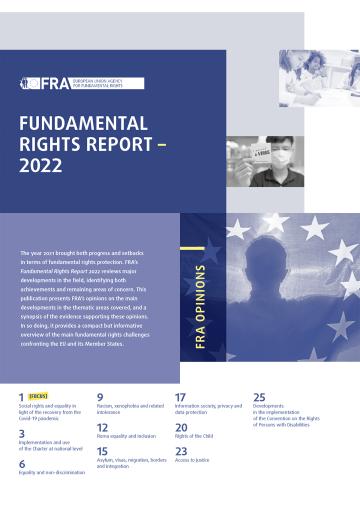
    Het jaar 2021 kende zowel vooruitgang als tegenslagen bij de bescherming van de grondrechten. Het Verslag over de grondrechten 2022 van FRA evalueert de belangrijkste ontwikkelingen op het gebied van de grondrechten, waarbij niet alleen wordt ingegaan op de successen die zijn behaald, maar ook wordt gewezen op de resterende punten van zorg. Deze publicatie zet de adviezen van FRA op een rij over de belangrijkste ontwikkelingen binnen deze thematische gebieden en geeft in het kort de feitelijke gegevens weer waarop deze adviezen berusten.
  • Report / Paper / Summary
    7
    July
    2021
    Italian version now available
    12 September 2022
    This report examines why victims do not report bias-motivated incidents and the barriers that they face when reporting incidents through national crime reporting systems. By mapping existing practices that have a bearing on the victim’s experiences when reporting bias-motivated violence and harassment, it aims to provide evidence to support national efforts to encourage and facilitate reporting – and ultimately assist Member States in delivering on their duties with regard to combating hate crime.
  • Fundamental Rights Report
    11
    June
    2026
    The Fundamental Rights Report: Challenges and Achievements in 2025 is FRA’s flagship annual publication. It provides an overview of the state of fundamental rights in the EU and highlights selected critical developments from 2025. This year, it focuses on four areas: rights protection in a rapidly changing digital environment; the housing crisis and rising homelessness rates; employment challenges for people from non-EU countries; and the implementation of the EU Charter of Fundamental Rights. The publication is a valuable resource for those seeking to stay informed about the EU’s shifting landscape of fundamental rights.
  • Report / Paper / Summary
    27
    November
    2025
    This report looks at the breadth and depth of violence and neglect faced by people with disabilities living in institutions. It highlights the shortcomings by EU Member States in preventing violence and protecting those who are at a higher risk of experiencing it, in line with the UN Convention on the Rights of Persons with Disabilities. Based on research across all EU Member States and FRA observer candidate countries, the report calls for better protection, stronger prevention of violence, and clear accountability. It urges the EU and its Member States to implement their obligations around equality and fundamental rights.
  • Report / Paper / Summary
    17
    September
    2025
    This report highlights the discrimination, harassment, violence, and non-consensual medical interventions faced by intersex people across 30 European countries, based on responses from nearly 2,000 participants in FRA's 2023 EU LGBTIQ Survey III. It reveals that many intersex individuals also identify as trans, non-binary, gender-diverse and have varied sexual orientations, which further compounds their experiences of discrimination. The report aims to support the development of laws and policies that promote the inclusion and dignity of intersex people.
  • In brief / Factsheet
    1
    September
    2025
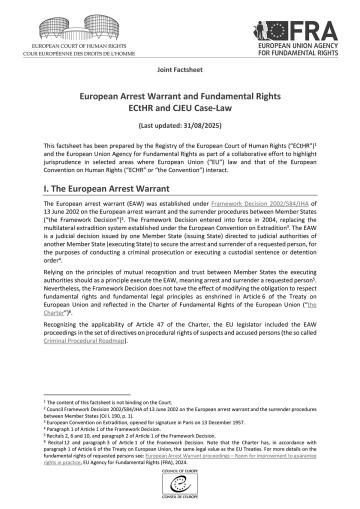
    This factsheet focuses on the European arrest warrant and EU Member States obligations to respect fundamental rights. EU law and the European Convention on Human Rights sometimes overlap. The publication clarifies where there are similar principles in different legislation and provides examples of case law. In collaboration, the EU Agency for Fundamental Rights and the European Court of Human Rights produced this short publication. It is designed to aid lawyers and policymakers in understanding and applying the jurisprudence in this area. The August 2025 version now contains recent case-law developments.
  • Opinion / Position Paper
    23
    July
    2025
    This position paper examines how the EU can counter the instrumentalisation of migrants while also upholding fundamental rights. Instrumentalisation refers to countries outside the EU using migration to exert political pressure. This position paper defines the phenomenon, provides examples, and outlines legal obligations under EU law. It provides legal analysis and warns that some responses risk undermining fundamental rights at the EU’s external borders, including the right to asylum. To counter instrumentalisation and uphold fundamental rights, the position paper proposes practical measures for Member States to take, such as sanctions, border controls, and cooperation with private operators.
  • In brief / Factsheet
    27
    May
    2025
    This factsheet focuses on the European arrest warrant and EU Member States obligations to respect fundamental rights. EU law and the European Convention on Human Rights sometimes overlap. The publication clarifies where there are similar principles in different legislation and provides examples of case law. In collaboration, the EU Agency for Fundamental Rights and the European Court of Human Rights produced this short publication. It is designed to aid lawyers and policymakers in understanding and applying the jurisprudence in this area. The 2025 version now contains recent case-law developments.
  • Opinion / Position Paper
    6
    February
    2025
    This FRA Position Paper outlines the Agency’s position on the creation of 'return hubs' in non-EU countries for migrants who have been ordered to leave the EU. Considering the serious fundamental rights risks connected with running return hubs, this legal analysis presents the conditions that would have to be met for return hubs to respect fundamental rights and comply with EU law. These include setting up agreements with the host countries and creating independent human rights monitoring mechanisms. The position paper does not examine centres in third countries that process asylum applications.
  • Handbook / Guide / Manual
    19
    September
    2024
    This publication guides EU countries on setting up independent monitoring mechanisms to ensure fundamental rights are respected during screening and asylum border procedures. These processes at borders are for people arriving from non-EU countries. Monitoring mechanisms are meant to prevent rights violations, protect victims, and support investigations into any allegations of wrongdoing by public authorities. The guidance highlights the importance of transparency and accountability, which builds trust in public authorities. New EU regulations coming into effect in 2026 will require such monitoring systems to be in place. This updates the guidance published in 2022.