eu-charter

Handvest van de grondrechten van de Europese Unie

Artikel 8 - De bescherming van persoonsgegevens

Artikel 8 - De bescherming van persoonsgegevens

1. Eenieder heeft recht op bescherming van zijn persoonsgegevens.

2. Deze gegevens moeten eerlijk worden verwerkt, voor bepaalde doeleinden en met toestemming van de betrokkene of op basis van een andere gerechtvaardigde grondslag waarin de wet voorziet. Eenieder heeft recht van inzage in de over hem verzamelde gegevens en op rectificatie daarvan.

3. Een onafhankelijke autoriteit ziet erop toe dat deze regels worden nageleefd.

Toelichtingen

  • Text:

    Dit artikel was gebaseerd op artikel 286 van het Verdrag tot oprichting van de Europese Gemeenschap en op Richtlijn 95/46/EG van het Europees Parlement en de Raad betreffende de bescherming van natuurlijke personen in verband met de verwerking van persoonsgegevens en betreffende het vrije verkeer van die gegevens (PB L 281 van 23.11.1995, blz. 31), alsmede op artikel 8 van het EVRM en op het Verdrag van de Raad van Europa van 28 januari 1981 tot bescherming van personen met betrekking tot de geautomatiseerde verwerking van persoonsgegevens, dat door alle lidstaten is bekrachtigd. Artikel 286 van het EG-Verdrag is nu vervangen door artikel 16 van het Verdrag betreffende de werking van de Europese Unie en artikel 39 van het Verdrag betreffende de Europese Unie. Voorts wordt verwezen naar Verordening (EG) nr. 45/2001 van het Europees Parlement en de Raad betreffende de bescherming van natuurlijke personen in verband met de verwerking van persoonsgegevens door de communautaire instellingen en organen en betreffende het vrije verkeer van die gegevens (PB L 8 van 12.1.2001, blz. 1). Bovengenoemde richtlijn en verordening bevatten voorwaarden en beperkingen voor de uitoefening van het recht op bescherming van persoonsgegevens.

    Source:
    Publicatieblad van de Europese Unie C 303/17 - 14.12.2007
    Preamble - Explanations relating to the Charter of Fundamental Rights:
    Deze toelichtingen werden oorspronkelijk opgesteld onder de verantwoordelijkheid van het praesidium van de Conventie die het Handvest van de grondrechten van de Europese Unie heeft opgesteld. Zij zijn bijgewerkt onder de verantwoordelijkheid van het praesidium van de Europese Conventie, in het licht van de wijzigingen die door laatstgenoemde Conventie in het Handvest zijn aangebracht (met name in artikel 51 en 52) en van verdere ontwikkelingen in het recht van de Unie. Hoewel zij op zich geen juridische waarde hebben, vormen zij een waardevol hulpmiddel voor de interpretatie, bedoeld om de bepalingen van het Handvest te verduidelijken.

Jurisprudentie

Nationaal constitutioneel recht

68 results found

  • European Convention on Human Rights - Article 8
    Land:
    Austria

    Article 8

    1 Everyone has the right to respect for his private and family life, his home and his correspondence.

    2 There shall be no interference by a public authority with the exercise of this right except such as is in accordance with the law and is necessary in a democratic society in the interests of national security, public safety or the economic well-being of the country, for the prevention of disorder or crime, for the protection of health or morals, or for the protection of the rights and freedoms of others.

  • Federal Data Protection Act
    Land:
    Germany

    Section 1 Purpose and scope (1) The purpose of this Act is to protect the individual against his right to privacy being impaired through the handling of his personal data. (2) This Act shall apply to the collection, processing and use of personal data by 1. public bodies of the Federation, 2. public bodies of the Länder in so far as data protection is not governed by Land legislation and in so far as they a) execute federal law or, b) act as bodies of the judicature and are not dealing with administrative matters, 3.private bodies in so far as they process or use data by means of data processing systems or collect data for such systems, process or use data in or from non-automated filing systems or collect data for such systems, except where the collection, processing or use of such data is effected solely for personal or family activities. (3) In so far as other legal provisions of the Federation are applicable to personal data, including their publication, such provisions shall take precedence over the provisions of this Act. This shall not affect the duty to observe the legal obligation of maintaining secrecy or professional or special official confidentiality not based on legal provisions. (4) The provisions of this Act shall take precedence over those of the Administrative Procedures Act in so far as personal data are processed in ascertaining the facts. (5) This Act shall not apply in so far as a controller located in another member state of the European Union or in another state party to the Agreement on the European Economic Area collects, processes or uses personal data, except where such collection, processing or use is carried out by a branch in Germany. This Act shall apply in so far as a controller which is not located in a member state of the European Union or in another state party to the Agreement on the European Economic Area collects, processes or uses personal data in Germany. In so far as the controller is to be named under this Act, information is also to be furnished on representatives established in Germany. Sentences 2 and 3 shall not apply in so far as data storage media are employed solely for the purposes of transit through Germany. The first sentence of Section 38 (1) shall remain unaffected.

  • Fizisko personu datu aizsardzības likums
    Land:
    Latvia

    1.pants.Šā likuma mērķis ir aizsargāt fizisko personu pamattiesības un brīvības, it īpaši privātās dzīves neaizskaramību, attiecībā uz fiziskās personas datu (turpmāk — personas dati) apstrādi.

  • Henkilötietolaki 22.4.1999/523
    Land:
    Finland

    1 § Tämän lain tarkoituksena on toteuttaa yksityiselämän suojaa ja muita yksityisyyden suojaa turvaavia perusoikeuksia henkilötietoja käsiteltäessä sekä edistää hyvän tietojenkäsittelytavan kehittämistä ja noudattamista.

  • Konstytucja Rzeczypospolitej Polskiej
    Land:
    Poland

    Art. 47 Każdy ma prawo do ochrony prawnej życia prywatnego, rodzinnego, czci i dobrego imienia oraz do decydowania o swoim życiu osobistym. Art. 51.1. Nikt nie może być obowiązany inaczej niż na podstawie ustawy do ujawniania informacji dotyczących jego osoby. 2. Władze publiczne nie mogą pozyskiwać, gromadzić i udostępniać innych informacji o obywatelach niż niezbędne w demokratycznym państwie prawnym. 3. Każdy ma prawo dostępu do dotyczących go urzędowych dokumentów i zbiorów danych. Ograniczenie tego prawa może określić ustawa. 4. Każdy ma prawo do żądania sprostowania oraz usunięcia informacji nieprawdziwych, niepełnych lub zebranych w sposób sprzeczny z ustawą. 5. Zasady i tryb gromadzenia oraz udostępniania informacji określa ustawa. 

  • Konvention zum Schutze der Menschenrechte und Grundfreiheiten
    Land:
    Austria

    Artikel 8 (1) Jedermann hat Anspruch auf Achtung seines Privat- und Familienlebens, seiner Wohnung und seines Briefverkehrs.

  • Law 2472/1997 on the Protection of Individuals with regard to the Processing of Personal Data
    Land:
    Greece
  • Law No. 677/2001 on the Protection of Individuals with Regard to the Processing of Personal Data and the Free Movement of Such Data, amended and completed
    Land:
    Romania

    Article 1: Purpose (1) The purpose of this law is to guarantee and protect the individual’s fundamental rights and freedoms, especially the right to personal, family and private life, with regard to the processing of personal data.

  • Law no.506/2004 on the processing of personal data and the protection of privacy in the electronic communications sector
    Land:
    Romania

    Article 4: (1) The confidentiality of communications and the related traffic data by means of public electronic communications networks and publicly available electronic communications services is guaranteed. (2) Listening, tapping, storage or other kinds of interception or surveillance of communications and the related traffic data are prohibited, except for the following cases: a) these operations are carried out by the users who participate in that communication; b) the users who participate in that communication have previously given their written consent; c) these operations are carried out by the competent authorities, under the conditions set out by the legal provisions in force.

  • Law of 2 August 2002 on the Protection of Persons with regard to the Processing of Personal Data
    URL:
    Land:
    Luxembourg

    The GDPR will replace the Luxembourg Law of 2 August 2002 on the protection of persons with regard to the processing of personal data (the “2002 Law”) and will be directly effective in Luxembourg as from 25 May 2018.

  • Lege nr. 506 din 17 noiembrie 2004 privind prelucrarea datelor cu caracter personal şi protecţia vieţii private în sectorul comunicaţiilor electronice
    Land:
    Romania

    Articolul 4: (1) Confidenţialitatea comunicărilor transmise prin intermediul reţelelor publice de comunicaţii electronice şi a serviciilor de comunicaţii electronice destinate publicului, precum şi confidenţialitatea datelor de trafic aferente sunt garantate.(2) Ascultarea, înregistrarea, stocarea şi orice altă formă de interceptare ori supraveghere a comunicărilor şi a datelor de trafic aferente sunt interzise, cu excepţia cazurilor următoare:a) se realizează de utilizatorii care participă la comunicarea respectivă;b) utilizatorii care participă la comunicarea respectivă şi-au dat, în prealabil, consimţământul scris cu privire la efectuarea acestor operaţiuni;c) se realizează de autorităţile competente, în condiţiile legii.

  • Lege nr. 677 din 21 noiembrie 2001 pentru protecţia persoanelor cu privire la prelucrarea datelor cu caracter personal şi libera circulaţie a acestor date
    Land:
    Romania

    Articolul 1: (1) Prezenta lege are ca scop garantarea şi protejarea drepturilor şi libertăţilor fundamentale ale persoanelor fizice, în special a dreptului la viaţa intima, familială şi privată, cu privire la prelucrarea datelor cu caracter personal.

  • Lei da protecçao de dados pessoais (Lei 67/98)
    Land:
    Portugal
  • LEY ORGÁNICA 15/1999, de 13 de diciembre, de Protección de Datos de Carácter Personal
    Land:
    Spain

    Artículo 1La presente Ley Orgánica tiene por objeto garantizar y proteger, en lo que concierne al tratamiento de los datos personales, las libertades públicas y los derechos fundamentales de las personas físicas, y especialmente de su honor e intimidad personal y familiar.

  • Lietuvos Respublikos Konstitucija
    Land:
    Lithuania

    22 straipsnis. Žmogaus privatus gyvenimas neliečiamas. Asmens susirašinėjimas, pokalbiai telefonu, telegrafo pranešimai ir kitoks susižinojimas neliečiami. Informacija apie privatų asmens gyvenimą gali būti renkama tik motyvuotu teismo sprendimu ir tik pagal įstatymą. Įstatymas ir teismas saugo, kad niekas nepatirtų savavališko ar neteisėto kišimosi į jo asmeninį ir šeimyninį gyvenimą, kėsinimosi į jo garbę ir orumą.

  • Loi du 2 août 2002 relative à la protection des personnes à l'égard du traitement des données à caractère personnel.
    Land:
    Luxembourg
  • Loi du 8 décembre 1992 relative à la protection de la vie privée à l'égard des traitements de données à caractère personnel
    Land:
    Belgium


  • Loi n°78-17 du 6 janvier 1978 relative à l'informatique, aux fichiers et aux libertés
    Land:
    France

    Article 1L'informatique doit être au service de chaque citoyen. Son développement doit s'opérer dans le cadre de la coopération internationale. Elle ne doit porter atteinte ni à l'identité humaine, ni aux droits de l'homme, ni à la vie privée, ni aux libertés individuelles ou publiques. Article 2 La présente loi s'applique aux traitements automatisés de données à caractère personnel, ainsi qu'aux traitements non automatisés de données à caractère personnel contenues ou appelées à figurer dans des fichiers, à l'exception des traitements mis en oeuvre pour l'exercice d'activités exclusivement personnelles, lorsque leur responsable remplit les conditions prévues à l'article 5. (...)

  • Luxembourg / Constitution of the Grand Ducal of Luxembourg
    Land:
    Luxembourg

    Art. 31. Toute personne a droit à l’autodétermination informationnelle et à la protection des données à caractère personnel la concernant. Ces données ne peuvent être traitées qu’à des fins et dans les conditions déterminées par la loi.

  • Magyarország Alaptörvénye
    Land:
    Hungary

     VI. cikk (SZABADSÁG ÉS FELELŐSSÉG) [...] (2) Mindenkinek joga van személyes adatai védelméhez, valamint a közérdekű adatok megismeréséhez és terjesztéséhez.(3) A személyes adatok védelméhez és a közérdekű adatok megismeréséhez való jog érvényesülését sarkalatos törvénnyel létrehozott, független hatóság ellenőrzi. 

EU-recht

37 results found

  • Regulation (EU) No 524/2013 of the European Parliament and of the Council of 21 May 2013 on online dispute resolution for consumer disputes and amending Regulation (EC) No 2006/2004 and Directive 2009/22/EC

    Preamble:

    (1) Article 169(1) and point (a) of Article 169(2) of the Treaty on the Functioning of the European Union (TFEU) provide that the Union is to contribute to the attainment of a high level of consumer protection through measures adopted pursuant to Article 114 TFEU. Article 38 of the Charter of Fundamental Rights of the European Union provides that Union policies are to ensure a high level of consumer protection.

    (2) In accordance with Article 26(2) TFEU, the internal market is to comprise an area without internal frontiers in which the free movement of goods and services is ensured. In order for consumers to have confidence in and benefit from the digital dimension of the internal market, it is necessary that they have access to simple, efficient, fast and low-cost ways of resolving disputes which arise from the sale of goods or the supply of services online. This is particularly important when consumers shop cross-border.‘

    (4) Fragmentation of the internal market impedes efforts to boost competitiveness and growth. Furthermore, the uneven availability, quality and awareness of simple, efficient, fast and low-cost means of resolving disputes arising from the sale of goods or provision of services across the Union constitutes a barrier within the internal market which undermines consumers’ and traders’ confidence in shopping and selling across borders.‘

    (13) The definition of ‘consumer’ should cover natural persons who are acting outside their trade, business, craft or profession. However, if the contract is concluded for purposes partly within and partly outside the person’s trade (dual purpose contracts) and the trade purpose is so limited as not to be predominant in the overall context of the supply, that person should also be considered as a consumer.‘

    (14) The definition of ‘online sales or service contract’ should cover a sales or service contract where the trader, or the trader’s intermediary, has offered goods or services through a website or by other electronic means and the consumer has ordered those goods or services on that website or by other electronic means. This should also cover cases where the consumer has accessed the website or other information society service through a mobile electronic device such as a mobile telephone.

    (26) The right to an effective remedy and the right to a fair trial are fundamental rights laid down in Article 47 of the Charter of Fundamental Rights of the European Union. ODR is not intended to and cannot be designed to replace court procedures, nor should it deprive consumers or traders of their rights to seek redress before the courts. This Regulation should not, therefore, prevent parties from exercising their right of access to the judicial system.

    (35) This Regulation respects fundamental rights and observes the principles recognised in particular by the Charter of Fundamental Rights of the European Union and specifically Articles 7, 8, 38 and 47 thereof.

    Article 1: Subject matter
    The purpose of this Regulation is, through the achievement of a high level of consumer protection, to contribute to the proper functioning of the internal market, and in particular of its digital dimension by providing a European ODR platform (‘ODR platform’) facilitating the independent, impartial, transparent, effective, fast and fair out-of-court resolution of disputes between consumers and traders online.

    Article 12: Processing of personal data

    1. Access to information, including personal data, related to a dispute and stored in the database referred to in Article 11 shall be granted, for the purposes referred to in Article 10, only to the ADR entity to which the dispute was transmitted in accordance with Article 9. Access to the same information shall be granted also to ODR contact points, in so far as it is necessary, for the purposes referred to in Article 7(2) and (4).

    2. The Commission shall have access to information processed in accordance with Article 10 for the purposes of monitoring the use and functioning of the ODR platform and drawing up the reports referred to in Article 21. It shall process personal data of the users of the ODR platform in so far as it is necessary for the operation and maintenance of the ODR platform, including for the purposes of monitoring the use of the ODR platform by ADR entities and ODR contact points.

    3. Personal data related to a dispute shall be kept in the database referred to in paragraph 1 of this Article only for the time necessary to achieve the purposes for which they were collected and to ensure that data subjects are able to access their personal data in order to exercise their rights, and shall be automatically deleted, at the latest, six months after the date of conclusion of the dispute which has been transmitted to the ODR platform in accordance with point (iii) of point (c) of Article 10. That retention period shall also apply to personal data kept in national files by the ADR entity or the ODR contact point which dealt with the dispute concerned, except if the procedural rules applied by the ADR entity or any specific provisions of national law provide for a longer retention period.

    4. Each ODR advisor shall be regarded as a controller with respect to its data processing activities under this Regulation, in accordance with point (d) of Article 2 of Directive 95/46/EC, and shall ensure that those activities comply with national legislation adopted pursuant to Directive 95/46/EC in the Member State of the ODR contact point hosting the ODR advisor.

    5. Each ADR entity shall be regarded as a controller with respect to its data processing activities under this Regulation, in accordance with point (d) of Article 2 of Directive 95/46/EC, and shall ensure that those activities comply with national legislation adopted pursuant to Directive 95/46/EC in the Member State where the ADR entity is established.

    6. In relation to its responsibilities under this Regulation and the processing of personal data involved therein, the Commission shall be regarded as a controller in accordance with point (d) of Article 2 of Regulation (EC) No 45/2001.

    Article 13: Data confidentiality and security

    1. ODR contact points shall be subject to rules of professional secrecy or other equivalent duties of confidentiality laid down in the legislation of the Member State concerned.

    2. The Commission shall take the appropriate technical and organisational measures to ensure the security of information processed under this Regulation, including appropriate data access control, a security plan and a security incident management, in accordance with Article 22 of Regulation (EC) No 45/2001.

    Article 14: Consumer information

    1. Traders established within the Union engaging in online sales or service contracts, and online marketplaces established within the Union, shall provide on their websites an electronic link to the ODR platform. That link shall be easily accessible for consumers. Traders established within the Union engaging in online sales or service contracts shall also state their e-mail addresses.

    2. Traders established within the Union engaging in online sales or service contracts, which are committed or obliged to use one or more ADR entities to resolve disputes with consumers, shall inform consumers about the existence of the ODR platform and the possibility of using the ODR platform for resolving their disputes. They shall provide an electronic link to the ODR platform on their websites and, if the offer is made by e-mail, in that e-mail. The information shall also be provided, where applicable, in the general terms and conditions applicable to online sales and service contracts.

    3. Paragraphs 1 and 2 of this Article shall be without prejudice to Article 13 of Directive 2013/11/EU and the provisions on consumer information on out-of-court redress procedures contained in other Union legal acts, which shall apply in addition to this Article.

    4. The list of ADR entities referred to in Article 20(4) of Directive 2013/11/EU and its updates shall be published in the ODR platform.

    5. Member States shall ensure that ADR entities, the centres of the European Consumer Centres Network, the competent authorities defined in Article 18(1) of Directive 2013/11/EU, and, where appropriate, the bodies designated in accordance with Article 14(2) of Directive 2013/11/EU provide an electronic link to the ODR platform.

    6. Member States shall encourage consumer associations and business associations to provide an electronic link to the ODR platform.

    7. When traders are obliged to provide information in accordance with paragraphs 1 and 2 and with the provisions referred to in paragraph 3, they shall, where possible, provide that information together.

  • Directive (EU) 2016/1148 of the European Parliament and of the Council of 6 July 2016 concerning measures for a high common level of security of network and information systems across the Union

    Article 2 - Processing of personal data
    ‘1. Processing of personal data pursuant to this Directive shall be carried out in accordance with Directive 95/46/EC.
    2. Processing of personal data by Union institutions and bodies pursuant to this Directive shall be carried out in accordance with Regulation (EC) No 45/2001.‘

  • Directive (EU) 2016/680 of the European Parliament and of the Council of 27 April 2016 on the protection of natural persons with regard to the processing of personal data by competent authorities for the purposes of the prevention, investigation, detec...

    Article 1 - Subject-matter and objectives
    ‘1. This Directive lays down the rules relating to the protection of natural persons with regard to the processing of personal data by competent authorities for the purposes of the prevention, investigation, detection or prosecution of criminal offences or the execution of criminal penalties, including the safeguarding against and the prevention of threats to public security.
    2. In accordance with this Directive, Member States shall:
    (a) protect the fundamental rights and freedoms of natural persons and in particular their right to the protection of personal data‘
    Article 4
    ‘Principles relating to processing of personal data
    1. Member States shall provide for personal data to be:
    (a) processed lawfully and fairly;
    (b) collected for specified, explicit and legitimate purposes and not processed in a manner that is incompatible with those purposes;
    (c) adequate, relevant and not excessive in relation to the purposes for which they are processed;
    (d) accurate and, where necessary, kept up to date; every reasonable step must be taken to ensure that personal data that are inaccurate, having regard to the purposes for which they are processed, are erased or rectified without delay;
    (e) kept in a form which permits identification of data subjects for no longer than is necessary for the purposes for which they are processed;
    (f) processed in a manner that ensures appropriate security of the personal data, including protection against unauthorised or unlawful processing and against accidental loss, destruction or damage, using appropriate technical or organisational measures.
    2. Processing by the same or another controller for any of the purposes set out in Article 1(1) other than that for which the personal data are collected shall be permitted in so far as:
    (a) the controller is authorised to process such personal data for such a purpose in accordance with Union or Member State law; and
    (b) processing is necessary and proportionate to that other purpose in accordance with Union or Member State law.
    3. Processing by the same or another controller may include archiving in the public interest, scientific, statistical or historical use, for the purposes set out in Article 1(1), subject to appropriate safeguards for the rights and freedoms of data subjects.
    4. The controller shall be responsible for, and be able to demonstrate compliance with, paragraphs 1, 2 and 3.‘

    Article 57. Penalties:
    Member States shall lay down the rules on penalties applicable to infringements of the provisions adopted pursuant to this Directive and shall take all measures necessary to ensure that they are implemented. The penalties provided for shall be effective, proportionate and dissuasive.

  • Directive (EU) 2016/681 of the European Parliament and of the Council of 27 April 2016 on the use of passenger name record (PNR) data for the prevention, detection, investigation and prosecution of terrorist offences and serious crime

    Article 13 - Protection of personal data
    ‘1. Each Member State shall provide that, in respect of all processing of personal data pursuant to this Directive, every passenger shall have the same right to protection of their personal data, rights of access, rectification, erasure and restriction and rights to compensation and judicial redress as laid down in Union and national law and in implementation of Articles 17, 18, 19 and 20 of Framework Decision 2008/977/JHA. Those Articles shall therefore apply.‘

  • Directive 2013/40/EU of the European Parliament and of the Council of 12 August 2013 on attacks against information systems and replacing Council Framework Decision 2005/222/JHA

    Preamble
    (30) The protection of personal data is a fundamental right in accordance with Article 16(1) TFEU and Article 8 of the Charter on Fundamental Rights of the European Union. Therefore, any processing of personal data in the context of the implementation of this Directive should fully comply with the relevant Union law on data protection

    Article 5 - Illegal data interference
    ‘Member States shall take the necessary measures to ensure that deleting, damaging, deteriorating, altering or suppressing computer data on an information system, or rendering such data inaccessible, intentionally and without right, is punishable as a criminal offence, at least for cases which are not minor.‘

    Article 6 - Illegal interception
    ‘Member States shall take the necessary measures to ensure that intercepting, by technical means, non-public transmissions of computer data to, from or within an information system, including electromagnetic emissions from an information system carrying such computer data, intentionally and without right, is punishable as a criminal offence, at least for cases which are not minor.‘

  • Regulation (EU) 2016/679 of the European Parliament and of the Council of 27 April 2016 on the protection of natural persons with regard to the processing of personal data and on the free movement of such data, and repealing Directive 95/46/EC (General...

    Article 1 - Subject-matter and objectives
    ‘1. This Regulation lays down rules relating to the protection of natural persons with regard to the processing of personal data and rules relating to the free movement of personal data.
    2. This Regulation protects fundamental rights and freedoms of natural persons and in particular their right to the protection of personal data.
    3. The free movement of personal data within the Union shall be neither restricted nor prohibited for reasons connected with the protection of natural persons with regard to the processing of personal data.‘

  • Regulation (EU) 2016/794 of the European Parliament and of the Council of 11 May 2016 on the European Union Agency for Law Enforcement Cooperation (Europol) and replacing and repealing Council Decisions 2009/371/JHA, 2009/934/JHA, 2009/935/JHA, 2009/93...

    Article 28 - General data protection principles
    ‘1. Personal data shall be:
    (a) processed fairly and lawfully;
    (b) collected for specified, explicit and legitimate purposes and not further processed in a manner incompatible with those purposes. Further processing of personal data for historical, statistical or scientific research purposes shall not be considered incompatible provided that Europol provides appropriate safeguards, in particular to ensure that data are not processed for any other purposes;
    (c) adequate, relevant, and limited to what is necessary in relation to the purposes for which they are processed;
    (d) accurate and kept up to date; every reasonable step must be taken to ensure that personal data that are inaccurate, having regard to the purposes for which they are processed, are erased or rectified without delay;
    (e) kept in a form which permits identification of data subjects for no longer than necessary for the purposes for which the personal data are processed; and
    (f) processed in a manner that ensures appropriate security of personal data.‘
    Article 31 - Time-limits for the storage and erasure of personal data
    ‘1. Personal data processed by Europol shall be stored by Europol only for as long as is necessary and proportionate for the purposes for which the data are processed.‘
    Article 36 - Right of access for the data subject
    ‘1. Any data subject shall have the right, at reasonable intervals, to obtain information on whether personal data relating to him or her are processed by Europol.‘

Internationaal recht

3 results found

  • European Convention on Human Rights - Article 8

    Article 8 – Right to respect for private and family life

    1. Everyone has the right to respect for his private and family life, his home and his correspondence.

    2. There shall be no interference by a public authority with the exercise of this right except such as is in accordance with the law and is necessary in a democratic society in the interests of national security, public safety or the economic well-being of the country, for the prevention of disorder or crime, for the protection of health or morals, or for the protection of the rights and freedoms of others.

  • Council of Europe, Guidelines on the protection of individuals with regard to the processing of personal data in a world of big data

    ‘The present Guidelines recommend measures that Parties, controllers and processors should take to prevent the potential negative impact of the use of Big Data on human dignity, human rights, and fundamental individual and collective freedoms, in particular with regard to personal data protection.
    Given the nature of Big Data and its uses, the application of some of the traditional principles of data processing (e.g. the principle of data minimisation, purpose limitation, fairness and transparency, and free, specific and informed consent) may be challenging in this technological scenario. These Guidelines therefore suggest a specific application of the principles of Convention 108, to make them more effective in practice in the Big Data context.‘

  • OECD, Guidelines governing the Protection of Privacy and Transborder Flows of Personal Data

    ‘2. These Guidelines apply to personal data, whether in the public or private sectors, which, because of the manner in which they are processed, or because of their nature or the context in which they are used, pose a risk to privacy and individual liberties.‘
    ‘3. The principles in these Guidelines are complementary and should be read as a whole. They should not be interpreted:
    a) as preventing the application of different protective measures to different categories of personal data, depending upon their nature and the context in which they are collected, stored, processed or disseminated; or
    b) in a manner which unduly limits the freedom of expression‘
    ‘7. There should be limits to the collection of personal data and any such data should be obtained by lawful and fair means and, where appropriate, with the knowledge or consent of the data subject.‘
    ‘9. The purposes for which personal data are collected should be specified not later than at the time of data collection and the subsequent use limited to the fulfilment of those purposes or such others as are not incompatible with those purposes and as are specified on each occasion of change of purpose.‘

Producten

  • Report / Paper / Summary
    22
    February
    2017
    Around 2.5 million children participate in judicial proceedings across the European Union (EU) every year, affected by parental divorce or as victims of, or witnesses to, crime. Although their effective participation in such proceedings is vital for improving the operation of justice, the treatment of children in justice systems remains a concern. FRA investigated to what extent children’s rights to be heard, to be informed, to be protected, and to non-discrimination are fulfilled in practice.
  • Report / Paper / Summary
    18
    November
    2015
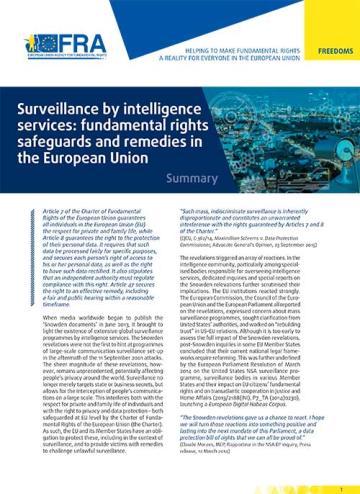
    This report, drafted in response to the European Parliament’s call for thorough research on fundamental rights protection in the context of surveillance, maps and analyses the legal frameworks on surveillance in place in EU Member States.
  • Report / Paper / Summary
    18
    November
    2015
    In April 2014, the European Parliament requested the European Union Agency for Fundamental Rights (FRA) “to undertake in–depth research on the protection of fundamental rights in the context
    of surveillance”. This summary presents FRA’s main research findings, which are published in full in the report entitled Surveillance by intelligence services: fundamental rights safeguards and remedies in the EU – Mapping Member States’ legal frameworks.
  • Handbook / Guide / Manual
    22
    October
    2015
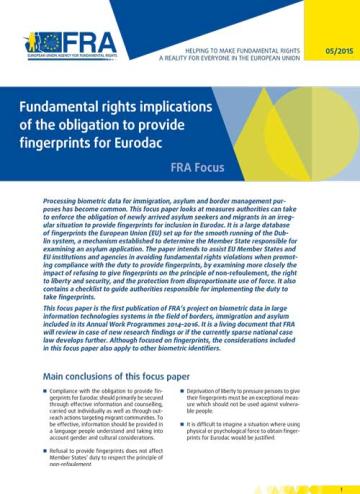
    Processing biometric data for immigration, asylum and border management purposes has become common. This focus paper looks at measures authorities can take to enforce the obligation of newly arrived asylum seekers and migrants in an irregular situation to provide fingerprints for inclusion in Eurodac.
  • Report / Paper / Summary
    12
    May
    2015
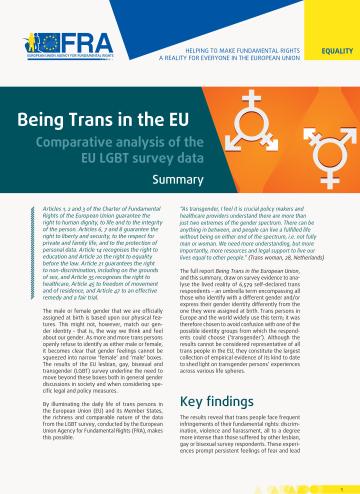
    Trans persons, or those whose gender identity and/or gender expression differs from the sex assigned them at birth, face frequent discrimination, harassment and violence across the European Union (EU) today. This reality triggers fears that persuade many to hide or disguise their true selves. This report examines issues of equal treatment and discrimination on two grounds, namely sexual orientation and gender identity.
  • Report / Paper / Summary
    5
    May
    2015
    Each year thousands of children take part in criminal and civil judicial proceedings, affected by parental divorce
    or as victims or witnesses to crime. Such proceedings can be stressful for anyone. The European Union Agency
    for Fundamental Rights (FRA) investigated whether children’s rights are respected in these proceedings.
  • Report / Paper / Summary
    5
    May
    2015
    Making justice systems more child‑friendly improves
    the protection of children, enhances their meaningful
    participation and at the same time improves
    the operation of justice. The findings in this summary
    can provide Member States with useful tools
    to identify barriers, gaps or weaknesses in their
    judicial proceedings, especially in the process of
    transposing and implementing relevant EU directives. Also available in BG - CS - DA - DE - EL - ES - ET - FI - FR - HR - HU - IT - LV - LT - MT - PL - PT - RO - SK - SK - SV
  • Report / Paper / Summary
    11
    February
    2015
    The recent events in Paris have challenged our sense of safety. They come at a time when the European Union is in the course of discussing its priorities in the area of internal security for the next five years. This paper examines the ways in which a fundamental rights perspective can benefit the current debate, so that a fundamental rights-anchored approach can support the creation of legitimate, effective and sustainable law enforcement and counter-radicalisation measures.
  • Handbook / Guide / Manual
    26
    January
    2015
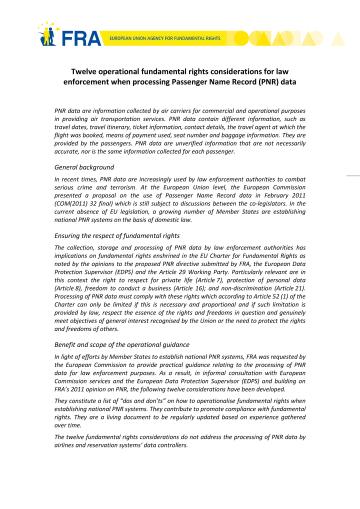
    FRA was requested by the European Commission (EC) in January 2014 to provide practical guidance on the processing of Passenger Name Record (PNR) data for law enforcement purposes, in light of efforts by Member States to establish national PNR systems. As a result, in informal consultation with EC services and the European Data Protection Supervisor (EDPS) and building on opinions FRA, the EDPS and the Article 29 Working Party on PNR, FRA presented twelve fundamental rights considerations to EU Member States experts at technical level.
  • Report / Paper / Summary
    9
    December
    2014
    Trans persons, or those whose gender identity and/or gender expression differs from the sex assigned them at birth, face frequent discrimination, harassment and violence across the European Union (EU) today. This reality triggers fears that persuade many to hide or disguise their true selves. This report examines issues of equal treatment and discrimination on two grounds, namely sexual orientation and gender identity. It analyses data on the experiences of 6,579 trans respondents from the EU Lesbian, gay, bisexual and transgender (LGBT) survey, the largest body of empirical evidence of its kind to date.