eu-charter

Listina základních práv EU

Článek 38 - Ochrana spotřebitele

Článek 38 - Ochrana spotřebitele

V politikách Unie je zajištěna vysoká úroveň ochrany spotřebitele.

Vysvětlivky

  • Text:

    Zásada stanovená v tomto článku je založena na článku 169 Smlouvy o fungování Evropské unie.

    Source:
    Úřední věstník Evropské unie C 303/17 - 14.12.2007
    Preamble - Explanations relating to the Charter of Fundamental Rights:
    Tato vysvětlení byla původně vyhotovena pod vedením prezídia Konventu, který vypracoval Listinu základních práv Evropské unie. Byla aktualizována pod vedením prezídia Evropského konventu s ohledem na změny návrhu znění Listiny provedené Konventem (zejména článků 51 a 52) a na vývoj práva Unie. Ačkoliv sama nemají právní závaznost, jsou cenným výkladovým nástrojem pro vyjasnění ustanovení Listiny.

Soudcovské právo

Vnitrostátního ústavního práva

21 results found

  • КОНСТИТУЦИЯ на Република България
    Země:
    Bulgaria

    Чл. 19 [...] (2) Законът създава и гарантира на всички граждани и юридически лица еднакви правни условия за стопанска дейност, като предотвратява злоупотребата с монополизма, нелоялната конкуренция и защитава потребителя.

Právo EU

13 results found

  • Directive 2014/92/EU of the European Parliament and of the Council of 23 July 2014 on the comparability of fees related to payment accounts, payment account switching and access to payment accounts with basic features Text with EEA relevance

    Preamble:
    ‘(25) The process for switching payment accounts should be harmonised across the Union. At present, existing measures at national level are extremely diverse and do not guarantee an adequate level of consumer protection in all Member States. The provision of legislative measures establishing the main principles to be followed by payment service providers when providing such a service in each Member State would improve the functioning of the internal market for both consumers and payment service providers. On the one hand, it would guarantee a level playing field for consumers who may be interested in opening a payment account in a different Member State, as it would ensure that an equivalent level of protection is offered. On the other hand, it would reduce the differences between the regulatory measures in place at national level and would therefore reduce the administrative burden for payment service providers which intend to offer their services on a cross-border basis. As a consequence, the measures on switching would facilitate the provision of services related to payment accounts within the internal market.‘

  • Regulation (EU) 2017/2394 of the European Parliament and of the Council of 12 December 2017 on cooperation between national authorities responsible for the enforcement of consumer protection laws and repealing Regulation (EC) No 2006/2004

    Article 1 - Subject matter
    ‘This Regulation lays down the conditions under which competent authorities, having been designated by their Member States as responsible for the enforcement of Union laws that protect consumers’ interests, cooperate and coordinate actions with each other and with the Commission, in order to enforce compliance with those laws and to ensure the smooth functioning of the internal market, and in order to enhance the protection of consumers’ economic interests.‘

  • Regulation (EU) No 524/2013 of the European Parliament and of the Council of 21 May 2013 on online dispute resolution for consumer disputes and amending Regulation (EC) No 2006/2004 and Directive 2009/22/EC

    Preamble:

    (1) Article 169(1) and point (a) of Article 169(2) of the Treaty on the Functioning of the European Union (TFEU) provide that the Union is to contribute to the attainment of a high level of consumer protection through measures adopted pursuant to Article 114 TFEU. Article 38 of the Charter of Fundamental Rights of the European Union provides that Union policies are to ensure a high level of consumer protection.

    (2) In accordance with Article 26(2) TFEU, the internal market is to comprise an area without internal frontiers in which the free movement of goods and services is ensured. In order for consumers to have confidence in and benefit from the digital dimension of the internal market, it is necessary that they have access to simple, efficient, fast and low-cost ways of resolving disputes which arise from the sale of goods or the supply of services online. This is particularly important when consumers shop cross-border.‘

    (4) Fragmentation of the internal market impedes efforts to boost competitiveness and growth. Furthermore, the uneven availability, quality and awareness of simple, efficient, fast and low-cost means of resolving disputes arising from the sale of goods or provision of services across the Union constitutes a barrier within the internal market which undermines consumers’ and traders’ confidence in shopping and selling across borders.‘

    (13) The definition of ‘consumer’ should cover natural persons who are acting outside their trade, business, craft or profession. However, if the contract is concluded for purposes partly within and partly outside the person’s trade (dual purpose contracts) and the trade purpose is so limited as not to be predominant in the overall context of the supply, that person should also be considered as a consumer.‘

    (14) The definition of ‘online sales or service contract’ should cover a sales or service contract where the trader, or the trader’s intermediary, has offered goods or services through a website or by other electronic means and the consumer has ordered those goods or services on that website or by other electronic means. This should also cover cases where the consumer has accessed the website or other information society service through a mobile electronic device such as a mobile telephone.

    (26) The right to an effective remedy and the right to a fair trial are fundamental rights laid down in Article 47 of the Charter of Fundamental Rights of the European Union. ODR is not intended to and cannot be designed to replace court procedures, nor should it deprive consumers or traders of their rights to seek redress before the courts. This Regulation should not, therefore, prevent parties from exercising their right of access to the judicial system.

    (35) This Regulation respects fundamental rights and observes the principles recognised in particular by the Charter of Fundamental Rights of the European Union and specifically Articles 7, 8, 38 and 47 thereof.

    Article 1: Subject matter
    The purpose of this Regulation is, through the achievement of a high level of consumer protection, to contribute to the proper functioning of the internal market, and in particular of its digital dimension by providing a European ODR platform (‘ODR platform’) facilitating the independent, impartial, transparent, effective, fast and fair out-of-court resolution of disputes between consumers and traders online.

    Article 12: Processing of personal data

    1. Access to information, including personal data, related to a dispute and stored in the database referred to in Article 11 shall be granted, for the purposes referred to in Article 10, only to the ADR entity to which the dispute was transmitted in accordance with Article 9. Access to the same information shall be granted also to ODR contact points, in so far as it is necessary, for the purposes referred to in Article 7(2) and (4).

    2. The Commission shall have access to information processed in accordance with Article 10 for the purposes of monitoring the use and functioning of the ODR platform and drawing up the reports referred to in Article 21. It shall process personal data of the users of the ODR platform in so far as it is necessary for the operation and maintenance of the ODR platform, including for the purposes of monitoring the use of the ODR platform by ADR entities and ODR contact points.

    3. Personal data related to a dispute shall be kept in the database referred to in paragraph 1 of this Article only for the time necessary to achieve the purposes for which they were collected and to ensure that data subjects are able to access their personal data in order to exercise their rights, and shall be automatically deleted, at the latest, six months after the date of conclusion of the dispute which has been transmitted to the ODR platform in accordance with point (iii) of point (c) of Article 10. That retention period shall also apply to personal data kept in national files by the ADR entity or the ODR contact point which dealt with the dispute concerned, except if the procedural rules applied by the ADR entity or any specific provisions of national law provide for a longer retention period.

    4. Each ODR advisor shall be regarded as a controller with respect to its data processing activities under this Regulation, in accordance with point (d) of Article 2 of Directive 95/46/EC, and shall ensure that those activities comply with national legislation adopted pursuant to Directive 95/46/EC in the Member State of the ODR contact point hosting the ODR advisor.

    5. Each ADR entity shall be regarded as a controller with respect to its data processing activities under this Regulation, in accordance with point (d) of Article 2 of Directive 95/46/EC, and shall ensure that those activities comply with national legislation adopted pursuant to Directive 95/46/EC in the Member State where the ADR entity is established.

    6. In relation to its responsibilities under this Regulation and the processing of personal data involved therein, the Commission shall be regarded as a controller in accordance with point (d) of Article 2 of Regulation (EC) No 45/2001.

    Article 13: Data confidentiality and security

    1. ODR contact points shall be subject to rules of professional secrecy or other equivalent duties of confidentiality laid down in the legislation of the Member State concerned.

    2. The Commission shall take the appropriate technical and organisational measures to ensure the security of information processed under this Regulation, including appropriate data access control, a security plan and a security incident management, in accordance with Article 22 of Regulation (EC) No 45/2001.

    Article 14: Consumer information

    1. Traders established within the Union engaging in online sales or service contracts, and online marketplaces established within the Union, shall provide on their websites an electronic link to the ODR platform. That link shall be easily accessible for consumers. Traders established within the Union engaging in online sales or service contracts shall also state their e-mail addresses.

    2. Traders established within the Union engaging in online sales or service contracts, which are committed or obliged to use one or more ADR entities to resolve disputes with consumers, shall inform consumers about the existence of the ODR platform and the possibility of using the ODR platform for resolving their disputes. They shall provide an electronic link to the ODR platform on their websites and, if the offer is made by e-mail, in that e-mail. The information shall also be provided, where applicable, in the general terms and conditions applicable to online sales and service contracts.

    3. Paragraphs 1 and 2 of this Article shall be without prejudice to Article 13 of Directive 2013/11/EU and the provisions on consumer information on out-of-court redress procedures contained in other Union legal acts, which shall apply in addition to this Article.

    4. The list of ADR entities referred to in Article 20(4) of Directive 2013/11/EU and its updates shall be published in the ODR platform.

    5. Member States shall ensure that ADR entities, the centres of the European Consumer Centres Network, the competent authorities defined in Article 18(1) of Directive 2013/11/EU, and, where appropriate, the bodies designated in accordance with Article 14(2) of Directive 2013/11/EU provide an electronic link to the ODR platform.

    6. Member States shall encourage consumer associations and business associations to provide an electronic link to the ODR platform.

    7. When traders are obliged to provide information in accordance with paragraphs 1 and 2 and with the provisions referred to in paragraph 3, they shall, where possible, provide that information together.

Mezinárodní právo

1 results found

  • The United Nations Guidelines for Consumer Protection (UNGCP) - Revised

    III. General principles
    ‘4. Member States should develop, strengthen or maintain a strong consumer protection policy, taking into account the guidelines set out below and relevant international agreements. In so doing, each Member State must set its own priorities for the protection of consumers in accordance with the economic, social and environmental circumstances of the country and the needs of its population, and bearing in mind the costs and benefits of proposed measures.
    5. The legitimate needs which the guidelines are intended to meet are the following:
    (a) Access by consumers to essential goods and services;
    (b) The protection of vulnerable and disadvantaged consumers;
    (c) The protection of consumers from hazards to their health and safety;
    (d) The promotion and protection of the economic interests of consumers;
    (e) Access by consumers to adequate information to enable them to make informed choices according to individual wishes and needs;
    (f) Consumer education, including education on the environmental, social and economic consequences of consumer choice;
    (g) Availability of effective consumer dispute resolution and redress;
    (h) Freedom to form consumer and other relevant groups or organizations and the opportunity of such organizations to present their views in decision-making processes affecting them;
    (i) The promotion of sustainable consumption patterns;
    (j) A level of protection for consumers using electronic commerce that is not less than that afforded in other forms of commerce;
    (k) The protection of consumer privacy and the global free flow of information.
    6. Unsustainable patterns of production and consumption, particularly in industrialized countries, are the major cause of the continued deterioration of the global environment. All Member States should strive to promote sustainable consumption patterns; developed countries should take the lead in achieving sustainable consumption patterns; developing countries should seek to achieve sustainable consumption patterns in their development process, having due regard for the principle of common but differentiated responsibilities. The special situation and needs of developing countries in this regard should be fully taken into account.
    7. Policies for promoting sustainable consumption should take into account the goals of eradicating poverty, satisfying the basic human needs of all members of society and reducing inequality within and between countries.
    8. Member States should provide or maintain adequate infrastructure to develop, implement and monitor consumer protection policies. Special care should be taken to ensure that measures for consumer protection are implemented for the benefit of all sectors of the population, particularly the rural population and people living in poverty.
    9. All enterprises should obey the relevant laws and regulations of the countries in which they do business. They should also conform to the appropriate provisions of international standards for consumer protection to which the competent authorities of the country in question have agreed. (Hereinafter, references to international standards in the guidelines should be viewed in the context of this paragraph.)
    10. The potential positive role of universities and public and private enterprises in research should be considered when developing consumer protection policies.‘
    IV. Principles for good business practices
    ‘11. The principles that establish benchmarks for good business practices for conducting online and offline commercial activities with consumers are as follows:
    (a) Fair and equitable treatment. Businesses should deal fairly and honestly with consumers at all stages of their relationship, so that it is an integral part of the business culture. Businesses should avoid practices that harm consumers, particularly with respect to vulnerable and disadvantaged consumers;
    (b) Commercial behaviour. Businesses should not subject consumers to illegal, unethical, discriminatory or deceptive practices, such as abusive marketing tactics, abusive debt collection or other improper behaviour that may pose unnecessary risks or harm consumers. Businesses and their authorized agents should have due regard for the interests of consumers and responsibility for upholding consumer protection as an objective;
    (c) Disclosure and transparency. Businesses should provide complete, accurate and not misleading information regarding the goods and services, terms, conditions, applicable fees and final costs to enable consumers to take informed decisions. Businesses should ensure easy access to this information, especially to the key terms and conditions, regardless of the means of technology used;
    (d) Education and awareness-raising. Businesses should, as appropriate, develop programmes and mechanisms to assist consumers to develop the knowledge and skills necessary to understand risks, including financial risks, to take informed decisions and to access competent and professional advice and assistance, preferably from an independent third party, when needed;
    (e) Protection of privacy. Businesses should protect consumers’ privacy through a combination of appropriate control, security, transparency and consent mechanisms relating to the collection and use of their personal data;
    (f) Consumer complaints and disputes. Businesses should make available complaints-handling mechanisms that provide consumers with expeditious, fair, transparent, inexpensive, accessible, speedy and effective dispute resolution without unnecessary cost or burden. Businesses should consider subscribing to domestic and international standards pertaining to internal complaints handling, alternative dispute resolution services and customer satisfaction codes.‘

Produkty

  • Report / Paper / Summary
    8
    March
    2021
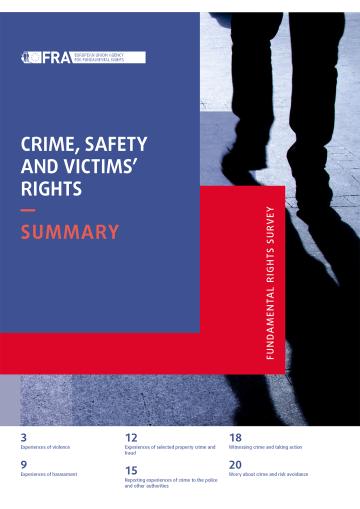
    Toto shrnutí představuje hlavní poznatky z druhé
    hlavní zprávy agentury FRA, která vychází
    z průzkumu o základních právech. Průzkum
    shromáždil od přibližně 35 000 osob údaje o jejich
    zkušenostech, vnímání a názorech na celou řadu
    otázek, které různým způsobem zasahují do oblasti
    lidských práv.
  • Fundamental Rights Report
    11
    June
    2026
    The Fundamental Rights Report: Challenges and Achievements in 2025 is FRA’s flagship annual publication. It provides an overview of the state of fundamental rights in the EU and highlights selected critical developments from 2025. This year, it focuses on four areas: rights protection in a rapidly changing digital environment; the housing crisis and rising homelessness rates; employment challenges for people from non-EU countries; and the implementation of the EU Charter of Fundamental Rights. The publication is a valuable resource for those seeking to stay informed about the EU’s shifting landscape of fundamental rights.
  • Fundamental Rights Report
    5
    June
    2024
    FRA’s Fundamental Rights Report 2024 analyses the year’s developments in fundamental rights. It focuses on the most pressing fundamental rights concerns facing Europe in 2023: the cost-of-living crisis, rights concerns at the EU’s external borders and migration, and threats to democracy. Re-structured, this year’s new approach is a shorter and sharper analysis. It also presents FRA’s opinions on these developments, including a summary of the evidence supporting these opinions.
  • Fundamental Rights Report
    10
    June
    2021
    FRA’s Fundamental Rights Report 2021 reviews major developments in the field in 2020, identifying both achievements and areas of concern. It also presents FRA’s opinions on these developments, including a synopsis of the evidence supporting these opinions. This year’s focus chapter explores the impact of the COVID-19 pandemic on fundamental rights. The remaining chapters cover: the EU Charter of Fundamental Rights; equality and non-discrimination; racism, xenophobia and related intolerance; Roma equality and inclusion; asylum, borders and migration; information society, privacy and data protection; rights of the child; access to justice; and the implementation of the Convention on the Rights of Persons with Disabilities.
  • Report / Paper / Summary
    19
    February
    2021
    This is the second main report from FRA’s Fundamental Rights Survey, which collected data from 35,000 people on a range of issues. This report focuses on respondents’ experiences as victims of selected types of crime, including violence, harassment, and property crime. The report also examines how often these crimes are reported to the police, and presents further details relating to harassment and violence, such as the perpetrators and where the incidents took place.
  • Fundamental Rights Report
    11
    June
    2020
    FRA’s Fundamental Rights Report 2020 reviews major developments in the field in 2019, identifying both achievements and areas of concern. It also presents FRA’s opinions on these developments, including a synopsis of the evidence supporting these opinions. This year’s focus chapter explores how to unlock the full potential of the EU Charter of Fundamental Rights.
  • Fundamental Rights Report
    11
    June
    2020
    This focus takes a closer look at the application of the Charter of Fundamental Rights of the European Union, which has been legally binding for 10 years. At EU level, it has gained visibility and sparked a new fundamental rights culture. At national level, awareness and use of the Charter are limited. Courts increasingly use the Charter, showing the impact of this modern instrument. But its use by governments and parliaments remains low. For instance, there is little indication of anyone regularly scrutinising national legislation that transposes EU law for compatibility with the Charter.
  • Report / Paper / Summary
    17
    March
    2016
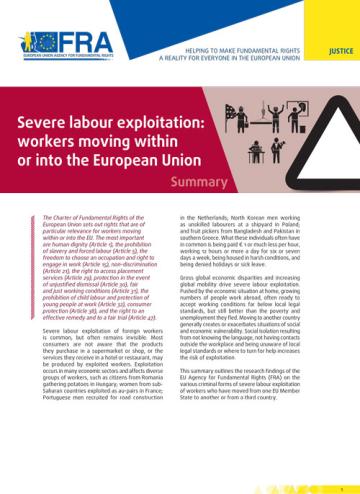
    Worker exploitation is not an isolated or marginal phenomenon. But despite its pervasiveness
    in everyday life, severe labour exploitation and its adverse effects on third-country nationals
    and EU citizens - as workers, but also as consumers - have to date not received much
    attention from researchers. This report identifies risk factors contributing to such exploitation and
    discusses means of improving the situation and highlights the challenges EU institutions and
    Member States face in making the right of workers who have moved within or into the EU
    to decent working conditions a reality.