eu-charter

EU's charter om grundlæggende rettigheder

Artikel 32 - Forbud mod børnearbejde og beskyttelse af unge på arbejdspladsen

Artikel 32 - Forbud mod børnearbejde og beskyttelse af unge på arbejdspladsen

Børnearbejde er forbudt. Minimumsalderen for adgang til at udføre erhvervsarbejde må ikke være lavere end den alder, hvor skolepligten ophører, dog med forbehold af regler, der er gunstigere for de unge, og af begrænsede undtagelser.
Unge, der udfører erhvervsarbejde, skal sikres arbejdsbetingelser, som er tilpasset deres alder, samt beskyttelse mod økonomisk udnyttelse og enhver form for arbejde, der kan skade deres sikkerhed, sundhed og fysiske, mentale, moralske eller sociale udvikling, eller som kan gå ud over deres skolegang.

Forklaringer

  • Text:

    Denne artikel er baseret på direktiv 94/33/EF om beskyttelse af unge på arbejdspladsen, artikel 7 i den europæiske socialpagt og punkt 20-23 i fællesskabspagten om arbejdstagernes grundlæggende arbejdsmarkedsmæssige og sociale rettigheder.

    Source:
    Den Europæiske Unions Tidende C 303/17 - 14.12.2007
    Preamble - Explanations relating to the Charter of Fundamental Rights:
    Disse forklaringer blev oprindelig udarbejdet under præsidiet for den forsamling, der udarbejdede chartret om grundlæggende rettigheder. De er blevet ajourført under Det Europæiske Konvents præsidiums ansvar i lyset af de udkast til tilpasninger, som konventet har foretaget i charterteksten (især i artikel 51 og 52) og videreudviklingen af EU-retten. Selv om forklaringerne ikke i sig selv har retskraft, udgør de et værdifuldt fortolkningsinstrument beregnet til nærmere præcisering af chartrets bestemmelser.

Retspraksis

  • Front populaire pour la libération de la saguia-el-hamra et du rio de oro (Front Polisario) v Council of the European Union
    Decision date:

National Forfatningsret

25 results found

  • Slovakia / Constitution of the Slovak Republic
    Land:
    Slovakia

    Article 38 (1) Women, minors, and persons with disabilities are entitled to an enhanced protection of their health at work, as well as to special working conditions. (2) Minors and persons with disabilities are entitled to special protection in labor relations as well as to assistance in professional training. (3) Details concerning rights listed in paragraphs 1 and 2 shall be laid down by law.

  • Slovenia / Constitution of the Republic of Slovenia
    Land:
    Slovenia

    Article 56 Children shall enjoy special protection and care. Children shall enjoy human rights and fundamental freedoms consistent with their age and maturity.Children shall be guaranteed special protection from economic, social, physical, mental or other exploitation and abuse. Such protection shall be regulated by law.Children and minors who are not cared for by their parents, who have no parents or who are without proper family care shall enjoy the special protection of the state. Their position shall be regulated by law.

  • The Fundamental Law of Hungary
    Land:
    Hungary

    Article XVIII (Freedom and Responsibility) (1) The employment of children shall be prohibited, except in those cases specified in an Act where there is no risk to their physical, mental or moral development.
    (2) By means of separate measures, Hungary shall ensure the protection of young people and parents at work.

  • Töölepingu seadus
    Land:
    Estonia

    § 7. Töölepingu sõlmimine alaealisega
    (1) Tööandja ei tohi töölepingut sõlmida alla 15-aastase või koolikohustusliku alaealisega ega teda tööle lubada, välja arvatud käesoleva paragrahvi lõikes 4 sätestatud juhtudel.
    (2) Tööandja ei tohi töölepingut sõlmida alaealisega ega lubada teda tööle, mis:
    1) ületab alaealise kehalisi või vaimseid võimeid;
    2) ohustab alaealise kõlblust;
    3) sisaldab ohte, mida alaealine ei suuda õigel ajal märgata ega ära hoida kogemuse või väljaõppe puudumise tõttu;
    4) takistab alaealise sotsiaalset arengut või hariduse omandamist;
    5) ohustab alaealise tervist töö iseloomu või töökeskkonna ohutegurite tõttu. (...)

  • Ustav Republike Hrvatske
    Land:
    Croatia

    Članak 65.
    (2) Djeca ne mogu biti primljena na rad prije zakonom određene dobi niti smiju biti prisiljavana na rad koji štetno utječe na njihovo zdravlje ili ćudoređe, niti im se takav rad smije dopustiti.
    (3) Mladež, majke i osobe s invaliditetom imaju pravo na osobitu zaštitu na radu.

EU-ret

6 results found

  • Directive 2011/93/EU of the European Parliament and of the Council of 13 December 2011 on combating the sexual abuse and sexual exploitation of children and child pornography

    Preamble 

    (2) In accordance with Article 6(1) of the Treaty on European Union, the Union recognises the rights, freedoms and principles set out in the Charter of Fundamental Rights of the European Union, in which Article 24(2) provides that in all actions relating to children, whether taken by public authorities or private institutions, the child’s best interests must be a primary consideration. Moreover, the Stockholm Programme — An Open and Secure Europe Serving and Protecting Citizens (4) gives a clear priority to combating the sexual abuse and sexual exploitation of children and child pornography.


    (6) Serious criminal offences such as the sexual exploitation of children and child pornography require a comprehensive approach covering the prosecution of offenders, the protection of child victims, and prevention of the phenomenon. The child’s best interests must be a primary consideration when carrying out any measures to combat these offences in accordance with the Charter of Fundamental Rights of the European Union and the United Nations Convention on the Rights of the Child. Framework Decision 2004/68/JHA should be replaced by a new instrument providing such comprehensive legal framework to achieve that purpose.

  • Community Charter of the Fundamental Social Rights of Workers (not in force)

    23. Following the end of compulsory education, young people must be entitled to receive initial vocational training of a sufficient duration to enable them to adapt to the requirements of their. future working life; for young workers, such training should take place during working hours.

  • Community Charter of the Fundamental Social Rights of Workers (not in force)

    22. Appropriate measures must be taken to adjust labour regulations applicable to young workers so that their specific development and vocational training and access to employment needs are met. The duration of work must, in particular, be limited - without it being possible to circumvent this limitation through recourse to overtime - and night work prohibited in the of workers of under 18 years of age, save in the of certain jobs laid down in national legislation or regulations.

  • Community Charter of the Fundamental Social Rights of Workers (not in force)

    21. Young people who are in gainful employment must receive equitable remuneration in accordance with national practice.

  • Community Charter of the Fundamental Social Rights of Workers (not in force)

    20. Without prejudice to such rules as may be more favourable to young people,· in particular those ensuring their preparation for work through' vocational training, and subject to derogations limited to certain light work, the minimum employment age must not be lower than the minimum school-leaving age and, in any case, not lower than 15 years.

  • Council Directive 94/33/EC of 22 June 1994 on the protection of young people at work

    .

International ret

4 results found

  • Committee on the Rights of the Child, General comment No. 21 (2017) on children in street situations

    Article 32 - on child labour
    ‘59. The Committee urges States to implement the provisions of article 32 (2) of the Convention, and the International Labour Organization Minimum Age Convention, 1973 (No. 138), and Worst Forms of Child Labour Convention, 1999 (No. 182), to protect children in street situations from economic exploitation and the worst forms of child labour. Action against child labour should comprise comprehensive measures, including the provision of support enabling children to transition into education and guaranteeing an adequate standard of living for them and their families. Such measures should be developed in collaboration with children in street situations and other key stakeholders to reflect children’s best interests and to ensure they do not have any inadvertent negative impact on children’s survival or development. The criminalization of begging or unlicensed trading can result in worse forms of survival behaviours, such as commercial sexual exploitation. Savings schemes to develop budgeting skills and safeguard earnings for children in street situations are beneficial.‘

  • Council of Europe, Parliamentary Assembly Recommendation 1336 (1997): Combating child labour exploitation as a matter of priority
  • R203 – Recommendation on supplementary measures for the effective suppression of forced labour, 2014 (No. 203)

    ‘3. Members should take preventive measures that include:
    (a) respecting, promoting and realizing fundamental principles and rights at work;
    (b) the promotion of freedom of association and collective bargaining to enable at-risk workers to join workers’ organizations;
    (c) programmes to combat the discrimination that heightens vulnerability to forced or compulsory labour;
    (d) initiatives to address child labour and promote educational opportunities for children, both boys and girls, as a safeguard against children becoming victims of forced or compulsory labour; and
    (e) taking steps to realize the objectives of the Protocol and the Convention.‘
    ‘10. Protective measures for children subjected to forced or compulsory labour should take into account the special needs and best interests of the child, and, in addition to the protections provided for in the Worst Forms of Child Labour Convention, 1999 (No. 182), should include:
    (a) access to education for girls and boys;
    (b) the appointment of a guardian or other representative, where appropriate;
    (c) when the person’s age is uncertain but there are reasons to believe him or her to be less than 18 years of age, a presumption of minor status, pending age verification; and
    (d) efforts to reunite children with their families, or, when it is in the best interests of the child, provide family-based care.‘

  • UN General Assembly Resolution adopted 69/157 (2014) - Rights of the child

    Child labour
    ‘15. Calls upon all States to translate into concrete action their commitment to the progressive and effective eradication of child labour that is likely to be hazardous, to interfere with the child’s education or to be harmful to the child’s health or physical, mental, spiritual, moral or social development, to eliminate immediately the worst forms of child labour and to promote education as a key strategy in this regard;
    16. Urges all States that have not yet done so to consider ratifying both the Worst Forms of Child Labour Convention, 1999 (No. 182)30 and the Minimum Age Convention, 1973 (No. 138)31 of the International Labour Organization;
    17. Recognizes that poverty and social exclusion, labour mobility, discrimination and lack of adequate social protection and educational opportunity as well as lack of birth registrations all influence child labour;‘

Produkter

  • Handbook / Guide / Manual
    7
    April
    2022
    ES, NL and PL version now available
    17 June 2025
    Børn er selvstændige indehavere af rettigheder. De er indehavere af alle menneskerettigheder og grundlæggende rettigheder og er genstande for særlig lovgivning i kraft af deres specifikke egenskaber. Målet med denne håndbog er at illustrere, hvordan lovgivningen inddrager børns særlige interesser og behov. Den illustrerer desuden betydningen af forældre og værger eller andre retlige repræsentanter, og der henvises, hvor det er relevant, til situationer, hvor barnets omsorgsperson i særlig grad har rettigheder og pligter i forhold til barnet.
  • Report / Paper / Summary
    20
    March
    2025
    In recent years, the EU has taken steps to improve child protection, yet some Member States do not have an integrated approach. FRA first produced an overview of child protection systems in the EU in 2014, and an update in 2023. The data is published in FRA’s ‘Mapping of Child Protection Systems in the EU – Update 2023’. This report completements the 2023 update with comparative analysis and provides greater detail on children in vulnerable situations, care and the participation of children in matters affecting them. It also offers guidance on creating comprehensive frameworks that ensure that children’s rights are respected.
  • Fundamental Rights Report
    8
    June
    2023
    FRA’s Fundamental Rights Report 2023 reviews major developments in the field in 2022, identifying both achievements and areas of concern. It also presents FRA’s opinions on these developments, including a synopsis of the evidence supporting these opinions.
  • Handbook / Guide / Manual
    1
    March
    2023
    This manual is designed to help institutions, organisations and individuals to train guardians of unaccompanied children or to deliver ‘train-the-trainers’ courses. It can be used in a range of training contexts, such as professional and academic training, on-the-job training and continuing training. The manual is based on human and fundamental rights principles and ethical standards and recognises that the child and the guardian have their own personal stories, resources and capacities. It enhances guardians’ confidence to promote the child’s rights and best interests. It also enhances their confidence to act independently and impartially in relation to different state
    officials, service providers and other community members.
  • Report / Paper / Summary
    9
    December
    2021
    This report sheds light on the realities faced by unaccompanied migrant children who are not in the care of child protection systems in the EU. Presented as a case study, it tells the story of children and young adults from Pakistan who travelled alone to the EU without their parents or other adults.
  • Report / Paper / Summary
    16
    January
    2018
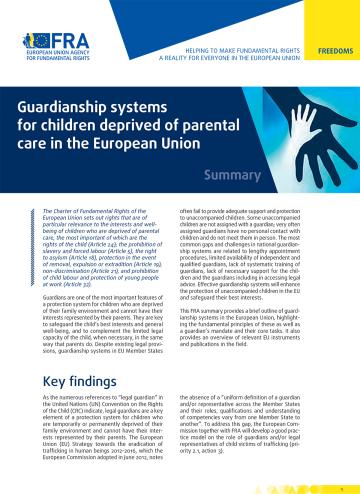
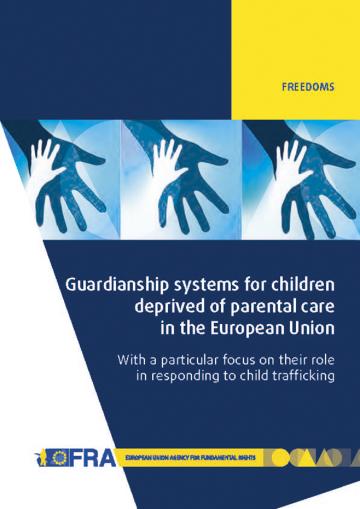
    Guardians are a key element of a protection system for children who are temporarily or
    permanently deprived of their family environment and cannot have their interests represented
    by their parents. Great disparities exist between the types of guardianship provided
    to children in and within European Union (EU) Member States. This report explores the key
    features of guardianship systems put in place to cater for the needs of all children in need
    of protection, including child victims and those at risk of becoming victims of trafficking in
    human beings or of other forms of exploitation.
  • Report / Paper / Summary
    17
    March
    2016
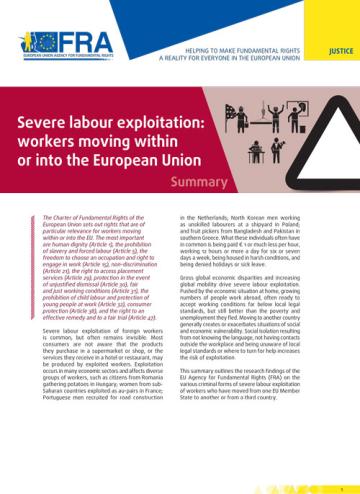
    Worker exploitation is not an isolated or marginal phenomenon. But despite its pervasiveness
    in everyday life, severe labour exploitation and its adverse effects on third-country nationals
    and EU citizens - as workers, but also as consumers - have to date not received much
    attention from researchers. This report identifies risk factors contributing to such exploitation and
    discusses means of improving the situation and highlights the challenges EU institutions and
    Member States face in making the right of workers who have moved within or into the EU
    to decent working conditions a reality.
  • Handbook / Guide / Manual
    20
    November
    2015
    Børn er selvstændige indehavere af rettigheder. De er indehavere af alle menneskerettigheder
    og grundlæggende rettigheder og er genstande for særlig lovgivning i kraft af deres specifikke
    karakteristika. Målet med denne håndbog er at illustrere, hvordan lovgivningen inddrager børns
    særlige interesser og behov.
  • Report / Paper / Summary
    16
    October
    2015
    This report explores the key features of guardianship systems put in place to cater for the needs of all children in need of protection, including child victims and those at risk of becoming victims of trafficking in human beings or of other forms of exploitation. The research covers four specific areas, namely the type of guardianship systems in place, the profile of appointed guardians, the appointment procedures, and the tasks of the guardians.