Displaying 1 - 20 of 66
  • In brief / Factsheet
    30
    June
    2026
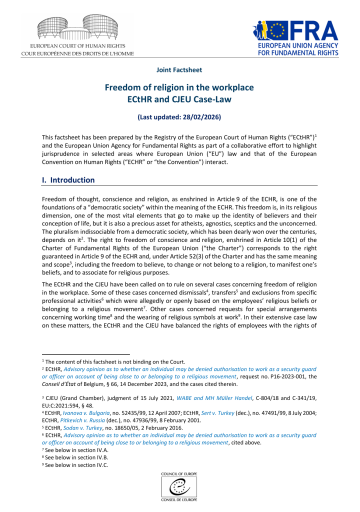
    This factsheet examines the importance of freedom of religion in the workplace as one of the foundations of a democratic society. Jointly published by FRA and the European Court of Human Rights, it examines relevant EU law on the topic, and explains how courts handle issues where EU law and human rights law overlap. It highlights key court decisions from the Court of Justice of the European Union (CJEU) and the European Court of Human Rights (ECtHR) to show how these two legal systems work together on aspects of religious freedom in the workplace, such as wearing religious symbols to work and time off for religious holidays.
  • Report / Paper / Summary
    27
    January
    2026
    This report looks at antisemitism in the EU, focusing on what can be done to address gaps in recording and inconsistencies in data collection. It highlights existing tools and guidance for Member States to improve their recording systems. The analysis is based on official administrative data and information from publicly available sources across EU Member States, as well as Albania, North Macedonia, and Serbia. Detailed country overviews are available for all countries covered. Antisemitism has been monitored by FRA since 2004. This report builds on the 2024 publication, ‘Jewish People’s Experiences and Perceptions of Antisemitism’.
  • Report / Paper / Summary
    22
    January
    2026
    Online terrorist content is a threat to fundamental rights, rule of law and democracy. EU measures to tackle such content aim to prevent terrorism while upholding these values. FRA’s report looks at how online terrorist content is detected and removed under EU legislation. It highlights challenges in interpreting rules, risks of over-removal and potential impacts on freedom of expression. It finds that moderation practices by authorities and platforms can disproportionately affect certain groups, such as Muslims and Arabic speakers, while far-right content often receives less scrutiny. The findings, based on research and expert interviews with those addressing online terrorist content, offer ways to improve transparency in content moderation and to better balance public security and fundamental rights, contributing to wider debates on regulating online content responsibly.

  • Report / Paper / Summary
    4
    December
    2025
    Artificial Intelligence comes with both benefits and risks. Safe AI use that accounts for fundamental rights is thus crucial. While the 2024 EU AI Act was a milestone in this regard, its broad definitions regarding AI systems and high-risk AI could introduce loopholes for fundamental rights compliance. This report offers an empirical basis for much-needed practical guidance on the Act’s implementation. Based on interviews with AI developers, sellers, and users, FRA addresses challenges of its use in critical domains, like asylum, education, and employment. Our findings help guide next steps in realising the AI Act’s potential to ensure responsible innovation.
  • Report / Paper / Summary
    11
    July
    2024
    Antisemitism is still a reality for many Jewish people in the EU today. Faced with prejudice and hostility, most feel unable to live openly Jewish lives. This report presents the results of FRA’s third EU survey of Jewish people’s experiences and perceptions of antisemitism. The survey took place before the Hamas attacks in October 2023 and the war in Gaza; however, it includes evidence from a consultation with national and European Jewish umbrella organisations since. It covers 13 EU Member States that together account for around 96 % of the EU’s Jewish population.
  • Fundamental Rights Report
    5
    June
    2024
    FRA’s Fundamental Rights Report 2024 analyses the year’s developments in fundamental rights. It focuses on the most pressing fundamental rights concerns facing Europe in 2023: the cost-of-living crisis, rights concerns at the EU’s external borders and migration, and threats to democracy. Re-structured, this year’s new approach is a shorter and sharper analysis. It also presents FRA’s opinions on these developments, including a summary of the evidence supporting these opinions.
  • Report / Paper / Summary
    8
    December
    2022
    Artificial intelligence is everywhere and affects everyone – from deciding what content people see on their social media feeds to determining who will receive state benefits. AI technologies are typically based on algorithms that make predictions to support or even fully automate decision-making.
  • Report / Paper / Summary
    3
    November
    2022
    Antisemitic incidents and hate crimes violate fundamental rights, especially the right to human dignity, the right to equality of treatment and the freedom of thought, conscience and religion. This report provides an overview of available data on antisemitism as recorded by official and unofficial sources in the EU Member States and in Albania, North Macedonia and Serbia. The data provided by the countries are supplemented with information from international organisations.
  • Rapport / Publication / Résumé
    28
    September
    2022
    Les actes de terrorisme représentent une menace de taille pour la vie et la sécurité des personnes et un défi majeur pour les États sur le plan de la sécurité. Dans le même temps, la législation, les politiques et les autres mesures de lutte contre le terrorisme peuvent donner lieu, directement ou indirectement, à de graves limitations des droits fondamentaux et porter préjudice à des individus, des groupes, ainsi qu’à la société dans son ensemble. Le présent résumé expose les principales conclusions du rapport de l’Agence des droits fondamentaux de l’Union européenne (FRA) sur la directive (UE) 2017/541 relative à la lutte contre le terrorisme, principal instrument de droit pénal dont dispose l’Union européenne (UE) en matière de lutte contre le terrorisme.
  • Report / Paper / Summary
    28
    September
    2022
    Teroristička djela ozbiljna su prijetnja životima i sigurnosti ljudi, te velik sigurnosni izazov za države. Istodobno, zakonodavstvo, politike i druge mjere u području borbe protiv terorizma mogu izravno ili neizravno dovesti do ozbiljnih ograničenja temeljnih prava i imati negativan utjecaj na pojedince, skupine i društvo u cjelini. U ovom su sažetku predstavljeni glavni nalazi Agencije Europske unije za temeljna prava iz njezina izvješća o Direktivi (EU) 2017/541 o suzbijanju terorizma, koja predstavlja glavni kaznenopravni instrument na razini EU-a u području borbe protiv terorizma.
  • Report / Paper / Summary
    28
    September
    2022
    A terrorcselekmények az emberek életére és biztonságára nézve súlyos fenyegetést, az államok számára pedig komoly biztonsági kihívást jelentenek. Ugyanakkor a terrorizmus elleni jogszabályok, politikák és egyéb intézkedések közvetlenül vagy közvetve az alapvető jogok súlyos korlátozásával járhatnak, és hátrányosan érinthetik az egyént, a csoportokat és a társadalom egészét. Ez az összefoglaló az FRA terrorizmus elleni küzdelemről szóló (EU) 2017/541 irányelvről, a terrorizmus elleni küzdelemmel kapcsolatos legfontosabb, uniós szintű büntetőjogi eszközről szóló jelentésében foglalt főbb megállapításokat mutatja be.
  • Report / Paper / Summary
    28
    September
    2022
    Gli atti di terrorismo rappresentano una grave minaccia per la vita e l’incolumità delle persone e una profonda sfida per gli Stati in materia di sicurezza. Al tempo stesso, la legislazione, le politiche e le altre misure antiterrorismo possono comportare, direttamente o indirettamente, gravi limitazioni ai diritti fondamentali e possono ripercuotersi negativamente sugli individui, sui gruppi e sulla società nel suo insieme. Questa sintesi presenta i principali risultati della FRA derivanti dalla sua relazione sulla direttiva (UE) 2017/541 sulla lotta contro il terrorismo, il principale strumento penale a livello UE nel campo della lotta contro il terrorismo.
  • Report / Paper / Summary
    28
    September
    2022
    Teroro aktai kelia didelę grėsmę žmonių gyvybėms ir saugumui ir tai yra rimta valstybių saugumo problema. Kartu kovos su terorizmu teisės aktuose, politikoje ir kitose priemonėse gali būti tiesiogiai ar netiesiogiai nustatyti rimti pagrindinių teisių apribojimai, kurie gali daryti neigiamą poveikį asmenims, asmenų grupėms ir visai visuomenei. Šioje santraukoje pateikiamos pagrindinės FRA ataskaitos apie Direktyvą (ES) 2017/541 dėl kovos su terorizmu išvados. Ši direktyva yra pagrindinė ES lygmeniu nustatyta kovos su terorizmu srities priemonė.
  • Report / Paper / Summary
    28
    September
    2022
    Terora akti ir nopietns drauds cilvēku dzīvībai un drošībai, kā arī ievērojams drošības apdraudējums valstīm. Tajā pašā laikā pretterorisma tiesību akti, politika un citi pasākumi var tieši vai netieši radīt nopietnus pamattiesību ierobežojumus un var nelabvēlīgi ietekmēt indivīdus, grupas un sabiedrību kopumā. Šajā kopsavilkumā ir izklāstīti galvenie FRA konstatējumi no tās ziņojuma par Direktīvu (ES) 2017/541 par terorisma apkarošanu, kas ir galvenais krimināltiesību instruments ES līmenī terorisma apkarošanas jomā.
  • Report / Paper / Summary
    28
    September
    2022
    Terreurdaden brengen het leven en de veiligheid van de bevolking in groot gevaar en het is voor staten een enorme uitdaging om hun burgers ertegen te beschermen. Daartegenover staat dat wetgeving, beleid en andere maatregelen ter bestrijding van terrorisme er direct of indirect toe kunnen leiden dat de grondrechten danig worden ingeperkt en negatieve gevolgen kunnen hebben voor individuen, groepen en de samenleving als geheel. Deze samenvatting bevat de belangrijkste bevindingen uit het verslag van het FRA over Richtlijn (EU) 2017/541 inzake terrorismebestrijding, het belangrijkste strafrechtelijke instrument op EU-niveau in de strijd tegen terrorisme.
  • Report / Paper / Summary
    28
    September
    2022
    Akty terrorystyczne stanowią poważne zagrożenie dla życia i bezpieczeństwa ludzi, a dla państw są poważnym wyzwaniem w zakresie zapewnienia bezpieczeństwa. Jednocześnie prawodawstwo, polityka i inne środki w zakresie zwalczania terroryzmu mogą wiązać się – bezpośrednio lub pośrednio – z poważnymi ograniczeniami praw podstawowych oraz mieć negatywne skutki dla osób, grup i społeczeństwa jako całości. Niniejsze streszczenie zawiera główne ustalenia FRA ze sprawozdania dotyczącego dyrektywy (UE) 2017/541 w sprawie zwalczania terroryzmu, która jest podstawowym instrumentem prawa karnego na poziomie UE w dziedzinie zwalczania terroryzmu.
  • Report / Paper / Summary
    28
    September
    2022
    Os atos de terrorismo representam uma grave ameaça para a vida e a segurança das pessoas e um profundo desafio para a segurança dos Estados. Ao mesmo tempo, a legislação, as políticas e outras medidas de combate ao terrorismo podem implicar, direta ou indiretamente, sérias limitações aos direitos fundamentais e podem afetar negativamente os indivíduos, os grupos e a sociedade no seu conjunto. A presente síntese apresenta as principais conclusões da FRA no seu relatório sobre a Diretiva (UE) 2017/541 relativa à luta contra o terrorismo, o principal instrumento do direito penal à escala da União Europeia (UE) no domínio do combate ao terrorismo.
  • Report / Paper / Summary
    28
    September
    2022
    Actele de terorism periclitează grav viețile și siguranța oamenilor și reprezintă o provocare intensă pentru state în ceea ce privește securitatea. Totodată, legislația, politicile și alte măsuri privind combaterea terorismului pot determina, în mod direct sau indirect, apariția unor restrângeri semnificative ale drepturilor fundamentale și pot afecta negativ persoane, grupuri și societatea în ansamblu. Acest rezumat prezintă constatările principale ale FRA desprinse din raportul său referitor la Directiva (UE) 2017/541 privind combaterea terorismului, principalul instrument de drept penal la nivelul UE în domeniul combaterii terorismului.
  • Report / Paper / Summary
    28
    September
    2022
    Teroristické činy prestavujú vážne hrozby pre životy a bezpečnosť ľudí a nesmiernu bezpečnostnú výzvu pre štáty. Právne predpisy, politiky a iné opatrenia v oblasti boja proti terorizmu môžu zároveň priamo alebo nepriamo viesť k vážnym obmedzeniam základných práv a môžu mať nepriaznivý vplyv na fyzické osoby, skupiny a spoločnosť ako celok. Tento súhrn predstavuje hlavné zistenia zo správy agentúry FRA týkajúcej sa smernice (EÚ) 2017/541 o boji proti terorizmu, ktorá je hlavným nástrojom trestného práva na úrovni EÚ v oblasti boja proti terorizmu.
  • Report / Paper / Summary
    28
    September
    2022
    Teroristična dejanja resno ogrožajo življenje in varnost ljudi ter so obsežen varnostni izziv za države članice. Zakonodaja, politike in drugi ukrepi za boj proti terorizmu lahko obenem neposredno ali posredno močno omejujejo temeljne pravice ter lahko škodljivo vplivajo na posameznike, skupine in družbo kot celoto. V tem povzetku so predstavljene glavne ugotovitve Agencije Evropske unije za temeljne pravice (FRA) iz njenega poročila o Direktivi (EU) 2017/541 o boju proti terorizmu, ki je glavni instrument kazenskega prava na ravni EU na področju boja proti terorizmu.
Displaying 1 - 20 of 66